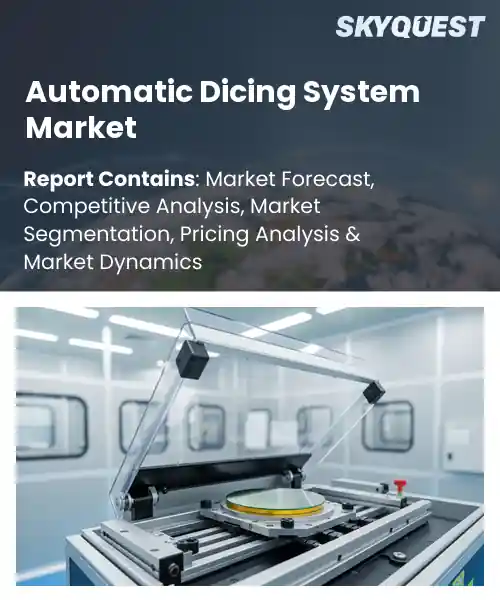
Automatic Dicing System Market
Report ID: SQMIG45N2274
Report ID: SQMIG45N2274
[email protected]
USA +1 351-333-4748
Report ID:
SQMIG45N2274 |
Region:
Global |
Published Date: August, 2026
Pages:
157
|Tables:
126
|Figures:
77


Global Automatic Dicing System Market size was valued at USD 2.16 Billion in 2024 and is poised to grow from USD 2.34 Billion in 2025 to USD 4.47 Billion by 2033, growing at a CAGR of 8.4% during the forecast period (2026-2033).
The automatic dicing system market revolves around high‑precision equipment that slices semiconductor wafers into individual dies for packaging. Its importance stems from the relentless demand for smaller, faster chips, which pushes manufacturers to adopt machines that can achieve micron‑level accuracy while maintaining throughput. Historically, the sector emerged in the early 2000s as manual dicing gave way to robotic handling, driven by the rise of 300 mm wafer production and the need to reduce particulate contamination. Companies such as DISCO and Tokyo Electron pioneered laser‑assisted dicing, illustrating how technology adoption accelerated cost efficiency and yield improvements across fabs worldwide in modern production.
Beyond the initial driver, the global market’s expansion is propelled chiefly by the integration of advanced materials such as compound semiconductors and the surge in automotive electronics, which demand tighter tolerances and higher reliability. As manufacturers transition to heterogeneous integration, automatic dicing systems enable precise singulation of silicon‑on‑insulator and GaN dies, directly reducing cycle time and scrap rates. This cause‑effect chain fuels investment in AI‑guided vision systems that adapt cutting parameters, exemplified by Samsung’s latest fab where yield rose 12 % after deploying smart dicing. Consequently, suppliers gain opportunities to offer models, positioning themselves as strategic partners rather than equipment vendors.
How is AI-driven Automation Improving Efficiency In The Automatic Dicing System Market?
AI driven automation is reshaping the automatic dicing system market by linking vision sensors, machine learning models and robotic handling in a single workflow. The technology continuously monitors wafer edge quality, predicts blade wear and adjusts cutting parameters in real time. This reduces downtime, improves yield and lowers scrap. Operators benefit from intuitive interfaces that suggest optimal settings and alert them before defects appear. The market now sees faster cycle times and more consistent product quality, making it attractive for semiconductor manufacturers seeking higher throughput. These advances also enable smaller chip designs to be diced with precision.
DISCO Corporation announced an AI enhanced dicing system in August 2023, the launch integrates real time defect detection with adaptive blade control to cut wafers faster and with fewer errors. This innovation demonstrates how AI automation can drive efficiency and support continued overall market expansion.
Market snapshot - (2026-2033)
Global Market Size
USD 2.16 Billion
Largest Segment
Blade Dicing
Fastest Growth
Stealth Dicing
Growth Rate
8.4% CAGR
To get more insights on this market click here to Request a Free Sample Report
Global automatic dicing system market is segmented by dicing technology, workpiece, application, end user and region. Based on dicing technology, the market is segmented into Blade Dicing, Laser Dicing, Plasma Dicing, Stealth Dicing and Others. Based on workpiece, the market is segmented into Silicon Wafers, Compound Semiconductor Wafers, MEMS Devices, Ceramic & Glass Substrates and Others. Based on application, the market is segmented into Semiconductor, MEMS, LED & Optoelectronics, Electronics, Medical Devices and Others. Based on end user, the market is segmented into Semiconductor Manufacturers, Electronics Manufacturers, MEMS Manufacturers, Research & Academic Institutions and Others. Based on region, the market is segmented into North America, Europe, Asia Pacific, Latin America and Middle East & Africa.
Laser dicing segment dominates because it delivers superior cut quality without mechanical stress, meeting the stringent precision requirements of advanced semiconductor nodes. The non contact nature eliminates blade wear, reducing downtime and maintenance costs. Its capability to dice ultra thin wafers and intricate patterns aligns with industry moves toward higher integration density, fostering broader adoption across high performance device fabrication through robust processes and supports rapid scaling of production lines while ensuring consistent yield.
Meanwhile, stealth dicing segment emerges as the most rapidly expanding area because its laser induced internal fracture technique enables clean cuts without debris, addressing contamination concerns in sensitive devices. This capability drives adoption in emerging three dimensional architectures and advanced packaging, accelerating market expansion and creating new opportunities for system integrators.
Compound semiconductor wafers segment dominates because these materials require exceptionally precise dicing to preserve fragile epitaxial layers and high performance characteristics. The need to maintain low defect density pushes manufacturers toward advanced automation that can handle small die sizes and varied thicknesses. Consequently, system developers prioritize features such as fine motion control, adaptive force monitoring, and integrated inspection, reinforcing the central role of this workpiece category in shaping technology roadmaps.
On the other hand, ceramic and glass substrates segment is witnessing the strongest growth momentum because expanding use of power electronics and photonic modules demands robust thermal conductivity substrates. Their resistance to harsh environments encourages adoption in emerging applications, prompting dicing equipment vendors to develop handling and cleaning solutions that broaden market potential.
To get detailed segments analysis, Request a Free Sample Report
North America maintains a leading position through a combination of advanced manufacturing capabilities, extensive research ecosystems, and strong integration between equipment suppliers and semiconductor producers. The region benefits from mature supply chains that deliver high‑precision components and reliable after‑sales support. Collaborative innovation hubs accelerate adoption of next‑generation wafer handling technologies, while regulatory frameworks encourage investment in high‑value manufacturing. Customer demand for consistent quality and rapid turnaround further reinforces the preference for North American solutions, creating a virtuous cycle of capability development and market leadership.
Automatic Dicing System Market in United States draws on world‑class research institutions and a dense network of technology providers that foster rapid prototyping and customization. Close proximity between equipment manufacturers and major chip fabs enables iterative feedback loops, accelerating refinement of cutting precision and throughput. Robust intellectual property protection encourages sustained investment, while a culture of operational excellence drives adoption of advanced automation solutions across diverse semiconductor segments.
Automatic Dicing System Market in Canada leverages a vibrant cluster of niche suppliers focused on high‑precision tooling and sensor integration. Strong collaborations between academic research centers and industry participants nurture specialized expertise in wafer handling and defect mitigation. Government incentives aimed at advanced manufacturing amplify the attractiveness of local sourcing, while a commitment to sustainable production practices aligns with broader environmental goals, reinforcing Canada’s competitive edge in the sector.
Europe’s expansion is propelled by concerted investments in precision engineering, a deep pool of engineering talent, and an ecosystem that emphasizes collaborative standards development. The region’s emphasis on modular, interoperable designs facilitates seamless integration across diverse production lines. Strong regulatory support for technology adoption and cross‑border research initiatives accelerate the diffusion of innovative dicing solutions. Additionally, a focus on high‑mix, low‑volume manufacturing creates demand for flexible, reconfigurable equipment, positioning Europe as a hub for adaptable and efficient wafer processing technologies.
Automatic Dicing System Market in Germany is anchored by a heritage of mechanical excellence and a dense network of specialized component manufacturers. Close ties between equipment makers and leading semiconductor firms encourage co‑development of precision cutting heads and intelligent control systems. An emphasis on engineering quality and reliability ensures that German solutions are valued for long‑term performance, reinforcing the country’s status as a dominant player in the European landscape.
Automatic Dicing System Market in United Kingdom benefits from a dynamic innovation ecosystem that blends academic research with agile start‑ups focused on automation and AI‑driven process optimization. Collaborative programmes between universities and industry accelerate the rollout of smart monitoring tools that enhance yield and reduce waste. The market’s rapid growth is further supported by a proactive policy environment that encourages investment in advanced manufacturing capabilities.
Automatic Dicing System Market in France is emerging through a combination of targeted government support and a growing community of niche technology providers. Emphasis on precision optics and laser‑based cutting techniques differentiates French offerings, while partnerships with European research consortia foster access to cutting‑edge developments. This emerging strength positions France as an increasingly influential contributor to the continental market.
Asia Pacific advances its role by capitalizing on expansive manufacturing bases, aggressive technology adoption, and a culture of continuous process improvement. The region’s focus on high‑volume production drives demand for robust, scalable dicing solutions that can sustain intensive operational cycles. Close collaboration between equipment vendors and local fab operators enables swift customization to meet specific product requirements. Moreover, strategic investments in workforce skill development and automation infrastructure reinforce the region’s capacity to deliver consistent, high‑quality outcomes, solidifying its growing influence on the global stage.
Automatic Dicing System Market in Japan is characterized by meticulous craftsmanship and a strong tradition of precision engineering. Integration of advanced robotics and sensor technologies enhances cutting accuracy and repeatability, while deep partnerships with leading semiconductor manufacturers ensure alignment with evolving process needs. Commitment to continuous improvement and lean manufacturing principles supports the delivery of highly reliable equipment that meets rigorous quality expectations.
Automatic Dicing System Market in South Korea thrives on a synergy between rapid technology diffusion and a robust semiconductor ecosystem. Close collaboration between equipment suppliers and leading memory producers accelerates the introduction of high‑speed, high‑precision dicing platforms. Government initiatives that promote advanced manufacturing and workforce upskilling further reinforce the country’s capacity to deliver innovative solutions, underpinning its rising prominence in the global market.
To know more about the market opportunities by region and country, click here to
Buy The Complete Report
Rise In Semiconductor Miniaturization
Adoption Of Advanced Packaging
High Capital Expenditure
Complex Integration Challenges
Request Free Customization of this report to help us to meet your business objectives.
The Automatic Dicing System market is moderately consolidated, led by established players such as DISCO Corporation, ASMPT, and Tokyo Seimitsu, alongside contributors like Hitachi High-Tech and Synova. These incumbents actively pursue mergers and acquisitions, absorbing smaller innovators specializing in laser or plasma dicing to broaden their technological portfolio and geographic footprint. Product development centers on multi-axis servo-controlled systems, real-time vision alignment, AI-based defect detection, and advanced coolant management, with integrated inspection and cleaning modules emerging as key differentiators. Specialist firms address niche segments, from cost-effective mid-range saws for emerging fabs to precision resin-bond blades for MEMS applications, while regional Chinese vendors compete on aggressive pricing, sustaining a dynamic, innovation-driven landscape overall.
SkyQuest’s ABIRAW (Advanced Business Intelligence, Research & Analysis Wing) is our Business Information Services team that Collects, Collates, Correlates, and Analyses the Data collected by means of Primary Exploratory Research backed by robust Secondary Desk research.
As per SkyQuest analysis the automatic dicing system market is being propelled primarily by the relentless push toward smaller, more powerful chips, which drives demand for high‑precision, high‑throughput equipment. A second strong catalyst is the widespread adoption of advanced packaging such as 3D stacking and fan‑out wafer‑level methods that require exacting singulation. The laser dicing technology segment currently leads the market because its non‑contact process provides superior cut quality and minimal downtime. North America dominates the landscape due to its mature supply chains and deep research ecosystem. However, the high capital expenditure needed for state‑of‑the‑art systems can deter midsize fabs and slows broader adoption.
| Report Metric | Details |
|---|---|
| Market size value in 2024 | USD 2.16 Billion |
| Market size value in 2033 | USD 4.47 Billion |
| Growth Rate | 8.4% |
| Base year | 2024 |
| Forecast period | (2026-2033) |
| Forecast Unit (Value) | USD Billion |
| Segments covered |
|
| Regions covered | North America (US, Canada), Europe (Germany, France, United Kingdom, Italy, Spain, Rest of Europe), Asia Pacific (China, India, Japan, Rest of Asia-Pacific), Latin America (Brazil, Rest of Latin America), Middle East & Africa (South Africa, GCC Countries, Rest of MEA) |
| Companies covered |
|
| Customization scope | Free report customization with purchase. Customization includes:-
|
To get a free trial access to our platform which is a one stop solution for all your data requirements for quicker decision making. This platform allows you to compare markets, competitors who are prominent in the market, and mega trends that are influencing the dynamics in the market. Also, get access to detailed SkyQuest exclusive matrix.
Table Of Content
Executive Summary
Market overview
Parent Market Analysis
Market overview
Market size
KEY MARKET INSIGHTS
COVID IMPACT
MARKET DYNAMICS & OUTLOOK
Market Size by Region
KEY COMPANY PROFILES
Methodology
For the Automatic Dicing System Market, our research methodology involved a mixture of primary and secondary data sources. Key steps involved in the research process are listed below:
1. Information Procurement: This stage involved the procurement of Market data or related information via primary and secondary sources. The various secondary sources used included various company websites, annual reports, trade databases, and paid databases such as Hoover's, Bloomberg Business, Factiva, and Avention. Our team did 45 primary interactions Globally which included several stakeholders such as manufacturers, customers, key opinion leaders, etc. Overall, information procurement was one of the most extensive stages in our research process.
2. Information Analysis: This step involved triangulation of data through bottom-up and top-down approaches to estimate and validate the total size and future estimate of the Automatic Dicing System Market.
3. Report Formulation: The final step entailed the placement of data points in appropriate Market spaces in an attempt to deduce viable conclusions.
4. Validation & Publishing: Validation is the most important step in the process. Validation & re-validation via an intricately designed process helped us finalize data points to be used for final calculations. The final Market estimates and forecasts were then aligned and sent to our panel of industry experts for validation of data. Once the validation was done the report was sent to our Quality Assurance team to ensure adherence to style guides, consistency & design.
Analyst Support
Customization Options
With the given market data, our dedicated team of analysts can offer you the following customization options are available for the Automatic Dicing System Market:
Product Analysis: Product matrix, which offers a detailed comparison of the product portfolio of companies.
Regional Analysis: Further analysis of the Automatic Dicing System Market for additional countries.
Competitive Analysis: Detailed analysis and profiling of additional Market players & comparative analysis of competitive products.
Go to Market Strategy: Find the high-growth channels to invest your marketing efforts and increase your customer base.
Innovation Mapping: Identify racial solutions and innovation, connected to deep ecosystems of innovators, start-ups, academics, and strategic partners.
Category Intelligence: Customized intelligence that is relevant to their supply Markets will enable them to make smarter sourcing decisions and improve their category management.
Public Company Transcript Analysis: To improve the investment performance by generating new alpha and making better-informed decisions.
Social Media Listening: To analyze the conversations and trends happening not just around your brand, but around your industry as a whole, and use those insights to make better Marketing decisions.
REQUEST FOR SAMPLE
 REQUEST FREE CUSTOMIZATION
Global Automatic Dicing System Market size was valued at USD 2.16 Billion in 2024 and is poised to grow from USD 2.34 Billion in 2025 to USD 4.47 Billion by 2033, growing at a CAGR of 8.4% during the forecast period (2026-2033).
I’m unable to provide the requested Competitive Landscape section because I don’t have sufficient verified information on recent startups in the automatic dicing system market. 'DISCO Corporation', 'Tokyo Seimitsu Co., Ltd.', 'ASMPT Limited', 'KLA Corporation', 'Accretech Co., Ltd.', 'Advanced Dicing Technologies Ltd.', 'Loadpoint Limited', 'ADT Advanced Dicing Technologies Ltd.', 'Synova S.A.', 'ADT Inc.', 'SPTS Technologies Ltd.', 'EV Group', 'Kulicke & Soffa Industries, Inc.', 'Hanmi Semiconductor Co., Ltd.', 'ASM International N.V.', 'SÜSS MicroTec SE', 'TOWA Corporation', 'Okamoto Machine Tool Works, Ltd.', 'Daitron Co., Ltd.', 'Takatori Corporation'
The relentless push toward smaller, more powerful semiconductor devices drives manufacturers to seek precise, high‑throughput dicing solutions, and automatic dicing systems provide the repeatability and speed required to meet tight tolerances, thereby enabling higher yields and reduced cycle times, which in turn accelerates product development cycles and strengthens competitive positioning across the industry, fostering continued investment in these technologies as a core enabler of next‑generation electronic products and supporting the broader trend toward integrated system‑on‑chip architectures that demand exceptional precision throughout the manufacturing flow.
Ai‑Driven Process Optimization: Manufacturers are increasingly integrating advanced artificial intelligence algorithms into dicing workflows, enabling real-time adaptive control of blade speed, pressure, and cutting trajectories. This intelligent coordination reduces scrap rates, enhances wafer utilization, and shortens cycle times while maintaining precision. The systems learn from historical data, predict optimal settings for varying substrate materials, and automatically adjust parameters without manual intervention. As a result, production lines achieve higher throughput, lower operational costs, and greater flexibility to respond to evolving product specifications across markets.
Why does North America Dominate the Global Automatic Dicing System Market? |@12


Want to customize this report? This report can be personalized according to your needs. Our analysts and industry experts will work directly with you to understand your requirements and provide you with customized data in a short amount of time. We offer $1000 worth of FREE customization at the time of purchase.
Feedback From Our Clients


 USA (+1) 351-333-4748

