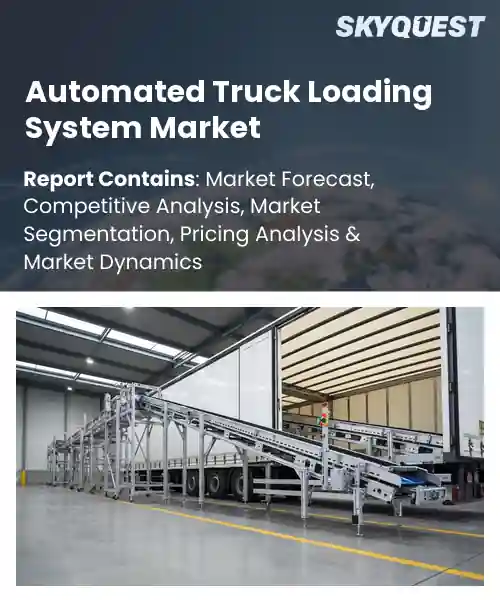
Automated Truck Loading System Market
Report ID: SQMIG20F2080
Report ID: SQMIG20F2080
[email protected]
USA +1 351-333-4748
Report ID:
SQMIG20F2080 |
Region:
Global |
Published Date: June, 2026
Pages:
157
|Tables:
125
|Figures:
77


Global Automated Truck Loading System Market size was valued at USD 2.3 Billion in 2024 and is poised to grow from USD 2.5 Billion in 2025 to USD 4.83 Billion by 2033, growing at a CAGR of 8.6% during the forecast period (2026-2033).
Rapid growth of e-commerce and tightening labor markets constitute the primary driver behind the automated truck loading system market, compelling logistics operators to rethink loading efficiency. Automated truck loading systems include mechanized conveyors, robotic arms, automated guided vehicles and integrated control software that load and secure pallets into trailers while minimizing damage. The market matters because predictable, higher throughput reduces transportation costs and improves delivery reliability for retailers, manufacturers and temperature-sensitive shippers. It has matured from basic conveyors in regional distribution centers to sophisticated robotic loading cells integrated with warehouse management systems. Early adopters report measurable throughput and labor savings.
The critical factor driving accelerated adoption is digital integration between loading hardware and warehouse execution systems because seamless data exchange enables predictive staging and real-time load sequencing. When systems share SKU, temperature and route information, operators can prioritize loads to reduce time on dock and avoid spoilage, as demonstrated by grocery chains that integrate cold-chain telemetry with robotic loaders. Rising labor costs and tighter delivery windows cause capital expenditure to shift toward modular automation, which in turn creates opportunities for retrofits, service-based business models and midmarket entrants seeking scalable, lower-risk deployments and wider resilience gains.
How is AI-powered automation improving efficiency in the automated truck loading system market?
AI powered automation improves efficiency in automated truck loading systems by combining machine perception, adaptive planning and robotic handling to streamline the dock workflow. Key aspects include vision systems that recognize varied cargo, planning agents that sequence loads to maximize trailer space, and manipulators that adapt to unpredictable items. The current market is moving from fixed conveyors to flexible AI driven solutions that learn from real operations and handle variability with less human intervention. This shift reduces loading errors and idle time while enabling safer work around personnel and faster, more resilient scheduling.Berkshire Grey February 2026, launched the Scoop robotic trailer unloader which uses AI guided perception and manipulation to automate unloading inside trailers. This innovation shortens dock time and lowers manual strain while making scheduling more predictable and supporting broader adoption of automated truck loading systems.
Market snapshot - (2026-2033)
Global Market Size
USD 2.3 Billion
Largest Segment
Semi-Automated Truck Loading Systems
Fastest Growth
Robotic Truck Loading Systems
Growth Rate
8.6% CAGR
To get more insights on this market click here to Request a Free Sample Report
Global automated truck loading system market is segmented by system type, component, loading type, end use industry and region. Based on system type, the market is segmented into Fully Automated Truck Loading Systems, Semi-Automated Truck Loading Systems, Robotic Truck Loading Systems, Conveyor-Based Loading Systems and Others. Based on component, the market is segmented into Hardware, Software and Services. Based on loading type, the market is segmented into Palletized Loading, Non-Palletized Loading, Mixed Loading and Bulk Loading. Based on end use industry, the market is segmented into Manufacturing, Logistics & Warehousing, Food & Beverage, Automotive, Retail & E-commerce, Pharmaceuticals, Chemicals and Others. Based on region, the market is segmented into North America, Europe, Asia Pacific, Latin America and Middle East & Africa.
Robotic truck loading systems segment dominates because robots deliver consistent precision and repeatable handling that directly reduces loading errors and product damage, enabling tighter process control and higher throughput. Their flexibility to handle varying payloads and seamless integration with warehouse control platforms decreases reliance on manual labor and improves safety, driving strong buyer preference for robotic solutions in complex, high volume loading environments where reliability and uptime are critical.
However, fully automated truck loading systems are witnessing the strongest growth as comprehensive automation appeals to companies seeking zero touch operations and seamless integration with warehouse execution systems. Advances in sensor fusion, control software and modular conveyors reduce deployment complexity and accelerate return on investment narratives, creating opportunities for broad scale adoption and unlocking new use cases across diverse industry applications.
Software segment leads because advanced control and orchestration platforms enable precise scheduling, load sequencing and real time decision making that materially improve throughput and resource utilization. Integration capabilities with warehouse execution and transportation management systems make software the operational backbone of loading solutions, enabling predictive analytics, adaptive algorithms and remote monitoring that reduce disruptions and support continuous process improvement and scalability.
However, services are emerging as the most rapidly expanding area as providers deliver installation, commissioning, remote support and lifecycle management that simplify adoption for end users. Growing demand for managed maintenance, performance contracts and operator training fosters recurring revenue models, deepens vendor customer relationships and accelerates market uptake by converting pilot deployments into long term, enterprise scale implementations.
To get detailed segments analysis, Request a Free Sample Report
North America dominates due to mature logistics infrastructure, deep automation adoption across distribution and manufacturing, and strong investment in warehouse modernization. Integrated supply chain ecosystems, advanced material handling providers, and close collaboration between system integrators and end users accelerate deployment of automated truck loading solutions. Demand is supported by high labor cost sensitivity, emphasis on safety and ergonomics, and robust aftermarket service networks that ensure uptime and scalability. Regulatory and industry standards favor predictable operations and facilitate technology trials. Access to capital and presence of leading vendors enable rapid refinement of solutions for diverse truck configurations and facility footprints. Strategic partnerships with logistics providers further strengthen regional adoption and innovation pathways.
Automated Truck Loading System Market in United States reflects high demand from e commerce and retail networks, complex intermodal freight flows, and a concentration of integrators and technology vendors. Emphasis on safety, throughput optimization, and flexible deployment drives interest from large distribution centers and contract logistics providers. Strong service ecosystems and financing options lower barriers to adoption, while pilot projects and vendor collaboration refine solutions for varied vehicle types effectively.
Automated Truck Loading System Market in Canada is shaped by cross border trade flows, distribution hubs, with emphasis on operational resilience in varied climates. Demand is influenced by a mix of national logistics providers seeking reliable, maintenance solutions that accommodate seasonal constraints and diverse vehicle fleets. Local integrators and service partners support implementation and customization, while focus on safety and energy efficiency supports uptake among warehousing and transport operators reliably.
Rapid expansion in Asia Pacific is driven by accelerating e commerce penetration, a rising focus on manufacturing automation, and increasing complexity of regional logistics networks. Strong adoption is supported by local system integrators adapting global technologies to compact facility layouts and unique pallet and truck standards. Labor market dynamics encourage capital investment in automated loading to improve consistency and reduce reliance on manual operations. Urban distribution and cross border trade create demand for flexible, space efficient solutions that integrate with warehouse management systems. Collaboration between technology vendors, logistics providers, and manufacturing firms fosters localized innovation and faster deployment cycles. Increasing availability of financing options and success stories from early adopters reduce perceived risk and encourage mid sized companies to embrace these systems, broadening the customer base and accelerating market depth.
Automated Truck Loading System Market in Japan is characterized by advanced robotics integration, precision engineering, and a strong orientation toward space efficient, high reliability systems. Demand stems from automotive and retail sectors seeking compact solutions that maintain throughput in constrained facilities. Local manufacturers and integrators emphasize customization, safety, and lifecycle support. A culture of incremental process improvement drives adoption of systems that align with strict quality and operational expectations consistently.
Automated Truck Loading System Market in South Korea is propelled by a strong manufacturing base and urban logistics networks, emphasizing high throughput solutions. Local logistics firms drive demand for integrated loading systems that link with factory automation and warehouse control platforms. System providers focus on rapid deployment, modular designs, and service responsiveness to meet delivery windows. Attention to energy efficiency, safety, and interoperability shapes procurement choices across sectors more broadly.
Europe is strengthening its position through a combination of technical innovation, regulatory alignment, and focus on sustainability within logistics operations. Investment by system providers and increasing collaboration with logistics operators support retrofit solutions for legacy facilities and enable integration with warehouse control and energy management systems. Regional standards and cross border supply chain networks encourage interoperable designs and modular architectures that address varied vehicle specifications and dock arrangements. Emphasis on energy efficient operation, lifecycle cost, and operator safety drives procurement choices, while pilot initiatives and vendor collaborations demonstrate operational benefits across sectors. Established industrial engineering expertise and mature aftermarket services further support wider adoption and refinement of automated truck loading solutions across the region. Public and private initiatives to demonstrate operational resilience and reduce environmental impact help build confidence among conservative buyers, enabling more standardized procurement and cross country rollouts.
Automated Truck Loading System Market in Germany benefits from strong industrial engineering capabilities, a dense supplier base, and integration with factory automation. Demand is influenced by automotive and manufacturing sectors seeking robust systems and service arrangements. System providers emphasize modular designs that facilitate retrofit into existing distribution centers and align with workplace safety standards. Focus on lifecycle performance and energy efficiency guides procurement, while skilled service networks support scalability objectives.
Automated Truck Loading System Market in United Kingdom is shaped by a vibrant logistics sector, strong e commerce distribution and port intermodal activity. Demand favors adaptable solutions deployable within varied facility footprints that integrate with warehouse execution systems. Providers emphasize service flexibility, retrofit capability, and operator training to meet labor and safety priorities. Procurement choices reflect focus on total cost of ownership, sustainability and reliable aftermarket support across market segments.
Automated Truck Loading System Market in France is influenced by a mix of large distribution centers, cold chain logistics, and manufacturing seeking tailored automation. Adoption is driven by the need for reliable handling in controlled environments and preference for adaptable systems that fit constrained site layouts. Local integrators emphasize customization, operator safety, and energy efficiency. Procurement balances upfront investment and operational resilience, with service partnerships supporting lifecycle needs across sectors.
To know more about the market opportunities by region and country, click here to
Buy The Complete Report
Evolving Warehouse Automation Requirements
Rising Need For Operational Efficiency
High Initial Capital Requirements
Integration Complexity With Legacy Systems
Request Free Customization of this report to help us to meet your business objectives.
Competition in the automated truck loading market centers on rapid product innovation, strategic M&A, and distributor partnerships. Large integrators and well-funded startups pursue deployments to secure fleet and carrier contracts; examples include Amazon's acquisition of Rightbot in January 2026, Dexterity's recent large funding and distribution agreements, and Anyware Robotics' Pixmo container-unloading product.
Top Player’s Company Profile
Recent Developments
SkyQuest’s ABIRAW (Advanced Business Intelligence, Research & Analysis Wing) is our Business Information Services team that Collects, Collates, Correlates, and Analyses the Data collected by means of Primary Exploratory Research backed by robust Secondary Desk research. As per SkyQuest analysis, the global automated truck loading system market is propelled by rapid e‑commerce growth and tightening labor markets as a key driver, while high initial capital requirements remain a significant restraint. North America emerges as the dominating region due to mature logistics infrastructure and strong investment in warehouse modernization, and robotic truck loading systems are the dominating segment because robots deliver repeatable precision and higher throughput. A second driver accelerating adoption is digital integration between loading hardware and warehouse execution systems that enables predictive staging and real‑time sequencing. Overall market momentum favors modular, AI‑enabled solutions that reduce dock time and operational variability.
| Report Metric | Details |
|---|---|
| Market size value in 2024 | USD 2.3 Billion |
| Market size value in 2033 | USD 4.83 Billion |
| Growth Rate | 8.6% |
| Base year | 2024 |
| Forecast period | (2026-2033) |
| Forecast Unit (Value) | USD Billion |
| Segments covered |
|
| Regions covered | North America (US, Canada), Europe (Germany, France, United Kingdom, Italy, Spain, Rest of Europe), Asia Pacific (China, India, Japan, Rest of Asia-Pacific), Latin America (Brazil, Rest of Latin America), Middle East & Africa (South Africa, GCC Countries, Rest of MEA) |
| Companies covered |
|
| Customization scope | Free report customization with purchase. Customization includes:-
|
To get a free trial access to our platform which is a one stop solution for all your data requirements for quicker decision making. This platform allows you to compare markets, competitors who are prominent in the market, and mega trends that are influencing the dynamics in the market. Also, get access to detailed SkyQuest exclusive matrix.
Table Of Content
Executive Summary
Market overview
Parent Market Analysis
Market overview
Market size
KEY MARKET INSIGHTS
COVID IMPACT
MARKET DYNAMICS & OUTLOOK
Market Size by Region
KEY COMPANY PROFILES
Methodology
For the Automated Truck Loading System Market, our research methodology involved a mixture of primary and secondary data sources. Key steps involved in the research process are listed below:
1. Information Procurement: This stage involved the procurement of Market data or related information via primary and secondary sources. The various secondary sources used included various company websites, annual reports, trade databases, and paid databases such as Hoover's, Bloomberg Business, Factiva, and Avention. Our team did 45 primary interactions Globally which included several stakeholders such as manufacturers, customers, key opinion leaders, etc. Overall, information procurement was one of the most extensive stages in our research process.
2. Information Analysis: This step involved triangulation of data through bottom-up and top-down approaches to estimate and validate the total size and future estimate of the Automated Truck Loading System Market.
3. Report Formulation: The final step entailed the placement of data points in appropriate Market spaces in an attempt to deduce viable conclusions.
4. Validation & Publishing: Validation is the most important step in the process. Validation & re-validation via an intricately designed process helped us finalize data points to be used for final calculations. The final Market estimates and forecasts were then aligned and sent to our panel of industry experts for validation of data. Once the validation was done the report was sent to our Quality Assurance team to ensure adherence to style guides, consistency & design.
Analyst Support
Customization Options
With the given market data, our dedicated team of analysts can offer you the following customization options are available for the Automated Truck Loading System Market:
Product Analysis: Product matrix, which offers a detailed comparison of the product portfolio of companies.
Regional Analysis: Further analysis of the Automated Truck Loading System Market for additional countries.
Competitive Analysis: Detailed analysis and profiling of additional Market players & comparative analysis of competitive products.
Go to Market Strategy: Find the high-growth channels to invest your marketing efforts and increase your customer base.
Innovation Mapping: Identify racial solutions and innovation, connected to deep ecosystems of innovators, start-ups, academics, and strategic partners.
Category Intelligence: Customized intelligence that is relevant to their supply Markets will enable them to make smarter sourcing decisions and improve their category management.
Public Company Transcript Analysis: To improve the investment performance by generating new alpha and making better-informed decisions.
Social Media Listening: To analyze the conversations and trends happening not just around your brand, but around your industry as a whole, and use those insights to make better Marketing decisions.
REQUEST FOR SAMPLE
 REQUEST FREE CUSTOMIZATION
Global Automated Truck Loading System Market size was valued at USD 2.3 Billion in 2024 and is poised to grow from USD 2.5 Billion in 2025 to USD 4.83 Billion by 2033, growing at a CAGR of 8.6% during the forecast period (2026-2033).
Competition in the automated truck loading market centers on rapid product innovation, strategic M&A, and distributor partnerships. Large integrators and well-funded startups pursue deployments to secure fleet and carrier contracts; examples include Amazon's acquisition of Rightbot in January 2026, Dexterity's recent large funding and distribution agreements, and Anyware Robotics' Pixmo container-unloading product. 'Daifuku Co., Ltd.', 'SSI Schaefer Group', 'BEUMER Group GmbH & Co. KG', 'Fives Group', 'JBT Corporation', 'Ancra Systems B.V.', 'Actiw Oy', 'Gebhardt Fördertechnik GmbH', 'Secon Components S.L.', 'Euroimpianti S.p.A.', 'Vanderlande Industries B.V.', 'TGW Logistics Group GmbH', 'Murata Machinery, Ltd.', 'Toyota Industries Corporation', 'KUKA AG', 'Dematic (KION Group AG)', 'Honeywell International Inc.', 'Siemens AG', 'ABB Ltd.', 'Interroll Holding AG'
Automated truck loading systems are increasingly adopted as warehouses evolve to handle diverse inventories and faster order cycles, enabling consistent, repeatable loading operations while integrating with warehouse management systems to coordinate throughput. These solutions reduce manual handling complexity and support scalability by simplifying load configuration for various freight profiles. Their ability to maintain stable material flow and decrease operational variability makes them attractive for facilities aiming to improve reliability and predictability, thereby motivating investment to align logistic processes with contemporary fulfillment expectations.
Ai Driven Operational Intelligence: Machine learning and computer vision are increasingly embedded within automated truck loading systems to enable real time decision making that optimizes throughput and adapts to variable cargo profiles. These capabilities allow dynamic sequencing, predictive placement, and proactive safety interventions while supporting remote supervision. The emphasis on edge analytics and interoperable software stacks accelerates deployment across diverse facilities, augments operator productivity, and facilitates continuous performance improvement through feedback loops and site specific customization without extensive manual rule changes or localized tuning.
Why does North America Dominate the Global Automated Truck Loading System Market? |@12


Want to customize this report? This report can be personalized according to your needs. Our analysts and industry experts will work directly with you to understand your requirements and provide you with customized data in a short amount of time. We offer $1000 worth of FREE customization at the time of purchase.
Feedback From Our Clients


 USA (+1) 351-333-4748

