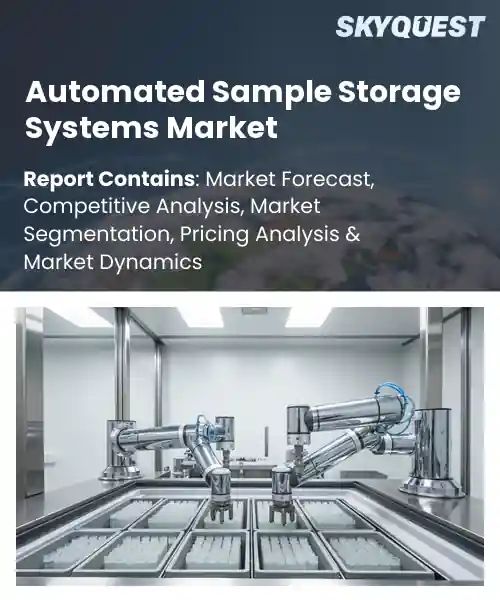
Automated Sample Storage Systems Market
Report ID: SQMIG35J2385
Report ID: SQMIG35J2385
[email protected]
USA +1 351-333-4748
Report ID:
SQMIG35J2385 |
Region:
Global |
Published Date: June, 2026
Pages:
157
|Tables:
117
|Figures:
77


Global Automated Sample Storage Systems Market size was valued at USD 652 Million in 2024 and is poised to grow from USD 730 Million in 2025 to USD 1852 Million by 2033, growing at a CAGR of 12.32% during the forecast period (2026-2033).
Growing demand for high-throughput laboratory operations, increasing investments in drug discovery and biobanking, rising adoption of laboratory automation technologies, advancements in sample management solutions, and growing emphasis on data integrity and regulatory compliance are driving sales of automated sample storage systems.
Rising adoption of biobanking programs, genomics research initiatives and pharmaceutical R&D activities is further magnifying demand for cutting edge sample storage infrastructure and systems. Larger data sets, increased connectivity, and embedded monitoring solutions are also evidently contributing to the market's growth. Laboratories are increasingly adopting IoT sensors, cloud-based management platforms, and automated inventory systems to achieve better control over their sample storage facilities. Such solutions help in analyzing predicted equipment components, significantly reduce storage capacity underutilization, and ultimately ward off sample loss through automated notifications and maintenance. As research institutes necessarily scale up multi-site infrastructures and decentralize clinical trials, the demand for coordinated, high-end sample management solutions are also expected to grow. This is creating opportunities for suppliers offering integrated software solutions, remote monitoring services, and automation enhanced products to improve laboratory efficiency and ultimately adhere to regulatory standards. The increasing need for accurate, high-throughput sample management in life sciences research and diagnostics is expected to primarily drive automated sample storage systems market growth.
However, high installation and maintenance costs, complexity associated with system integration, concerns regarding data security, and limited adoption among smaller laboratories due to budget constraints are anticipated to slow down automated sample storage systems market penetration through 2033 and beyond.
How is AI Enhancing the Operational Efficiency of Automated Sample Storage Systems?
AI also is used in automated sample storage for better inventory management, robotic-enabled process synchronization, and instrument upkeep scheduling. Some of the recent innovative solutions included the use of predictive models learning from the event logs monitoring equipment health and performance, use of intelligent routing algorithms enabling faster search and retrieval of samples, and the application of computer vision for more accurate barcode reading, label reading, and sample identification. Integrated automated sample storage access platform that link storage facilities with robotic sample handling and computerize available sample management may be the most prominent solution, optimizing sample storage, retrieval, access speed, traceability, and flexibility by enabling connected workflows with reduced operation downtime and contamination, fewer access errors, and reduction in manual handling.
Market snapshot - (2026-2033)
Global Market Size
USD 0.652 Billion
Largest Segment
Ultra-Low Temperature (ULT) Storage (-80°C)
Fastest Growth
Cryogenic Storage (-196°C)
Growth Rate
12.32% CAGR
To get more insights on this market click here to Request a Free Sample Report
Global automated sample storage systems market is segmented by type, application, product, end-user, and region. Based on type, the market is segmented into Ultra-Low Temperature (ULT) Storage (-80°C), Cryogenic Storage (-196°C), and ambient/refrigerated storage. Based on application, the market is segmented into drug discovery, biobanking, and clinical diagnostics. Based on product, the market is segmented into sample storage systems, sample retrieval robots, and sample management software. Based on end-user, the market is segmented into pharma & biotech, academic research, and hospitals & biobanks. Based on region, the market is segmented into North America, Europe, Asia Pacific, Latin America, and Middle East & Africa.
The ultra-Low Temperature (ULT) Storage (-80°C) segment is anticipated to lead the global automated sample storage systems market revenue generation in the long run. Deep refrigeration suits complex biological samples, providing molecular preservation over a long period and minimizing the risk of degradation. Uniquely compatible with existing automated racks and retrieval workflows, its adoption is promoted by laboratories with high sample integrity demands, in turn prompting vendors to design more robust interfaces and dependability and consolidating market esteem for ULT systems. Regulatory standards for cold chain and audit preservation further facilitate its use in applications of high value.
However, cryogenic storage (-196°C) is emerging as the most rapidly expanding segment as per this automated sample storage systems industry analysis backed by high demand from cell and gene therapy that require vitrification to maintain viability. Innovations in cryo robotics and regulatory acknowledgement of cryopreservation processes allow for investment and create automation opportunities for living cell banks and long term sample storage.
he sample retrieval robots segment is expected to account for the highes global automated sample storage systems market share in the future. Automated handlers significantly boost throughput eliminating human factors associated with routine pick and place operations thus allowing for dependable scales of operation. Closely aligned mechanically-powered storage architecture and instrument integration also help to increase turnaround, improve cleanliness on-line and the eliminate procurement issues in high-volume contexts.
However, sample management software is the most rapidly expanding subsegment as the digital transformation accelerates the integration of unified inventory and chain of custody, availability of analytics and the use of AI aided auditing have pioneered remote operations and enhanced the consumption of automated hardware enabling new service lines and upgrade revenue streams.
To get detailed segments analysis, Request a Free Sample Report
Advanced life sciences infrastructure, concentrated biopharmaceutical and diagnostics activity, and a mature ecosystem of suppliers and service providers are helping this region cement its dominance. Automated storage systems are quickly becoming a part of integrated workflows due to strong linking between academia, clinical laboratories, and commercial developers. High expectations for sample integrity, traceability, and compliance with regulations create high demand for complex systems that can provide reliable cold chain management and integrated informatics. Well-defined aftermarket networks and technical expertise enable fast deployment and customization, while collaborative innovation between the industry and healthcare system facilitates ongoing product improvement and operational support across a variety of laboratory environments.
Sales of automated sample storage systems in the United States is characterized by high adoption among biopharmaceutical companies, clinical laboratories, and research institutions seeking scalable, integrated sample management. Established suppliers and startups co-locate with major research hubs, enabling product development, customization, and service support. Strong collaborations between industry and academic centers drive application diversity, while sophisticated laboratory infrastructure and skilled workforce facilitate deployment of advanced automation solutions across diagnostic and discovery workflows.
Public research institutes, hospital laboratories, and a biotech sector seeking dependable sample preservation and traceability are supporting demand for automated sample storage systems in Canada. Cooperative efforts stimulate the uptake of modular, space-efficient automation that complements regional lab configurations. Local distributors and service providers facilitate installations, with the drive for compliance and interoperability spurring the patronage of systems that synergize with current informatics and lab processes to facilitate reproducible research in the laboratory.
A dense pharmaceutical and diagnostics industry, strong translational research activity, and increasing centralization of biobanking and laboratory services support high demand for automated sample storage systems in Europe. Demand is also supported by increased centralization of biobanking and laboratory services using standardized, high-quality requirements, and needs for traceable sample management throughout multicenter studies. In addition, many suppliers offer configurable systems for laboratory management and analytical instruments with interoperability as a primary requirement. Increased cross-border collaborations and regional funding programs have encouraged modernization of existing laboratory infrastructure and the creation of service networks and technical partnerships would allow for scalable implementation and continued support enabling Europe to be one of the top-market regions for advanced automated storage systems that can fulfil the diverse requirements of clinical and research applications.
Demand for automated sample storage systems in Germany is driven by clusters of pharmaceutical manufacturers, engineering suppliers, and research institutions that demand precision and customization. Robust manufacturing capacity enables storage platform production while mature service network delivers installation and servicing. Focus on high quality standards and on aiding cross-platform interoperability helps to introduce comprehensive integrated solutions overcoming cold chain needs and sample governance in clinical, diagnostic and industrial laboratories, while building up collaborative partnerships.
Automated sample storage systems market in the United Kingdom is shaped by dynamic biotech clusters, a vibrant diagnostics sector, and growing network of clinical research organizations seeking agile automation. Supplier activity is driven by market need for flexible and modular systems that can be adaptable to any laboratory footprint. An intense focus on translational work and academic/public/private collaboration hastens the time to market, and flexible service providers can assist with scale-up, customization and on-site support and maintenance.
Automated sample storage system adoption in France is characterized by a rising interest from academic research centers, hospitals, and biotech firms seeking reliable and compact storage solutions. Inter-institutional and national initiatives promote sample processing and integrationist in laboratory informatics, while developed local engineering skills with high strength of distributor is focused on data accuracy and traceability, overall acceptance of automation in clinical research, pathology, and translational laboratories.
Localized manufacturing, advanced automation know how, and growing demand from clinical and research laboratories are supporting consistent sales of automated sample storage systems in Asia Pacific. Local suppliers have expertise in both electronic and robotic technologies and therefore create compact and energy-efficient storage solutions that meet the needs of dense laboratory footprints. Local production partners work with international vendors to enable technology transfer and the ability for local vendors to adapt products to the workflow of the region. Investment in laboratory infrastructure, the expansion of clinical and diagnostic services, as well as greater emphasis on cold chain integrity will all aid in the movement toward acquiring integrated systems. Moreover, digital integration with informatics and local training initiatives will further enhance operational readiness and total lifetime value of integrated systems.
Automated sample storage systems market in Japan leverages strengths in precision engineering, robotics, and electronics integration to deliver compact, reliable storage solutions tailored to laboratory environments. Local manufacturers emphasize system durability, efficient operation, and tight integration with laboratory informatics. Strong partnerships between industry and research institutions promote applied innovation, while technical service networks ensure dependable installation and maintenance, supporting broad adoption across clinical diagnostics, pharmaceutical research, and specialized testing facilities.
Strong expertise in electronics and automation, enabling development of integrated, space efficient storage platforms tailored to laboratory needs are boosting sales of automated sample storage systems in South Korea. Partnerships between technology firms and biopharma companies allows development of optimized solutions for high throughput workflows and clinical diagnostics. Strong distributor and service networks facilitate deployment and support, and focus on interoperability, ease of use drives adoption in hospital, research and testing labs.
To know more about the market opportunities by region and country, click here to
Buy The Complete Report
Rising Need For Sample Integrity
Automation Adoption In Laboratories
High Initial Capital Requirements
Integration And Interoperability Challenges
Request Free Customization of this report to help us to meet your business objectives.
Competitive dynamics in automated sample storage prioritize service network scale and platform lock in through LIMS integration, robotics and cryogenic capability upgrades, with incumbents using M&A and facility expansion while niche vendors push software and cryo innovations; recent examples include Brooks Automation’s life sciences repositioning and Azenta’s new Billerica biorepository, alongside academic Hamilton BiOS deployments showing active M&A, site growth and system integration strategies.
SkyQuest’s ABIRAW (Advanced Business Intelligence, Research & Analysis Wing) is our Business Information Services team that Collects, Collates, Correlates, and Analyses the Data collected by means of Primary Exploratory Research backed by robust Secondary Desk research.
As per SkyQuest analysis, high demand for high-throughput laboratory operations, increasing investments in drug discovery and biobanking, rising adoption of laboratory automation technologies, and growing emphasis on data integrity and regulatory compliance are anticipated to drive the demand for automated sample storage systems going forward. However, high installation and maintenance costs, complexity associated with system integration, concerns regarding data security, and limited adoption among smaller laboratories due to budget constraints are slated to slow down the adoption of automated sample storage systems in the future. North America is slated to spearhead the demand for automated sample storage systems owing to strong investments in life sciences research, the presence of leading biopharmaceutical companies, and widespread adoption of laboratory automation technologies. Development of AI-driven inventory management solutions, increasing integration of robotics with laboratory information management systems (LIMS), and adoption of predictive maintenance technologies are anticipated to be key trends driving the automated sample storage systems market in the future.
| Report Metric | Details |
|---|---|
| Market size value in 2024 | USD 0.652 Billion |
| Market size value in 2033 | USD 1.852 Billion |
| Growth Rate | 12.32% |
| Base year | 2024 |
| Forecast period | (2026-2033) |
| Forecast Unit (Value) | USD Billion |
| Segments covered |
|
| Regions covered | North America (US, Canada), Europe (Germany, France, United Kingdom, Italy, Spain, Rest of Europe), Asia Pacific (China, India, Japan, Rest of Asia-Pacific), Latin America (Brazil, Rest of Latin America), Middle East & Africa (South Africa, GCC Countries, Rest of MEA) |
| Companies covered |
|
| Customization scope | Free report customization with purchase. Customization includes:-
|
To get a free trial access to our platform which is a one stop solution for all your data requirements for quicker decision making. This platform allows you to compare markets, competitors who are prominent in the market, and mega trends that are influencing the dynamics in the market. Also, get access to detailed SkyQuest exclusive matrix.
Table Of Content
Executive Summary
Market overview
Parent Market Analysis
Market overview
Market size
KEY MARKET INSIGHTS
COVID IMPACT
MARKET DYNAMICS & OUTLOOK
Market Size by Region
KEY COMPANY PROFILES
Methodology
For the Automated Sample Storage Systems Market, our research methodology involved a mixture of primary and secondary data sources. Key steps involved in the research process are listed below:
1. Information Procurement: This stage involved the procurement of Market data or related information via primary and secondary sources. The various secondary sources used included various company websites, annual reports, trade databases, and paid databases such as Hoover's, Bloomberg Business, Factiva, and Avention. Our team did 45 primary interactions Globally which included several stakeholders such as manufacturers, customers, key opinion leaders, etc. Overall, information procurement was one of the most extensive stages in our research process.
2. Information Analysis: This step involved triangulation of data through bottom-up and top-down approaches to estimate and validate the total size and future estimate of the Automated Sample Storage Systems Market.
3. Report Formulation: The final step entailed the placement of data points in appropriate Market spaces in an attempt to deduce viable conclusions.
4. Validation & Publishing: Validation is the most important step in the process. Validation & re-validation via an intricately designed process helped us finalize data points to be used for final calculations. The final Market estimates and forecasts were then aligned and sent to our panel of industry experts for validation of data. Once the validation was done the report was sent to our Quality Assurance team to ensure adherence to style guides, consistency & design.
Analyst Support
Customization Options
With the given market data, our dedicated team of analysts can offer you the following customization options are available for the Automated Sample Storage Systems Market:
Product Analysis: Product matrix, which offers a detailed comparison of the product portfolio of companies.
Regional Analysis: Further analysis of the Automated Sample Storage Systems Market for additional countries.
Competitive Analysis: Detailed analysis and profiling of additional Market players & comparative analysis of competitive products.
Go to Market Strategy: Find the high-growth channels to invest your marketing efforts and increase your customer base.
Innovation Mapping: Identify racial solutions and innovation, connected to deep ecosystems of innovators, start-ups, academics, and strategic partners.
Category Intelligence: Customized intelligence that is relevant to their supply Markets will enable them to make smarter sourcing decisions and improve their category management.
Public Company Transcript Analysis: To improve the investment performance by generating new alpha and making better-informed decisions.
Social Media Listening: To analyze the conversations and trends happening not just around your brand, but around your industry as a whole, and use those insights to make better Marketing decisions.
REQUEST FOR SAMPLE
 REQUEST FREE CUSTOMIZATION
Global Automated Sample Storage Systems Market size was valued at USD 0.652 Billion in 2024 and is poised to grow from USD 0.73 Billion in 2025 to USD 1.852 Billion by 2033, growing at a CAGR of 12.32% during the forecast period (2026-2033).
Competitive dynamics in automated sample storage prioritize service network scale and platform lock in through LIMS integration, robotics and cryogenic capability upgrades, with incumbents using M&A and facility expansion while niche vendors push software and cryo innovations; recent examples include Brooks Automation’s life sciences repositioning and Azenta’s new Billerica biorepository, alongside academic Hamilton BiOS deployments showing active M&A, site growth and system integration strategies. 'Brooks Automation', 'Liconic Instruments', 'Askion GmbH', '4titude Ltd.', 'TTP Labtech', 'Hamilton Company', 'Thermo Fisher Scientific', 'Cybio AG (Analytik Jena)', 'Micronic BV', 'Azenta Life Sciences (GENEWIZ)', 'Twinid (Sanovo Technology)', 'Biosero Inc.', 'Agilent Technologies', 'HighRes Biosolutions', 'CRS Robotics (Precise Automation)', 'LGC Biosearch Technologies', 'FluidX (Brooks)', 'Matrical Bioscience', 'Nexus Biosystems', 'REMP (Thermo Fisher)'
Robust sample integrity requirements in research and clinical environments drive demand for automated storage systems because they reduce human error, standardize handling, and preserve sample conditions consistently. Laboratories face increasing pressure to maintain chain of custody and reproducibility, and automated systems provide controlled environments, precise tracking, and minimized contamination risk. As a result, institutions prioritize solutions that enhance reliability and traceability of valuable biological materials. The qualitative assurance of consistent preservation and reduced procedural variability encourages procurement of integrated storage automation as a core infrastructure investment.
Ai Driven Workflow: Adoption of advanced machine learning and predictive analytics is reshaping automated sample storage by enabling intelligent scheduling, adaptive retrieval, and proactive maintenance that reduce process variability and human intervention. Systems increasingly learn from operational patterns to optimize throughput, prioritize critical samples, and anticipate capacity needs while improving traceability and audit readiness. This shift fosters tighter integration with laboratory information systems, accelerates decision cycles, and empowers laboratories to scale operations with enhanced reliability and reproducibility across diverse research and clinical workflows.
Why does North America Dominate the Global Automated Sample Storage Systems Market? |@12


Want to customize this report? This report can be personalized according to your needs. Our analysts and industry experts will work directly with you to understand your requirements and provide you with customized data in a short amount of time. We offer $1000 worth of FREE customization at the time of purchase.
Feedback From Our Clients


 USA (+1) 351-333-4748

