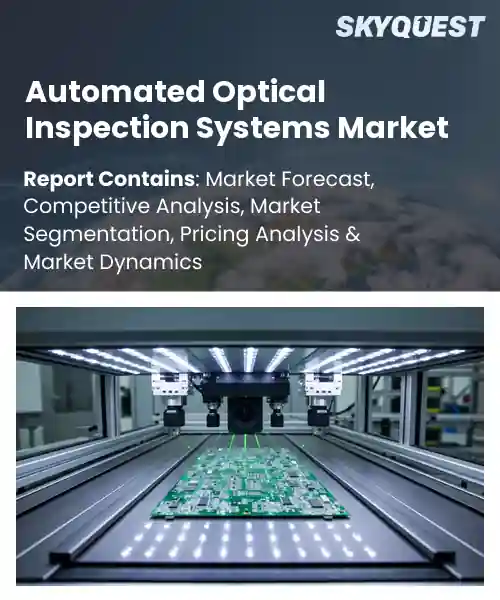
Automated Optical Inspection Systems Market
Report ID: SQMIG45J2437
Report ID: SQMIG45J2437
[email protected]
USA +1 351-333-4748
Report ID:
SQMIG45J2437 |
Region:
Global |
Published Date: May, 2026
Pages:
157
|Tables:
143
|Figures:
73


Global Automated Optical Inspection Systems Market size was valued at USD 1.52 Billion in 2024 and is poised to grow from USD 1.67 Billion in 2025 to USD 3.52 Billion by 2033, growing at a CAGR of 9.82% during the forecast period (2026-2033).
The use of automated optical inspection (AOI) system market growth detect faults on printed circuit boards, semiconductor wafers, and assembled electronic devices is driven by the increasing size and complexity of components to the point that they can no longer be inspected manually. As the size of the devices has decreased and the thickness of the multi-layer PCBs has increased, manufacturers have required higher yields and better quality from AOI systems. This has led to an evolution of the technology from a simple two-dimensional (2D) brightfield image capture (i.e., visual inspections of PCBs) to detailed three-dimensional (3D) profiling and inspection capabilities, utilizing multiple angles at once for each PCB. An example of this technology evolution can be found in how the use of 3D AOI inline systems has improved production efficiency and reduced defect rates by in excess of 40% compared to traditional manual visual inspection, illustrating the importance of this technology within high volume manufacturing to this day.
Machine learning and connectivity have become vital components of the global AOI market trends, through improved defect identification and predicting/avoiding downtime and warranty expenditures, in turn making a higher upfront investment more appealing. Advanced AI enabled inspection by manufacturers reduces the rate of false failures while increasing yields which has accelerated adoption into the automotive safety electronics market due to zero defect tolerance and the medical device assembly market due to traceability regulations requiring in-line inspection. The use of connectivity facilitates cloud based analytics to aggregate defect data across multiple locations, thus continually enhancing algorithms and enabling software-as-a-service and vendor collaboration.
How is AI Improving Defect Detection Accuracy in the Automated Optical Inspection Systems Market?
Artificial Intelligence (AI) is improving defect detection accuracy in automated optical inspection (AOI) market share, through advanced image analysis techniques that utilize Machine Learning (ML). The current methods used to detect defects in a part include; using data driven techniques for pattern recognition (finding similarities), using anomaly (finding differences) detection approach that learns what is a normal appearance of an item as opposed to a faulty appearance, receiving multimodal data from both 2D and 3D sensors, and periodically retraining the model, such that the false positives and false negatives are minimized. As a result of these developments, the market has moved from rule-based, threshold driven approaches to AI enabled systems that provide improved defect coverage across PCB / advanced packaging manufacturing lines. Therefore, the improvements in these systems create higher throughput and reduced operator reviews.
More and more suppliers are embedding AI directly into their vision hardware, as a way of simplifying installation and speeding up the cycle time of inspection across complex manufacturing lines.
At Nordson's March 2026 event, we demonstrated AutoProgram and the AI Hub for the AOI platforms. The AutoProgram provides a quicker way to create programs and the continuous model improvements provide a direct increase in defect detection accuracies with a decrease in manual intervention, thus allowing for greater efficiency and easier scaling of inspection processes across complex manufacturing lines.
Market snapshot - (2026-2033)
Global Market Size
USD 1.52 Billion
Largest Segment
2D AOI Systems
Fastest Growth
3D AOI Systems
Growth Rate
9.82% CAGR
To get more insights on this market click here to Request a Free Sample Report
Global automated optical inspection systems market is segmented by system type, technology, application, end-use industry, distribution and region. Based on system type, the market is segmented into 2D AOI systems and 3D AOI systems. Based on technology, the market is segmented into machine vision and AI-based inspection. Based on application, the market is segmented into PCB inspection, semiconductor wafer inspection, LCD panel inspection and SMT component inspection. Based on end-use industry, the market is segmented into electronics, semiconductor, automotive and medical devices. Based on distribution, the market is segmented into direct sales and system integrators. Based on region, the market is segmented into North America, Europe, Asia Pacific, Latin America and Middle East & Africa.
The largest segment of PCB Inspection is characterized by the use of AOI systems designed specifically for board level inspection; they provide the ability to detect solder joint defects, component misplacing, and tombstoning at an earlier stage of production. This in turn means that there is potential for saving on downstream costs associated with testing circuits; drive continual improvement in optics and illumination methods; and continue development of pattern recognition processes in conjunction with implementation of feedback from the manufacturing process.
On the other hand, semiconductor wafer inspection continues to show the most significant growth trend due in part to increased device scaling and defect sensitivity leading all fabs to implement higher resolution optical inspection methods within their wafer fabrication facilities. Due in part to advances in imaging technology and inline analytics, early detection of defects and faster process feedback are available to enable vendors to create integrated inspection and process control solutions that lead to improved yield and higher-value service.
The adaptive algorithm-based Inspection is being the leading segment of the market, as adaptive algorithms offer an adaptive way to detect complex and variable defects that traditional vision systems are unable to detect reliably. This increases the accuracy of inspections and reduces the amount of rework. The adaptive, continuous learning capabilities of the adaptive algorithm-based system allows for tuning through variations in product designs, thereby increasing process stability, and decreasing the chance for false rejects. This causes manufacturers to make Inclusion of AI a significant priority, and encourages vendors to invest in providing specialized software, analytics pipelines, and workflow integration, in order to allow for wider adoption of the technology.
Machine vision is the area of market that is presently experiencing the largest growth. The low complexity of implementation, and proven deterministic inspection workflows of machine vision technology are causing rapid adoption in traditional manufacturing processes. Advancements in optics, processing throughput, and overall costs of machine vision technologies allow vendors to provide complete, turnkey solutions for the machine vision and manufacturing services industries and expand the use of machine vision for high-speed safety checks, which further allows machine vision vendors to simplify integration and provide new business opportunities to manufacturers that operate in the legacy manufacturing environment.
To get detailed segments analysis, Request a Free Sample Report
The Asia-Pacific region's dominance is the result of a number of factors converging including a high concentration of electronics manufacturing, the existence of deep supply chains and ecosystems, and the adoption of new technologies ahead of the rest of the world. These factors contribute to an increased demand for advanced inspection capabilities driven by the presence of major production clusters for semiconductors, consumer electronics, and automotive parts. Equipment suppliers, integrators, and component manufacturers are located close to one another making the ability for manufacturers to customize and deploy their products quickly very feasible. Additionally, many of the major economies within the region have a focus on advancing the development of manufacturing automation and machine vision supporting continued development of new inspection algorithms and hardware solutions. The use of efficient supplier networks and highly skilled engineering resources makes it easier for manufacturers to integrate their inspection systems into complex assembly-line processes. Support from government policies that encourage the modernization of the industrial base and provide incentives for high-value manufacturing has enhanced these manufacturers' ability to implement automated optical inspection capabilities. As a result, the region as a whole is uniquely positioned as both a significant consumer and a prolific producer of automated optical inspection solutions through its: scale of production, technical knowledge, and collaboration across its ecosystem partners.
Automated optical inspection systems market outlook in Japan will see strong demand from the high-value manufacturing sectors in relation to the continuing focus on precision, miniaturization and reliability within these industries. Close cooperation between manufacturers and equipment manufacturers provides for the development of high-quality inspection technologies that address the stringent quality requirements; such as those found in the semiconductor, automotive and industrial electrical/electronic manufacturing sectors. Through the continuing integration of inspection systems into automated production lines, manufacturers have access to the necessary expertise to integrate inspection into their production process.
Automated optical inspection systems market forecast in South Korea is driven by significant production requirements for both large scale memory (semiconductors) and displays (LCDs/LEDs) along with an active consumer electronics marketplace. Increasing demand is driven by needs for high throughput (speed), dependable defect detection (capability), and ability to accommodate new packaging or display configurations. Both local manufacturers and global suppliers are teaming with integrators to maximize inspection solutions available for high volume production lines; investments in machine learning and enhanced optics will continue to enable improvements in inspection systems. Close collaboration between equipment suppliers and manufacturing locations is fostering quick application of customized inspection methods; a large talent pool in engineering is keeping pace with innovation in inspection software and hardware customization.
The growth of North America is increasing according to new trends in high precision manufacturing, reshoring of strategic manufacturing operations, and an increasing reliance on advanced automation technologies across multiple high value industries. All examples of these industries (fabrication of semiconductors; production of medical devices; aerospace component production; and automotive electronic production) will require a considerable investment in quality assurance related to optical inspection technologies. Accordingly, as we move to integrate Artificial Intelligence (AI) and advanced analytics into current processes, optical inspection systems will become instrumental to the smart manufacturing initiative as they will enhance not only classified defect resolution, but also the feedback provided to production lines by accounting for how inspections should occur throughout the process. The existence of a large network of equipment manufacturers, systems integrators, and service providers will enable companies to customize their solutions. Thus, enabling partnerships between Private Enterprise and Research based organizations to develop next generation inspection solutions for complex substrates and newly developed packaging designs while working to achieve adherence to both existing quality assurance and regulatory requirements.
Automated optical inspection systems market outlook in United States is driven by demand from advanced semiconductor fabs, contract manufacturers, and high-tech OEMs. Because of the increasingly rapid pace of innovation, it has also been possible to develop AI-based analytical capabilities and to integrate these systems with automated handling systems. The emphasis on these areas has made inspection a strategic tool for improving yield. Cooperation among end users and equipment designers is yielding specialized inspection equipment specifically targeted at both advanced packaging and heterogeneous integration. A mature ecosystem of systems integrators and service providers is supporting deployment, calibration, and ongoing optimization of automated optical inspection systems across a wide range of manufacturing settings.
Automated optical inspection systems market regional forecast in Canada is largely driven by precision manufacturing in various sectors, including aerospace, medical devices, and automotive components, as well as the need for quality assurance and reliable processes. Manufacturers are looking to find inspection solutions that can be customized based on their specific assembly types and can easily connect to current production lines. There is also collaboration among industry, technical service providers, and universities to help with the adoption of new inspection algorithms and imaging methods. Aftermarket service and local integration capabilities are critical to maintain uptime and to make changes in inspection strategies due to changes in product specifications.
Europe is reinforcing its competitiveness through high quality manufacturing, strong regulatory consumer protection, and advanced capabilities in industrial automation and systems engineering. Investments in the digitalization of manufacturing processes, increased collaboration between suppliers of equipment and manufacturing clusters, and investments to accelerate modernization of inspection processes for manufacturers with a greater focus on sustainable, efficient methods of manufacturing are enabling a faster pace of advancement worldwide for inspection technologies. The inherent strengths of Europe in the manufacturing sectors of automotive, aerospace, and industrial electronics create a large need for custom inspection solutions that meet the technical complexity of manufacturing assembly and high levels of reliability. Cross border collaborations between businesses and consortium-based r&D initiatives are advancing the development of technologies in machine vision, robotics integration, and advanced analytics. The strong support of small and mid-sized manufacturing enterprises to implement automated inspection systems, as well as strong service ecosystems, continue to position Europe as a market for sophisticated, flexible, and adaptive inspection technologies.
Automated optical inspection systems market analysis in Germany is focused on the fact that Germany has a wealth of industrial automation capabilities and a concentration of automotive and industrial electronics manufacturing activity. The product offerings will be centered on demanding inspection systems that can be integrated into complex production lines, and also meet stringent quality and reliability requirements. Equipment suppliers and systems integrators are partnering with manufacturers to provide custom-designed inspection solutions and ensure seamless process control. As a result, the use of engineering and process improvement as a means of continually enhancing both inspection accuracy and throughput in precision manufacturing environments is a major focus area for many manufacturers pursuing improvement in these areas.
Automated optical inspection systems industry in United Kingdom has a well-developed research base as well as a varied manufacturing industry that includes defence, aerospace and specialty electronics. The trend towards increased use of automated optical inspection systems is driving an increasing emphasis on flexible solutions, easy integration and enhanced analytics capabilities. In addition to the above trends, some companies are actively working in partnership with research institutions to accelerate the advancement of new imaging technologies and defect classification methods. Additionally, the collaboration between technology suppliers and service providers will play an important part in designing automated optical inspection systems to meet specific needs of niche manufacturing industries.
Automated optical inspection systems market in France relies on strong performance in aerospace, automotive and industrial equipment manufacturers as a necessity for traceability and a high level of confidence in inspection systems providing accurate measuring devices as well as supporting the verification of complex assemblies during production. The focus of local equipment manufacturers and integrators is primarily on customizing and providing ongoing support to regulated industries, while partnerships between local equipment manufacturer and research entities also provide avenues to explore new developments in vision algorithms and multisensory approaches to inspection. There is currently an ongoing trend towards operational efficiency and quality assurance in both manufacturing and service processing among strategic manufacturing sectors within France.
To know more about the market opportunities by region and country, click here to
Buy The Complete Report
Advancements In Machine Vision Technology
Integration With Manufacturing Systems
High Initial Capital Investment
Shortage Of Skilled Operators
Request Free Customization of this report to help us to meet your business objectives.
The use of consolidation and platform differentiation as competitive pressure in the global AOI market has given rise to large M&A and merger activity that expands the portfolios of the players in the market. Concurrently, AI partnerships are driving innovation via accelerated development. KLA's recent acquisition of Orbotech and the Nanometrics Rudolph Merger into Onto Innovation illustrate this trend. Furthermore, companies like those mentioned above have partnered with AI start-up companies to develop inline 3D inspection and edge AI AOI solutions that can be marketed to companies producing small batch parts. Fast integration of AI into operations using partnerships and embedded edge solutions is one of the key factors separating the winning companies from the others in this space.
Top Player’s Company Profile
Recent Developments in the Automated Optical Inspection Systems Market
SkyQuest’s ABIRAW (Advanced Business Intelligence, Research & Analysis Wing) is our Business Information Services team that Collects, Collates, Correlates, and Analyses the Data collected by means of Primary Exploratory Research backed by robust Secondary Desk research.
As per SkyQuest analysis, the rise in AI based inspection that enhances defect detection and increases yield in the global automated optical inspection systems market is the primary engine for growth, while technological advancements in machine vision and imaging hardware that allow for higher resolution, faster throughput and easier integration is a second major driver. Cash strapped manufacturers struggling to pay for the generally high initial capital investment are severely limiting the market’s potential overall growth rate. The Asia Pacific region accounts for a large proportion of the global market and will continue to dominate due to the concentration of electronic manufacturing, developing supply chains and rapid adoption of new technologies. The PCB Inspection segment currently holds the largest share based on the need for inline verification of complex board assemblies. Vendors with an emphasis on AI (artificial intelligence), connectivity, and scalable deployment will have the best chance to capture a larger share of this growing market.
| Report Metric | Details |
|---|---|
| Market size value in 2024 | USD 1.52 Billion |
| Market size value in 2033 | USD 3.52 Billion |
| Growth Rate | 9.82% |
| Base year | 2024 |
| Forecast period | (2026-2033) |
| Forecast Unit (Value) | USD Billion |
| Segments covered |
|
| Regions covered | North America (US, Canada), Europe (Germany, France, United Kingdom, Italy, Spain, Rest of Europe), Asia Pacific (China, India, Japan, Rest of Asia-Pacific), Latin America (Brazil, Rest of Latin America), Middle East & Africa (South Africa, GCC Countries, Rest of MEA) |
| Companies covered |
|
| Customization scope | Free report customization with purchase. Customization includes:-
|
To get a free trial access to our platform which is a one stop solution for all your data requirements for quicker decision making. This platform allows you to compare markets, competitors who are prominent in the market, and mega trends that are influencing the dynamics in the market. Also, get access to detailed SkyQuest exclusive matrix.
Table Of Content
Executive Summary
Market overview
Parent Market Analysis
Market overview
Market size
KEY MARKET INSIGHTS
COVID IMPACT
MARKET DYNAMICS & OUTLOOK
Market Size by Region
KEY COMPANY PROFILES
Methodology
For the Automated Optical Inspection Systems Market, our research methodology involved a mixture of primary and secondary data sources. Key steps involved in the research process are listed below:
1. Information Procurement: This stage involved the procurement of Market data or related information via primary and secondary sources. The various secondary sources used included various company websites, annual reports, trade databases, and paid databases such as Hoover's, Bloomberg Business, Factiva, and Avention. Our team did 45 primary interactions Globally which included several stakeholders such as manufacturers, customers, key opinion leaders, etc. Overall, information procurement was one of the most extensive stages in our research process.
2. Information Analysis: This step involved triangulation of data through bottom-up and top-down approaches to estimate and validate the total size and future estimate of the Automated Optical Inspection Systems Market.
3. Report Formulation: The final step entailed the placement of data points in appropriate Market spaces in an attempt to deduce viable conclusions.
4. Validation & Publishing: Validation is the most important step in the process. Validation & re-validation via an intricately designed process helped us finalize data points to be used for final calculations. The final Market estimates and forecasts were then aligned and sent to our panel of industry experts for validation of data. Once the validation was done the report was sent to our Quality Assurance team to ensure adherence to style guides, consistency & design.
Analyst Support
Customization Options
With the given market data, our dedicated team of analysts can offer you the following customization options are available for the Automated Optical Inspection Systems Market:
Product Analysis: Product matrix, which offers a detailed comparison of the product portfolio of companies.
Regional Analysis: Further analysis of the Automated Optical Inspection Systems Market for additional countries.
Competitive Analysis: Detailed analysis and profiling of additional Market players & comparative analysis of competitive products.
Go to Market Strategy: Find the high-growth channels to invest your marketing efforts and increase your customer base.
Innovation Mapping: Identify racial solutions and innovation, connected to deep ecosystems of innovators, start-ups, academics, and strategic partners.
Category Intelligence: Customized intelligence that is relevant to their supply Markets will enable them to make smarter sourcing decisions and improve their category management.
Public Company Transcript Analysis: To improve the investment performance by generating new alpha and making better-informed decisions.
Social Media Listening: To analyze the conversations and trends happening not just around your brand, but around your industry as a whole, and use those insights to make better Marketing decisions.
REQUEST FOR SAMPLE
 REQUEST FREE CUSTOMIZATION
Global Automated Optical Inspection Systems Market size was valued at USD 1.52 Billion in 2024 and is poised to grow from USD 1.67 Billion in 2025 to USD 3.52 Billion by 2033, growing at a CAGR of 9.82% during the forecast period (2026-2033).
Competitive pressure in the global AOI market is driven by consolidation and platform differentiation, with large M&A and mergers expanding portfolios while AI partnerships accelerate innovation. Examples include KLA’s acquisition of Orbotech and the Nanometrics Rudolph merger into Onto Innovation, alongside vendor collaborations with AI startups to commercialize inline 3D inspection and edge AI AOI solutions. Something that differentiates winners is rapid AI integration through partnerships and embedded edge solutions. 'Koh Young Technology', 'Omron Corporation', 'Cyberoptics Corporation', 'Nordson Corporation (Asymtek)', 'Mirtec Co. Ltd.', 'Saki Corporation', 'ViTrox Technologies', 'Viscom AG', 'Mycronic AB', 'Test Research Inc. (TRI)', 'Orbotech (KLA)', 'ISRA VISION', 'Cognex Corporation', 'Basler AG', 'Keyence Corporation'
Advancements in image capture, processing algorithms, and sensor design have significantly enhanced the ability of automated optical inspection systems to detect increasingly complex defects with greater consistency. Improved optics, higher resolution imaging, and smarter pattern recognition enable more reliable component verification and reduce false positives, which increases user confidence and broadens applicability across challenging inspection tasks. These technological improvements lower barriers to adoption by simplifying integration with production lines and enabling manufacturers to maintain higher yields and consistent quality standards, thereby driving market expansion.
Ai Driven Defect Intelligence: Increasing integration of advanced machine learning and computer vision enables automated optical inspection systems to learn complex defect patterns, prioritize critical failures, and reduce false positives. These capabilities support continuous improvement through feedback loops and adaptive algorithms, improving throughput and yield while simplifying operator decision making. Vendors and manufacturers are collaborating to embed smarter analytics, creating scalable solutions that adapt to diverse product families and evolving manufacturing tolerances, accelerating deployment across varied production environments seeking higher quality consistency and reliability.
Why does Asia Pacific Dominate the Global Automated Optical Inspection Systems Market? |@12


Want to customize this report? This report can be personalized according to your needs. Our analysts and industry experts will work directly with you to understand your requirements and provide you with customized data in a short amount of time. We offer $1000 worth of FREE customization at the time of purchase.
Feedback From Our Clients


 USA (+1) 351-333-4748

