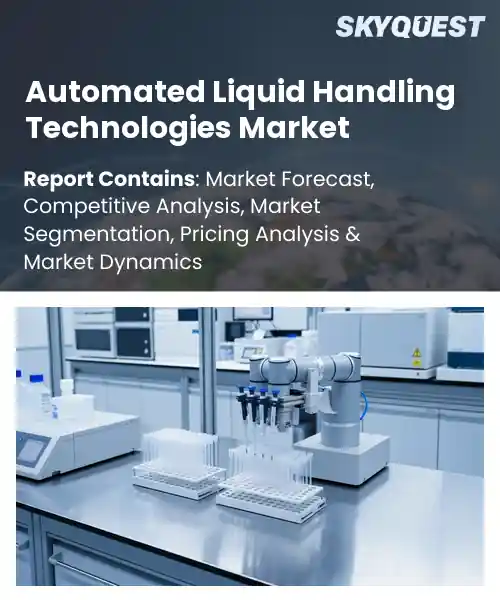
Automated Liquid Handling Technologies Market
Report ID: SQMIG45J2485
Report ID: SQMIG45J2485
[email protected]
USA +1 351-333-4748
Report ID:
SQMIG45J2485 |
Region:
Global |
Published Date: June, 2026
Pages:
157
|Tables:
169
|Figures:
79


Global Automated Liquid Handling Technologies Market size was valued at USD 2.5 Billion in 2024 and is poised to grow from USD 2.7 Billion in 2025 to USD 5.0 Billion by 2033, growing at a CAGR of 8.0% during the forecast period (2026-2033).
The automated liquid handling technologies market is driven by the imperative to increase throughput, precision and reproducibility in laboratory workflows, which has pushed laboratories to adopt robotic pipetting platforms and integrated automation suites. This market encompasses hardware, consumables and software that automate sample transfer, mixing across genomics, drug discovery and clinical diagnostics, and it matters because faster, standardized processing reduces experimental variability and accelerates time to result. Historically the sector evolved from simple benchtop pipetting robots to complex, modular systems that integrate plate handling, sensors and data management, a transformation accelerated by demand from large-scale sequencing and pandemic response programs.Building on that accelerated adoption, a critical factor shaping global expansion is convergence of software intelligence, connectivity and modular hardware; integrated control enables complex protocols to scale safely and predictably across diverse laboratory environments. When systems communicate with LIMS and employ scheduling algorithms, throughput rises while human error and batch variability fall, which makes automated solutions more attractive to CROs and clinical labs facing stringent audits. Real-world examples include pandemic-era diagnostics centers scaled to tens of thousands daily and biomanufacturing quality control lines using automated handlers to shorten assay turnaround, lower costs and accelerate biologics commercialization while improving data traceability.
How is AI-driven automation enhancing throughput in the automated liquid handling technologies market?
AI driven automation in automated liquid handling blends machine learning orchestration real time feedback and predictive scheduling to raise throughput across sample preparation workflows. Key aspects include adaptive pipetting error detection and workflow optimization that reduce downtime and improve reproducibility. The market is shifting from fixed protocol automation to intelligent platforms that coordinate instruments and data across labs for greater capacity and traceable results. Vendors are pairing AI enabled orchestration software with established liquid handlers to streamline sequencing and assay pipelines and to scale routine experiments with less manual intervention.Curiox June 03, 2026, launched software that automates flow cytometry sample preparation on a single instrument and shows how software defined automation paired with AI orchestration can cut manual steps accelerate throughput and improve consistency across labs while reducing staff training and enabling multi site standardization to support scalable lab operations.
Market snapshot - (2026-2033)
Global Market Size
USD 2.5 Billion
Largest Segment
Hardware
Fastest Growth
Software
Growth Rate
8.0% CAGR
To get more insights on this market click here to Request a Free Sample Report
Global automated liquid handling technologies market is segmented by component, product type, system type, modality, application, end user and region. Based on component, the market is segmented into Hardware, Software and Services. Based on product type, the market is segmented into Automated Workstations and Reagents & Consumables. Based on system type, the market is segmented into Standalone Systems and Integrated / Workstation Systems. Based on modality, the market is segmented into Fixed Tip Systems and Disposable Tip Systems. Based on application, the market is segmented into Drug Discovery & ADME-Tox Research, Genomics & Proteomics Research, Cancer Research and Bioprocessing / Biotechnology. Based on end user, the market is segmented into Pharmaceutical & Biotechnology Companies, Academic & Research Institutes and Contract Research Organizations (CROs). Based on region, the market is segmented into North America, Europe, Asia Pacific, Latin America and Middle East & Africa.
Hardware segment dominates because core instrumentation defines the functional capability of automated liquid handling systems and sets the ceiling for throughput precision and robustness required by complex laboratory workflows, so investments in instrument platforms drive adoption. Strong engineering in motion control pipetting modules and plate handling improves reproducibility and uptime, which encourages procurement and creates ecosystems of compatible consumables and third party integrations that reinforce platform leadership.
However, Software is emerging as the most rapidly expanding area in the automated liquid handling technologies market, as laboratories seek workflow orchestration and intelligent protocol optimization. Advances in instrument control algorithms and experiment management tools accelerate adoption by reducing manual intervention and enabling scalable automation that unlocks new application and service opportunities.
Disposable Tip Systems segment dominates because their single use design eliminates cross contamination risks and simplifies validation workflows critical to sensitive assays in genomics and clinical applications, driving preference for consumable based approaches. Reliable supply chains and continuous innovation in tip geometry and liquid handling precision support varied sample types and multiplexed protocols, lowering operational complexity and reinforcing adoption across research and regulated laboratory settings.
However, Fixed Tip Systems are emerging as the most rapidly expanding area as laboratories pursue sustainability and lower operating costs. Improvements in wash validation, tip cleaning technologies and contamination monitoring enable reliable reuse and consistent performance, attracting adoption in high throughput environments and opening opportunities in bioprocessing and large scale service operations.
To get detailed segments analysis, Request a Free Sample Report
North America commands the market due to a confluence of innovation ecosystems, well funded life science infrastructure, and a dense concentration of instrument manufacturers and service providers. Strong integration between academic research centers, contract research organizations, and pharmaceutical development fosters rapid adoption of automation platforms. Robust private investment and established procurement pathways in clinical and industrial laboratories accelerate deployment, while comprehensive regulatory frameworks and technical support networks reduce adoption barriers. Leading suppliers maintain local manufacturing and application development teams that tailor solutions to complex workflows. A mature aftermarket for consumables, maintenance, and software services further sustains long term utilization. The region also benefits from a skilled technical workforce and cultivated standards that encourage interoperability and scalability across diverse laboratory environments.
Automated Liquid Handling Technologies Market in United States is characterized by broad adoption across academic and clinical laboratories driven by deep technical expertise and collaboration between vendors and end users. High expectations for workflow efficiency, integration with laboratory information systems, and customization for high throughput applications encourage advanced automation uptake. Well established service networks and local application support enable rapid deployment and adaptation to evolving protocols across research and diagnostics.
Automated Liquid Handling Technologies Market in Canada demonstrates steady institutional adoption driven by emphasis on translational research and supportive funding for laboratory modernization. Regional laboratories prioritize flexible automation that can serve diverse projects from molecular assays to compound handling. Close partnerships between universities, public health laboratories, and distributors facilitate knowledge transfer and localized service. Preference for modular systems and attention to consumable availability shape procurement choices and encourage scalable implementations.
Europe is experiencing rapid market expansion due to a combination of strong industrial research networks, progressive laboratory modernization programs, and proactive collaboration between instrument makers and end users. Fragmented national healthcare systems nonetheless benefit from harmonized regulatory guidance and cross border research initiatives that encourage adoption of automated platforms. Significant demand arises from pharmaceutical development, diagnostics, and academic consortia seeking reproducible, high throughput workflows. Local engineering expertise supports customization for complex assays, while growing service and maintenance capabilities reduce operational friction. Additionally, evolving procurement models and an emphasis on open standards for laboratory automation promote interoperability, enabling laboratories of varied sizes to integrate automation into existing workflows. Public private partnerships and clustered innovation hubs accelerate commercialization, while a growing focus on sustainability and reagent efficiency shapes purchasing decisions.
Automated Liquid Handling Technologies Market in Germany benefits from a strong industrial base and engineering expertise that support precision automation for demanding laboratory workflows. Collaboration between research institutes and manufacturers fosters application driven innovation. Laboratories emphasize reliability, serviceability, and integration with analytical instruments, prompting suppliers to provide localized technical support and customization. Regional manufacturing capability and rigorous quality standards encourage widespread adoption across pharmaceutical and applied research sectors including diagnostics.
Automated Liquid Handling Technologies Market in United Kingdom is marked by uptake across academic hubs and biotech clusters that demand adaptable high throughput automation. Active translational research and venture investment encourage adoption of novel platforms. Emphasis on integration with data systems and flexible throughput scaling drives preference for modular solutions. Close engagement between suppliers and end users accelerates protocol optimization and supports deployment across diagnostic and research laboratories, including startups.
Automated Liquid Handling Technologies Market in France is emerging through targeted investment in academic centers and public laboratories that seek improved throughput and reproducibility. Emphasis on translational programs and collaborations encourages suppliers to adapt solutions for varied workflows. French laboratories often prioritize user friendly interfaces, local application training, and compatibility with established analytical platforms. Interest from regional biotech firms increases demand for modular systems and reliable after sales support nationwide.
Asia Pacific is strengthening its market position through concentrated investments in laboratory infrastructure, growing domestic manufacturing capabilities, and strategic collaborations among academic, industrial, and government stakeholders. Increasing proficiency in automation design and local assembly reduces lead times and enables cost competitive offerings that attract regional laboratories. Emphasis on workforce training and localized application development supports adoption across diagnostics, biopharma, and research institutions. Regional manufacturers and distributors provide tailored service packages and consumable supply chains that address logistical challenges. Cross border research collaborations and technology transfer partnerships further accelerate capability building, while demand for scalable and modular systems encourages suppliers to localize both product portfolios and technical support. Government incentives and regional standardization initiatives complement private sector activity, enabling broader deployment in clinical diagnostics and emerging biotech, while emphasis on consumable availability and localized spare part networks improves operational resilience.
Automated Liquid Handling Technologies Market in Japan is driven by advanced engineering capacity and strong ties between research institutions and manufacturers. Laboratories favor reliable, compact systems that integrate smoothly with analytical instrumentation and data management tools. Domestic suppliers emphasize quality control, long term service agreements, and training to meet stringent laboratory expectations. Demand spans pharmaceutical research, diagnostics, and biotechnology, with suppliers focusing on customization, miniaturization, and seamless software integration nationally.
Automated Liquid Handling Technologies Market in South Korea is advancing through commercialization of innovative platforms supported by domestic manufacturers and university partnerships. Laboratories seek compact high throughput solutions with strong software capabilities and instrument connectivity. Emphasis on deployment speed, local technical support, and reliable consumable supply chains helps overcome logistical barriers. Interest from biotech startups and clinical laboratories drives demand for scalable automation and collaborative development of application specific protocols.
To know more about the market opportunities by region and country, click here to
Buy The Complete Report
Rising Demand For High Throughput
Integration With Laboratory Informatics
High Initial Capital Investment
Complex Regulatory And Validation
Request Free Customization of this report to help us to meet your business objectives.
Competitive rivalry in the automated liquid handling market is driven by targeted M&A, strategic partnerships, and platform differentiation through AI and integration. Consolidators pursue tuck-in acquisitions to add niche liquid handling capabilities while CDMO and automation specialists secure long-term manufacturing deals and AI collaborations to lock in workflows and consumable ecosystems.
Top Player’s Company Profile
Recent Developments
SkyQuest’s ABIRAW (Advanced Business Intelligence, Research & Analysis Wing) is our Business Information Services team that Collects, Collates, Correlates, and Analyses the Data collected by means of Primary Exploratory Research backed by robust Secondary Desk research. As per SkyQuest analysis, the automated liquid handling market is propelled by rising demand for high throughput laboratory processing while facing a key restraint in high initial capital investment that limits uptake among smaller labs. North America remains the dominant region thanks to concentrated innovation ecosystems and established procurement and service networks, and hardware leads the market as core instrumentation dictates throughput, precision and platform ecosystems. A second growth driver is the rapid integration of AI driven orchestration and laboratory informatics that boosts reproducibility, scheduling and instrument interoperability, enabling scalable, multi site automation and strengthening value propositions for CROs, diagnostics labs and biomanufacturers.
| Report Metric | Details |
|---|---|
| Market size value in 2024 | USD 2.5 Billion |
| Market size value in 2033 | USD 5.0 Billion |
| Growth Rate | 8.0% |
| Base year | 2024 |
| Forecast period | (2026-2033) |
| Forecast Unit (Value) | USD Billion |
| Segments covered |
|
| Regions covered | North America (US, Canada), Europe (Germany, France, United Kingdom, Italy, Spain, Rest of Europe), Asia Pacific (China, India, Japan, Rest of Asia-Pacific), Latin America (Brazil, Rest of Latin America), Middle East & Africa (South Africa, GCC Countries, Rest of MEA) |
| Companies covered |
|
| Customization scope | Free report customization with purchase. Customization includes:-
|
To get a free trial access to our platform which is a one stop solution for all your data requirements for quicker decision making. This platform allows you to compare markets, competitors who are prominent in the market, and mega trends that are influencing the dynamics in the market. Also, get access to detailed SkyQuest exclusive matrix.
Table Of Content
Executive Summary
Market overview
Parent Market Analysis
Market overview
Market size
KEY MARKET INSIGHTS
COVID IMPACT
MARKET DYNAMICS & OUTLOOK
Market Size by Region
KEY COMPANY PROFILES
Methodology
For the Automated Liquid Handling Technologies Market, our research methodology involved a mixture of primary and secondary data sources. Key steps involved in the research process are listed below:
1. Information Procurement: This stage involved the procurement of Market data or related information via primary and secondary sources. The various secondary sources used included various company websites, annual reports, trade databases, and paid databases such as Hoover's, Bloomberg Business, Factiva, and Avention. Our team did 45 primary interactions Globally which included several stakeholders such as manufacturers, customers, key opinion leaders, etc. Overall, information procurement was one of the most extensive stages in our research process.
2. Information Analysis: This step involved triangulation of data through bottom-up and top-down approaches to estimate and validate the total size and future estimate of the Automated Liquid Handling Technologies Market.
3. Report Formulation: The final step entailed the placement of data points in appropriate Market spaces in an attempt to deduce viable conclusions.
4. Validation & Publishing: Validation is the most important step in the process. Validation & re-validation via an intricately designed process helped us finalize data points to be used for final calculations. The final Market estimates and forecasts were then aligned and sent to our panel of industry experts for validation of data. Once the validation was done the report was sent to our Quality Assurance team to ensure adherence to style guides, consistency & design.
Analyst Support
Customization Options
With the given market data, our dedicated team of analysts can offer you the following customization options are available for the Automated Liquid Handling Technologies Market:
Product Analysis: Product matrix, which offers a detailed comparison of the product portfolio of companies.
Regional Analysis: Further analysis of the Automated Liquid Handling Technologies Market for additional countries.
Competitive Analysis: Detailed analysis and profiling of additional Market players & comparative analysis of competitive products.
Go to Market Strategy: Find the high-growth channels to invest your marketing efforts and increase your customer base.
Innovation Mapping: Identify racial solutions and innovation, connected to deep ecosystems of innovators, start-ups, academics, and strategic partners.
Category Intelligence: Customized intelligence that is relevant to their supply Markets will enable them to make smarter sourcing decisions and improve their category management.
Public Company Transcript Analysis: To improve the investment performance by generating new alpha and making better-informed decisions.
Social Media Listening: To analyze the conversations and trends happening not just around your brand, but around your industry as a whole, and use those insights to make better Marketing decisions.
REQUEST FOR SAMPLE
 REQUEST FREE CUSTOMIZATION


Want to customize this report? This report can be personalized according to your needs. Our analysts and industry experts will work directly with you to understand your requirements and provide you with customized data in a short amount of time. We offer $1000 worth of FREE customization at the time of purchase.
Feedback From Our Clients


 USA (+1) 351-333-4748

