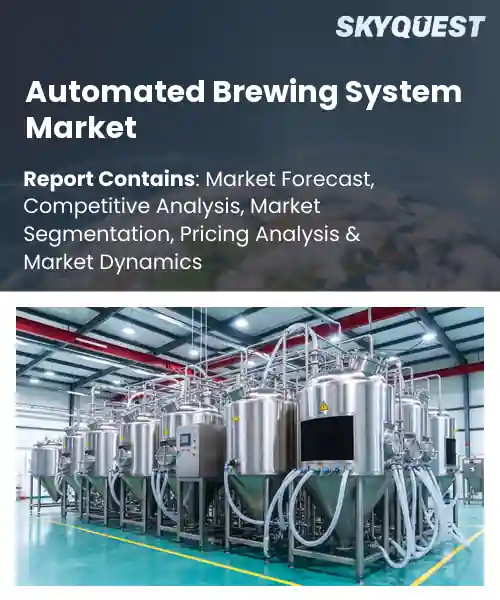
Automated Brewing System Market
Report ID: SQMIG20I3191
Report ID: SQMIG20I3191
[email protected]
USA +1 351-333-4748
Report ID:
SQMIG20I3191 |
Region:
Global |
Published Date: July, 2026
Pages:
157
|Tables:
143
|Figures:
78


Global Automated Brewing System Market size was valued at USD 1.52 Billion in 2024 and is poised to grow from USD 1.67 Billion in 2025 to USD 3.52 Billion by 2033, growing at a CAGR of 9.82% during the forecast period (2026-2033).
As a result of the increasing consumer need for a large variety of high-quality beers and/or fermented beverages, the driving force of the automated brewing system market continues to be the demand for product consistency and operational efficiency through automation. An automated brewing system comprises three primary components: equipment (hardware), control software, and services (examples include the automation of the mashing process, fermentation monitoring, cleaning, and packaging). Companies can thus experience less human error, quicker time-to-market, and greater scale across both craft and industrial breweries. The market has historically progressed from manual kettle systems with basic temperature controllers to programmable logic controllers and now to integrated IoT platforms. Additionally, compact automated brewhouses have been increasingly adopted by microbreweries while larger producers deploy networked fermentation management systems.
The continued development of the automated brewing systems' technological evolution is driven by the integration of IoT and advanced analytics (measurable operational benefits and new business models through predictive maintenance will reduce excessive unplanned downtime and average maintenance costs). For example, craft brewers can produce more batches per day without compromising quality due to predictive maintenance tools used for monitoring fermentation, flow, and temperature data collected by sensors on the cloud. Another example would be that recipe control systems based on data analysis enable brewers to quickly scale successful SKUs and facilitate the contract brewing of products that meet defined specifications. These capabilities open opportunities for software-as-a-service offerings, retrofit packages for legacy plants and geographic expansion into emerging beverage markets where capital-efficient automation lowers entry barriers.
How is IoT-enabled Automation Improving Efficiency In The Automated Brewing System Market?
Automation of brewing requires IoT enabled integrated systems consisting of sensor networks, cloud computation, and associated control systems. These systems provide continuous monitoring of key process parameters: temperature, pressure, gravity; automated execution of recipes; real time alerts; and predictive maintenance. As of October 2023, craft and industrial brewers are now utilizing modular, connected production systems that allow them to scale without compromising their product's flavor. By automating processes with IoT technologies, breweries no longer need to perform manual checks, have reduced batch cycle time, and have achieved lower levels of waste through precise process control.
Examples include in-tank fermentation sensors that monitor yeast activity, and automatic cleaning and dosing systems that ensure properly cleaned tanks and accurate measurement of ingredients with every brew. In April 2025, Sennos launched an innovative cloud-connected in-tank sensor stack and analytics platform designed to make continuous monitoring a common practice within breweries. This IoT-enabled solution increases efficiency by enabling brewers to quickly identify issues with fermentation, reduce periods of downtime, and grow their ability to consistently produce product.
Market snapshot - (2026-2033)
Global Market Size
USD 1.52 Billion
Largest Segment
Large-Scale Industrial Brewing Automation
Fastest Growth
Commercial Micro-Brewery Systems
Growth Rate
9.82% CAGR
To get more insights on this market click here to Request a Free Sample Report
Global automated brewing system market is segmented by type, technology, application, end-user, distribution and region. Based on type, the market is segmented into Home Automated Brewing Systems, Commercial Micro-Brewery Systems and Large-Scale Industrial Brewing Automation. Based on technology, the market is segmented into PLC-Controlled, IoT-Connected and AI-Optimized. Based on application, the market is segmented into Beer Brewing, Craft Beer and Non-Alcoholic Brewing. Based on end-user, the market is segmented into Home Brewers, Craft Breweries and Commercial Breweries. Based on distribution, the market is segmented into Direct and Dealers. Based on region, the market is segmented into North America, Europe, Asia Pacific, Latin America and Middle East & Africa.
The PLC-Controlled (Programmable Logic Controller) segment is a market leader because its deterministic control architecture and mature engineering practices provide powerful and consistent profiles for all three processes: mashing, boiling, and fermentation; therefore reducing variability in production processes and operational downtime. The vast majority of PLCs have legacy equipment to be operated with a simple programming interface. This allows users to standardize production recipes, create products that conform to quality standards, thus building operator trust and influencing both purchasing preference and operator trust. Furthermore, with low training requirements and predictable maintenance paths, PLCs continue to have a stronghold in production environments due to their reliability and operational efficiencies.
The IoT-Connected segment is the most rapidly growing segment because of remote monitoring, real-time telemetry, and cloud-based analysis; all of which allow for predictive maintenance and agile quality control. Additionally, connectivity has opened up new service relationship opportunities, new data-driven value propositions for brewers, and new opportunity for building product development and recurring revenue through an ecosystem of platforms.
The Commercial Microbrewery Systems segment is leading because they provide the ultimate combination of production capabilities, automation, and flexibility, all of which are necessary for a growing craft brewer's needs. Modular packages of automated equipment allow manufacturers to implement a recipe quickly and easily, while also providing a fast turnaround of production batches; creating lower time to market and providing ease for manufacturers as they increase their production levels.
The Home Automated Brewing Systems segment is experiencing the highest uptake due primarily to consumer interest in craft beer and smart home appliance integration, which is lowering the barriers to entry into home brewing. Further, the compactness of home brewing equipment, combined with a variety of recipes that can be obtained via smartphone applications and online community platforms, are significantly contributing to increased demand for home brewing products and solutions; as well as creating a feeder system to support the development of innovative products and commercial opportunities.
To get detailed segments analysis, Request a Free Sample Report
Due to the combined effects of their development in terms of mature brewing systems and strong buyer sophistication and consolidated vendor capability; this has allowed for quick wide scale implementation of automated brewing technologies. The regional brewers have an emphasis on the need for consistency, throughput and regulatory compliance; therefore, they are looking to invest in integrated systems for process control, recipe management, and data analytics. The existence of robust service networks and facilities that manufacture products locally, along with the presence of equipment manufacturers working closely with software suppliers for purposes of developing new products has helped to reduce obstacles to deploying and/or customization for a variety of production processes. Access to capital/good distribution networks/active small craft environment is generating ongoing demand for both upgrades and retrofits. In addition to cultural values of innovation and the need for improvement in production efficiency combined with the need for suppliers to design cost-effective systems for long-term performance will drive the trend toward the development of pilot programs that have the potential to go into major or mainstream operations.
Use of Automated Brewing Systems in the United States is widespread; both craft and commercial brewers are using automated brewing systems for consistency, efficiency, and increased volume. The major vendors work with local breweries to provide customized automation solutions through process automation, data collection, and integration of modular equipment. They have developed extensive, widespread service networks that provide after-sales support to ensure rapid deployment and servicing of products. As brewers become increasingly sophisticated in their buying practices, as well as their willingness to invest in automated systems, there has been an increased demand for turnkey systems and highly customized products for varying production volumes.
Automated Brewing Systems in Canada have their primary emphasis on efficient and high-quality production processes for both regional brewers and contract manufacturing. Suppliers have primarily developed compact and scalable systems that meet the varied needs of facility design and energy-efficiency requirements. The rapid adoption of automated systems for small batch production has been hastened through joint collaboration between suppliers and local companies who provide engineering design services. Suppliers also provide operator training and the equipment necessary to support the reliable operation of Automated Brewing Systems, further enhancing operator confidence and motivating them to continue using integrated controls and digital monitoring tools.
Europe is experiencing rapid expansion driven by a convergence of modernization pressures, a vibrant craft beer movement, and heightened focus on energy efficiency and production traceability. Established brewing firms are retrofitting legacy plants with modular automated solutions to improve consistency while new entrants favor turnkey systems that reduce time to market. Regional engineering expertise and specialized equipment manufacturers support local customization, while integration of digital monitoring and quality control tools responds to regulatory and consumer expectations for provenance and product safety. Cross border collaboration among vendors, system integrators, and brewing groups accelerates technology diffusion. Market momentum is also supported by operator demand for scalable systems that accommodate diverse production models and deliver measurable gains in yield and resource utilization, and supply chain resilience.
Automated Brewing System Market in Germany benefits from concentrated engineering know how and a deep industrial brewing base that favors automation. Suppliers provide engineered systems for large production and export oriented operations. A focus on process reliability, strict quality standards, and enterprise integration fosters collaboration between equipment manufacturers and brewers. Well established service networks and attention to energy efficient design support ongoing adoption across established brewing enterprises and operational flexibility.
Automated Brewing System Market in United Kingdom shows rapid adoption driven by a vibrant craft sector and demand for compact, flexible automation. Vendors supply modular, easy to install systems suitable for microbreweries and contract producers. Focus on software enabled recipe control and remote monitoring supports experimentation and fast product iteration. Growing presence of local integrators and financing solutions reduces adoption barriers, fostering deployment of integrated automation across varied brewing formats.
Automated Brewing System Market in France is emerging through a wave of modernization that balances artisanal traditions with demand for consistent production. Small regional brewers are adopting automation to preserve recipe integrity while increasing throughput. Suppliers emphasize flexible systems that maintain craft techniques alongside digital quality controls. Collaborative initiatives between local vendors and brewing communities facilitate training, helping operators transition from manual processes to integrated automation without compromising flavor profiles.
Asia Pacific is strengthening its position through a mix of technological integration, growing production sophistication, and closer collaboration between equipment suppliers and brewing operators. Manufacturers in the region leverage strengths in control systems, robotics, and sensor technology to produce automation solutions suited to compact and high throughput operations. Market progress is supported by local system integrators who adapt global platforms to regional production practices and supply chain requirements. Increasing interest in premium and craft products encourages operators to adopt automation that enhances consistency while preserving local brewing techniques. Strategic partnerships, targeted training programs, and expanding maintenance networks are enabling faster deployments and higher confidence among brewers considering modernization. Expanded local engineering and cloud analytics support enable vendors to offer integrated packages that align with regional production practices.
Automated Brewing System Market in Japan benefits from advanced control technology and precise engineering culture that suit premium and specialty brewing needs. Vendors emphasize hygienic design, compact footprint, and high levels of instrumentation to maintain flavor consistency across small and large production runs. Integration with sensor arrays and automated quality checks supports stringent quality expectations. Close collaboration between equipment manufacturers and breweries facilitates customization and efficient maintenance services, encouraging modernization.
Automated Brewing System Market in South Korea advances on strengths in electronics integration and compact automation for urban production environments. Suppliers combine control systems, IoT enabled monitoring, and efficient layouts to meet needs of craft and contract producers. Emphasis on rapid deployment and strong remote support reduces operational risk for smaller operators. Partnerships between local integrators and equipment makers enable tailored solutions and dependable aftercare, encouraging wider ongoing automation uptake.
To know more about the market opportunities by region and country, click here to
Buy The Complete Report
Integration With Smart Home Systems
Enhanced User Experience Through Automation
High Initial Capital Investment
Complex Maintenance And Support Requirements
Request Free Customization of this report to help us to meet your business objectives.
The Automated Brewing System market features a moderately fragmented competitive landscape, blending large industrial automation firms with specialized brewery equipment makers and consumer-focused startups. Companies like Rockwell Automation, Siemens, and Yokogawa compete with brewery-focused players such as ProLeiT and Czech Brewery System, while leading players like BREWIE, PicoBrew, MiniBrew, BrewArt, LG, and Shandong-based manufacturers serve home and craft segments. Traditional equipment giants Alfa Laval, GEA, and Krones also hold strong positions. Competition centers on automation depth, IoT/AI integration, customization, energy efficiency, and after-sales support, with innovation and strategic partnerships driving differentiation.
SkyQuest’s ABIRAW (Advanced Business Intelligence, Research & Analysis Wing) is our Business Information Services team that Collects, Collates, Correlates, and Analyses the Data collected by means of Primary Exploratory Research backed by robust Secondary Desk research.
As per SkyQuest analysis, the global automated brewing system market is advancing as a key driver is rising demand for product consistency and operational efficiency among craft and industrial brewers, which favors automation that reduces variability and speeds scale-up. A restraint is the high initial capital investment and perceived maintenance complexity that can slow adoption among price-sensitive buyers. Dominating region is North America, supported by mature breweries, service networks and buyer sophistication. Dominating segment is PLC-Controlled systems owing to their reliability and compatibility with legacy equipment. A second driver is integration of IoT and advanced analytics, which enables predictive maintenance, remote monitoring and new service models that expand market opportunities.
| Report Metric | Details |
|---|---|
| Market size value in 2024 | USD 1.52 Billion |
| Market size value in 2033 | USD 3.52 Billion |
| Growth Rate | 9.82% |
| Base year | 2024 |
| Forecast period | (2026-2033) |
| Forecast Unit (Value) | USD Billion |
| Segments covered |
|
| Regions covered | North America (US, Canada), Europe (Germany, France, United Kingdom, Italy, Spain, Rest of Europe), Asia Pacific (China, India, Japan, Rest of Asia-Pacific), Latin America (Brazil, Rest of Latin America), Middle East & Africa (South Africa, GCC Countries, Rest of MEA) |
| Companies covered |
|
| Customization scope | Free report customization with purchase. Customization includes:-
|
To get a free trial access to our platform which is a one stop solution for all your data requirements for quicker decision making. This platform allows you to compare markets, competitors who are prominent in the market, and mega trends that are influencing the dynamics in the market. Also, get access to detailed SkyQuest exclusive matrix.
Table Of Content
Executive Summary
Market overview
Parent Market Analysis
Market overview
Market size
KEY MARKET INSIGHTS
COVID IMPACT
MARKET DYNAMICS & OUTLOOK
Market Size by Region
KEY COMPANY PROFILES
Methodology
For the Automated Brewing System Market, our research methodology involved a mixture of primary and secondary data sources. Key steps involved in the research process are listed below:
1. Information Procurement: This stage involved the procurement of Market data or related information via primary and secondary sources. The various secondary sources used included various company websites, annual reports, trade databases, and paid databases such as Hoover's, Bloomberg Business, Factiva, and Avention. Our team did 45 primary interactions Globally which included several stakeholders such as manufacturers, customers, key opinion leaders, etc. Overall, information procurement was one of the most extensive stages in our research process.
2. Information Analysis: This step involved triangulation of data through bottom-up and top-down approaches to estimate and validate the total size and future estimate of the Automated Brewing System Market.
3. Report Formulation: The final step entailed the placement of data points in appropriate Market spaces in an attempt to deduce viable conclusions.
4. Validation & Publishing: Validation is the most important step in the process. Validation & re-validation via an intricately designed process helped us finalize data points to be used for final calculations. The final Market estimates and forecasts were then aligned and sent to our panel of industry experts for validation of data. Once the validation was done the report was sent to our Quality Assurance team to ensure adherence to style guides, consistency & design.
Analyst Support
Customization Options
With the given market data, our dedicated team of analysts can offer you the following customization options are available for the Automated Brewing System Market:
Product Analysis: Product matrix, which offers a detailed comparison of the product portfolio of companies.
Regional Analysis: Further analysis of the Automated Brewing System Market for additional countries.
Competitive Analysis: Detailed analysis and profiling of additional Market players & comparative analysis of competitive products.
Go to Market Strategy: Find the high-growth channels to invest your marketing efforts and increase your customer base.
Innovation Mapping: Identify racial solutions and innovation, connected to deep ecosystems of innovators, start-ups, academics, and strategic partners.
Category Intelligence: Customized intelligence that is relevant to their supply Markets will enable them to make smarter sourcing decisions and improve their category management.
Public Company Transcript Analysis: To improve the investment performance by generating new alpha and making better-informed decisions.
Social Media Listening: To analyze the conversations and trends happening not just around your brand, but around your industry as a whole, and use those insights to make better Marketing decisions.
REQUEST FOR SAMPLE
 REQUEST FREE CUSTOMIZATION
Global Automated Brewing System Market size was valued at USD 1.52 Billion in 2024 and is poised to grow from USD 1.67 Billion in 2025 to USD 3.52 Billion by 2033, growing at a CAGR of 9.82% during the forecast period (2026-2033).
I cannot verify two real automated brewing startups established in 2019 or later. May I either include firms founded before 2019 or expand the scope to related fermentation sensor and smart fermenter startups founded 2019 or later? Please tell me which option you prefer. 'PicoBrew (Pilot Brewing)', 'MiniBrew (Netherlands)', 'Grainfather Group', 'BrewBilt Manufacturing', 'Ss Brewtech', 'Portland Kettle Works', 'Premier Stainless Systems', 'Specific Mechanical Systems', 'Moeschle GmbH', 'Krones AG', 'GEA Group (Brewing)', 'Ziemann Holvrieka', 'Paul Mueller Company', 'SALM Brewing', 'Rolec Engineering', 'ABE Equipment', 'Comac SpA', 'Cedarstone Industry', 'Prospero Equipment', 'Alpha Brewing Operations'
Integration of automated brewing systems with smart home ecosystems enhances user convenience and creates broader appeal among consumers seeking interconnected appliances, which in turn drives adoption. Interoperability with voice assistants and home automation platforms simplifies operation, scheduling, and remote monitoring, reducing perceived complexity and increasing perceived value. Manufacturers that enable seamless integration can leverage existing smart home purchasing behaviors, encourage repeat use, and foster brand loyalty, thereby expanding market reach and supporting sustained demand for automated brewing solutions across both residential and hospitality segments.
Digitalization Of Brewing Workflows: Automated brewing systems increasingly integrate sensors, cloud connectivity and analytics to streamline operations, enable remote monitoring and standardize recipes across facilities. This digitalization supports tighter process control, faster iteration of product development and more responsive quality assurance without relying on manual oversight. Integration with enterprise systems enhances traceability and supplier coordination, while user-friendly interfaces democratize advanced control for smaller brewers. Overall, digital workflows raise operational agility, support consistent output and unlock service-oriented offerings such as remote support and software upgrades.
Why does North America Dominate the Global Automated Brewing System Market? |@12


Want to customize this report? This report can be personalized according to your needs. Our analysts and industry experts will work directly with you to understand your requirements and provide you with customized data in a short amount of time. We offer $1000 worth of FREE customization at the time of purchase.
Feedback From Our Clients


 USA (+1) 351-333-4748

