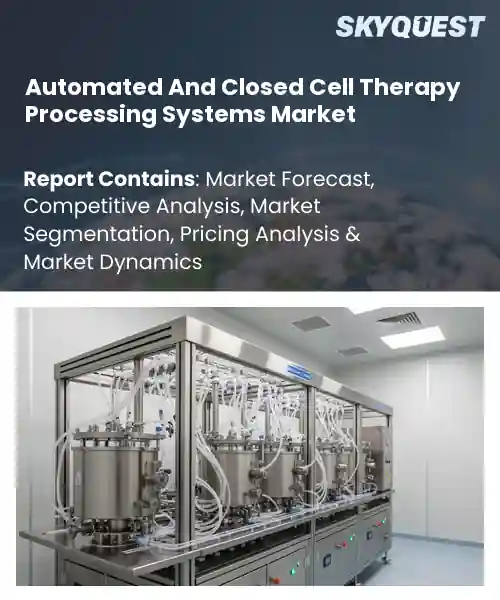
Automated And Closed Cell Therapy Processing Systems Market
Report ID: SQMIG35J2341
Report ID: SQMIG35J2341
[email protected]
USA +1 351-333-4748
Report ID:
SQMIG35J2341 |
Region:
Global |
Published Date: May, 2026
Pages:
157
|Tables:
117
|Figures:
77


Global Automated And Closed Cell Therapy Processing Systems Market size was valued at USD 1.52 Billion in 2024 and is poised to grow from USD 1.75 Billion in 2025 to USD 5.52 Billion by 2033, growing at a CAGR of 15.32% during the forecast period (2026-2033).
Automated and closed cell therapy processing systems market is driven by the need to scale safe cell manufacturing for advanced therapies, CAR T and stem cell treatments. The market encompasses platforms that integrate cell isolation, expansion, washing and formulation within contained environments to minimize contamination and operator variability, which matters because patient safety, batch consistency and time to infusion directly affect clinical outcomes and commercial viability. Over the past decade technologies moved from manual cleanroom operations toward modular automation with examples including point of care autologous systems and centralized allogeneic facilities that adopted closed processing to meet stricter regulatory standards.
Globally, a key trend driving the global automated and closed cell therapy processing systems sector is the expanding clinical pipeline of cell based products, because approvals and late stage trials create demand that drives investment in scalable, standardized platforms. Manufacturer adoption of automation reduces variability and contamination, prompting regulators to accept data from closed workflows and lowering approval uncertainty, which encourages payers to explore reimbursement. Real world examples show commercial CAR T producers scaling with centralized automated suites, while hospitals use point of care closed devices to shorten vein to vein time for autologous therapies and unlock new revenue. This expands capacity, lowers logistics burdens and accelerates patient access.
How is AI Enhancing Operational Efficiency in the Automated and Closed Cell Therapy Processing Systems Market?
To aid in efficient operations through automation, AI enables a closed loop in the processing of cell therapies with the use of process data to allow for actionable control via analytical and timely decision making. Elements of this approach include machine vision for automated analytics, predictive modelling to detect process drift and orchestration software that allows instruments and quality checks to be linked together as part of an integrated workflow. This context is driven by industry pressure for reproducibility and scalable supply. Real world examples of integrated automation and QC workcells show how these capabilities are moving from pilot use into clinical and commercial production.
In April 2026, Cellares announced a commercial supply agreement and supported first patients dosed on its Cell Shuttle automated platform which demonstrates how AI enabled analytics can streamline batch scheduling, reduce manual quality testing and accelerate release decisions to support scale and consistent manufacturing.
Market snapshot - (2026-2033)
Global Market Size
USD 1.52 Billion
Largest Segment
Cell Expansion Systems
Fastest Growth
Cell Expansion Systems
Growth Rate
15.32% CAGR
To get more insights on this market click here to Request a Free Sample Report
Global automated and closed cell therapy processing systems market is segmented by system type, technology, application, end-user and region. Based on system type, the market is segmented into Cell Isolation Systems, Cell Expansion Systems, Cell Washing & Formulation and Cryopreservation Systems. Based on technology, the market is segmented into Automated Platforms and Closed-Loop Systems. Based on application, the market is segmented into CAR-T Cell Manufacturing, NK Cell Therapy and Stem Cell Therapy. Based on end-user, the market is segmented into Cell Therapy Manufacturers, Academic Research Centers and CDMOs. Based on region, the market is segmented into North America, Europe, Asia Pacific, Latin America and Middle East & Africa.
What Role do Cell Isolation Systems Play in Scaling Automated Closed Cell Therapy Processing?
Based on the global automated and closed cell therapy processing systems market growth, cell isolation systems segment dominates because these platforms serve as the critical front end in automated and closed cell therapy processing, delivering high purity starting materials that determine downstream yield and potency. Robust automation of enrichment and selection reduces variability and contamination risk, enabling reproducible inputs for expansion and formulation. By having good integration process with clean workflows and user-friendly software a vendor can create more adoption of their systems and lead to an essential component of an efficient manufacturing process of therapy.
However, cell expansion systems are emerging as the most rapidly expanding area due to demand for scalable, closed format bioreactors and microcarrier approaches that shorten culture times and improve cell yields. Advances in automation, perfusion control, and integrated analytics are intensifying process capabilities, unlocking capacity for broader clinical programs and supporting commercial supply chain maturation.
How are Closed Loop Systems Addressing Process Consistency in Automated Cell Therapy Processing?
Automated platforms segment leads because integrated instrumentation and software provide standardized, repeatable workflows that reduce manual intervention and operator dependent variability across the entire cell therapy processing chain. Manufacturers pursuing operational efficiency are encouraged to adopt automated platforms as their foundational manufacturing system due to the overall compatibility of their interfaces with analytical modules and data repositories, as well as vendor investments in modularity, scaling of throughput, and downstream interoperability. This widespread compatibility and modularity allows for process monitoring and compliance with the required regulations for the manufacture of closed cell therapy products.
However, closed loop systems are witnessing the strongest growth momentum because end to end integration reduces contamination risk and supports continuous processing for complex therapies. Advances in inline sensing, automated control loops, and closed consumable designs are accelerating adoption, enabling manufacturers to shorten development cycles and scale production with predictable quality and lower operational complexity.
To get detailed segments analysis, Request a Free Sample Report
How do Validated Processing Systems Improve Clinical Development in North America?
As per the global automated and closed cell therapy processing systems market share, North America commands a leading role in the industry due to a convergence of advanced clinical infrastructure, concentrated research excellence, and well developed commercialization pathways. Large networks of academic medical centers and specialized contract development organizations create sustained demand for scalable, validated processing platforms. An active ecosystem of instrument manufacturers, software developers, and service providers drives iterative innovation and supports regulatory navigation and quality systems that are critical for clinical translation. Access to experienced manufacturing talent, established supply chain channels, and collaborative public private initiatives further accelerates adoption. Growth is reinforced by workforce training programs, mature funding mechanisms for translational projects, and diverse clinical programs that generate use cases for automation, together enabling rapid integration of closed handling solutions across therapeutic development and delivery.
United States Automated And Closed Cell Therapy Processing Systems Market
Automated and closed cell therapy processing systems market benefits from a dense network of research hospitals, established manufacturing capabilities, and deep clinical trial activity that together drive demand for integrated platforms. Strong collaborations among academic centers, biotech firms, and instrument vendors support rapid technology validation and adoption. Reimbursement policy clarity and specialized service providers further enable translation of automated processing solutions into routine therapeutic workflows across complex care settings nationwide.
Canada Automated And Closed Cell Therapy Processing Systems Market
Automated and closed cell therapy processing systems market reflects a mix of public health system demand and growing private sector innovation focused on cell therapy manufacturing. Provincial centers of excellence work with developers to set up automated workflows and improve the consistency of processes. Through policy frameworks and investments to support translational infrastructure, centers can adopt automated workflows, partnerships between provincial centers and multinational suppliers are developing validated platforms for clinical processing.
Why are Closed Cell Therapy Systems Gaining Greater Adoption Across Europe?
Based on global automated and closed cell therapy processing systems regional forecast, Europe is experiencing rapid expansion in the automated and closed cell therapy processing systems market driven by increasing coordination among national health authorities, strong translational research networks, and a growing base of manufacturing expertise. Collaboration and harmonization across borders create barriers for multicenter clinical studies and increase investments in standardized processing systems. Major contract manufacturing and engineering companies provide market ready solutions to meet local country regulations. The momentum in the market is enhanced through partnerships between academic institutions and industry, with public funds being allocated for the development of infrastructure for the development of cell therapies and establishing a skilled workforce to enable transfer of technology. Collectively, these factors create an environment where automation and closed systems are progressively adopted to improve reproducibility, throughput, and compliance across therapeutic development pathways.
Germany Automated And Closed Cell Therapy Processing Systems Market
Automated and closed cell therapy processing systems market in Germany activity is driven by strong engineering capabilities, concentrated biomanufacturing clusters, and close collaboration between universities and industry. Technical expertise supports development of tailored automation and closed platforms for industrial processes. Research centers and translational programs provide validation venues while specialist suppliers enable platform integration and servicing. This combination positions Germany as a leading regional market for applied cell therapy processing.
United Kingdom Automated And Closed Cell Therapy Processing Systems Market
Automated and closed cell therapy processing systems market in United Kingdom combines a dynamic innovation ecosystem with strong translational pipelines and a supplier community. Clinical trial networks and incubator programs promote prototyping and adoption of automated solutions. Agile regulatory engagement and investment into commercial manufacturing encourage vendors to localize support and validation services. This environment favors rapid commercialization of closed handling platforms across academic and clinical programs and health centers.
France Automated And Closed Cell Therapy Processing Systems Market
Automated and closed cell therapy processing systems market in France is emerging through increased funding for translational research and focused development within clusters. Clinical research infrastructures and hospital cell therapy units provide sites for evaluation of automated workflows. Local manufacturers and engineering teams contribute adaptable solutions that reflect regulatory and clinical preferences. Strengthening the collaborative relationships among academic institutions, medical facilities, and manufacturers of medical supplies fosters local adoption of medical innovations and development of local supply chains.
What Impact do Technology Transfer Agreements Have on Market Growth in Asia Pacific?
As per global automated and closed cell therapy processing systems regional outlook, Asia Pacific is strengthening its position in the automated and closed cell therapy processing systems market through strategic investments in manufacturing infrastructure, growing technical expertise, and active public private collaboration. To achieve enhanced consistency in processes and facilitate local manufacturing in cell therapy, regional excellence hubs and industry partners have begun to put various forms of automated systems into place. Technology transfer agreements and joint ventures with established global manufacturers assist with the rapid introduction of validated production platforms, and domestic engineering firms are working to adapt these platforms to meet local regulatory and/or clinical conditions. The development of a large, well-trained workforce, focused talent development programs, and technological growth and maturity are allowing for the increased deployment of closed handling and automated workflows in concert with various supportive policies.
Japan Automated And Closed Cell Therapy Processing Systems Market
Automated and closed cell therapy processing systems market in Japan activity is supported by precision engineering, strong academic industry collaborations, and established manufacturing expertise. Local system integrators deliver reliable automation tailored to stringent quality requirements. Validation sites at research facilities provide the basis for collaborating globally on complementary capabilities. Process control and operator training are instrumental in helping to ensure that closed handling platforms will be adopted more widely as therapeutic development and manufacturing pathways are implemented nationwide.
South Korea Automated And Closed Cell Therapy Processing Systems Market
Automated and closed cell therapy processing systems market in South Korea leverages a strong electronics and precision manufacturing base, biotech entrepreneurship, and government support for biomanufacturing. Hospital networks and domestic businesses work together to create automated working process pilot cases and closed handling technology to use within clinical workflows. The focus of technological application is to enable compact throughput systems to suite the physical limitations of each individual facility; will need to provide commercialisation routes throughout their respective markets and size, but also provide training programs with global manufacturers and partners.
To know more about the market opportunities by region and country, click here to
Buy The Complete Report
Drivers
Increased Adoption Of Automation
Regulatory Emphasis on Quality
Restraints
High Capital Investment Requirements
Complex Integration With Legacy Workflows
Request Free Customization of this report to help us to meet your business objectives.
The global Automated and Closed Cell Therapy Processing Systems market is highly competitive, with key participants including Lonza, Cytiva, Terumo Blood and Cell Technologies, Fresenius Kabi, Miltenyi Biotec, and Sartorius. Competition centers on automation, closed-system manufacturing, scalability, and regulatory compliance. Companies are pursuing strategic partnerships, platform integration, and product innovation to strengthen market positions. Lonza focuses on expanding its Cocoon® Platform ecosystem, while Cytiva emphasizes automation partnerships and end-to-end manufacturing solutions. Terumo is making strides toward integrated closed systems to improve the efficiency of producing CAR-T cell therapy via cellular therapeutics at a commercial scale.
Top Player’s Company Profile
Recent Developments
SkyQuest’s ABIRAW (Advanced Business Intelligence, Research & Analysis Wing) is our Business Information Services team that Collects, Collates, Correlates, and Analyses the Data collected by means of Primary Exploratory Research backed by robust Secondary Desk research.
As per SkyQuest analysis, the global automated and closed cell therapy processing systems industry is being propelled primarily by the need to scale safe cell manufacturing for advanced therapies while expanding clinical pipelines create demand for standardized platforms; the growing integration of AI to improve operational efficiency and decision making provides an important second driver by enabling predictive control and faster batch release. Adoption is tempered by high capital investment requirements that limit uptake among smaller centers. North America remains the dominating region thanks to its strong clinical and manufacturing ecosystem, and Cell Isolation Systems stand out as the dominating segment because they deliver the high‑quality starting material that underpins downstream consistency and yield.
| Report Metric | Details |
|---|---|
| Market size value in 2024 | USD 1.52 Billion |
| Market size value in 2033 | USD 5.52 Billion |
| Growth Rate | 15.32% |
| Base year | 2024 |
| Forecast period | (2026-2033) |
| Forecast Unit (Value) | USD Billion |
| Segments covered |
|
| Regions covered | North America (US, Canada), Europe (Germany, France, United Kingdom, Italy, Spain, Rest of Europe), Asia Pacific (China, India, Japan, Rest of Asia-Pacific), Latin America (Brazil, Rest of Latin America), Middle East & Africa (South Africa, GCC Countries, Rest of MEA) |
| Companies covered |
|
| Customization scope | Free report customization with purchase. Customization includes:-
|
To get a free trial access to our platform which is a one stop solution for all your data requirements for quicker decision making. This platform allows you to compare markets, competitors who are prominent in the market, and mega trends that are influencing the dynamics in the market. Also, get access to detailed SkyQuest exclusive matrix.
Table Of Content
Executive Summary
Market overview
Parent Market Analysis
Market overview
Market size
KEY MARKET INSIGHTS
COVID IMPACT
MARKET DYNAMICS & OUTLOOK
Market Size by Region
KEY COMPANY PROFILES
Methodology
For the Automated And Closed Cell Therapy Processing Systems Market, our research methodology involved a mixture of primary and secondary data sources. Key steps involved in the research process are listed below:
1. Information Procurement: This stage involved the procurement of Market data or related information via primary and secondary sources. The various secondary sources used included various company websites, annual reports, trade databases, and paid databases such as Hoover's, Bloomberg Business, Factiva, and Avention. Our team did 45 primary interactions Globally which included several stakeholders such as manufacturers, customers, key opinion leaders, etc. Overall, information procurement was one of the most extensive stages in our research process.
2. Information Analysis: This step involved triangulation of data through bottom-up and top-down approaches to estimate and validate the total size and future estimate of the Automated And Closed Cell Therapy Processing Systems Market.
3. Report Formulation: The final step entailed the placement of data points in appropriate Market spaces in an attempt to deduce viable conclusions.
4. Validation & Publishing: Validation is the most important step in the process. Validation & re-validation via an intricately designed process helped us finalize data points to be used for final calculations. The final Market estimates and forecasts were then aligned and sent to our panel of industry experts for validation of data. Once the validation was done the report was sent to our Quality Assurance team to ensure adherence to style guides, consistency & design.
Analyst Support
Customization Options
With the given market data, our dedicated team of analysts can offer you the following customization options are available for the Automated And Closed Cell Therapy Processing Systems Market:
Product Analysis: Product matrix, which offers a detailed comparison of the product portfolio of companies.
Regional Analysis: Further analysis of the Automated And Closed Cell Therapy Processing Systems Market for additional countries.
Competitive Analysis: Detailed analysis and profiling of additional Market players & comparative analysis of competitive products.
Go to Market Strategy: Find the high-growth channels to invest your marketing efforts and increase your customer base.
Innovation Mapping: Identify racial solutions and innovation, connected to deep ecosystems of innovators, start-ups, academics, and strategic partners.
Category Intelligence: Customized intelligence that is relevant to their supply Markets will enable them to make smarter sourcing decisions and improve their category management.
Public Company Transcript Analysis: To improve the investment performance by generating new alpha and making better-informed decisions.
Social Media Listening: To analyze the conversations and trends happening not just around your brand, but around your industry as a whole, and use those insights to make better Marketing decisions.
REQUEST FOR SAMPLE
 REQUEST FREE CUSTOMIZATION
Global Automated And Closed Cell Therapy Processing Systems Market size was valued at USD 1.52 Billion in 2024 and is poised to grow from USD 1.75 Billion in 2025 to USD 5.52 Billion by 2033, growing at a CAGR of 15.32% during the forecast period (2026-2033).
Competitive dynamics center on consolidation and targeted technology partnerships as instrument makers and CDMOs race to automate closed cell therapy workflows to lower per patient cost and scale autologous programs. Recent examples include Thermo Fisher integrating robotic automation with Multiply Labs and major suppliers expanding through acquisitions and platform integrations to secure end to end solutions. 'Miltenyi Biotec (CliniMACS)', 'Cytiva (Danaher) - Sepax', 'Thermo Fisher Scientific', 'Terumo BCT', 'Fresenius Kabi', 'BioSpherix Ltd.', 'Wilson Wolf Manufacturing', 'Ori Biotech', 'Octane Biotech (Cytiva)', 'Multiply Labs', 'MaxCyte Inc.', 'Lonza Group (Cocoon Platform)', 'ThermoGenesis Holdings', 'Global Blood Therapeutics', 'Cellero (Novatek)', 'Charles River Laboratories', 'PCT (Hitachi)', 'BioAtla', 'Cellipont Bioservices', 'AMPIO Pharmaceuticals'
Automation adoption streamlines complex cell processing workflows by reducing manual interventions and variability, which enhances reproducibility and product consistency across batches. This reliability attracts clinical and commercial stakeholders seeking predictable manufacturing outcomes and supports scale-up efforts without proportionate increases in skilled labor. By lowering the operational burden associated with delicate cell handling, automated systems facilitate broader integration into manufacturing pipelines and clinical facilities, thereby encouraging investment and procurement decisions that collectively expand market demand for automated and closed cell therapy processing solutions.
Standardization Driving Scalability: Industry wide standards for protocols, interfaces, and quality metrics are accelerating adoption by reducing workflow variability and enabling interoperable modules across platforms. Vendors and clinical stakeholders are aligning on common data formats and validation frameworks, streamlining technology transfer and supporting scalable manufacturing. This harmonization fosters supplier ecosystems, lowers operational friction, and facilitates regulatory dialogue focused on consistent outcomes rather than device specific idiosyncrasies. As processes become more repeatable, providers can expand capacity and replicate successful therapies with confidence and predictability.
Why does North America Dominate the Global Automated And Closed Cell Therapy Processing Systems Market? |@12


Want to customize this report? This report can be personalized according to your needs. Our analysts and industry experts will work directly with you to understand your requirements and provide you with customized data in a short amount of time. We offer $1000 worth of FREE customization at the time of purchase.
Feedback From Our Clients


 USA (+1) 351-333-4748

