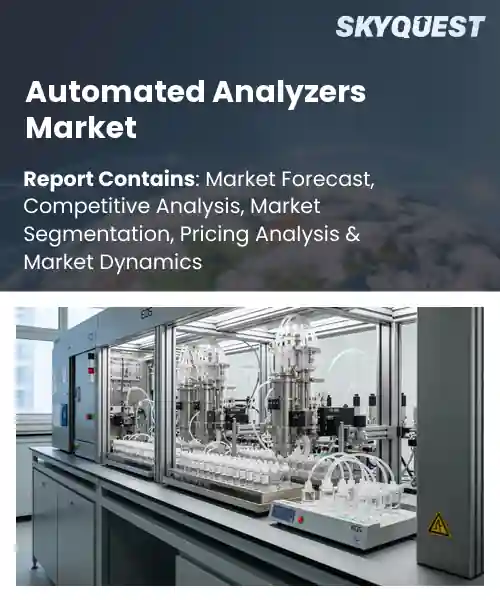
Automated Analyzers Market
Report ID: SQMIG35A3898
Report ID: SQMIG35A3898
[email protected]
USA +1 351-333-4748
Report ID:
SQMIG35A3898 |
Region:
Global |
Published Date: June, 2026
Pages:
157
|Tables:
183
|Figures:
79


Global Automated Analyzers Market size was valued at USD 11.5 Billion in 2024 and is poised to grow from USD 12.42 Billion in 2025 to USD 22.99 Billion by 2033, growing at a CAGR of 8.0% during the forecast period (2026-2033).
Growing demand for high-throughput laboratory testing, increasing adoption of laboratory automation, rising need for accurate diagnostic results, advancements in analytical technologies, and expanding integration of digital laboratory systems are driving sales of automated analyzers.
Surge in demand for faster and more reliable testing across healthcare, pharmaceutical, environmental, and food safety applications is expected to primarily drive automated analyzers market growth. The increasing need to increase laboratory productivity, minimize hands-on errors, and improve operational capacity is driving innovation in automated analyzer systems. Advances in robotics, container and sample handling technologies, connectivity and lab information systems are further driving improvements in workflow productivity and turn-around times. Automated analyzer platforms linked through to digital information management systems and population-level tracking and monitoring frameworks are facilitating improved operational efficiency and decision-making. Investment in diagnostic infrastructure and quality control measures is also anticipated to open up new market opportunities.
On the contrary, high acquisition and maintenance costs, complexity of system integration, shortage of skilled laboratory personnel, and challenges related to data standardization and interoperability are anticipated to slow down automated analyzers market penetration across the study period and beyond.
How is AI Enhancing Throughput And Accuracy of Automated Analyzer Equipment?
Artificial intelligence (AI) is transforming the automated analyzers sector by dramatically improving sample throughput, accuracy, and efficiency. It merges sophisticated data analysis with machine learning to improve and automate laboratory operations on a large scale. Core functionalities offered by AI are automate result validation, intelligent interpretation of signals and predictive maintenance. AI can almost instantly identify normal results and automate repots validation for routine samples. Laboratory personnel are thus free to investigate anomalies or edge cases as they see fit. Machine learning techniques improve the interpretation of polymorphic signal patterns in complex assays, giving laboratory staff a better insight into assay results. Visualization software tracks trends in malfunctions and alerts users of equipment issues before they disrupt lab operations, resulting in better productivity and smoother analyzer operation. Automated analyzers' vendors are actively implementing artificial intelligence technologies into their hematology, flow cytometry, and other analyzer platforms.
Market snapshot - (2026-2033)
Global Market Size
USD 11.5 Billion
Largest Segment
Clinical Chemistry Analyzers
Fastest Growth
Molecular Diagnostics Analyzers
Growth Rate
8.0% CAGR
To get more insights on this market click here to Request a Free Sample Report
Global automated analyzers market is segmented by analyzer type, application, technology, sample type, platform, end-user, and region. Based on analyzer type, the market is segmented into clinical chemistry analyzers, immunoassay analyzers, hematology analyzers, coagulation analyzers, molecular diagnostics analyzers, biochemical analyzers, and others. Based on application, the market is segmented into clinical diagnostics, drug discovery & development, environmental testing, food & beverage testing, and others. Based on technology, the market is segmented into clinical chemistry, immunoassay, electrochemistry, molecular diagnostics, and point-of-care technologies. Based on sample type, the market is segmented into blood, urine, saliva, tissue, and others. Based on platform, the market is segmented into benchtop analyzers, floor-standing systems, and portable. Based on end-user, the market is segmented into hospitals, diagnostic laboratories, research institutes, clinics, and others. Based on region, the market is segmented into North America, Europe, Asia Pacific, Latin America, and Middle East & Africa.
The immunoassay analyzers segment is projected to account for the highest global automated analyzers market share going forward. It covers a wide range of diagnostic applications for which heightened sensitivity and specificity are important factors, stimulating their widespread use in hospitals and laboratories. The established use of extensive reagent systems, the automation of complex assay procedures and the ability to operate under a high volume throughput is likely to be popular. Competitive manufacturers value the platform's reliability and gain approval to strengthen IDAs as standard automated tools for monitoring chronic disease and treatment therapies.
However, clinical chemistry analyzers are emerging as the fastest growing segment as routine testing becomes more streamlined with automatic processing, reducing cost per test, and improving daily operation efficiency provides a growth market. Improvements in higher levels of automation of reagents, stability of reagents, and connectivity to LIS will lead to continued growth in this area. This will lead to more applications in local laboratory environments and within the hospital outpatient testing settings.
The molecular diagnostics segment is expected to lead the global automated analyzers market revenue generation across the study period. It allows high accuracy of nucleic acid target detection necessary for infectious disease control and oncology profiling, thus driving continued investment. Fully integrated multi-step processes from extraction through amplification and detection in closed system designs yields reduced hands on time and minimizes cross contaminations draws laboratories towards integrated molecular platform adoption. Regulatory approval sales point and robust reagent partnerships establish this system as a cornerstone for precision medicine.
On the other hand, point of care technologies are the fastest expanding subsegment as per this automated analyzers industry analysis, prompted by the need for fast decentralized testing and bedside clinical support. Miniaturization, connectivity to laboratory networks and single-use assay kits are reducing barriers to adoption and stimulating the development of smaller automated analyzers which open up new service concepts and access to market.
To get detailed segments analysis, Request a Free Sample Report
Advanced healthcare infrastructure, concentrated research and development capabilities, strong presence of leading instrument manufacturers, and well-established laboratory networks are helping cement the dominance of this region. Regulatory frameworks and reimbursement policies promote increased use of automated processes. Collaborations between the public and private sectors also help to speed up new platform development and validation. Another benefit of North America is that it possesses strong service and distribution networks to facilitate installation and maintenance, thus reducing barriers to entry for laboratories. Because the market is mature, laboratories are encouraged to continue upgrading their current systems and integrating them into laboratory information systems, creating a virtuous demand cycle. Additionally, the presence of skilled laboratory personnel, along with early adopters of new technologies further solidifies North America as the largest market for automated analysis systems. Additionally, the investment into digital connectivity and commitment to maintaining quality management systems will continue building on this leadership position going forward.
Sales of automated analyzers in the United States are characterized by early adoption of cutting-edge platforms, extensive clinical laboratory networks, and a concentration of major manufacturers and service providers. Demand focuses on workflow efficiency, high volume testing, and integration with the electronic laboratory system. Several collaborative projects among hospitals, diagnostics companies, and research institutes help to validate and commercialize new analyzers, contributing to a highly competitive and innovation-oriented environment.
Automated analyzer demand in Canada reflects a strong emphasis on interoperability, laboratory quality assurance, and regional laboratory networks that adopt automation to improve efficiency. Procurement operates on a cost and term service partnership basis. Public health laboratories and hospital systems work with suppliers to authenticate platforms for testing requirements; distributors and service operators maintain and optimize the deployment, servicing and training, which in turn ensure continued analyzer use in many clinical environments.
Strong demand for standardized, high-quality diagnostic services across diverse healthcare systems, increasing emphasis on laboratory consolidation and efficiency, and a supportive regulatory environment help create an opportune setting in the region. Investment in central laboratories and networked diagnostic hubs facilitates adoption of high-throughput and modular analyzer platforms that can be customized according to regional demands. Manufacturer, clinical lab, and governmental health agency collaboration accelerates the rollout of interoperable systems and quality assurance programs. Increased focus on data integration, harmonized testing protocols, and cross-border service models will continue to strengthen market dynamics, while targeted innovation from established vendors and emerging specialty suppliers will continue adding to the range of automated analyzer alternatives. Reimbursement structures and clinical guidelines that support investments in automated systems are integral in recognizing the value of automation in improving turnaround and standardization across the region.
Automated Analyzers Market in Germany is anchored by a strong industrial base of diagnostic manufacturers, well-structured laboratory networks, and a rigorous regulatory and accreditation framework that prioritizes quality and reliability. Demand for durable, scalable analyzer platforms results from, among other things, the benchmark placed on technical performance and long term service support. Development of innovative automated solutions and enhancement of existing technologies benefit from partnerships between research institutions, industry, and clinical facilities seeking solutions to unique or complex diagnostic workflows.
Automated analyzers market in United Kingdom shows dynamic adoption driven by centralized procurement initiatives, investment in integrated laboratory networks, and a strong emphasis on innovation adoption from established vendors and niche suppliers. Clinical laboratories require an adaptable and scalable platform that allows a broad test menu and meets established quality controls. Collaboration between academia, technology developers and service organization fast-tracks validation and implementation of new automated platforms into hospitals and laboratories.
Automated analyzer sales in France are emerging through modernization of laboratory infrastructure, growing interest in automation to enhance standardization, and targeted adoption in regional hospital systems and diagnostic centers. Procurement tends to follow how the interoperability and local service networks of the products are ahead with the technical performances. The cooperation between the manufacturers and the worldwide leading firms enables laboratory specific solution in French hospitals, and the quality-systems and accreditation systems creation provide a synergetic context for the automatic analyzers adoption.
Expanding domestic manufacturing capabilities, targeted investments in laboratory infrastructure, and growing collaboration between regional manufacturers and global technology providers supports sales of automated analyzers in the region. Market players show flexibility by adapting their instrument designs to meet local workflows, and models of service delivery, ultimately improving their affordability and suitability for use in a variety of clinical settings. The increased use of automated systems is supported by regulatory and accreditation advancements in key regions, and the development of data management solutions enhances efficiency in the laboratory. The increase in demand for centralized diagnostic services and the focus on quality are driving partnerships and localized innovation, all of which elevate the role of the region in the global Automated Analyzer market. Support from public-private partnerships, the increased complexity of clinical testing, and the growing number of private laboratories are driving adoption and creating a sustainable ecosystem for service and training across the Asia Pacific region.
Automated analyzers market in Japan benefits from a focus on precision engineering, strict instrument performance standards, and close collaboration between device manufacturers and clinical laboratories. Hospital and diagnostic centers emphasize reliability, LIS integration and solid service agreement. Particulars of package platform are centered on various local dealerships customizing the facilities, quality & expectation of the workflow. Research and commercial institutes enable validation and further innovations while demanding the need for fully automated analyzer systems in all zones.
Automated analyzer demand in South Korea is marked by rapid integration of advanced instrumentation, strong local manufacturing capabilities, and a competitive supplier landscape that emphasizes compact, efficient platforms suited to diverse laboratory environments. Healthcare providers and laboratories focus on interoperability with information systems and reliable service partnerships. Collaboration between technology firms, clinical laboratories, and academic research centers supports validation, customization, and wider adoption of automated analyzers across public testing networks.
To know more about the market opportunities by region and country, click here to
Buy The Complete Report
Technological Advancements and Integration
Growing Demand For Rapid Diagnostics
High Initial Capital Requirements
Regulatory Complexity and Reimbursement
Request Free Customization of this report to help us to meet your business objectives.
Competitive dynamics in the global automated analyzers market center on faster time-to-result and lab workflow integration, driving incumbents to pursue acquisitions, partnerships and product innovation. For example Beckman Coulter's parent Danaher acquired AI capabilities to strengthen decision support, Roche forged AI partnerships for digital pathology and Thermo Fisher introduced benchtop automated AST systems to address mid-size labs.
SkyQuest’s ABIRAW (Advanced Business Intelligence, Research & Analysis Wing) is our Business Information Services team that Collects, Collates, Correlates, and Analyses the Data collected by means of Primary Exploratory Research backed by robust Secondary Desk research.
As per SkyQuest analysis, high demand for high-throughput laboratory testing, increasing adoption of laboratory automation, and rising need for accurate diagnostic results are anticipated to drive the demand for automated analyzers going forward. However, high acquisition and maintenance costs and complexity of system integration are slated to slow down the adoption of automated analyzers in the future. North America is slated to spearhead the demand for automated analyzers owing to its advanced healthcare infrastructure, strong presence of diagnostic laboratories, and high adoption of laboratory automation technologies. AI-powered data analysis tools and the integration of automated analyzers with digital laboratory management platforms are anticipated to be key trends driving the automated analyzers sector through 2033.
| Report Metric | Details |
|---|---|
| Market size value in 2024 | USD 11.5 Billion |
| Market size value in 2033 | USD 22.99 Billion |
| Growth Rate | 8.0% |
| Base year | 2024 |
| Forecast period | (2026-2033) |
| Forecast Unit (Value) | USD Billion |
| Segments covered |
|
| Regions covered | North America (US, Canada), Europe (Germany, France, United Kingdom, Italy, Spain, Rest of Europe), Asia Pacific (China, India, Japan, Rest of Asia-Pacific), Latin America (Brazil, Rest of Latin America), Middle East & Africa (South Africa, GCC Countries, Rest of MEA) |
| Companies covered |
|
| Customization scope | Free report customization with purchase. Customization includes:-
|
To get a free trial access to our platform which is a one stop solution for all your data requirements for quicker decision making. This platform allows you to compare markets, competitors who are prominent in the market, and mega trends that are influencing the dynamics in the market. Also, get access to detailed SkyQuest exclusive matrix.
Table Of Content
Executive Summary
Market overview
Parent Market Analysis
Market overview
Market size
KEY MARKET INSIGHTS
COVID IMPACT
MARKET DYNAMICS & OUTLOOK
Market Size by Region
KEY COMPANY PROFILES
Methodology
For the Automated Analyzers Market, our research methodology involved a mixture of primary and secondary data sources. Key steps involved in the research process are listed below:
1. Information Procurement: This stage involved the procurement of Market data or related information via primary and secondary sources. The various secondary sources used included various company websites, annual reports, trade databases, and paid databases such as Hoover's, Bloomberg Business, Factiva, and Avention. Our team did 45 primary interactions Globally which included several stakeholders such as manufacturers, customers, key opinion leaders, etc. Overall, information procurement was one of the most extensive stages in our research process.
2. Information Analysis: This step involved triangulation of data through bottom-up and top-down approaches to estimate and validate the total size and future estimate of the Automated Analyzers Market.
3. Report Formulation: The final step entailed the placement of data points in appropriate Market spaces in an attempt to deduce viable conclusions.
4. Validation & Publishing: Validation is the most important step in the process. Validation & re-validation via an intricately designed process helped us finalize data points to be used for final calculations. The final Market estimates and forecasts were then aligned and sent to our panel of industry experts for validation of data. Once the validation was done the report was sent to our Quality Assurance team to ensure adherence to style guides, consistency & design.
Analyst Support
Customization Options
With the given market data, our dedicated team of analysts can offer you the following customization options are available for the Automated Analyzers Market:
Product Analysis: Product matrix, which offers a detailed comparison of the product portfolio of companies.
Regional Analysis: Further analysis of the Automated Analyzers Market for additional countries.
Competitive Analysis: Detailed analysis and profiling of additional Market players & comparative analysis of competitive products.
Go to Market Strategy: Find the high-growth channels to invest your marketing efforts and increase your customer base.
Innovation Mapping: Identify racial solutions and innovation, connected to deep ecosystems of innovators, start-ups, academics, and strategic partners.
Category Intelligence: Customized intelligence that is relevant to their supply Markets will enable them to make smarter sourcing decisions and improve their category management.
Public Company Transcript Analysis: To improve the investment performance by generating new alpha and making better-informed decisions.
Social Media Listening: To analyze the conversations and trends happening not just around your brand, but around your industry as a whole, and use those insights to make better Marketing decisions.
REQUEST FOR SAMPLE
 REQUEST FREE CUSTOMIZATION
Global Automated Analyzers Market size was valued at USD 11.5 Billion in 2024 and is poised to grow from USD 12.42 Billion in 2025 to USD 22.99 Billion by 2033, growing at a CAGR of 8.0% during the forecast period (2026-2033).
Competitive dynamics in the global automated analyzers market center on faster time-to-result and lab workflow integration, driving incumbents to pursue acquisitions, partnerships and product innovation. For example Beckman Coulter's parent Danaher acquired AI capabilities to strengthen decision support, Roche forged AI partnerships for digital pathology and Thermo Fisher introduced benchtop automated AST systems to address mid-size labs. 'Abbott Laboratories', 'Roche Diagnostics', 'Siemens Healthineers', 'Thermo Fisher Scientific', 'Danaher Corporation (Beckman Coulter)', 'Sysmex Corporation', 'Mindray Medical International', 'Horiba Ltd.', 'Agilent Technologies', 'Becton, Dickinson and Company (BD)', 'Bio-Rad Laboratories', 'PerkinElmer Inc.', 'Tecan Group Ltd.', 'Hudson Robotics Inc.', 'Ortho Clinical Diagnostics', 'Randox Laboratories', 'Analytik Jena AG', 'ELITechGroup', 'Awareness Technology Inc.', 'Nova Biomedical'
The continuous innovation in assay technologies, automation platforms, and software interoperability enhances analyzer reliability, throughput, and accuracy, enabling laboratories to expand test menus and streamline workflows. Integration with laboratory information systems and middleware simplifies data management and reduces manual steps, improving operational efficiency and decision support. These qualitative improvements lower per-test labor needs and support faster clinician reporting, making automated analyzers more attractive to hospitals, reference labs, and diagnostic service providers seeking consistent results and improved patient management across diverse testing environments.
Ai Enabled Workflow Optimization: Integration of machine learning and advanced analytics into automated analyzers is accelerating smarter workflow orchestration, predictive maintenance, and adaptive testing protocols. Systems increasingly synthesize multiple data sources to recommend assay panels, flag anomalous results for review, and streamline reagent allocation. This trend enhances consistency across sites, reduces manual intervention, and supports remote monitoring and decision support for laboratory personnel. Vendors prioritize interoperability and native analytics to deliver continuous performance improvement and enable laboratories to scale operations while preserving quality.
Why does North America Dominate the Global Automated Analyzers Market? |@12


Want to customize this report? This report can be personalized according to your needs. Our analysts and industry experts will work directly with you to understand your requirements and provide you with customized data in a short amount of time. We offer $1000 worth of FREE customization at the time of purchase.
Feedback From Our Clients


 USA (+1) 351-333-4748

