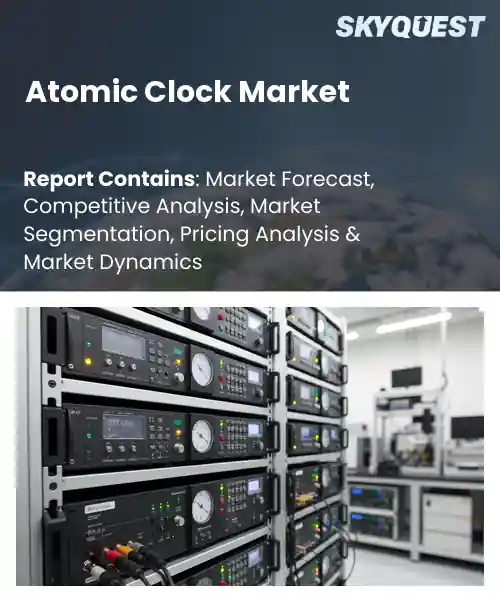
Atomic Clock Market
Report ID: SQMIG45J2559
Report ID: SQMIG45J2559
[email protected]
USA +1 351-333-4748
Report ID:
SQMIG45J2559 |
Region:
Global |
Published Date: June, 2026
Pages:
157
|Tables:
121
|Figures:
77


Global Atomic Clock Market size was valued at USD 2.33 Billion in 2024 and is poised to grow from USD 2.43 Billion in 2025 to USD 3.38 Billion by 2033, growing at a CAGR of 4.23% during the forecast period (2026-2033).
The global atomic clock market is concentrating on highly accurate timekeeping devices that are critical for navigation, telecommunications and scientific research. It’s important for the need for nanosecond accuracy in synchronizing satellite constellations, financial transactions and particle-physics experiments. The field evolved from laboratory cesium standards in the 1950s, to chip-scale rubidium standards in the 1990s, and really took off in the 2010s with the development of optical lattice clocks with 10-18 fractional uncertainties. These technological milestones have revolutionized atomic clocks from specialized metrology instruments into commercially feasible components, leading manufacturers to diversify product lines and expand supply chains globally. As a result, competition increases, leading to lower prices and a substantial rise in innovation.
The global deployment of GNSS constellations requiring the timing accuracy beyond the capacity of traditional quartz oscillators is the major growth driver of the atomic clock market. With satellite operators moving to satellite links and autonomous navigation, the need for on-board atomic references is increasing and aerospace companies are incorporating small rubidium or new optical clocks into their payloads. This integration decreases latency for position calculation, which improves the safety of autonomous vehicles, and allows trading platforms to synchronize trades in microseconds. Meanwhile, atomic timing is being adopted by data center operators to reduce packet loss, which is driving demand for turnkey clock as a service offerings and expanding the addressable base for the market.
How is AI improving precision and reliability in the atomic clock market?
AI helps atomic clocks by automatically analyzing signals and correcting for environmental disturbances in real time. Machine learning models learn drift patterns and predict the optimal operating points, which reduces the need for human intervention and downtime. Neural networks wrestle with quantum noise, refining the frequency reference and increasing the useful life of the hardware. Integrated AI platforms also streamline calibration routines, enabling remote updates and continuous performance monitoring across worldwide networks. The intersection of advanced algorithms and precise hardware is improving confidence in timing services and opening new possibilities for satellite navigation, telecommunications and scientific research, thereby accelerating market momentum.
In March 2024, the launch of an AI based calibration platform for optical clocks showed faster tuning cycles and improved long‑term stability, directly supporting the market’s demand for more reliable and scalable timing solutions.
Market snapshot - (2026-2033)
Global Market Size
USD 2.33 Billion
Largest Segment
Cesium Atomic Clocks
Fastest Growth
Optical Lattice Atomic Clocks
Growth Rate
4.23% CAGR
To get more insights on this market click here to Request a Free Sample Report
Global atomic clock market is segmented by clock technology type, system platform layout, core functional application, end user category and region. Based on clock technology type, the market is segmented into Rubidium Atomic Clocks, Cesium Atomic Clocks, Hydrogen Maser Atomic Clocks, Optical Lattice Atomic Clocks and Chip-Scale Atomic Clocks. Based on system platform layout, the market is segmented into Space-Based Systems, Ground-Based Reference Stations and Portable and Embedded Infrastructure. Based on core functional application, the market is segmented into Navigation Positioning, Telecommunications Network Synchronization, Defense and Electronic Warfare, Financial Trading and Data Centers and Scientific Metrology Research. Based on end user category, the market is segmented into Government and Defense Agencies, Telecommunication Operators and National Research Laboratories. Based on region, the market is segmented into North America, Europe, Asia Pacific, Latin America and Middle East & Africa.
Rubidium Atomic Clock segments are dominant, due to their demonstrated performance, reliability and cost that satisfy the majority of commercial and government timing requirements. A mature manufacturing base and extensive field heritage ensure confidence for long term deployments. Their output stability meets the needs of both navigation and telecommunications. These features make them widely used among the reference stations and network backbones, ensuring their position as the leaders in the atomic clock market.
However, Chip Scale Atomic Clocks are experiencing the highest growth momentum, with miniaturization and low power consumption allowing integration into mobile devices, autonomous systems and IoT infrastructure. The new emerging form factor creates new timing solutions, expands market reach, and spurs manufacturers to accelerate development, which then fuels future market growth.
Ground Based Reference Stations segment leads as they are the primary timing backbone of national networks, providing continuous, high precision synchronization to vast geographic areas. The fixed infrastructure has strong environmental controls and is easy to maintain, which means that performance and reliability are optimal. This makes them essential for critical services and is leading to continued investment in the market. Their integration with satellite timing constellations adds an additional layer of redundancy and allows seamless cross system validation to reinforce their central role in the ecosystem.
Demand for field deployable timing solutions in autonomous platforms, tactical units and edge computing nodes is rising and Portable and Embedded Infrastructure is emerging as the key high growth area. Their relatively small form factor and rapid deployment create new market niches, leading to accelerated development and a larger overall market opportunity.
To get detailed segments analysis, Request a Free Sample Report
North America remains at the forefront, with a mature research ecosystem, substantial defense spending and a robust telecommunications infrastructure requiring ultra-precise timing. For major aerospace and satellite operators, domestic expertise is crucial for mission-critical synchronization, and leading universities and national laboratories continue to advance quantum standards and optical clock technologies. Demand is being driven by a regulatory environment that is driving uptake in industries such as finance, energy and navigation. Moreover, a mature high-tech component supply chain and strong intellectual property rights protection provide a fast track to commercialization of new atomic clock technologies, further cementing the region’s dominance. Collaborative frameworks between government agencies, industry consortia and academic partners accelerate prototype testing, and allow early deployment in critical infrastructure. Moreover, the involvement of the main standardisation bodies guarantees the interoperability and increases the confidence of the final users, supporting the market leadership.
The US atomic clock market is helped by a cluster of federal research labs and defense contractors that push for the most sophisticated timekeeping solutions. Strong partnerships between universities and private firms that commercialize breakthroughs in optical lattice technology. A constant flow of deployments of advanced atomic clocks, driven by domestic demand from space exploration programs, high-frequency trading platforms and emerging quantum networks, further strengthens the country’s leadership role. These capabilities are in aerospace, telecommunications and scientific research.
Canada's atomic clock market has the advantage of a solid foundation of government funding and a thriving ecosystem of time-frequency metrology research institutes. Accelerate deployment of small fiber-based atomic clocks with national standards bodies and telecom operators to synchronize the nation’s broadband and power grids. The home innovation environment is also increasingly reflected in sustainable technology and the emergence of niche applications in autonomous transport, further diversifying the market landscape.
Europe’s atomic clock market is booming, in part thanks to collaborative research initiatives, substantial investment from the public and private sector and a common standards approach that allows technology to cross borders. Breakthroughs in optical and microwave clock technologies courtesy of top universities and specialized metrology institutes in the region are witnessing active integration of these solutions by aerospace, rail signaling and financial services sectors to meet stringent synchronization requirements. The EU’s emphasis on digital sovereignty and secure communications creates incentives to rely on domestic timing infrastructure, rather than external sources. The collaboration platforms, involving telecom operators, chip manufacturers and defence agencies, speed up prototype validation and scale-up, creating a dynamic ecosystem that promotes growth throughout the continent. These dynamics also contribute to the development of capabilities for precision manufacturing, providing a reliable supply chain for high-performance components across member states.
The German Atomic Clock Market is driven by a system of top-tier research universities and the national metrology institute, which are leading the innovation of optical lattice clocks. High-value applications for manufacturing control and intelligent transport systems are born from strong collaboration with automotive and industrial automation manufacturers providing precision timing. The government incentives for advanced manufacturing and the emphasis on export-oriented technology further boost Germany’s position as a top European supplier of atomic clock solutions.
The UK’s atomic clock market is being driven by its vibrant fintech clusters and a burgeoning quantum research industry focused on ultra-precise timing for trading platforms and secure communications. Strong collaborations between universities, government labs and start-ups in the pipeline speed up the commercialisation of portable atomic clocks for telecom networks and autonomous vehicle testing. The focus on regulatory data integrity and strategic investment in digital infrastructure creates fertile ground for faster market uptake.
The France Atomic Clock market is nascent, driven by concerted efforts to embed precision timing into renewable energy grids and aerospace initiatives. The national metrology institute is teaming up with leading telecom operators to deploy fiber-based atomic clock solutions for national network synchronization. Start-ups are focusing on niche applications, such as precision agriculture and maritime navigation, in a bid to help position France as an emerging player in the European timing ecosystem, helped by incentives to develop high-tech clusters.
The Asia Pacific region is playing catch‑up in the atomic clock market through aggressive investment in research and rapid expansion of high‑tech manufacturing capabilities. Major economies are developing next-generation optical clocks for satellite navigation, 5G/6G networks and future quantum communication infrastructure through strategic government programs. Close cooperation of electronics manufacturers and academic laboratories expedites the conversion of prototypes into mass production, reducing costs, increasing reliability. The need for precision timing is on the rise across the region for applications such as autonomous transport, smart cities and financial trading, driving the uptake of compact, low-power atomic clock modules and making the Asia Pacific region a key hub for both innovation and supply chain resilience. On top of this, cooperative standards bodies are harmonizing protocols among adjacent countries that can then be stitched together to provide timing solutions across the wider Asia Pacific network.
Japan Atomic Clock market has a rich tradition of precision engineering and strong government backed initiatives in time keeping research. Leading electronics companies and national research institutes are collaborating to speed up the development of chip-scale atomic clocks for satellite communication and high-frequency trading platforms. This focus on reliability and miniaturization supports deployment of the technology in autonomous vehicle systems and smart grid synchronization, further reinforcing Japan’s position as a leader of advanced timing technologies.
South Korea is pushing its atomic clock market forward with conscious national policies that integrate atomic timing into its telecom infrastructure and defense systems. A consortium of leading chip manufacturers and research universities is working together to create robust and low-power atomic clock modules for 5G/6G base stations and autonomous drone navigation. Incentives for advanced technology are provided by the South Korean government and the start-up ecosystem is vibrant which further accelerates the commercialization of the technology and makes South Korea a key player in the precision timing landscape.
To know more about the market opportunities by region and country, click here to
Buy The Complete Report
Rising Need For Navigation Accuracy
Expansion Of Telecom Synchronization
High Cost Of Atomic Devices
Complexity In System Integration
Request Free Customization of this report to help us to meet your business objectives.
The global atomic clock market is competitive with the presence of established players and new entrants in the technology space trying to innovate and develop precision timing solutions at a faster pace. The rising demand from telecommunications, navigation and quantum computing industries further intensifies the competition forcing companies to ramp up product development and establish strategic partnerships with research institutions in order to stay ahead in the market.
SkyQuest’s ABIRAW (Advanced Business Intelligence, Research & Analysis Wing) is our Business Information Services team that Collects, Collates, Correlates, and Analyses the Data collected by means of Primary Exploratory Research backed by robust Secondary Desk research.
As per SkyQuest analysis, the global atomic clock market is being propelled primarily by the rising need for navigation accuracy across aviation, maritime and autonomous‑vehicle sectors, while a second important driver is the expanding demand for ultra‑precise timing in 5G/6G telecom networks. The market is led by North America, where mature research ecosystems and strong defense spending sustain demand, and Rubidium atomic clocks remain the dominant technology segment because of their proven balance of performance and cost. However, the high cost of atomic devices limits broader adoption, especially among smaller players and emerging economies, tempering overall growth despite the strong drivers.
| Report Metric | Details |
|---|---|
| Market size value in 2024 | USD 2.33 Billion |
| Market size value in 2033 | USD 3.38 Billion |
| Growth Rate | 4.23% |
| Base year | 2024 |
| Forecast period | (2026-2033) |
| Forecast Unit (Value) | USD Billion |
| Segments covered |
|
| Regions covered | North America (US, Canada), Europe (Germany, France, United Kingdom, Italy, Spain, Rest of Europe), Asia Pacific (China, India, Japan, Rest of Asia-Pacific), Latin America (Brazil, Rest of Latin America), Middle East & Africa (South Africa, GCC Countries, Rest of MEA) |
| Companies covered |
|
| Customization scope | Free report customization with purchase. Customization includes:-
|
To get a free trial access to our platform which is a one stop solution for all your data requirements for quicker decision making. This platform allows you to compare markets, competitors who are prominent in the market, and mega trends that are influencing the dynamics in the market. Also, get access to detailed SkyQuest exclusive matrix.
Table Of Content
Executive Summary
Market overview
Parent Market Analysis
Market overview
Market size
KEY MARKET INSIGHTS
COVID IMPACT
MARKET DYNAMICS & OUTLOOK
Market Size by Region
KEY COMPANY PROFILES
Methodology
For the Atomic Clock Market, our research methodology involved a mixture of primary and secondary data sources. Key steps involved in the research process are listed below:
1. Information Procurement: This stage involved the procurement of Market data or related information via primary and secondary sources. The various secondary sources used included various company websites, annual reports, trade databases, and paid databases such as Hoover's, Bloomberg Business, Factiva, and Avention. Our team did 45 primary interactions Globally which included several stakeholders such as manufacturers, customers, key opinion leaders, etc. Overall, information procurement was one of the most extensive stages in our research process.
2. Information Analysis: This step involved triangulation of data through bottom-up and top-down approaches to estimate and validate the total size and future estimate of the Atomic Clock Market.
3. Report Formulation: The final step entailed the placement of data points in appropriate Market spaces in an attempt to deduce viable conclusions.
4. Validation & Publishing: Validation is the most important step in the process. Validation & re-validation via an intricately designed process helped us finalize data points to be used for final calculations. The final Market estimates and forecasts were then aligned and sent to our panel of industry experts for validation of data. Once the validation was done the report was sent to our Quality Assurance team to ensure adherence to style guides, consistency & design.
Analyst Support
Customization Options
With the given market data, our dedicated team of analysts can offer you the following customization options are available for the Atomic Clock Market:
Product Analysis: Product matrix, which offers a detailed comparison of the product portfolio of companies.
Regional Analysis: Further analysis of the Atomic Clock Market for additional countries.
Competitive Analysis: Detailed analysis and profiling of additional Market players & comparative analysis of competitive products.
Go to Market Strategy: Find the high-growth channels to invest your marketing efforts and increase your customer base.
Innovation Mapping: Identify racial solutions and innovation, connected to deep ecosystems of innovators, start-ups, academics, and strategic partners.
Category Intelligence: Customized intelligence that is relevant to their supply Markets will enable them to make smarter sourcing decisions and improve their category management.
Public Company Transcript Analysis: To improve the investment performance by generating new alpha and making better-informed decisions.
Social Media Listening: To analyze the conversations and trends happening not just around your brand, but around your industry as a whole, and use those insights to make better Marketing decisions.
REQUEST FOR SAMPLE
 REQUEST FREE CUSTOMIZATION
Global Atomic Clock Market size was valued at USD 2.33 Billion in 2024 and is poised to grow from USD 2.43 Billion in 2025 to USD 3.38 Billion by 2033, growing at a CAGR of 4.23% during the forecast period (2026-2033).
The global atomic clock market is shaped by intense competition among established manufacturers and emerging technology firms, driving rapid innovation in precision timing solutions. Growing demand from telecommunications, navigation and quantum computing sectors intensifies rivalry, prompting firms to accelerate product development and secure strategic partnerships with research institutions to maintain market leadership. 'Microchip Technology Inc.', 'Orolia', 'Spectratime', 'Excelitas Technologies Corp.', 'Teledyne Technologies Incorporated', 'Leonardo S.p.A.', 'Safran S.A.', 'Frequency Electronics Inc.', 'AccuBeat Ltd.', 'T4Science', 'Casic', 'Oscilloquartz S.A.', 'Vremya CH JSC', 'Stanford Research Systems Inc.', 'Kernco Instruments Co. Inc.', 'Rakon Limited', 'Tokyo Denpa Co. Ltd.', 'FEI-Zyfer Inc.', 'Zurich Instruments AG', 'Phasor Lab'
Rising need for navigation accuracy across aviation, maritime, and autonomous vehicle sectors drives investment in atomic clock technology. Precise timing enhances route planning, safety protocols, and compliance with regulatory standards. As stakeholders prioritize reliable positioning, they increasingly adopt high‑precision timekeeping solutions that mitigate signal drift and improve system resilience. This demand fuels development of compact, low‑power atomic clocks, encouraging manufacturers to expand product portfolios and accelerate market entry, thereby reinforcing overall growth dynamics within the global atomic clock market. Consequently, strategic partnerships form to streamline supply chains and support broader adoption.
Quantum Timing Integration Expansion: Manufacturers of telecommunications infrastructure and high‑frequency trading platforms are increasingly embedding atomic clock technology directly into system chassis to eliminate reliance on external timing sources. This shift toward on‑board quantum timing enables seamless synchronization across distributed networks, reduces latency, and enhances resilience against signal disruptions. As component miniaturization advances, vendors can offer plug‑and‑play atomic modules that integrate with standard power and data interfaces, accelerating adoption in edge computing, 5G base stations, and autonomous vehicle control units for critical timing solutions.
Why does North America Dominate the Global Atomic Clock Market? |@12


Want to customize this report? This report can be personalized according to your needs. Our analysts and industry experts will work directly with you to understand your requirements and provide you with customized data in a short amount of time. We offer $1000 worth of FREE customization at the time of purchase.
Feedback From Our Clients


 USA (+1) 351-333-4748

