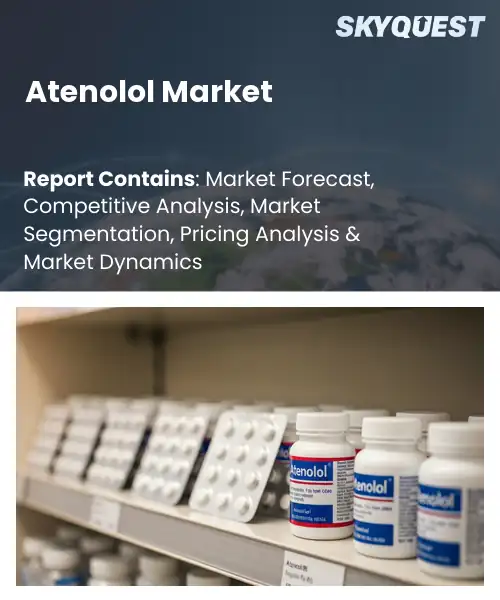
Atenolol Market
Report ID: SQMIG35I3007
Report ID: SQMIG35I3007
[email protected]
USA +1 351-333-4748
Report ID:
SQMIG35I3007 |
Region:
Global |
Published Date: June, 2026
Pages:
157
|Tables:
141
|Figures:
78


Global Atenolol Market size was valued at USD 1.52 Billion in 2024 and is poised to grow from USD 1.59 Billion in 2025 to USD 2.22 Billion by 2033, growing at a CAGR of 4.3% during the forecast period (2026-2033).
Atenolol industry is a medication for improving health by treatment of high blood pressure and chest pain (also known as angina). Manufacturers, distributors, and health care professionals make up the global atenolol marketplace; as a result, mining companies have extensive global reach in the healthcare sector as a result of this expansive marketplace. Due to the overall increasing number of people with heart disease, there is a growing demand for affordable and dependable treatments for high blood pressure. The atenolol marketplace saw explosive growth in the 1990s due to the fact that the US and other developed nations began seeing large numbers of generic anti-hypertensive medications entering their markets. Emerging economies, such as Brazil and India, benefited from the availability of lower-cost generic medications resulting in increased accessibility.
In addition, a larger proportion of people with chronic illnesses are now living in Europe and North America as people age and are living longer, which results in greater emphasis on long-term chronic disease management. As a result, there has been a continued increase in prescriptions of atenolol and its' continuing importance as a first-line therapy in the treatment of acute and chronic diseases. One of the most significant drivers of the atenolol market trends continues to be the adoption of fixed-dose combination therapy, which combines beta-blockers such as atenolol with diuretics and calcium channel blockers. Health professionals looking to reduce the pill burden for their patients are encouraging the use of fixed-dose combination therapy, resulting in the increase of stock availability from pharmacy retailers.
As a result of this rapid increase in market size for atenolol and other anti-hypertensive medications, manufacturers are investing in product reformulations or submitting for new regulatory approval to expand their overall market share of atenolol; for example, manufacturers are currently introducing tablets combining atenolol and hydrochlorothiazide to pharmacies throughout the US and China. The combined growth of product offerings for atenolol and other anti-hypertensive medications will create many new opportunities for contract manufacturers to get into the growing market for atenolol while also driving down the retail price of atenolol will also drive increased overall consumption of this class of drugs.
How is AI-driven Analytics Reshaping the Global Atenolol Market?
Analytics powered by artificial intelligence (AI), is changing the atenolol market growth from a traditional product-based environment to one based on data. Through machine learning, various data such as prescriptions, electronic health records, and manufacturing logs will be put into an algorithm that can predict demand changes before those changes show up on actual sales reports. By being able to provide this information to producers, they can reduce the amount of excess inventory they have and also shorten their lead times by aligning their batch sizes to actual demand.
Moreover, AI solutions are being used to track price movements throughout North America and Europe in order for the manufacturer to set competitive pricing while protecting their margins. These two areas of improvement will help manufacturers identify opportunity gaps in patient adherence by linking supply trends to patient adherence data, enabling manufacturers to create targeted outreach programs to patients to fill those gaps. Overall, this will allow the market to be far more cost effective and responsive to clinical and commercial signals in addition to being far more agile.
Rising Pharmaceuticals announced in February 2018, that they have developed an AI driven demand forecasting system for its Atenolol tablets which will enable them to improve their production planning and decrease their waste, thus allowing them to respond to market needs faster. The system uses real-time sales data along with historical regional prescribtion practices to help Rising Pharmaceuticals estimate appropriate inventory adjustments to meet service demands for pharmacies within key markets in near real-time.
Market snapshot - (2026-2033)
Global Market Size
USD 1.52 Billion
Largest Segment
Oral Tablets
Fastest Growth
Injectable
Growth Rate
4.31% CAGR
To get more insights on this market click here to Request a Free Sample Report
Global atenolol market is segmented by formulation, indication, distribution, end-user, product type and region. Based on formulation, the market is segmented into oral tablets and injectable. Based on indication, the market is segmented into hypertension, angina pectoris and cardiac arrhythmia. Based on distribution, the market is segmented into retail pharmacies, hospital pharmacies and online. Based on end-user, the market is segmented into adults and elderly. Based on product type, the market is segmented into branded (Tenormin) and generic. Based on region, the market is segmented into North America, Europe, Asia Pacific, Latin America and Middle East & Africa.
Segment of oral tablets is a dominant player in the market due to patient preference for easy access to medication at home for treating chronic high blood pressure; thus, patients have less need to visit a doctor, leading to greater adherence. The availability of tablet press technology provides manufacturers with established production methods, low costs of production, and extensive insurance reimbursement, resulting in improved penetration into the atenolol marketplace and reinforcing their leadership position within the sector and providing consistent supply chains to support healthcare providers and patient trust.
On the other hand, the injectables segment is currently experiencing the highest rate of growth because of increased use of rapid-acting formulations to manage angina pectoris and stabilize arrhythmia in acute cardiac environments. As a result, innovations in sterile manufacturing coupled with increased reimbursement for in-hospital administration are contributing to the adoption of these products and establishing injectables as a key driver of future growth opportunities for atenolol.
Currently, the retail pharmacies segment dominates the market because it is the most likely place for adults with chronic hypertension to obtain immediate access to both branded and generic forms of atenolol market outlook. The pharmacy's large geographic footprint, and pharmacy-based counseling services help build patients' confidence in their medications and therefore support patient adherence to therapy. Additionally, insurance formularies usually prioritize retail pharmacies as the primary dispensing channel which promotes high-volume sales, further solidifying retail pharmacies as a major contributor to the overall market dynamics and allow for continuous refill cycles to support revenue streams; this dynamic will remain constant.
The online segment is a fast-growing sector as it eliminates barriers to consistent use of therapy for elderly patients that are technologically savvy and allows for much easier process of ordering from digital pharmacies. Integration with telehealth platforms, and use of automated reminders improve adherence rates, while changing e-prescription regulations will create an opportunity for additional growth in this segment and position online channels as a key driver for future expansion of the atenolol market forecast.
To get detailed segments analysis, Request a Free Sample Report
North America's level of atenolol use is determined by many factors, including large, well-developed health systems and widely available options for generic manufacturers to produce the drug at low cost. In North America, physicians typically have been prescribing beta-blockers as part of established, well-accepted clinical patterns for a long time and therefore feel comfortable with the therapeutic use of beta-blockers. As a consequence of this extensive use of beta-blockers, there are relatively few barriers to prescribing for primary care or specialty care providers and as a result, all of their patients have access to beta-blockers, both in urban and rural communities. The regulatory environment surrounding the approval of Atenolol has encouraged quick and easy launch of products; good patient insurance coverage; and minimize the out-of-pocket costs associated with this drug by both patients and their providers. These advantages work together to create high volume usage of Atenolol in North America and solidify the North American market as the world's leading market for atenolol. North America also has a network of ongoing clinical research ventures to support continued evaluation of therapy outcomes using Atenolol and this information will give the prescriber an increased degree of confidence in the decision to utilize Atenolol as part of their patients' treatment regimen. Lastly, manufacturers and pharmacy benefits management companies are working together to facilitate the most cost-effective distribution of Atenolol to their patients which will continue to strengthen the position of Atenolol as a first line therapy across the cardiovascular care continuum.
Atenolol market regional outlook in United States demonstrates extensive integration within both hospital formularies and retail pharmacy channels, reflecting deep clinician confidence. The supply chain benefits from large‑scale domestic production that aligns with stringent quality standards, ensuring reliable availability. Reimbursement mechanisms across public and private plans prioritize cost‑effectiveness, reinforcing preference for generic options. Ongoing professional education programs sustain high prescribing familiarity, while patient awareness initiatives support adherence and long‑term utilization across population segments.
Atenolol market regional forecast in Canada is characterized by widespread inclusion in provincial drug formularies, enabling equitable patient access nationwide. Domestic manufacturing capabilities complement import channels, delivering product quality and supply resilience. Health authority guidelines emphasize evidence‑based prescribing, reinforcing clinician reliance on atenolol for appropriate cardiovascular indications. Collaborative frameworks between payors and providers focus on value, ensuring that cost considerations align with clinical efficacy, thereby supporting sustained utilization within the Canadian healthcare ecosystem.
Europe’s atenolol market continues to expand due to a combination of governmental cost-containment policies, harmonized regulatory pathways and strong clinical support for beta-blockers across multiple cardiovascular care protocols. There are unified prescribing guidelines promoting the use of beta-blockers as a therapeutic option, ultimately resulting in consistent demand from a diverse range of providers. The region also benefits from well-established generic drugs manufacturing hubs that produce high-quality generics at competitive prices, consistent with payer requirements for value-based therapies. Cross-border communication and collaboration between health authorities expedite the time to market and ensure the consistent acceptance of products across Europe. The upward trend in the aging population results in a higher prevalence of hypertension and related medical conditions increasing the demand for clinical product solutions. Routine professional development activities keep atenolol at the forefront of prescribers’ minds, allowing for continued expansion on both economic and clinical rationales. In addition, there are collaborative research efforts among the member nation’s prescribers generating real-time evidence supporting the safety of atenolol as a model for continuing to build clinician and regulatory confidence.
Atenolol market penetration in Germany reflects deep integration within national treatment guidelines, positioning the drug as a cornerstone of hypertension management. Domestic generic producers capitalize on rigorous quality standards, ensuring reliable supply to both hospital and outpatient settings. Reimbursement schemes prioritize cost‑effective options, reinforcing clinician preference for atenolol. Ongoing clinical education reinforces its therapeutic profile, while patient support programs promote adherence, collectively sustaining a robust market presence across the German healthcare system.
Atenolol market analysis in United Kingdom is experiencing accelerated uptake driven by national health service endorsement of evidence‑based antihypertensive regimens. The market benefits from a supply chain that links established UK manufacturers with international generic suppliers, guaranteeing uninterrupted availability. Value‑oriented procurement policies underscore the drug’s cost‑effectiveness, while targeted prescriber outreach emphasizes its role in heart rate control. Patient education initiatives further reinforce acceptance, enabling rapid market expansion within the British clinical environment.
Atenolol industry in France is in an emerging phase, supported by recent inclusion of beta‑blockers in national therapeutic protocols for hypertension and angina. Local generic manufacturers are scaling production capacities to meet growing demand, while import channels supplement supply gaps. Health insurance frameworks increasingly recognize the economic advantage of generic atenolol, encouraging prescription. Educational outreach to primary‑care physicians highlights evidence of efficacy, fostering gradual market development within the French healthcare landscape.
A mixture of developing healthcare infrastructure, a growing generic drug manufacturing ecosystem, and a greater understanding of how to manage cardiovascular disease in the Asia Pacific is establishing the region's significance in the atenolol market. National health programs throughout the Asia Pacific region are focusing on making antihypertensive therapies more affordable, making atenolol a first-line drug option in many treatment algorithms. New investments in state-of-the-art manufacturing facilities within the region are resulting in higher quality production standards for both domestic and global competitors; in turn, giving domestic manufacturers/companies the ability to compete for market share while providing stable supply of atenolol to meet the growing domestic demand. Due to increased collaborative regulatory harmonization between the key economies of Asia Pacific, the market access process has been streamlined, leading to increased acceptance of generic alternatives. Additionally, through targeted healthcare provider education and outreach campaigns, patients' and healthcare providers' confidence in the therapeutic benefits of atenolol is being enhanced, leading to consistent prescribing patterns by physicians. Lastly, through the implementation of digital health initiatives for remote blood pressure monitoring, the integration of atenolol therapy into patient-centered care is being improved.
Atenolol industry outlook in Japan benefits from an established pharmaceutical landscape that emphasizes stringent quality controls and strong physician familiarity with beta‑blocker therapy. Domestic producers align with national pricing policies that favor cost‑effective generics, ensuring broad formulary inclusion. The healthcare system’s emphasis on preventive cardiology elevates atenolol’s role in early hypertension intervention. Medical education reinforces its therapeutic value, while assistance schemes improve adherence, together sustaining overall market presence across Japanese clinical settings.
Atenolol industry trends in South Korea is experiencing growth supported by health insurance coverage that prioritizes affordable antihypertensive options. Local generic manufacturers leverage manufacturing technologies to meet quality expectations, ensuring reliable supply chains. Clinical guidelines endorse atenolol as a first‑line agent for cohorts, reinforcing physician confidence. Professional development programs and patient awareness campaigns promote use, while pharmacy networks facilitate access, reinforcing the drug’s expanding role within the South Korean cardiovascular treatment paradigm.
To know more about the market opportunities by region and country, click here to
Buy The Complete Report
Rising Prevalence of Cardiovascular Disorders
Expansion of Generic Pharmaceutical Networks
Stringent Regulatory Compliance Requirements
Emerging Competition from Novel Cardiovascular Agents
Request Free Customization of this report to help us to meet your business objectives.
The global atenolol market is characterized by intense competition among generic pharmaceutical manufacturers that compete primarily on pricing, regulatory approvals, manufacturing scale, and geographic expansion. Leading companies continue to strengthen their cardiovascular portfolios through abbreviated new drug application (ANDA) approvals, capacity expansions, and broader distribution networks. Competitive differentiation increasingly depends on supply-chain reliability, cost-efficient manufacturing, and the ability to secure regulatory approvals across major markets. Emerging pharmaceutical companies and contract development and manufacturing organizations (CDMOs) are also contributing to market competition by developing improved oral solid-dose manufacturing capabilities and expanding access to affordable cardiovascular medicines in developing economies.
Top Player’s Company Profile
Recent Developments in the Atenolol Market
SkyQuest’s ABIRAW (Advanced Business Intelligence, Research & Analysis Wing) is our Business Information Services team that Collects, Collates, Correlates, and Analyses the Data collected by means of Primary Exploratory Research backed by robust Secondary Desk research. As per SkyQuest analysis, the global atenolol market is projected to grow at a 4.3 % CAGR through 2033, driven primarily by the rising prevalence of cardiovascular disorders which fuels prescription demand, while the expansion of generic pharmaceutical networks further broadens access and cost‑effectiveness. The market’s dominant region is North America, where mature reimbursement systems and extensive generic manufacturing sustain high volumes, and the oral tablets formulation remains the leading segment because of patient convenience and low production costs. However, stringent regulatory compliance requirements pose a notable restraint, slowing the launch of new formulations and adding cost pressure for manufacturers globally in the industry.
| Report Metric | Details |
|---|---|
| Market size value in 2024 | USD 1.52 Billion |
| Market size value in 2033 | USD 2.22 Billion |
| Growth Rate | 4.31% |
| Base year | 2024 |
| Forecast period | (2026-2033) |
| Forecast Unit (Value) | USD Billion |
| Segments covered |
|
| Regions covered | North America (US, Canada), Europe (Germany, France, United Kingdom, Italy, Spain, Rest of Europe), Asia Pacific (China, India, Japan, Rest of Asia-Pacific), Latin America (Brazil, Rest of Latin America), Middle East & Africa (South Africa, GCC Countries, Rest of MEA) |
| Companies covered |
|
| Customization scope | Free report customization with purchase. Customization includes:-
|
To get a free trial access to our platform which is a one stop solution for all your data requirements for quicker decision making. This platform allows you to compare markets, competitors who are prominent in the market, and mega trends that are influencing the dynamics in the market. Also, get access to detailed SkyQuest exclusive matrix.
Table Of Content
Executive Summary
Market overview
Parent Market Analysis
Market overview
Market size
KEY MARKET INSIGHTS
COVID IMPACT
MARKET DYNAMICS & OUTLOOK
Market Size by Region
KEY COMPANY PROFILES
Methodology
For the Atenolol Market, our research methodology involved a mixture of primary and secondary data sources. Key steps involved in the research process are listed below:
1. Information Procurement: This stage involved the procurement of Market data or related information via primary and secondary sources. The various secondary sources used included various company websites, annual reports, trade databases, and paid databases such as Hoover's, Bloomberg Business, Factiva, and Avention. Our team did 45 primary interactions Globally which included several stakeholders such as manufacturers, customers, key opinion leaders, etc. Overall, information procurement was one of the most extensive stages in our research process.
2. Information Analysis: This step involved triangulation of data through bottom-up and top-down approaches to estimate and validate the total size and future estimate of the Atenolol Market.
3. Report Formulation: The final step entailed the placement of data points in appropriate Market spaces in an attempt to deduce viable conclusions.
4. Validation & Publishing: Validation is the most important step in the process. Validation & re-validation via an intricately designed process helped us finalize data points to be used for final calculations. The final Market estimates and forecasts were then aligned and sent to our panel of industry experts for validation of data. Once the validation was done the report was sent to our Quality Assurance team to ensure adherence to style guides, consistency & design.
Analyst Support
Customization Options
With the given market data, our dedicated team of analysts can offer you the following customization options are available for the Atenolol Market:
Product Analysis: Product matrix, which offers a detailed comparison of the product portfolio of companies.
Regional Analysis: Further analysis of the Atenolol Market for additional countries.
Competitive Analysis: Detailed analysis and profiling of additional Market players & comparative analysis of competitive products.
Go to Market Strategy: Find the high-growth channels to invest your marketing efforts and increase your customer base.
Innovation Mapping: Identify racial solutions and innovation, connected to deep ecosystems of innovators, start-ups, academics, and strategic partners.
Category Intelligence: Customized intelligence that is relevant to their supply Markets will enable them to make smarter sourcing decisions and improve their category management.
Public Company Transcript Analysis: To improve the investment performance by generating new alpha and making better-informed decisions.
Social Media Listening: To analyze the conversations and trends happening not just around your brand, but around your industry as a whole, and use those insights to make better Marketing decisions.
REQUEST FOR SAMPLE
 REQUEST FREE CUSTOMIZATION
Global Atenolol Market size was valued at USD 1.52 Billion in 2024 and is poised to grow from USD 1.59 Billion in 2025 to USD 2.22 Billion by 2033, growing at a CAGR of 4.31% during the forecast period (2026-2033).
The competitive landscape is shaped by large generic manufacturers accelerating portfolio consolidation, such as Teva’s 2023 acquisition of Amneal’s cardiovascular generic assets and Viatris’ 2022 partnership with a drug‑delivery biotech to enhance atenolol bioavailability. Sun Pharma’s rollout of continuous‑manufacturing technology for atenolol tablets and Lupin’s 2024 launch of a fixed‑dose combination with hydrochlorothiazide illustrate tech‑driven differentiation, while pricing pressure intensifies as new low‑cost entrants expand into emerging markets. 'Pfizer Inc. (Tenormin - historical)', 'AstraZeneca', 'Teva Pharmaceutical', 'Mylan (Viatris)', 'Sun Pharmaceutical', 'Dr. Reddy's Laboratories', 'Cipla Ltd.', 'Sandoz (Novartis)', 'Aurobindo Pharma', 'Lupin Limited', 'Hikma Pharmaceuticals', 'Amneal Pharmaceuticals', 'Apotex Inc.', 'Glenmark Pharmaceuticals', 'Macleods Pharmaceuticals', 'Alkem Laboratories', 'Torrent Pharmaceuticals', 'Zydus Cadila', 'IPCA Laboratories', 'Strides Pharma Science'
The increasing incidence of hypertension, angina and myocardial infarction globally creates sustained demand for aten atenolol as clinicians seek effective beta‑blocker therapy to manage heart rate and blood pressure, thereby driving market expansion through heightened prescription rates and broader therapeutic adoption across primary and secondary care settings. These conditions are often associated with aging populations and lifestyle changes that further amplify the therapeutic need, encouraging pharmaceutical companies to invest in product availability and patient education initiatives, which collectively reinforce the upward trajectory of market demand.
Increased Generic Prescription: The market is seeing a steady shift toward generic atenolol as healthcare payers prioritize cost containment, prompting physicians to favor lower‑priced formulations. This transition is reinforced by expanded insurance coverage for generics and heightened awareness of therapeutic equivalence among clinicians. As a result, sales volumes for brand‑name products are declining while generic manufacturers scale production, driving broader accessibility and reinforcing the drug’s role in standard hypertension management protocols across diverse patient demographics worldwide and emerging markets globally.
Why does North America Dominate the Global Atenolol Market? |@12


Want to customize this report? This report can be personalized according to your needs. Our analysts and industry experts will work directly with you to understand your requirements and provide you with customized data in a short amount of time. We offer $1000 worth of FREE customization at the time of purchase.
Feedback From Our Clients


 USA (+1) 351-333-4748

