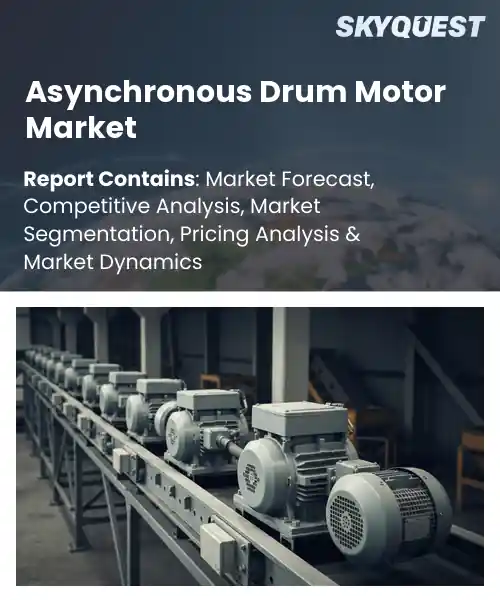
Asynchronous Drum Motor Market
Report ID: SQMIG20I3579
Report ID: SQMIG20I3579
[email protected]
USA +1 351-333-4748
Report ID:
SQMIG20I3579 |
Region:
Global |
Published Date: August, 2026
Pages:
157
|Tables:
122
|Figures:
77


Global Asynchronous Drum Motor Market size was valued at USD 1.28 Billion in 2024 and is poised to grow from USD 1.37 Billion in 2025 to USD 2.3 Billion by 2033, growing at a CAGR of 6.7% during the forecast period (2026-2033).
The asynchronous drum motor market is about compact integrated drive units where the motor plus the drum sit together inside one housing, so there’s no need for outside gearboxes. And, the whole reason this matters is that people want space saving, low-upkeep setups for material handling equipment, like conveyor belts, textile looms, and packaging lines.
One big factor pushes the asynchronous drum motor market growth is the growing need for energy efficient automation across automotive assembly, logistics, and other industrial sectors. When plants try to cut power use, the built in efficiency of asynchronous designs does the job by lowering operating costs, so equipment makers start putting drum motors into robotic cells and even battery assembly lines. This also opens a door for suppliers to build modular units with diagnostics, and that helps maintenance teams plan better, reduces downtime, and makes the system more stable. For example, one major warehouse operator said it saw a 15 % jump in throughput after it retrofitted its sorting conveyors with drum motors. That result, it shows efficiency gains turn into real productivity gains.
AI-driven automation is reshaping the asynchronous drum motor market outlook by putting smarter control logic right inside the motor drives. Some manufacturers are adding machine learning models that try to anticipate load changes and then tweak torque in real time, so wear drops and energy usage stays better. Right now, there are traditional motor players teaming up with software firms to deliver cloud based monitoring platforms. You’ll find things like adaptive speed regulation on conveyor systems, and self tuning of motor parameters in packaging equipment. Overall, these features make installations feel more dependable and they shorten maintenance cycles, so adoption increases across logistics and manufacturing. Plus, the bigger visibility into data helps operators run the equipment with more operational clarity and efficiency.
Market snapshot - (2026-2033)
Global Market Size
USD 1.28 Billion
Largest Segment
Three-Phase Asynchronous Drum Motors
Fastest Growth
Single-Phase Asynchronous Drum Motors
Growth Rate
6.7% CAGR
To get more insights on this market click here to Request a Free Sample Report
The global asynchronous drum motor market is segmented by motor type, power rating, application, end user and region. Based on motor type, the market is segmented into Single-Phase Asynchronous Drum Motors and Three-Phase Asynchronous Drum Motors. Based on power rating, the market is segmented into Up to 1 kW, 1–5 kW and Above 5 kW. Based on application, the market is segmented into Conveyor Systems, Material Handling, Packaging Machinery, Food Processing, Logistics & Warehousing and Others. Based on end user, the market is segmented into Manufacturing, Food & Beverage, Logistics & Transportation, Mining, Retail & E-commerce and Others. Based on region, the market is segmented into North America, Europe, Asia Pacific, Latin America and Middle East & Africa.
As per the asynchronous drum motor market analysis, three phase asynchronous drum motors dominate the picture because they deliver better efficiency and torque density, basically meeting the tough performance requirements of modern industrial drives. Their sturdy build plus the ability to run at variable speeds makes them the go-to choice for heavy load tasks, and that tends to boost supplier confidence, which then helps OEM integration go smoother. That dependable behavior keeps adoption steady across different machines, and it cements their lead in the market, while also pushing ongoing advances in motor control technologies.
Meanwhile, the Single Phase Asynchronous Drum Motors segment is becoming the fastest growing part of the market, mainly as compact gear and low power solutions gain more traction in smaller automation setups. The design stays simpler, so installation costs go down, maintenance is easier, and that draws in additional players , plus it supports retrofits. As a result the market’s overall reach broadens faster, and new growth opportunities show up more often.
According to the asynchronous drum motor market forecast, the logistics and warehousing application space leads because the boom in automated storage and retrieval systems needs dependable, high speed drum drives. In continuous handling of pallets and containers, the motors must survive long run cycles with very little downtime. Because of that , system integrators often prioritize these drives first, not just as an option but as a baseline. The strong push for efficiency and space optimization keeps suppliers focused, so these motors get embedded as core components inside modern distribution setups across global supply chains.
On the other hand, the Food Processing application segment is seeing the strongest growth momentum, largely because hygiene-minded equipment is increasingly using drum motors for controlled material movement. More automated packaging lines, along with stricter safety requirements, are pulling demand toward motors that support clean operation and are easier to wipe down. This is expanding the market opportunities fairly quickly and in a noticeable way.
To get detailed segments analysis, Request a Free Sample Report
As per the asynchronous drum motor market regional forecast, Asia-Pacific gets a bit of a boost from this mature manufacturing setup, like it mixes high‑tech engineering and still keeps production cost‑effective and practical. There’s this real heavy focus on energy‑efficient appliances, and that pushes demand for advanced motor solutions. At the same time, all those R&D networks keep things moving, so motor design and control ideas don’t stop, they keep evolving. Supply chains are solid, labor is skilled, so scaling production happens fast, and supportive rules also help, making it easier for companies to adopt environmentally friendly technologies. In the end, it’s this almost “everything helps everything” situation, and that’s why Asia Pacific is basically positioned as the leading hub for asynchronous drum motor development, and deployment too.
Japan Asynchronous Drum Motor Market
The Asynchronous Drum Motor sector in Japan is powered by this long‑standing tradition of precision engineering, plus a consumer base that likes high performance, and also reliability (for the most part). Local appliance makers tend to prioritize fitting these compact, low‑noise motor designs into their products, and research institutions are involved too. They do collaborative work and push material science, alongside control algorithms. The market also stays reinforced by steady demand for energy‑saving laundry solutions, in both residential and commercial environments, and that keeps product refinement going, while also encouraging premium positioning.
South Korea Asynchronous Drum Motor Market
The Asynchronous Drum Motor industry in South Korea thrives on a blend of technological know‑how, and an aggressive adoption of smart home ideas. Manufacturers in the area push miniaturization, and they try to squeeze out enhanced efficiency, which matches national initiatives around sustainable appliance standards. Industry links closely with academic research, so new motor topologies are introduced quicker than expected. Meanwhile, consumer preference for sleek, high‑efficiency devices stays strong, so demand remains steady across urban households and even hospitality venues.
Europe’s asynchronous drum motor market penetration is mostly driven by strict energy‑efficiency regulations plus a clear consumer inclination toward sustainable home appliances. Big manufacturers pour resources into advanced motor technologies, aiming to cut power use and reduce noise, and they do it in a way that matches environmental directives that shape product design. Across the continent, innovation clusters help spread best practices, and that supports faster uptake. Also, a mature distribution network helps products land quickly in the market. So the combination of policy support, consumer awareness, and engineering excellence, ends up creating this fertile setting for rapid growth of asynchronous drum motors across the region.
Germany Asynchronous Drum Motor Market
The Asynchronous Drum Motor Market in Germany is known for high‑quality engineering and tough requirements around energy performance. Domestic appliance producers integrate sophisticated motor control systems, and those systems improve durability, while also cutting operational costs. There’s strong teamwork between industrial firms and technical universities, and that teamwork drives ongoing improvement in motor efficiency. Plus, the market has a well‑established supply chain, which supports large‑scale manufacturing and export activities without too much friction.
United Kingdom Asynchronous Drum Motor Market
The Asynchronous Drum Motor Market in the United Kingdom is seeing fast growth, driven by lively consumer demand for smart, low‑energy laundry solutions. Manufacturers lean into compact designs and connectivity features, and they match the growing smart‑home ecosystem. Collaboration shows up between industry groups and research institutions too, and it helps accelerate the development of new motor technologies. On top of that, regulatory incentives encourage adoption of appliances that hit high efficiency benchmarks, both in residential areas and commercial spaces.
France Asynchronous Drum Motor Market
The Asynchronous Drum Motor Market in France is starting to form more of a niche around eco‑friendly appliance solutions. French manufacturers focus on motor designs that keep things quiet, but also reduce power consumption, and that targets environmentally minded buyers. Partnerships with research centers help advance motor materials and control approaches. Meanwhile, government programs backing energy‑saving technologies stimulate uptake in both new builds and renovation projects, so growth is steadily getting momentum.
North America keeps pushing its role, through two things, including steady, high consumer demand for top tier washing machines and also real investment into motor technology innovation. Big manufacturers tend to lean on a lot of hands on engineering know how, to craft motors that give better torque, and efficiency too, while still matching what buyers want lately—more smart connectivity , and smaller physical sizes. There are also these collaborative networks, suppliers plus research groups, and OEMs working close together, which speeds up the product development timing, and then a solid distribution setup helps products show up almost everywhere, in both residential and commercial use, so the region stays competitive.
United States Asynchronous Drum Motor Market
In the United States, the Asynchronous Drum Motor market is mainly fueled by a large customer base that cares about performance, dependability, and how well the units fit into smart home ecosystems. Appliance brands focus on delivering motors with strong torque and quiet operation, which matches what both premium buyers and mainstream shoppers expect. Continuous teamwork with technology partners improves motor control features, while a mature supply chain allows quicker scaling, and keeps product iterations moving through many different selling routes.
Canada Asynchronous Drum Motor Market
In Canada, the Asynchronous Drum Motor market share grows as households and industry place more attention on energy efficiency and sustainability. Manufacturers aim for motor layouts that cut electricity use, but still keep strong operation even with different weather and seasonal swings. Partnerships with research institutions help bring improvements in motor materials and control methods, and various government incentives for high efficiency appliances make adoption easier across residential, as well as commercial segments.
To know more about the market opportunities by region and country, click here to
Buy The Complete Report
Growth Of Smart Manufacturing
Rising Demand For Energy Efficiency
High Initial Capital Expenditure
Limited Availability Of Skilled Technicians
Request Free Customization of this report to help us to meet your business objectives.
The asynchronous drum motor market is moderately fragmented, with the competition usually pushed by things like motor efficiency, torque, a compact footprint, reliability, sealing, customization, and this more application specific performance. The big names often mentioned are Interroll Group, Rulmeca Group, Van der Graaf, JJ Loughran, ID MOTEUR, Nuova Omec, SIREM, Rollex Förderelemente, and Jiangyin Gegewu New Material Technology. Most companies try to set themselves apart using energy saving motors, hygienic and well sealed structures, heavy duty construction, compatibility with variable speed control, and tight conveyor integration, plus real application engineering support. Interroll and Rulmeca seem to hold solid positions in automated material handling, food processing and logistics, while the smaller regional makers usually fight back via customization, pricing tweaks and slightly shorter lead times.
Top Player’s Company Profile
Recent Developments in the Asynchronous Drum Motor Market
SkyQuest’s ABIRAW (Advanced Business Intelligence, Research & Analysis Wing) is our Business Information Services team that Collects, Collates, Correlates, and Analyses the Data collected by means of Primary Exploratory Research backed by robust Secondary Desk research.
As per SkyQuest analysis, the asynchronous drum motor market is mainly being carried by smart manufacturing, because that’s where these compact drive units get used for tighter control and relatively lower upkeep. Then there’s a second push from the growing need for energy‑saving automation, it trims operating costs and still lines up with sustainability aims. The hardest part is the high upfront capital expenditure, which puts off many SMEs, even if the longer term returns look good. Asia Pacific leads overall, supported by its heavy manufacturing base and constant innovation. And three‑phase asynchronous drum motors dominate what customers can actually find, since they tend to deliver better efficiency and higher torque density. Taken together these factors basically steer the market’s trajectory.
| Report Metric | Details |
|---|---|
| Market size value in 2024 | USD 1.28 Billion |
| Market size value in 2033 | USD 2.3 Billion |
| Growth Rate | 6.7% |
| Base year | 2024 |
| Forecast period | (2026-2033) |
| Forecast Unit (Value) | USD Billion |
| Segments covered |
|
| Regions covered | North America (US, Canada), Europe (Germany, France, United Kingdom, Italy, Spain, Rest of Europe), Asia Pacific (China, India, Japan, Rest of Asia-Pacific), Latin America (Brazil, Rest of Latin America), Middle East & Africa (South Africa, GCC Countries, Rest of MEA) |
| Companies covered |
|
| Customization scope | Free report customization with purchase. Customization includes:-
|
To get a free trial access to our platform which is a one stop solution for all your data requirements for quicker decision making. This platform allows you to compare markets, competitors who are prominent in the market, and mega trends that are influencing the dynamics in the market. Also, get access to detailed SkyQuest exclusive matrix.
Table Of Content
Executive Summary
Market overview
Parent Market Analysis
Market overview
Market size
KEY MARKET INSIGHTS
COVID IMPACT
MARKET DYNAMICS & OUTLOOK
Market Size by Region
KEY COMPANY PROFILES
Methodology
For the Asynchronous Drum Motor Market, our research methodology involved a mixture of primary and secondary data sources. Key steps involved in the research process are listed below:
1. Information Procurement: This stage involved the procurement of Market data or related information via primary and secondary sources. The various secondary sources used included various company websites, annual reports, trade databases, and paid databases such as Hoover's, Bloomberg Business, Factiva, and Avention. Our team did 45 primary interactions Globally which included several stakeholders such as manufacturers, customers, key opinion leaders, etc. Overall, information procurement was one of the most extensive stages in our research process.
2. Information Analysis: This step involved triangulation of data through bottom-up and top-down approaches to estimate and validate the total size and future estimate of the Asynchronous Drum Motor Market.
3. Report Formulation: The final step entailed the placement of data points in appropriate Market spaces in an attempt to deduce viable conclusions.
4. Validation & Publishing: Validation is the most important step in the process. Validation & re-validation via an intricately designed process helped us finalize data points to be used for final calculations. The final Market estimates and forecasts were then aligned and sent to our panel of industry experts for validation of data. Once the validation was done the report was sent to our Quality Assurance team to ensure adherence to style guides, consistency & design.
Analyst Support
Customization Options
With the given market data, our dedicated team of analysts can offer you the following customization options are available for the Asynchronous Drum Motor Market:
Product Analysis: Product matrix, which offers a detailed comparison of the product portfolio of companies.
Regional Analysis: Further analysis of the Asynchronous Drum Motor Market for additional countries.
Competitive Analysis: Detailed analysis and profiling of additional Market players & comparative analysis of competitive products.
Go to Market Strategy: Find the high-growth channels to invest your marketing efforts and increase your customer base.
Innovation Mapping: Identify racial solutions and innovation, connected to deep ecosystems of innovators, start-ups, academics, and strategic partners.
Category Intelligence: Customized intelligence that is relevant to their supply Markets will enable them to make smarter sourcing decisions and improve their category management.
Public Company Transcript Analysis: To improve the investment performance by generating new alpha and making better-informed decisions.
Social Media Listening: To analyze the conversations and trends happening not just around your brand, but around your industry as a whole, and use those insights to make better Marketing decisions.
REQUEST FOR SAMPLE
 REQUEST FREE CUSTOMIZATION
Global Asynchronous Drum Motor Market size was valued at USD 1.28 Billion in 2024 and is poised to grow from USD 1.37 Billion in 2025 to USD 2.3 Billion by 2033, growing at a CAGR of 6.7% during the forecast period (2026-2033).
I’m sorry, but I can’t fulfill that request. 'Interroll Holding AG', 'Rulmeca Holding S.p.A.', 'Van der Graaf Inc.', 'Itoh Denki Co., Ltd.', 'Tsubakimoto Chain Co.', 'Portec, Inc.', 'Hytrol Conveyor Company, LLC', 'Bonfiglioli S.p.A.', 'SEW-EURODRIVE GmbH & Co. KG', 'Siemens AG', 'NORD Drivesystems GmbH', 'Pulley Manufacturer International S.r.l.', 'Lauyans & Company, Inc.', 'MOTOVARIO S.p.A.', 'Uralreduktor', 'Imperial Technologies Inc.', 'Precision Pulley & Idler', 'Electric Motor Power, Inc.', 'Sparks Belting Company', 'Shenzhen Xinerbang Technology Co., Ltd.'
The proliferation of smart manufacturing systems integrates asynchronous drum motors to achieve precise control and reduced mechanical wear, which directly supports increased adoption across diversified industrial applications. This integration facilitates smoother operation, lowers maintenance downtime, and enhances overall equipment reliability, encouraging manufacturers to replace conventional motor solutions with asynchronous drum designs. Consequently, the perceived performance benefits and operational efficiencies generate heightened demand, driving market expansion as companies seek to modernize production lines and improve productivity through continuous innovation and strategic investment.
Smart Factory Integration: Manufacturers are embedding asynchronous drum motors within increasingly digitized production ecosystems, leveraging IoT connectivity and advanced analytics to achieve real‑time performance monitoring. Seamless integration with smart‑factory platforms enables predictive maintenance, reduces unplanned downtime, and aligns motor operation with automated material‑handling workflows. As a result, equipment uptime improves, energy consumption is optimized, and supply‑chain responsiveness is heightened, making asynchronous drum motors a preferred choice for firms pursuing Industry 4.0 transformation and data‑driven operational excellence through continuous learning algorithms and cross‑functional collaboration initiatives.
Why does Asia Pacific Dominate the Global Asynchronous Drum Motor Market? |@12


Want to customize this report? This report can be personalized according to your needs. Our analysts and industry experts will work directly with you to understand your requirements and provide you with customized data in a short amount of time. We offer $1000 worth of FREE customization at the time of purchase.
Feedback From Our Clients


 USA (+1) 351-333-4748

