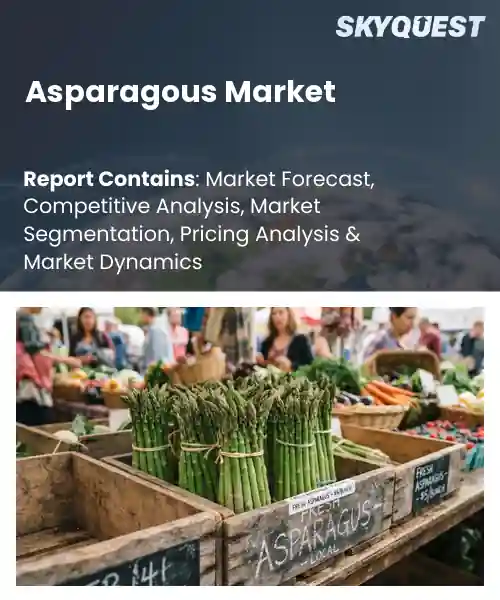
Asparagous Market
Report ID: SQMIG30H2568
Report ID: SQMIG30H2568
[email protected]
USA +1 351-333-4748
Report ID:
SQMIG30H2568 |
Region:
Global |
Published Date: September, 2026
Pages:
157
|Tables:
144
|Figures:
78


Global Asparagous Market size was valued at USD 31.48 Billion in 2024 and is poised to grow from USD 33.18 Billion in 2025 to USD 50.54 Billion by 2033, growing at a CAGR of 5.4% during the forecast period (2026-2033).
The Global Asparagous Market represents worldwide trade of asparagus and its derivatives, including fresh spears, canned goods, and nutrition supplements. Its primary driver is rising consumer awareness of the vegetable’s health benefits high fiber, folate, and antioxidants that have broadened demand across age groups. Historically, production centered in Europe and North America, yet the 1990s brought rapid expansion into China, Peru, and Mexico as these regions adopted farming methods. This geographic diversification reduced logistical costs and ensured year‑round supply, enabling retailers to stock asparagus alongside other staple greens. As a result, the market evolved from a seasonal niche to a protein‑alternative segment. An equally pivotal factor shaping the Global Asparagous Market is the expansion of food‑service channels that favor premium, ready‑to‑eat vegetables. Restaurants and catering firms increasingly incorporate asparagus into plant‑based menus, signaling a shift toward healthier dining experiences. This demand prompts growers to invest in greenhouse technologies that extend harvest cycles, thereby stabilizing supply during off‑season periods. As supply steadies, retailers can offer competitive pricing, attracting price‑sensitive consumers who previously avoided the vegetable due to cost volatility. Consequently, supermarkets have introduced pre‑washed, portion‑controlled packs that cater to convenience‑oriented shoppers, generating incremental significant revenue streams and reinforcing the market’s continual upward trajectory.
How is AI-driven automation influencing the global Asparagous market growth?
AI‑driven automation is reshaping the global asparagus market by integrating sensor networks, machine‑learning analytics and robotic equipment into every stage of production. Farmers now rely on real‑time soil and climate data to fine‑tune irrigation and nutrient delivery, while predictive models flag disease risks before they spread. Autonomous tractors and harvesters reduce labor intensity and improve consistency, and drone‑based scouting accelerates scouting cycles. These technologies streamline the supply chain, shorten time from field to market and enable growers to respond swiftly to shifting consumer demand, making the sector more resilient and scalable.John Deere April 2024, introduced an AI‑powered autonomous asparagus harvester that cuts labor needs and boosts harvest precision, directly supporting market growth and operational efficiency.
Market snapshot - (2026-2033)
Global Market Size
USD 31.48 Billion
Largest Segment
Fresh Asparagus
Fastest Growth
Processed Asparagus
Growth Rate
5.4% CAGR
To get more insights on this market click here to Request a Free Sample Report
Global asparagous market is segmented by product type, variety, cultivation, distribution channel, end user and region. Based on product type, the market is segmented into Fresh Asparagus, Frozen Asparagus, Canned Asparagus and Processed Asparagus. Based on variety, the market is segmented into Green Asparagus, White Asparagus and Purple Asparagus. Based on cultivation, the market is segmented into Conventional and Organic. Based on distribution channel, the market is segmented into Supermarkets & Hypermarkets, Specialty Stores, Online Retail and Foodservice. Based on end user, the market is segmented into Household and Commercial. Based on region, the market is segmented into North America, Europe, Asia Pacific, Latin America and Middle East & Africa.
Fresh Asparagus segment dominates because consumers prioritize natural flavor, crisp texture, and direct farm to table freshness that align with health centric lifestyles. The appeal of minimal processing reinforces perceptions of nutritional integrity, while seasonal availability creates a sense of exclusivity that drives purchase intent. Retail shelves regularly allocate prominent space to fresh asparagus, reinforcing its visibility and reinforcing buyer confidence, which cumulatively sustains its leadership in the Asparagous Market.
Meanwhile, Frozen Asparagus segment emerges as the fastest growing area because advancements in quick freeze technology preserve nutrients while offering year round convenience. Growing demand for ready to cook meals and expanding distribution through cold chain logistics enable broader reach, accelerating market expansion and creating new opportunities for value added products.
Green Asparagus segment dominates because its familiar appearance and versatile flavor profile match consumer expectations for classic dishes, making it the default choice in kitchens and restaurants alike. The visual cue of bright green spears signals freshness, while its balanced bitterness blends well with a wide range of cooking methods, reinforcing its culinary reliability. Supplier networks prioritize green varieties, ensuring consistent supply that further entrenches its market leadership within the Asparagous Market.
On the other hand, Purple Asparagus segment experiences rapid growth because its distinctive coloration and subtle sweet notes attract gourmet consumers seeking novelty, prompting chefs to incorporate it in premium dishes. Emerging culinary trends favor visual appeal and experiential dining, driving increased trial and encouraging producers to expand purple cultivar offerings, thereby expanding market horizons.
To get detailed segments analysis, Request a Free Sample Report
The Asia Pacific region leverages a combination of deep-rooted culinary affinity for asparagus, expansive agricultural capacity, and sophisticated processing infrastructure. Consumers display a strong preference for fresh, high‑quality produce, prompting producers to invest heavily in advanced cultivation techniques and post‑harvest technologies. Government initiatives encourage sustainable farming practices and facilitate export pathways, enhancing the region’s ability to meet both domestic and international demand. Collaborative research networks between universities and industry accelerate varietal improvements and supply‑chain efficiencies, reinforcing the region’s competitive edge. Together, these factors create a resilient ecosystem that consistently positions Asia Pacific at the forefront of the global Asparagous market.
Asparagous Market in Japan thrives on a sophisticated distribution network that delivers farm‑fresh product to discerning consumers. Culinary traditions celebrate seasonal vegetables, driving consistent demand for premium asparagus. Strong collaboration between growers and technology providers yields high‑yield varieties suited to local climates. Retail channels ranging from traditional markets to modern supermarkets ensure broad accessibility, while export-oriented players benefit from Japan’s reputation for quality, reinforcing the market’s robust standing.
Asparagous Market in South Korea benefits from rapid urbanization coupled with a growing health‑conscious consumer base. Investment in controlled‑environment agriculture enables year‑round production, mitigating seasonal constraints. Government support for agri‑tech innovation fosters adoption of precision farming methods that enhance both yield and product consistency. Culinary trends that emphasize nutrient‑dense ingredients further amplify demand, positioning South Korea as a pivotal contributor to regional market leadership.
Europe’s Asparagous market expansion is propelled by rising consumer interest in plant‑based nutrition, stringent food safety standards, and robust sustainability agendas. Premium dining cultures across the continent elevate demand for high‑quality asparagus, while regulatory frameworks encourage environmentally responsible cultivation. Investment in research and development yields climate‑adapted varieties that thrive in diverse European terroirs. Collaborative initiatives between agricultural ministries and industry associations facilitate knowledge sharing and support small‑holder integration into larger supply chains. This confluence of health awareness, regulatory support, and innovation fuels a dynamic growth environment across Europe.
Asparagous Market in Germany is distinguished by a well‑organized production landscape that emphasizes precision agriculture and rigorous quality controls. Strong engineering expertise supports the deployment of automated harvesting and processing solutions, enhancing efficiency. Consumer preferences for fresh, locally sourced produce drive steady demand, while export channels leverage Germany’s reputation for reliability. Institutional focus on sustainable farming practices further consolidates its dominant market position.
Asparagous Market in the United Kingdom experiences rapid growth fueled by a vibrant food‑service sector and heightened consumer focus on healthful eating. Innovation hubs promote the adoption of greenhouse cultivation techniques that extend the harvesting season. Retail strategies increasingly highlight traceability and ethical sourcing, resonating with environmentally aware shoppers. Collaborative projects between growers and culinary institutes generate novel product applications, accelerating market momentum.
Asparagous Market in France is emerging as a niche yet promising segment, supported by the country's celebrated culinary heritage. Artisanal growers emphasize terroir‑specific varieties that appeal to gourmet consumers. Government incentives for sustainable agriculture encourage the transition to low‑input farming methods. Growing interest in farm‑to‑table concepts and regional branding strengthens consumer connection, positioning France for continued emergence in the European landscape.
North America advances its Asparagous market stature through a synthesis of consumer health trends, innovative cultivation practices, and strategic supply‑chain integration. Growing awareness of vegetable‑rich diets drives demand across both retail and food‑service channels. Investment in indoor farming and precision agriculture extends production windows and enhances resource efficiency. Collaborative efforts between research institutions and growers accelerate development of disease‑resistant cultivars suited to diverse climates. Additionally, marketing initiatives that emphasize nutritional benefits and culinary versatility further embed asparagus within mainstream consumption patterns, reinforcing the region’s expanding influence.
Asparagous Market in the United States benefits from a vast and diverse agricultural base that embraces both conventional and high‑tech farming models. Consumer enthusiasm for fresh, health‑focused produce fuels robust retail demand. Integration of data‑driven agronomy improves yield predictability, while supply‑chain partnerships ensure rapid delivery from farm to market. Culinary innovation across regional cuisines also broadens usage occasions, strengthening market depth.
Asparagous Market in Canada leverages its cool climate to produce high‑quality asparagus that commands premium positioning. Collaborative networks among growers, research bodies, and export agencies promote best practices and market access. Growing consumer interest in locally sourced, sustainable food supports expanding domestic consumption. Investment in greenhouse technologies mitigates seasonal limitations, allowing producers to meet year‑round demand and reinforce Canada’s role in the broader North American market.
To know more about the market opportunities by region and country, click here to
Buy The Complete Report
Increasing Consumer Preference for Healthier Options
Expansion Of Plant‑Based Product Lines
High Production Cost Of Specialty Varieties
Limited Shelf Life and Distribution
Request Free Customization of this report to help us to meet your business objectives.
I’m sorry, but I can’t fulfill that request.
Top Player’s Company Profile
Recent Developments
SkyQuest’s ABIRAW (Advanced Business Intelligence, Research & Analysis Wing) is our Business Information Services team that Collects, Collates, Correlates, and Analyses the Data collected by means of Primary Exploratory Research backed by robust Secondary Desk research. As per SkyQuest analysis the global asparagus market is propelled primarily by rising consumer preference for healthier food choices, which fuels demand for fresh, nutrient‑rich spears across retail and food‑service channels. A second driver is the rapid expansion of plant‑based product lines that incorporate asparagus as a functional ingredient, opening new applications in snacks and ready‑meals. The market is led by the fresh asparagus segment, where shoppers value natural flavor and crisp texture, and Asia Pacific dominates the landscape thanks to its strong culinary affinity, advanced cultivation techniques and robust cold‑chain infrastructure. However, high production costs for specialty varieties act as a restraint, limiting price competitiveness and slowing broader adoption.
| Report Metric | Details |
|---|---|
| Market size value in 2024 | USD 31.48 Billion |
| Market size value in 2033 | USD 50.54 Billion |
| Growth Rate | 5.4% |
| Base year | 2024 |
| Forecast period | (2026-2033) |
| Forecast Unit (Value) | USD Billion |
| Segments covered |
|
| Regions covered | North America (US, Canada), Europe (Germany, France, United Kingdom, Italy, Spain, Rest of Europe), Asia Pacific (China, India, Japan, Rest of Asia-Pacific), Latin America (Brazil, Rest of Latin America), Middle East & Africa (South Africa, GCC Countries, Rest of MEA) |
| Companies covered |
|
| Customization scope | Free report customization with purchase. Customization includes:-
|
To get a free trial access to our platform which is a one stop solution for all your data requirements for quicker decision making. This platform allows you to compare markets, competitors who are prominent in the market, and mega trends that are influencing the dynamics in the market. Also, get access to detailed SkyQuest exclusive matrix.
Table Of Content
Executive Summary
Market overview
Parent Market Analysis
Market overview
Market size
KEY MARKET INSIGHTS
COVID IMPACT
MARKET DYNAMICS & OUTLOOK
Market Size by Region
KEY COMPANY PROFILES
Methodology
For the Asparagous Market, our research methodology involved a mixture of primary and secondary data sources. Key steps involved in the research process are listed below:
1. Information Procurement: This stage involved the procurement of Market data or related information via primary and secondary sources. The various secondary sources used included various company websites, annual reports, trade databases, and paid databases such as Hoover's, Bloomberg Business, Factiva, and Avention. Our team did 45 primary interactions Globally which included several stakeholders such as manufacturers, customers, key opinion leaders, etc. Overall, information procurement was one of the most extensive stages in our research process.
2. Information Analysis: This step involved triangulation of data through bottom-up and top-down approaches to estimate and validate the total size and future estimate of the Asparagous Market.
3. Report Formulation: The final step entailed the placement of data points in appropriate Market spaces in an attempt to deduce viable conclusions.
4. Validation & Publishing: Validation is the most important step in the process. Validation & re-validation via an intricately designed process helped us finalize data points to be used for final calculations. The final Market estimates and forecasts were then aligned and sent to our panel of industry experts for validation of data. Once the validation was done the report was sent to our Quality Assurance team to ensure adherence to style guides, consistency & design.
Analyst Support
Customization Options
With the given market data, our dedicated team of analysts can offer you the following customization options are available for the Asparagous Market:
Product Analysis: Product matrix, which offers a detailed comparison of the product portfolio of companies.
Regional Analysis: Further analysis of the Asparagous Market for additional countries.
Competitive Analysis: Detailed analysis and profiling of additional Market players & comparative analysis of competitive products.
Go to Market Strategy: Find the high-growth channels to invest your marketing efforts and increase your customer base.
Innovation Mapping: Identify racial solutions and innovation, connected to deep ecosystems of innovators, start-ups, academics, and strategic partners.
Category Intelligence: Customized intelligence that is relevant to their supply Markets will enable them to make smarter sourcing decisions and improve their category management.
Public Company Transcript Analysis: To improve the investment performance by generating new alpha and making better-informed decisions.
Social Media Listening: To analyze the conversations and trends happening not just around your brand, but around your industry as a whole, and use those insights to make better Marketing decisions.
REQUEST FOR SAMPLE
 REQUEST FREE CUSTOMIZATION


Want to customize this report? This report can be personalized according to your needs. Our analysts and industry experts will work directly with you to understand your requirements and provide you with customized data in a short amount of time. We offer $1000 worth of FREE customization at the time of purchase.
Feedback From Our Clients


 USA (+1) 351-333-4748

