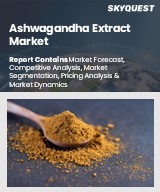
Ashwagandha Extract Market
Report ID: SQMIG30I2563
Report ID: SQMIG30I2563
[email protected]
USA +1 351-333-4748
Report ID:
SQMIG30I2563 |
Region:
Global |
Published Date: December, 2025
Pages:
188
|Tables:
89
|Figures:
69


Global Ashwagandha Extract Market size was valued at USD 775.28 Million in 2024 and is poised to grow from USD 852.81 Million in 2025 to USD 1828.07 Million by 2033, growing at a CAGR of 10% during the forecast period (2026–2033).
The global ashwagandha extract market is seeing steady growth in this space fuelled by increasing consumer understanding of its health benefits. Ashwagandha is an adaptogen and is perceived as a stress reducer, and an anxiolytic. Another market driver is the current trend for natural or herbal supplements. Consumers are looking for preventive healthcare based on natural alternatives to synthetic or pharmaceutical products. As a result, the demand and requirements for quality standardized ashwagandha extracts in the dietary supplements and functional foods markets are making this a market driver.
However, the global ashwagandha extract market analysis offers some challenges. One of the biggest restraints is quality control and standardization. The potency of the extract depends on both the raw material utilized and what extraction methods are utilized. The inconsistency in one's product can seriously affect consumer trust and product claim. The market also varies significantly with respect to regions and regulations regarding health claims and product registrations. The threat of adulteration with substandard products also threatens legitimate suppliers and the market in general.
How Are Advances in Extraction Technology and Clinical Research Shaping the Global Ashwagandha Extract Market?
The global ashwagandha extract market trends are driven by technological advances in extraction methods and the increasing prevalence of clinical trials. Recent technological developments such as supercritical CO2 extraction have allowed to produce extremely pure, potent extracts of the herb. This will allow for greater standardization of active constituents, such as the withanolides. The emerging science is moving ashwagandha from a traditional herb to a clinically substantiated nutraceutical ingredient and will therefore increase the scientific credence of ashwagandha for use in functional foods and beverages.
In early 2025, a study published in a top wellness journal confirmed that a branded ashwagandha extract improved sleep quality, and lowered cortisol levels in human populations. This study helps to complement their published claims, with meaningful science. This research is providing direct support for the use of ashwagandha in mainstream supplement brands, as well as for health-based consumers.
Market snapshot - 2026-2033
Global Market Size
USD 704.8 million
Largest Segment
Powder form
Fastest Growth
Capsules/Tablets form
Growth Rate
10.0% CAGR
To get more insights on this market click here to Request a Free Sample Report
Global Ashwagandha Extract Market is segmented by Form, Application, Distribution Channel and region. Based on Form, the market is segmented into Powder, Capsules/Tablets and Liquid. Based on Application, the market is segmented into Dietary Supplements, Functional Foods & Beverages, Pharmaceuticals and Cosmetics & Personal Care. Based on Distribution Channel, the market is segmented into B2B (Business-to-Business) and B2C (Business-to-Consumer). Based on region, the market is segmented into North America, Europe, Asia Pacific, Latin America and Middle East & Africa.
The Powder form segment holds the majority market share in the global ashwagandha extract market share due to its flexibility and affordability. Powdered extract can be added to many different products, including dietary supplement blends, functional foods, and beverages. The bulk format allows manufacturing companies to produce a large-scale product easily, making powder extract the most common form in use.
The Capsules/Tablets form segment is the fastest-growing segment in the global ashwagandha extract market outlook, due to consumer preferences for simple, accurate dosing. Capsules and tablets as dosage forms offer an easy way to consume the supplement in a tasteless form. This attracts the interest of a wide base of health-conscious consumers that want easy and accessible solutions to wellness.
The global ashwagandha extract market size is primarily driven by the dietary supplements application segment. This dominance is driven by the rising consumer interest in natural health and wellness products to prevent stress, improve cognitive function, and overall wellbeing. Ashwagandha is a foundational component of the adaptogen category. It is a top-selling ingredient in dietary supplements being sold through many different retail channels and creating ongoing market demand.
The functional foods & beverages is the fastest growing segment in the global ashwagandha extract industry. This growth is predominantly led by the mainstream utilization of adaptogens in everyday products. Brands have begun to market ashwagandha tea, coffee, snack bars and relaxation drinks. This may allow for more consumer touchpoints and brand awareness of the adaptogen beyond traditional dietary supplement users.
To get detailed segments analysis, Request a Free Sample Report
North America dominated the global ashwagandha extract regional outlook because consumers have high awareness of mental wellness and a strong demand for natural supplements to relieve stress. North America's very well-established nutraceutical industry, and the more mainstream acceptance of adaptogens supported by major supplement brands and distribution channels, will sustain this dominance as it continues to grow.
The U.S. is leading the North American ashwagandha extract market, thanks largely to a large health-conscious consumer base and growing holistic wellness trends. Early 2025 saw substantial marketing from major U.S. supplement retailers on adaptogenic blends for stress and sleep. The increased marketing has certainly raised ashwagandha awareness and sales.
Canada has the fastest growing ashwagandha extract market in North America. This is due to a growing interest in natural health products and a permissive supplement regulatory environment. The latest development is Health Canada approved new health claims for ashwagandha-containing products, which has helped build consumer confidence and led to several brands entering this market space.
The Asia Pacific region is anticipated to emerge as the fastest-growing region in global ashwagandha extract regional forecast. There is a strong history of Ashwagandha use in traditional Ayurvedic medicine, especially in India, the original source of the raw material. The region's supply chain also creates a natural advantage. Increasing disposable income, an increasing consciousness of health, and acceptance of traditional herbs in contemporary formats promote fast-market growth. The region portrays a large population and increasing export activities as additional enablers.
Japan leads the Asia Pacific ashwagandha extract market. An aging population that is very interested in supplements for cognitive health and vitality is the main reason. Japan also has an advanced food and beverage market. Recently, Japanese companies have introduced new functional drinks and snacks supplemented with ashwagandha to the market, claiming benefits of stress relief and clarity of mind.
South Korea is currently experiencing the fastest growth in the Asia Pacific ashwagandha extract market. As well as the highly trend-focused beauty and wellness market, which also focuses on "inner beauty" and stress management. For example, in March 2022, South Korean beauty brands began launching ashwagandha-infused "beauty from within" supplements and "skin food" skincare lines. These products were marketed as having anti-inflammatory and antioxidant benefits.
Europe plays an important role in the global ashwagandha extract market revenue. This is driven by an increase in consumers who are looking for herbal solutions or natural alternatives to stress management and sleep quality. The health and wellness retail sector in Europe is well established, and the rise of yoga and mindfulness is also contributing to the growth of the market. There is increased demand for ethically sourced, organic certification, and transparency in all three markets at the same time.
Germany is leading the European ashwagandha extract market, primarily due to major consumer preference for natural or herbal medicine, which is frequently sold out of pharmacies and once again stiff quality standards. There have also been very recent developments with German pharmaceutical companies launching high quality and high prestigious, standardized ashwagandha extracts as herbal medicinal products for stress relief having a high degree of credibility.
The United Kingdom is witnessing the fastest growth within the European ashwagandha extract market. This is being instigated by a huge demand for supplements for mental health assistance, particularly with younger consumers. Its vibrant online retail environment is very much a factor. More recently, there has been an emergence of UK-based start-ups launching inventive ashwagandha products ranging from gummies, tinctures, and powders, but generally all sold via social media marketing.
France is seeing considerable progress in the European ashwagandha extract market due to increased interest in "nutraceutiques" and natural products sold through pharmacies and parapharmacies. Quality of product is paramount, and this factor is also contributing to its growth. Recently, French supplement brands have launched certified organic ashwagandha capsules. They are marketed with emphasis on traceability and sustainable sourced from India.
To know more about the market opportunities by region and country, click here to
Buy The Complete Report
Growing Consumer Focus on Mental Wellness and Stress Management
Increasing Demand for Natural and Herbal Supplements
Issues with Quality Control and Standardization
Complex Regulatory Hurdles and Health Claims
Request Free Customization of this report to help us to meet your business objectives.
The global ashwagandha extract industry is in a competitive duality, with two broad categories. On one side are the larger, established ingredient companies providing standardized extracts: KSM-66 (Ixoreal Biomed) and Sensoril (Natreon Inc.). These companies dominate the B2B space by focusing on clinical research, patents, and quality certifications to guarantee potently efficacious products for major supplement brands. Their strategy is based on both strong scientific confirmation and a reliable supply.
On the emergent side is the fast-growing number of consumer-facing brands and startups that build brands around wellness, transparency, and lifestyle. They often sourcing high-quality extracts from the major suppliers but then adopting different ways to play through novel product formats such as gummies, drinks, and tinctures. Their marketing efforts deal with direct-to-consumer channels, appealing social media engagement, and sharing the story around the benefits of ashwagandha in our contemporary life.
SkyQuest’s ABIRAW (Advanced Business Intelligence, Research & Analysis Wing) is our Business Information Services team that Collects, Collates, Correlates, and Analyses the Data collected by means of Primary Exploratory Research backed by robust Secondary Desk research.
As per SkyQuest analysis, the global ashwagandha extract market is witnessing huge growth. This continues to be fueled by a major consumer shift towards natural means of mental wellness and stress management. The very rise in the demand for herbal supplements remains a key driver. Consumers are gravitating towards options in preventative health. This has translated into strong demand for ashwagandha in dietary supplements and functional foods.
Regional markets led by North America demonstrate this large opportunity. This is due to an engaged consumer base and strong nutraceuticals industry. Despite challenges with quality controls and regulatory hurdles, the competitive landscape of the market continues to spur innovation. The Dietary Supplements segment continues to have the largest share of the market, demonstrating the ongoing consumer trend towards using natural products for health maintenance.
| Report Metric | Details |
|---|---|
| Market size value in 2024 | USD 775.28 Million |
| Market size value in 2033 | USD 1828.07 Million |
| Growth Rate | 10% |
| Base year | 2024 |
| Forecast period | 2026-2033 |
| Forecast Unit (Value) | USD Million |
| Segments covered |
|
| Regions covered | North America (US, Canada), Europe (Germany, France, United Kingdom, Italy, Spain, Rest of Europe), Asia Pacific (China, India, Japan, Rest of Asia-Pacific), Latin America (Brazil, Rest of Latin America), Middle East & Africa (South Africa, GCC Countries, Rest of MEA) |
| Companies covered |
|
| Customization scope | Free report customization with purchase. Customization includes:-
|
To get a free trial access to our platform which is a one stop solution for all your data requirements for quicker decision making. This platform allows you to compare markets, competitors who are prominent in the market, and mega trends that are influencing the dynamics in the market. Also, get access to detailed SkyQuest exclusive matrix.
Table Of Content
Executive Summary
Market overview
Parent Market Analysis
Market overview
Market size
KEY MARKET INSIGHTS
COVID IMPACT
MARKET DYNAMICS & OUTLOOK
Market Size by Region
KEY COMPANY PROFILES
Methodology
For the Ashwagandha Extract Market, our research methodology involved a mixture of primary and secondary data sources. Key steps involved in the research process are listed below:
1. Information Procurement: This stage involved the procurement of Market data or related information via primary and secondary sources. The various secondary sources used included various company websites, annual reports, trade databases, and paid databases such as Hoover's, Bloomberg Business, Factiva, and Avention. Our team did 45 primary interactions Globally which included several stakeholders such as manufacturers, customers, key opinion leaders, etc. Overall, information procurement was one of the most extensive stages in our research process.
2. Information Analysis: This step involved triangulation of data through bottom-up and top-down approaches to estimate and validate the total size and future estimate of the Ashwagandha Extract Market.
3. Report Formulation: The final step entailed the placement of data points in appropriate Market spaces in an attempt to deduce viable conclusions.
4. Validation & Publishing: Validation is the most important step in the process. Validation & re-validation via an intricately designed process helped us finalize data points to be used for final calculations. The final Market estimates and forecasts were then aligned and sent to our panel of industry experts for validation of data. Once the validation was done the report was sent to our Quality Assurance team to ensure adherence to style guides, consistency & design.
Analyst Support
Customization Options
With the given market data, our dedicated team of analysts can offer you the following customization options are available for the Ashwagandha Extract Market:
Product Analysis: Product matrix, which offers a detailed comparison of the product portfolio of companies.
Regional Analysis: Further analysis of the Ashwagandha Extract Market for additional countries.
Competitive Analysis: Detailed analysis and profiling of additional Market players & comparative analysis of competitive products.
Go to Market Strategy: Find the high-growth channels to invest your marketing efforts and increase your customer base.
Innovation Mapping: Identify racial solutions and innovation, connected to deep ecosystems of innovators, start-ups, academics, and strategic partners.
Category Intelligence: Customized intelligence that is relevant to their supply Markets will enable them to make smarter sourcing decisions and improve their category management.
Public Company Transcript Analysis: To improve the investment performance by generating new alpha and making better-informed decisions.
Social Media Listening: To analyze the conversations and trends happening not just around your brand, but around your industry as a whole, and use those insights to make better Marketing decisions.
REQUEST FOR SAMPLE
 REQUEST FREE CUSTOMIZATION


Want to customize this report? This report can be personalized according to your needs. Our analysts and industry experts will work directly with you to understand your requirements and provide you with customized data in a short amount of time. We offer $1000 worth of FREE customization at the time of purchase.
Feedback From Our Clients


 USA (+1) 351-333-4748

