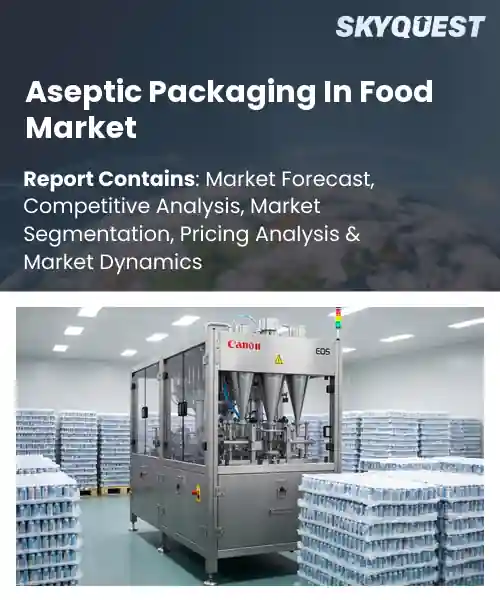
Aseptic Packaging In Food Market
Report ID: SQMIG15H2181
Report ID: SQMIG15H2181
[email protected]
USA +1 351-333-4748
Report ID:
SQMIG15H2181 |
Region:
Global |
Published Date: February, 2026
Pages:
157
|Tables:
123
|Figures:
77


Global Aseptic Packaging in Food Market size was valued at USD 19.82 Billion in 2024 and is poised to grow from USD 20.69 Billion in 2025 to USD 29.23Billion by 2033, growing at a CAGR of 4.41% during the forecast period (2026-2033).
The global aseptic packaging in food market growth is driven because it provides a solution for food products which require safe international distribution and extended storage durations without refrigeration. Aseptic packaging uses a dual sterilization method which first disinfects both the product and its container before the package design protects dairy, juice, soup, and baby food products from bacterial damage while keeping their essential nutritional value. The market creates value by reducing transportation expenses which allows UHT milk and shelf-stable fruit purees to access remote markets. The introduction of barrier material technology and fill-line automation systems and standardized regulations have created better conditions for emerging markets and developed markets to implement new technologies.
In addition, global aseptic packaging in food market penetration is driven because consumers demand foods which provide both health benefits and instant readiness to eat, which creates business opportunities for suppliers and machine builders. Aseptic technology enables retailers to sell high profit margin products through its ability to maintain product quality without using cold storage. The lightweight cartons and recyclable laminates which companies choose to reduce food waste create material barrier innovations which protect their products. The business seeks to increase its capital budget for sterile filling lines while developing research partnerships which will lead to business growth through decreased operational expenses and expedited product launch times.
How is AI Enhancing Operational Efficiency in the Aseptic Packaging Food Market?The operational efficiency of aseptic packaging procedures receives improvement through AI technology because it streamlines the process of inspection and equipment fault detection and process parameter management. The main operational elements depend on three components which include machine vision for defect detection and predictive maintenance to avoid unplanned stops and process analytics which accelerate changeovers and result in stable sterilization procedures.
The market experiences operational difficulties because it must maintain continuous production while reducing waste and achieving its environmental targets with multiple product types. Machine data becomes actionable for business intelligence when suppliers and converters implement sensor systems together with cloud-based analytical solutions. The use of AI technology together with robotics and advanced sealing techniques results in better production yields and faster production scaling according to real-world examples.
Market snapshot - (2026-2033)
Global Market Size
USD 15.6 Billion
Largest Segment
Composite
Fastest Growth
Plastic
Growth Rate
10.1% CAGR
To get more insights on this market click here to Request a Free Sample Report
The global aseptic packaging in the food market is segmented based on material type, packaging type, application, end use, and region. By material type, the market is categorized into paperboard, plastic, glass, metal, and composite materials. Based on packaging type, it is segmented into cartons, pouches, containers, bottles, bags, ampoules, and others. In terms of application, the market is divided into food, pharmaceuticals, and others. Based on end use, it is classified into retail, food service, and institutional segments. Regionally, the market is segmented into North America, Europe, Asia Pacific, Latin America, and the Middle East & Africa.
As per the global aseptic packaging in food market analysis, the pouches segment leads the market because its flexible film design and advanced barrier laminate technology create lightweight packaging solutions which preserve sterile contents through quick high-speed filling operations. Manufacturers are adopting pouches because they provide cost-efficient transport solutions which work well with their aseptic processing systems to maintain food products fresh for longer periods while simplifying their operational processes.
Whereas the cartons category is growing quickly because barrier coating advancements and fiber-based liner development enable products to meet aseptic requirements while satisfying consumer demand for environmentally friendly options. The combination of improved carton filling systems and retailer demand for eco-friendly products has resulted in new product introductions to create premium products which differentiate themselves from standard shelf products.
According to the global aseptic packaging in food market forecast, the plastic segment leads the market because its polymer film and coating solutions enable manufacturers to create customized barrier systems which control both oxygen and moisture while delivering lightweight materials that can be molded into various packaging designs. Manufacturers select their products based on two factors which include their ability to maintain fast aseptic filling operations and their development of multilayer packaging solutions with recyclable resin materials.
Whereas the paperboard category is anticipated to have the maximum aseptic packaging in food market share because new biodegradable coating solutions and bio-based liner solutions enable seamless fiber sourcing with the requirements of aseptic barrier production. The increasing consumer demand for renewable packaging together with government regulations which restrict plastic usage has led brands to transform their products while they build new aseptic carton systems, which enables them to create fresh market opportunities and build sustainable product differentiation.
To get detailed segments analysis, Request a Free Sample Report
As per the aseptic packaging in food market regional forecast, the market size together with manufacturing strength and fast processing technology adoption creates an environment that enables Asia Pacific to maintain its market leadership position. The need for safe shelf stable products has become a priority for food manufacturers because of urban centers that have high population density and people who want both convenient and ready to eat food items. Regional packaging equipment manufacturers together with their conversion partners developed specialized knowledge which enables them to execute projects at lower costs while achieving faster product launch times. The food industry now requires aseptic conversion processes because of new regulations which focus on food safety and longer product shelf life.
The Japanese aseptic packaging in food sector uses precision engineering and strict quality assurance methods to create products which meet customer demand for high product quality and safety. The packaging industry works with food brands to create vending materials which need compact, efficient designs. Food safety regulations together with recycling requirements drive businesses to improve their processes through ongoing improvements which help them use less resources.
The aseptic packaging in food industry in South Korea is shaped by rapid innovation cycles and consumer demand for fresh yet convenient products. The beverage sector, together with dairy alternative products and ready meal products, sees companies from both major food companies and small-scalebusinesses implementing aseptic solutions to improve their product distribution capabilities. Companies use flexible packaging solutions and automated filling equipment to deliver a wide range of products which they can launch into the market. Aseptic technology adoption increases because companies want to create sustainable products which achieve efficiency while maintaining their product shelf life.
European markets expand rapidly because strong food safety regulations combined with sustainable shelf stable product demand and efficient processing operations of established processing facilities drive market growth. Retailers push for new product development through their innovation programs which lead to the creation of aseptic packaging systems that maintain product quality while using less refrigeration. Aseptic systems need to redesign work to achieve material recovery capabilities based on organizations which use circular packaging systems and recycling infrastructure as their basis for investment decisions. Packaging suppliers and processors work together with research institutions to develop advanced aseptic processes which use custom formats and automated systems to enhance delivery of their products in the modern supply chain.
The aseptic packaging in food market in Germany uses advanced engineering systems which handle food processing through machinery that meets strict safety regulations. The processors work together with equipment manufacturers to create aseptic production lines which deliver high production capacity while ensuring reliable operation for their industrial needs. The beverage and liquid food industries adopt technology because it helps them achieve their technical performance requirements and energy efficiency standards together with material optimization goals. The strong industrial networks of the region together with their dedication to sustainability enable businesses to create sustainable solutions which enhance market leadership through ongoing product development.
The Aseptic Packaging in Food Market in United Kingdom experiences rapid development through constant innovation which responds to retail channel changes and consumer demand for easy access to products. The increase in private label products and online grocery shopping has caused a need for packaging products which can remain stable on shelves while improving distribution processes. The converters and manufacturers of the industry develop modular aseptic systems and flexible packaging solutions to handle the diverse requirements of their products. The market will achieve faster growth and operational flexibility through sustainable packaging system development and filling system modernization which will create regulatory compliance.
French food packaging uses aseptic technology to protect traditional artisanal products between their first production and their final sale. The food industry selects aseptic formats through their choice of materials because they need to maintain both taste and texture in their final products. The rising consumer interest in organic and minimally processed foods has prompted processors to develop gentle aseptic processing systems with their converter partners. The niche markets for food products grow through partnerships between food artisans and technology providers who help their businesses prepare for export.
The competitive strength of North America improves through joint financial support for processing functions and compliance with regulations and development of new materials. Food processing companies and retail networks need shelf stable products to enhance their supply chain operations and decrease their transportation expenditures. The implementation of modern aseptic filling technologies together with automated systems increases production capacity while ensuring safety for all products. The research of new materials together with the development of recycling systems for sustainable packaging materials creates partnerships between research institutions and supply chain companies. Aseptic system implementation gets accelerated through cross-border technology provider and manufacturer partnerships, which enable manufacturers to introduce more product varieties to the market with faster delivery times.
The United States aseptic packaging in food market operates through major food processors and retail networks which require shelf stable products to decrease their dependence on cold chain systems for their national distribution networks. The partnership between innovation hubs and equipment suppliers leads to the creation of scalable aseptic production lines which use digital process control to improve operational performance while providing better product traceability. The demand for portable nutrition products which can be stored without refrigeration creates various applications for aseptic technology. The combination of sustainability commitments and regulatory oversight requirements leads manufacturing facilities to implement recyclable material usage together with resource-efficient operational practices.
The Canadian aseptic packaging in food market operates through processors who use aseptic packaging systems to reach remote markets and distant communities which lack the need for extensive refrigerated storage systems. The market for premium and specialty products requires businesses to select aseptic methods which maintain product excellence. The public-private partnership between United States suppliers and material sustainability investment enables KFC to implement broader sustainability practices while the regulatory framework ensures KFC restaurants comply with food safety regulations and maintain product quality throughout their supply chain.
To know more about the market opportunities by region and country, click here to
Buy The Complete Report
Extended Shelf-Life Benefits
Aseptic packaging maintains product sterility and quality over prolonged storage while it maintains sensory attributes and nutritional integrity without using chemical preservatives. The production of extended shelf-life foods, which require protection against both microbial contamination and oxidation, enables manufacturers to create products that maintain their consumer appeal and can be distributed throughout the entire supply chain. The reduction of spoilage losses helps retailers manage their inventory effectively, which reduces product losses while enabling brands to expand their distribution and introduce new product formats that meet consumer needs for convenient and fresh products while maintaining sustainable supply chain operations.
Consumer Demand for Convenience
Aseptic packaging meets consumer demands for convenience through its provision of ready-to-eat products and single-serve packages which remainfresh without the need for refrigeration. The production of on-the-go products which suit informal eating situations and busy routines is possible through its provision of portable products which maintain their quality without refrigeration and can be stored at room temperature. The packaging formats which manufacturers create through this process will drive product development, while the expansion of retail stores in convenience markets will decrease the need for cold chain delivery systems. The combination of these elements enhances product variety and improves brand recognition among consumers who lack sufficient time while creating better market acceptance for foods packaged using aseptic technology.
High Initial Capital Requirements
The cost of both aseptic filling equipment and sterile processing infrastructure creates a financial barrier which prevents smaller producers and new companies from adopting these technologies. The installation of advanced equipment and building upgrades needs specialized staff expertisetogether with extended planning time, which results in both operational delays and limited production capacity. The need for significant upfront expenditure can lead companies to prioritize legacy packaging methods that demand less capital, thereby slowing widespread adoption and limiting competitive diversification across regions where funding or technical resources are less accessible.
Regulatory Compliance Complexity
The regulatory environment for aseptic processing and packaging includes strict requirements which create challenges for product development and business expansion because companies need to demonstrate compliance through extensive documentation and validation plus continuous monitoring. The regulatory environment creates challenges because different jurisdictions require specific coordination efforts to work with regulatory agencies, which lengthens the time needed to repackage or reformulate food products. The compliance landscape also requires investment in quality systems and trained personnel, which can divert resources from innovation and limit the agility of manufacturers to respond quickly to market opportunities.
Request Free Customization of this report to help us to meet your business objectives.
The global aseptic food packaging market experiences its competitive environment through three main factors which include market mergers and specific technology partnerships and development of new packaging materials. The main suppliers of carton products and equipment use their M&A activities together with their robotics partnerships to develop new sterile filling and automation and barrier functions which BOBST demonstrated through its 2023 purchase of a controlling interest in Dücker Robotics. The industry leaders develop new compostable barrier films together with their specialized partners to create upgraded aseptic production lines which they use to secure contracts for shelf stable products.
Sustainable Material Innovation: The global aseptic packaging in food industry trend is shifting toward recyclable and compostable and biobased aseptic packaging materials which reduce environmental footprint while maintaining product safety and shelf stability. Suppliers work with brands to develop simpler multilayer constructions which will receive composability certification while testing different barrier materials. Retailers require procurement to provide products which follow circularity principles while showing their supply routes, and this requirement leads to product testing and market introduction. The design team needs to find solutions which will enable them to assess barrier effectiveness and develop methods for end-of-life material recovery. The movement creates opportunities for brands to showcase their unique materials through partnerships with suppliers who provide sustainable products and authentic sustainability claims which lead to premium market positioning.
Digital Traceability Adoption: Digital tracking has become a common practice in aseptic packaging because companies need complete visibility of their entire packaging system. Brands use serialized identifiers together with sensor seals and interoperable data platforms to track their sterile filling operations from the source of their materials to their cold chain storage history. The system supports businesses to achieve their sustainability goals and protect against product counterfeiting while building trust with retailers and consumers through its enhanced visibility system which detects quality issues. Packaging equipment manufacturers and suppliers work together to create standards for data sharing which they will use to develop traceability solutions that will be implemented throughout their design process to deliver safety and authenticity evidence that will be used for international product verification.
SkyQuest’s ABIRAW (Advanced Business Intelligence, Research & Analysis Wing) is our Business Information Services team that Collects, Collates, Correlates, and Analyses the Data collected by means of Primary Exploratory Research backed by robust Secondary Desk research.
As per SkyQuest analysis, the need for extended shelf life without refrigeration serves as a primary market driver which the industry must address while the market requires aseptic filling equipment through its high initial capital cost which keeps smaller companies from entering the market. The region of Asia Pacific dominates the market through its product segment, which includes pouches that use lightweight, high barrier films, and fast filling systems. The second driver of market growth occurs because consumers increasingly prefer ready to eat foods. The material development process and digital tracking system development will lead to new supplier connections and advanced product development. The trends help businesses to reduce their need for cold storage while they decrease their shipping costs, and they drive companies to extend their distribution of ambient SKUs into retail spaces and food service outlets.
| Report Metric | Details |
|---|---|
| Market size value in 2024 | USD 15.6 Billion |
| Market size value in 2033 | USD 37.09 Billion |
| Growth Rate | 10.1% |
| Base year | 2024 |
| Forecast period | (2026-2033) |
| Forecast Unit (Value) | USD Billion |
| Segments covered |
|
| Regions covered | North America (US, Canada), Europe (Germany, France, United Kingdom, Italy, Spain, Rest of Europe), Asia Pacific (China, India, Japan, Rest of Asia-Pacific), Latin America (Brazil, Rest of Latin America), Middle East & Africa (South Africa, GCC Countries, Rest of MEA) |
| Companies covered |
|
| Customization scope | Free report customization with purchase. Customization includes:-
|
To get a free trial access to our platform which is a one stop solution for all your data requirements for quicker decision making. This platform allows you to compare markets, competitors who are prominent in the market, and mega trends that are influencing the dynamics in the market. Also, get access to detailed SkyQuest exclusive matrix.
Table Of Content
Executive Summary
Market overview
Parent Market Analysis
Market overview
Market size
KEY MARKET INSIGHTS
COVID IMPACT
MARKET DYNAMICS & OUTLOOK
Market Size by Region
KEY COMPANY PROFILES
Methodology
For the Aseptic Packaging In Food Market, our research methodology involved a mixture of primary and secondary data sources. Key steps involved in the research process are listed below:
1. Information Procurement: This stage involved the procurement of Market data or related information via primary and secondary sources. The various secondary sources used included various company websites, annual reports, trade databases, and paid databases such as Hoover's, Bloomberg Business, Factiva, and Avention. Our team did 45 primary interactions Globally which included several stakeholders such as manufacturers, customers, key opinion leaders, etc. Overall, information procurement was one of the most extensive stages in our research process.
2. Information Analysis: This step involved triangulation of data through bottom-up and top-down approaches to estimate and validate the total size and future estimate of the Aseptic Packaging In Food Market.
3. Report Formulation: The final step entailed the placement of data points in appropriate Market spaces in an attempt to deduce viable conclusions.
4. Validation & Publishing: Validation is the most important step in the process. Validation & re-validation via an intricately designed process helped us finalize data points to be used for final calculations. The final Market estimates and forecasts were then aligned and sent to our panel of industry experts for validation of data. Once the validation was done the report was sent to our Quality Assurance team to ensure adherence to style guides, consistency & design.
Analyst Support
Customization Options
With the given market data, our dedicated team of analysts can offer you the following customization options are available for the Aseptic Packaging In Food Market:
Product Analysis: Product matrix, which offers a detailed comparison of the product portfolio of companies.
Regional Analysis: Further analysis of the Aseptic Packaging In Food Market for additional countries.
Competitive Analysis: Detailed analysis and profiling of additional Market players & comparative analysis of competitive products.
Go to Market Strategy: Find the high-growth channels to invest your marketing efforts and increase your customer base.
Innovation Mapping: Identify racial solutions and innovation, connected to deep ecosystems of innovators, start-ups, academics, and strategic partners.
Category Intelligence: Customized intelligence that is relevant to their supply Markets will enable them to make smarter sourcing decisions and improve their category management.
Public Company Transcript Analysis: To improve the investment performance by generating new alpha and making better-informed decisions.
Social Media Listening: To analyze the conversations and trends happening not just around your brand, but around your industry as a whole, and use those insights to make better Marketing decisions.
REQUEST FOR SAMPLE
 REQUEST FREE CUSTOMIZATION
Global Aseptic Packaging In Food Market size was valued at USD 15.6 Billion in 2024 and is poised to grow from USD 17.18 Billion in 2025 to USD 37.09 Billion by 2033, growing at a CAGR of 10.1% during the forecast period (2026-2033).
Competitive landscape in global aseptic food packaging is defined by consolidation, targeted technology alliances and material innovation. Major equipment and carton suppliers pursue M&A and robotics partnerships to add sterile filling, automation and barrier capabilities, as illustrated by BOBST’s 2023 majority stake in Dücker Robotics. Incumbents also co develop compostable barrier films and aseptic line upgrades with specialist partners to win shelf stable contracts. 'Tetra Pak', 'SIG Combibloc', 'Elopak', 'Stora Enso', 'Mondi Group', 'Sealed Air', 'Amcor', 'Scholle IPN', 'Graham Packaging', 'Ecolean AB', 'DS Smith', 'Reynolds Group Holding Limited', 'E.I. du Pont de Nemours and Company', 'Gualapack', 'Huhtamaki', 'Ardagh Group', 'Smurfit Kappa', 'Printpack', 'Clondalkin Group', 'Constantia Flexibles'
Aseptic packaging maintains product sterility and quality over prolonged storage, preserving sensory attributes and nutritional integrity without relying on chemical preservatives. By preventing microbial contamination and oxidation, manufacturers can offer foods with extended usable life that remain appealing to consumers and suitable for broader supply chain journeys. This reduction in spoilage supports retailer inventory management and lowers product losses, enabling brands to expand distribution reach and introduce novel formats that meet consumer expectations for convenience and freshness while supporting sustainable supply chain practices.
Sustainable Material Innovation: The market is shifting toward recyclable, compostable and biobased aseptic packaging materials that reduce environmental footprint while preserving product safety and shelf stability. Suppliers and brands collaborate to simplify multilayer constructions, certify compostability and qualify alternative barriers. Retailer procurement emphasizes circularity stories and supply transparency, prompting pilots and rollouts. Design teams reconcile barrier performance with end of life recovery pathways. This movement creates opportunities for material differentiation, strategic supplier partnerships and premium positioning based on credible sustainability credentials and transparency.
As per the aseptic packaging in food market regional forecast, the market size together with manufacturing strength and fast processing technology adoption creates an environment that enables Asia Pacific to maintain its market leadership position. The need for safe shelf stable products has become a priority for food manufacturers because of urban centers that have high population density and people who want both convenient and ready to eat food items.


Want to customize this report? This report can be personalized according to your needs. Our analysts and industry experts will work directly with you to understand your requirements and provide you with customized data in a short amount of time. We offer $1000 worth of FREE customization at the time of purchase.
Feedback From Our Clients


 USA (+1) 351-333-4748

