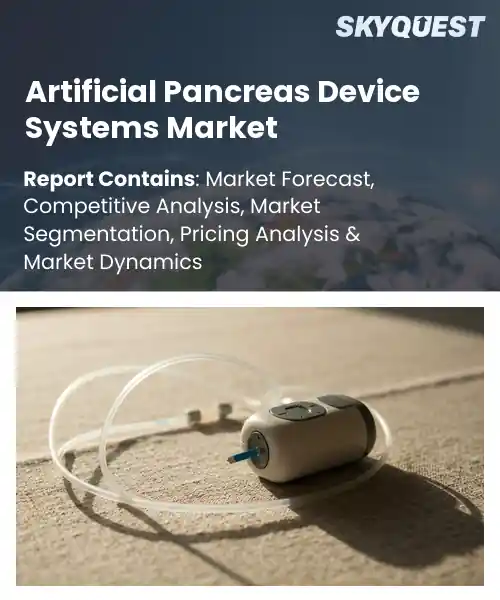
Artificial Pancreas Device Systems Market
Report ID: SQMIG35A3462
Report ID: SQMIG35A3462
[email protected]
USA +1 351-333-4748
Report ID:
SQMIG35A3462 |
Region:
Global |
Published Date: May, 2026
Pages:
157
|Tables:
171
|Figures:
79


Global Artificial Pancreas Device Systems Market size was valued at USD 332.6 Million in 2024 and is poised to grow from USD 391.14 Million in 2025 to USD 1430.83 Million by 2033, growing at a CAGR of 17.6% during the forecast period (2026-2033).
The main factor behind the global artificial pancreas device systems market growth is the overlap of diabetes numbers going up and also fast progress in continuous glucose monitoring and automated insulin delivery algorithms. In practice, the market is made of those integrated setups that blend insulin pumps, glucose sensors, and control software, so they can handle glycemic management with less hands-on work, and the reason people care is it takes diabetes care away from reactive, clinic only fixes and turns it into more daily proactive management that can lower complications.
Moreover, with bigger acceptance, more regulatory clarity, and payer coverage, that’s another big driver for expansion, because clearer approval paths and reimbursement make the adoption risk smaller and also bring in more investment. When clinical evidence keeps showing fewer minutes spent in hypoglycemia, and better average glucose, providers start folding these systems into standard care routines. After that hospitals and clinics often set up remote monitoring programs, which helps reduce readmissions and also cuts down clinic workload, somewhat quietly but steadily. In day-to-day life patients typically see fewer severe episodes and a better overall quality of life, while manufacturers respond by scaling output and teaming up, including in emerging markets where there’s unmet demand and healthcare spending is rising, thus, growing opportunities.
AI is improving glycemic control in artificial pancreas device systems by bringing together continuous glucose monitoring with predictive and adaptive algorithms, that see the glucose direction ahead of time then adjust insulin delivery before problems get worse. Major factors include personalized dosing that keeps learning from the person, sensor fusion that sharpens the inputs, and automation that cuts down the mental load of manual calculations. Right now, the market has commercial closed loop systems using these ideas to reduce lows, smooth out glucose swings, and make daily management simpler. Regulatory approvals, and software based upgrades, are helping the systems slide out of strictly trial settings and into broader real-world usage.
Market snapshot - (2026-2033)
Global Market Size
USD 332.6 Million
Largest Segment
Control-to-Range (CTR) Systems
Fastest Growth
Control-to-Target (CTT) Systems
Growth Rate
17.6% CAGR
To get more insights on this market click here to Request a Free Sample Report
The global artificial pancreas device systems market is segmented by device type, component, age group, distribution channel, application, end user, and region. Based on device type, the market is segmented into Threshold Suspend Devices, Control-to-Range (CTR) Systems and Control-to-Target (CTT) Systems. Based on component, the market is segmented into Continuous Glucose Monitoring (CGM) Systems, Insulin Pumps, Control Algorithms & Software and Others. Based on age group, the market is segmented into Pediatric, Adult and Geriatric. Based on distribution channel, the market is segmented into Hospital Pharmacies, Retail Pharmacies and Online Pharmacies & Direct Sales. Based on application, the market is segmented into Type 1 Diabetes and Type 2 Diabetes. Based on end user, the market is segmented into Hospitals & Diabetes Clinics, Home Care Settings and Ambulatory Care Centers. Based on region, the market is segmented into North America, Europe, Asia Pacific, Latin America and Middle East & Africa.
As per the artificial pancreas device systems market analysis, the Control to Target Systems segment dominates since these systems deliver fully closed loop regulation, and it directly aims at preset glucose goals, so steadier automated insulin delivery and less need for all that manual fiddling are offered. Their clinical validation and the observed improvements in glycemic stability help build clinician confidence, which then encourages integration into the pump and sensor ecosystems people already use. On top of that the interoperability is solid, regulatory routes are already well established, and vendors keep emphasizing safety and reliability, so they become entrenched as the main answers for tricky diabetes care.
However, the Control to Range Systems are starting to show up as the fastest growing slice, largely because simpler control logic reduces development barriers , and it helps commercialization move faster. Improvements in adaptive algorithms, and better compatibility with existing sensors. Combined with clinician interest in more pragmatic closed loop tools , this is pushing adoption wider, and it also opens up room for fresh product and service models.
According to the artificial pancreas device systems market forecast, the continuous glucose monitoring Systems segment still dominates overall because these sensors provide nonstop, near real time glucose readings, and those readings are what let automated dosing decisions work, enabling closed loop operation across different device platforms. With better accuracy, longer sensor life, and smoother connectivity, clinicians and patients tend to trust them more, which then leads to tighter integration with pumps and control software. And ongoing progress in calibration free use, wireless data transport, and analytics capabilities basically makes these systems key enablers for product differentiation, along with clinical uptake.
Whereas, the Control Algorithms and Software category is predicted to have the largest artificial pancreas device systems market share because machine learning, along with personalization, makes dosing more exact. Regulatory momentum for software as a medical device, increased demand for cloud based analytics and remote monitoring, and new business models that support algorithm updates are all accelerating rollouts, and expanding commercial chances.
To get detailed segments analysis, Request a Free Sample Report
As per the artificial pancreas device systems market regional forecast, North America is leading the market, like it’s a mix of mature health care infrastructure, advanced clinical research, and well concentrated industry presence. There is robust, almost everyday collaboration among medical centers, tech firms and payers, and that speeds up device development and clinical adoption. Then there’s a regulatory setup that feels favorable, and reimbursement pathways that look clear enough, which really backs commercialization and patient access. On top of that , strong patient advocacy, clinician familiarity with diabetes management technologies, and the fact that digital health integration is everywhere, all push demand for closed loop solutions.
United States Artificial Pancreas Device Systems Market
In the United States, the Artificial Pancreas Device Systems sector benefits from deep clinical know-how, lots of medtech headquarters clustered in the right places, and a reimbursement environment that’s well developed, which makes adoption easier. High clinician engagement levels, patient awareness that keeps growing, and established digital health ecosystems help everything connect with closed loop therapies. Strong academic research and ongoing industry partnerships drive those iterative product changes, while experienced device manufacturers and distribution networks support commercialization and keep service available across different care settings.
Canada Artificial Pancreas Device Systems Market
In Canada , the Artificial Pancreas Device Systems industry is shaped by a publicly funded healthcare environment, with heavy emphasis on equitable access, and centralized procurement pathways that affect when adoption happens. Clinical centers of excellence and research networks back evidence generation, and clinician training. Academia, hospital systems, and newer technology firms often collaborate on pilot programs and validation efforts. Patient advocacy and telehealth integration also push use along regional care pathways, even where access can vary a bit.
Europe is witnessing rapid expansion in the artificial pancreas device systems market because healthcare policy attention is aligning, clinical validation keeps growing, and industry activity is strategic. Regulatory alignment and reimbursement pilots in multiple countries reduce early friction for market entry, and make adoption more likely across more regions. Specialized diabetes clinic networks are expanding , clinician expertise is building, and that supports integration into standard care. Local medtech players and multinational companies are moving into partnerships that improve sensor performance, adapt algorithms to local needs, and design service models that fit national health systems. Patient organizations and professional societies help with awareness and guideline formation, while investments in interoperability and telehealth infrastructure enable remote monitoring and more consistent chronic care management , which together strengthens regional uptake and innovation. Even with diverse national approaches, like stronger industry ecosystems in the leading markets and agile regulatory engagement, the goal is basically turning clinical evidence into scalable care pathways across the region.
Germany Artificial Pancreas Device Systems Market
For Germany, the Artificial Pancreas Device Systems Market is driven by a strong medtech manufacturing base, a clinical research infrastructure that’s well developed, and structured health technology assessment processes that support evidence based adoption. Specialized diabetes centers and clinician expertise encourage use of advanced management systems. Coordinated reimbursement pathways and hospital procurement practices make integration within standard care more straightforward. Collaboration between local industry, research organizations , and health providers helps push product refinement faster and supports clinical implementation.
United Kingdom Artificial Pancreas Device Systems Market
In the United Kingdom, the Artificial Pancreas Device Systems Market is marked by strong digital health adoption, active clinical pilot programs, and an innovation ecosystem that supports quicker deployment. Startups, academic centers, and health care providers collaborate on initiatives that accelerate testing and guideline development. A pragmatic regulatory approach, paired with engagement with health technology assessment bodies, helps open reimbursement pathways. Patient engagement and integrated telehealth services also support broader uptake across specialist care networks.
France Artificial Pancreas Device Systems Market
The French Artificial Pancreas Device Systems Market is developing through focused clinical research, rising clinician familiarity, and pilot initiatives that highlight value for standard care. Organization under the national health system, and regional diabetes networks, shapes procurement decisions and adoption timing. Hospitals, research institutes, and medtech companies partner up to adapt solutions to local clinical practice. Patient associations support awareness and education, while connections to ambulatory care and telemonitoring platforms help expand usage across more care settings.
Asia Pacific is strengthening its role in the artificial pancreas device systems market, driven by targeted innovation, better electronics manufacturing, and more clinical involvement. A bunch of leading markets are spending on sensor development, algorithm tuning and, integration with digital health platforms, to match regional care needs more closely. In parallel, joint efforts between local technology players and larger medtech firms help move know how faster and also make it easier to localize the solutions. Meanwhile, clinicians are getting more hands on exposure, and specialized diabetes centers are backing clinical testing. On top of that, government health programs and shifting reimbursement rules make broader rollout feel more realistic. There’s also a clear focus on compact device design, smooth connectivity, and user centric interfaces, which fits local preferences and improves day to day usability , so the region looks more like an emerging hub for both building and adopting these systems. Academic collaborations and clinical trial activity further support regional approaches, and they help with regulatory discussions that are aligned to local pathways.
Japan Artificial Pancreas Device Systems Market
The artificial pancreas device systems market in Japan benefits from deep electronics knowhow, strong clinical research capacity, and ongoing collaboration between tech firms and healthcare organizations. There is a strong emphasis on precision engineering and device miniaturization, which supports building systems that are more approachable for everyday users. Specialized diabetes centers and practitioner networks allow clinical evaluation and ongoing refinement. Policy support for digital health, with attention on patient first care models, strengthens how these tools fit into routine practice and encourages both adoption and continued innovation.
South Korea Artificial Pancreas Device Systems Market
In South Korea, the artificial pancreas device systems market draws on electronics capability and semiconductor expertise, and a lively startup scene, and it stays tied to collaboration between technology companies and healthcare institutions. Government programs together with industry partnerships back up clinical validation and make regulatory engagement easier to manage. Large hospitals and specialist clinics also play a role, especially by supporting clinician training and clinical assessment. The overall direction keeps pointing toward connectivity, mobile integration, and patient centered design, which helps adoption in hospital environments. At the same time, export focused manufacturers support customization for local market needs, even when requirements can differ by region.
To know more about the market opportunities by region and country, click here to
Buy The Complete Report
Enhanced Glycemic Control Through Automation
Advances In Sensor Accuracy
Cost Barriers To Accessibility
Regulatory Approval Complexity
Request Free Customization of this report to help us to meet your business objectives.
The competitive landscape is formed by regulatory milestones, consolidation via strategic acquisitions, and some technical licensing arrangements that nudge the APDS rollout forward. Big medtech players lean on M&A to lock in algorithms and platform integrations, like Abbott did when it acquired Bigfoot. On the other side, licensing and partnerships, for example TypeZero’s agreement with EOFlow, and also product approvals like CamDiab’s fully closed loop clearance, all of that makes the direct, head to head competition more intense.
Top Player’s Company Profile
Recent Developments in the Artificial Pancreas Device Systems Market
SkyQuest’s ABIRAW (Advanced Business Intelligence, Research & Analysis Wing) is our Business Information Services team that Collects, Collates, Correlates, and Analyses the Data collected by means of Primary Exploratory Research backed by robust Secondary Desk research.
As per SkyQuest analysis, the global artificial pancreas device systems market is mostly pushed forward by the rise in diabetes prevalence along with quick improvements in continuous glucose monitoring and automated insulin delivery algorithms, this is a core driver for broader uptake in clinics and for better day to day glycemic management. A restraint is still there though, it’s the ongoing cost barrier, like high purchase prices for devices and ongoing consumable bills that can reduce access. In terms of geography, North America stays out front because it has well-established healthcare infrastructure, solid clinical research activity, and clearer reimbursement pathways, and Control-to-Target systems are the leading segment since fully closed-loop control tends to deliver steady, proven results. Another driver is growing regulatory clarity and payer coverage, which lowers commercialization risk and encourages investment.
| Report Metric | Details |
|---|---|
| Market size value in 2024 | USD 332.6 Million |
| Market size value in 2033 | USD 1430.83 Million |
| Growth Rate | 17.6% |
| Base year | 2024 |
| Forecast period | (2026-2033) |
| Forecast Unit (Value) | USD Million |
| Segments covered |
|
| Regions covered | North America (US, Canada), Europe (Germany, France, United Kingdom, Italy, Spain, Rest of Europe), Asia Pacific (China, India, Japan, Rest of Asia-Pacific), Latin America (Brazil, Rest of Latin America), Middle East & Africa (South Africa, GCC Countries, Rest of MEA) |
| Companies covered |
|
| Customization scope | Free report customization with purchase. Customization includes:-
|
To get a free trial access to our platform which is a one stop solution for all your data requirements for quicker decision making. This platform allows you to compare markets, competitors who are prominent in the market, and mega trends that are influencing the dynamics in the market. Also, get access to detailed SkyQuest exclusive matrix.
Table Of Content
Executive Summary
Market overview
Parent Market Analysis
Market overview
Market size
KEY MARKET INSIGHTS
COVID IMPACT
MARKET DYNAMICS & OUTLOOK
Market Size by Region
KEY COMPANY PROFILES
Methodology
For the Artificial Pancreas Device Systems Market, our research methodology involved a mixture of primary and secondary data sources. Key steps involved in the research process are listed below:
1. Information Procurement: This stage involved the procurement of Market data or related information via primary and secondary sources. The various secondary sources used included various company websites, annual reports, trade databases, and paid databases such as Hoover's, Bloomberg Business, Factiva, and Avention. Our team did 45 primary interactions Globally which included several stakeholders such as manufacturers, customers, key opinion leaders, etc. Overall, information procurement was one of the most extensive stages in our research process.
2. Information Analysis: This step involved triangulation of data through bottom-up and top-down approaches to estimate and validate the total size and future estimate of the Artificial Pancreas Device Systems Market.
3. Report Formulation: The final step entailed the placement of data points in appropriate Market spaces in an attempt to deduce viable conclusions.
4. Validation & Publishing: Validation is the most important step in the process. Validation & re-validation via an intricately designed process helped us finalize data points to be used for final calculations. The final Market estimates and forecasts were then aligned and sent to our panel of industry experts for validation of data. Once the validation was done the report was sent to our Quality Assurance team to ensure adherence to style guides, consistency & design.
Analyst Support
Customization Options
With the given market data, our dedicated team of analysts can offer you the following customization options are available for the Artificial Pancreas Device Systems Market:
Product Analysis: Product matrix, which offers a detailed comparison of the product portfolio of companies.
Regional Analysis: Further analysis of the Artificial Pancreas Device Systems Market for additional countries.
Competitive Analysis: Detailed analysis and profiling of additional Market players & comparative analysis of competitive products.
Go to Market Strategy: Find the high-growth channels to invest your marketing efforts and increase your customer base.
Innovation Mapping: Identify racial solutions and innovation, connected to deep ecosystems of innovators, start-ups, academics, and strategic partners.
Category Intelligence: Customized intelligence that is relevant to their supply Markets will enable them to make smarter sourcing decisions and improve their category management.
Public Company Transcript Analysis: To improve the investment performance by generating new alpha and making better-informed decisions.
Social Media Listening: To analyze the conversations and trends happening not just around your brand, but around your industry as a whole, and use those insights to make better Marketing decisions.
REQUEST FOR SAMPLE
 REQUEST FREE CUSTOMIZATION
Global Artificial Pancreas Device Systems Market size was valued at USD 332.6 Million in 2024 and is poised to grow from USD 391.14 Million in 2025 to USD 1430.83 Million by 2033, growing at a CAGR of 17.6% during the forecast period (2026-2033).
The competitive landscape is shaped by regulatory milestones, consolidation through strategic acquisitions, and technical licensing that accelerate APDS rollout. Large medtechs use M&A to secure algorithms and platform integrations, as Abbott did when it acquired Bigfoot. Licensing and partnerships, such as TypeZero’s deal with EOFlow, and recent product approvals like CamDiab’s fully closed loop clearance, intensify head-to-head competition. 'Medtronic plc', 'Tandem Diabetes Care, Inc.', 'Insulet Corporation', 'Dexcom, Inc.', 'Abbott Laboratories', 'Beta Bionics, Inc.', 'Bigfoot Biomedical, Inc.', 'Diabeloop SA', 'EOFlow Co., Ltd.', 'F. Hoffmann-La Roche Ltd', 'Ypsomed AG', 'Senseonics Holdings, Inc.', 'Ascensia Diabetes Care Holdings AG', 'Pancreum, Inc.', 'Cellnovo Group SA', 'TypeZero Technologies, LLC', 'CamDiab Ltd', 'A. Menarini Diagnostics S.r.l.', 'SOOIL Development Co., Ltd.', 'MicroTech Medical (Hangzhou) Co., Ltd.'
Artificial pancreas systems integrate continuous glucose monitoring and automated insulin delivery to maintain tighter glycemic control, reducing the burden of manual dosing decisions for patients and caregivers. By delivering insulin based on real time glucose trends, these systems improve daily glucose stability and reduce variability, which can enhance patient confidence and adherence. Improved therapeutic outcomes and perceived quality of life encourage clinician recommendations and payer interest, thereby supporting broader adoption and sustained market growth through increased demand for automated, patient centered diabetes management solutions.
𝐈𝐍𝐓𝐄𝐆𝐑𝐀𝐓𝐄𝐃 𝐖𝐄𝐀𝐑𝐀𝐁𝐋𝐄 𝐄𝐂𝐎𝐒𝐘𝐒𝐓𝐄𝐌𝐒: Adoption of interoperable sensors and consumer wearables is driving seamless integration of artificial pancreas devices into daily life, enabling continuous data sharing across health platforms and care teams. This trend fosters user-centric experiences, streamlines remote monitoring workflows, and encourages partnerships among device manufacturers, software developers, and payers. Emphasis on compatibility and user convenience accelerates ecosystem development, supports longitudinal care coordination, and enhances device acceptance among patients seeking discreet, connected solutions aligned with broader digital health strategies and scalable clinical workflows.
Why does North America Dominate the Global Artificial Pancreas Device Systems Market? |@12


Want to customize this report? This report can be personalized according to your needs. Our analysts and industry experts will work directly with you to understand your requirements and provide you with customized data in a short amount of time. We offer $1000 worth of FREE customization at the time of purchase.
Feedback From Our Clients


 USA (+1) 351-333-4748

