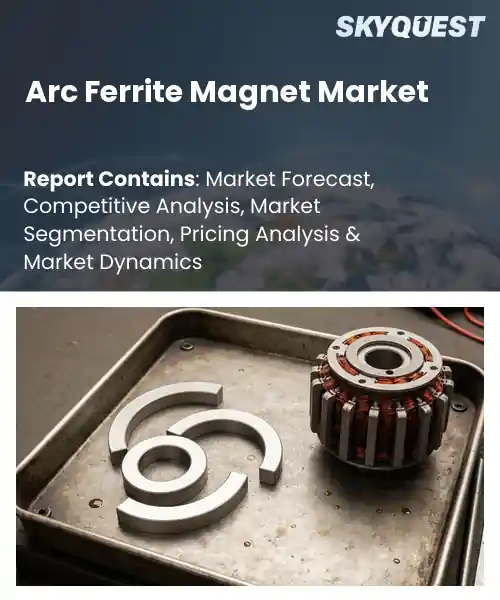
Arc Ferrite Magnet Market
Report ID: SQMIG15E3280
Report ID: SQMIG15E3280
[email protected]
USA +1 351-333-4748
Report ID:
SQMIG15E3280 |
Region:
Global |
Published Date: February, 2026
Pages:
157
|Tables:
125
|Figures:
77


Global Arc Ferrite Magnet Market size was valued at USD 8.2 Billion in 2024 and is poised to grow from USD 8.66 Billion in 2025 to USD 13.39 Billion by 2033, growing at a CAGR of 5.6% during the forecast period (2026-2033).
The primary driver of the arc ferrite magnet market is accelerating demand for compact, cost-efficient permanent magnets in electrified motion systems, which has shifted a niche ceramic product into a component that influences design choices across industries. Arc ferrite magnets are curved segments used in motors and generators where radial magnetization and air gaps raise torque density, so technology matters as appliance makers and renewable energy developers pursue lighter, lower-cost magnetic solutions. Historically the market progressed from basic ferrite blocks for loudspeakers to precision molded and sintered arc geometries for brushless motors in automotive actuators and wind turbine pitch systems, reflecting technical maturation and broader adoption.
A key trend driving the global arc ferrite magnet sector is material economics, because volatile rare-earth prices and supply insecurity drive designers toward ferrite options that provide stable cost and performance. As manufacturers are converting to arc ferrites for their auxiliary EV motors, HVAC blowers and appliance compressors, the predictable nature of procurement will lower system costs and encourage OEMs to redesign the rotor for segmented arcs and use precision molding and bonding. This change in engineering will lead to increased torque density and consistent production, thus creating new opportunities in automotive actuators with low-to-mid torque requirements, small wind generators and industrial automation, thus creating a positive feedback process of adoption, economies of scale and innovation.
How is AI Improving Production Efficiency in the Arc Ferrite Magnet Market?
Through enhanced processing control and reduction of scrap, AI is creating higher levels of productivity within the Arc Ferrite Magnet Industry. Key components include machine vision systems used for surface/ dimensional inspection of parts and predictive controls for sintering and firing operations. Current trends demonstrate an increase in manufacturer use of these technologies in emphasizing stable batch quality and quick recovery to production. Market demand from motors and consumer electronics is pushing scale and automation. Practical instances include AI guided robotic handling, real time defect detection and adaptive recipe tuning that together improve throughput and yield and make plants more responsive to variable feedstock.
Market snapshot - 2026-2033
Global Market Size
USD 8.2 Billion
Largest Segment
Anisotropic Magnets
Fastest Growth
Anisotropic Magnets
Growth Rate
5.6% CAGR
To get more insights on this market click here to Request a Free Sample Report
Global arc ferrite magnet market is segmented by type of magnet, application area, form factor, end-use industry and region. Based on type of magnet, the market is segmented into isotropic magnets and anisotropic magnets. Based on application area, the market is segmented into electric motors, loudspeakers & audio devices, sensors, actuators, magnetic assemblies, generators and others. Based on form factor, the market is segmented into disc magnets, ring magnets and block magnets. Based on end-use industry, the market is segmented into automotive, consumer electronics, home appliances, industrial machinery, renewable energy, medical devices, robotics & automation and others. Based on region, the market is segmented into North America, Europe, Asia Pacific, Latin America and Middle East & Africa.
Based on the global arc ferrite magnet market forecast, anisotropic magnets segment dominates because their directional magnetic orientation yields higher coercivity and energy product in arc ferrite compositions, enabling stronger and more stable magnetic fields for demanding applications. Due to this manufacturing process, designers can manipulate the operation of magnets by controlling the grain alignment of the materials used to manufacture magnets. This leads to higher torque density and thermal stability for a magnet; therefore, anisotropic arc ferrite (ANE) magnets are typically selected when the performance characteristics of electric motors or other devices require high and consistent performance.
However, Isotropic Magnets are emerging as the most rapidly expanding area due to lower production costs and greater flexibility in multi directional applications, supporting cost sensitive designs and large volume manufacturing. They are easier to process therefore consumers will be more likely to want to use these in products with a focus on consumer or cost benefit which will help to speed up their market penetration and give rise to new opportunities for large scale manufacture of arc ferrite magnets.
Electric Motors segment dominates because arc ferrite magnets provide cost effective magnetic solutions that balance performance and manufacturability for a wide range of motor types, from small precision drives to larger traction units. The strength and compatibility of their different types of motors drive designers who are looking for reliable torque generation and thermal durability to use them, therefore creating ongoing OEM demands as manufacturers try to modify their electric motors for higher efficiency and longer life using arc ferrite technology.
However, Sensors are witnessing the strongest growth momentum as miniaturization and precision sensing needs drive demand for compact, stable arc ferrite magnets that retain performance in small footprints. More innovative developments of the shape of magnets along with their low noise characteristics allow for greater integration into both Internet of Things (IoT) connectivity and contactless detection, thereby creating an expanding realm of potential application areas as well as new supplier opportunities with the development of ongoing product design innovation.
To get detailed segments analysis, Request a Free Sample Report
As per the global arc ferrite magnet market analysis, Asia Pacific dominates due to a highly integrated manufacturing ecosystem that combines raw material access, large scale production capabilities and concentrated demand from electronics and automotive industries. Having well established supply chains provide both the opportunity for low cost sourcing and quick scaling. Advanced research facilities in major markets also provide key markets for innovative materials and upgraded ferrite formulations. An established OEM base within consumer electronics, automotive electrification & industrial equipment allows for continuous application development and product re-engineering through the entire OEM chain. Government support through manufacturing clusters and logistics promotes regional competitiveness, thus providing suppliers in the area with the ability to service a wide range of applications and strengthen their leadership position through both commodity and high-end applications of arc ferrite products.
Arc Ferrite Magnet Market benefits from an established high precision manufacturing ecosystem and materials science expertise that supports development of premium ferrite formulations for motors and electronics. The strong cooperation between producers of goods and scientific research facilities is improving product performance. The high level of quality that manufacturers adhere to is driving up the demand for products by both the automotive and robotics industries. As a result, Japan has evolved into a hub for companies requiring stable processes and engineering assistance in order to manufacture their product lines utilizing these manufacturers’ supply chains.
Arc Ferrite Magnet Market in South Korea is driven by a concentrated electronics and automotive manufacturing base that demands high performance magnetic components and innovation. Product performance improvement is driven by close collaboration between manufacturers of finished products and research labs conducting scientific research. High-quality production standards from manufacturers result in demand increases from both the automotive and robotics sectors for manufactured products. Consequently, Japan has developed into a centre for business continuity and engineering assistance for companies that use manufacturer-based supply chains to manufacture their products.
Europe is experiencing rapid expansion in the Arc Ferrite Magnet Market driven by a combination of industrial modernization, electrification of transport, and policy frameworks that encourage local sourcing and sustainable component supply chains. Magnet technology utilizing ferrite magnets (high-energy permanent magnets) will be quickly and readily developed for use in various types of motors, generators, and actuators by leveraging established engineering design centers populated by dense manufacturing clusters. The collaboration between the academic community, raw materials suppliers, and original equipment manufacturers (OEMs) will advance and expedite the use of customized geometries and grades of magnets through innovation and commercialization. Suppliers commit to quality, traceability, and being environmentally compliant to satisfy meet the requirements of demanding customers, and cooperative efforts to reduce foreign "import-dependence" will help foster investment in a strong domestic manufacturing base and supplier development in that region. Invests in R&D centers, test centers, and workforce development will support better-performing magnet compositions and more complex arc geometries.
Arc Ferrite Magnet Market in Germany is anchored by a robust automotive and industrial equipment manufacturing ecosystem that prioritizes precision, reliability and continuity. Due to the high performance expectations of equipment manufacturers (OEMs), there will be continued demand for highly specialized magnet products and consistent manufacturing processes. Supplier relationships and a focus on process controls support Germany's continued regional leadership in sourcing ferrite products for the above applications.
Arc Ferrite Magnet Market in United Kingdom is characterized by a shift toward advanced manufacturing clusters and rising procurement from technology sectors. Research facilities and flexible suppliers cooperating in the development of customized ferrite materials for specialized electric motors, sensors and other niche industrial applications will help build a supply chain around demand for these materials. Increased emphasis on design for manufacturability and supplier agility should allow manufacturers to take advantage of these business opportunities. Supportive policies and an expanding base of application engineers accelerate entry and diversification of supply.
Arc Ferrite Magnet Market in France is experiencing adoption driven by commitments to electrified transport and renewable energy projects that favor cost effective magnetic components. Both industrial modernization growth and the investment into material science platforms help to scale production capabilities. Working closely between component makers, universities, and equipment manufacturers supports bringing ferrite shapes and grades to market. Emphasis on supply chain resilience and local sourcing promotes an environment for new entrants.
North America is strengthening its position in the Arc Ferrite Magnet Market through strategic moves to diversify supply chains, support domestic production and accelerate materials innovation. The ability to produce specialized ferrite shapes at higher performance grades is improved through a combination of targeted manufacturing investments, advanced production technologies, and partnerships between industry and academic/governmental/research.x292; organizations. By using a combination of targeted investments in manufacturing capacity, advanced production technologies and partnerships between the industry and research organizations, the ability to manufacture specialty ferrite shapes and higher performance grades is being improved. Demand from the transportation, industrial automation and defense industries is creating a strong demand for reliable, certified components, while suppliers are focused on both traceability and end-to-end quality assurance. As a result, there is an increased emphasis on workforce development, regionally based supplier networks and flexible production models, which will increase resilience and improve speed of response to changing application requirements throughout North America. Facilities for regional testing and certification, as well as initiatives for managing the lifecycle of materials and for recycling.
Arc Ferrite Magnet Market in United States is supported by research infrastructure, manufacturing expertise and demand from automotive, aerospace and industrial automation sectors. Emphasis on certification, quality management and supply chain transparency helps domestic suppliers meet exacting customer requirements. Partnerships between industry groups and laboratories accelerate material qualification and production techniques. Focus on resilient sourcing, flexible production lines and service offerings strengthens readiness for widespread adoption across end use markets.
Arc Ferrite Magnet Market in Canada benefits from access to raw material supply chains and a manufacturing sector that supports customized production. Collaboration between material producers, universities and component fabricators promotes applied research and transfer of advanced ferrite processes to production. Through its proximity to North American OEMs and efficient logistics, exporters have access to a dependable supply chain for exporting/transborder/international shipments. Emphasis on sustainability via sourcing and stewardship due to the above also attracts those customers looking for responsible procurement options.
To know more about the market opportunities by region and country, click here to
Buy The Complete Report
Electric Vehicle Traction Motors
The use of arc ferrite magnets in traction motors is becoming increasingly popular because of their magnetic characteristics that permit compact and efficient motor designs, resulting in smaller and lighter motors with maintained torque. There will be an increasing demand for the supply and integration of these types of magnet solutions into traction motor assemblies as manufacturers continue to emphasize energy efficiency and drivability. Therefore, the need for magnets that support high flux densities and thermal stability has increased, encouraging the supply of arc ferrite solutions to fulfil this demand and supporting manufacturers’ goals of economically producing a product that meets the requirements for electric vehicles.
Renewable Energy Generator Integration
Integration of arc ferrite magnets in renewable energy generators enhances compactness and magnetic performance for direct drive configurations, enabling developers to design turbines and other generators with fewer mechanical components and improved reliability. Due to focus on life cycle efficiency and minimized maintenance needs, renewable project designers will prefer magnets which provide consistent flux, have little chance of losing their magnetism under changes in operating conditions, and therefore encourage equipment manufacturers to utilize arc ferrite solutions as standard. The trend toward using arc ferrite solutions also helps suppliers to expand their business and create new innovations in components used for renewable energy applications.
Raw Material Supply Constraints
The limitations on the use of specific types of raw materials and insufficient processing capabilities for ferrite products can inhibit market growth by creating a supply chain bottleneck and creating uncertainty in the procurement process for manufacturers and end users. Restricted availability of feedstock or complicated logistical sourcing of feedstock can cause manufacturers to have difficulty meeting their production schedules and making long-term commitments to supply. This uncertainty results in manufacturers being extremely cautious about the speed in which they can ramp-up production and maintain inventories, as well as causing them to use alternate materials and suppliers.
Recycling and End of Life
The recycling infrastructure is limited and there are technical obstacles for recovering ferrites from products that are at the end of their life, which limits circular sourcing and increases dependency on primary production resulting in slow global arc ferrite magnet market growth over time. The complex processes to separate ferrite and variable designs in products make it impractical to efficiently reclaim material and discourages investment into closed loop systems. Regulatory requirements regarding product stewardship increase compliance obligations for producing manufacturers and can shift resources away from innovation and expansion.
Request Free Customization of this report to help us to meet your business objectives.
Competition in the global arc ferrite magnet market outlook is driven by raw material and supply chain pressures, prompting incumbents to expand capacity and pursue targeted deals. Firms are executing capacity expansions and technology partnerships such as TDK’s ferrite line upgrades. Novel businesses are encouraging alternative use of materials, as well as innovating in the production process. Examples of those efforts include magnet agnostic Conifer, as well as government-backed manufacturers like Vulcan Elements (onshoring).
Electrification Driving Demand: Because of the growing need for electric-powered cars, trucks, trains, and so on, many manufacturers are producing Arc Ferrite Magnets to meet demand for these types of electric motors. Arc Ferrite Magnets have been designed to provide a balance between performance and cost, while enabling higher torque density and thermal stability in the latest electric motors. As a result, the size of electric motors has been decreased as well; therefore, suppliers and original equipment manufacturers (OEMs) must work together to ensure that new designs can be developed quickly through coordinated design integration, effective supply chain coordination, and timely qualification to reduce the time it takes to develop new electric motor designs.
Advanced Magnet Design Adoption: As per the global arc ferrite industry analysis, design advances in sintering, grain alignment, and hybrid magnet assemblies are enabling arc ferrite variants with improved flux density and demagnetization resistance tailored to specific end uses. Because OEMs are specifying more custom geometries and material grades to drive down costs and improve reliability at a system-level, the development of product portfolios and co-development partnerships has increased as well. The need for scalable manufacturing processes and consistent quality will speed up the development and use of engineered ferrite products throughout appliance, renewable energy system, and industrial drive applications, presenting opportunities for suppliers who want to position themselves differently in the marketplace.
SkyQuest’s ABIRAW (Advanced Business Intelligence, Research & Analysis Wing) is our Business Information Services team that Collects, Collates, Correlates, and Analyses the Data collected by means of Primary Exploratory Research backed by robust Secondary Desk research.
As per SkyQuest analysis, the global arc ferrite magnet industry is being propelled primarily by accelerating demand for compact, cost-efficient permanent magnets in electrified motion systems, while a second important driver is broad electrification across transportation and industrial applications pushing OEMs toward higher torque density solutions. Growth is constrained by raw material supply constraints that can create bottlenecks and procurement uncertainty. Due to their higher directional performance, anisotropic magnets are the leading product in the marketplace. The largest market will continue to be in the Asia Pacific region due to its integrated manufacturing capabilities, as well as access to materials and an abundance of electronic and automotive consumers. Suppliers are focusing on precision molding, Artificial Intelligence (AI) driven improvements in production processes, and co-developing solutions with Original Equipment Manufacturers (OEM) to take advantage of the growing number of opportunities presented by motors, sensors, and renewable generators.
| Report Metric | Details |
|---|---|
| Market size value in 2024 | USD 8.2 Billion |
| Market size value in 2033 | USD 13.39 Billion |
| Growth Rate | 5.6% |
| Base year | 2024 |
| Forecast period | 2026-2033 |
| Forecast Unit (Value) | USD Billion |
| Segments covered |
|
| Regions covered | North America (US, Canada), Europe (Germany, France, United Kingdom, Italy, Spain, Rest of Europe), Asia Pacific (China, India, Japan, Rest of Asia-Pacific), Latin America (Brazil, Rest of Latin America), Middle East & Africa (South Africa, GCC Countries, Rest of MEA) |
| Companies covered |
|
| Customization scope | Free report customization with purchase. Customization includes:-
|
To get a free trial access to our platform which is a one stop solution for all your data requirements for quicker decision making. This platform allows you to compare markets, competitors who are prominent in the market, and mega trends that are influencing the dynamics in the market. Also, get access to detailed SkyQuest exclusive matrix.
Table Of Content
Executive Summary
Market overview
Parent Market Analysis
Market overview
Market size
KEY MARKET INSIGHTS
COVID IMPACT
MARKET DYNAMICS & OUTLOOK
Market Size by Region
KEY COMPANY PROFILES
Methodology
For the Arc Ferrite Magnet Market, our research methodology involved a mixture of primary and secondary data sources. Key steps involved in the research process are listed below:
1. Information Procurement: This stage involved the procurement of Market data or related information via primary and secondary sources. The various secondary sources used included various company websites, annual reports, trade databases, and paid databases such as Hoover's, Bloomberg Business, Factiva, and Avention. Our team did 45 primary interactions Globally which included several stakeholders such as manufacturers, customers, key opinion leaders, etc. Overall, information procurement was one of the most extensive stages in our research process.
2. Information Analysis: This step involved triangulation of data through bottom-up and top-down approaches to estimate and validate the total size and future estimate of the Arc Ferrite Magnet Market.
3. Report Formulation: The final step entailed the placement of data points in appropriate Market spaces in an attempt to deduce viable conclusions.
4. Validation & Publishing: Validation is the most important step in the process. Validation & re-validation via an intricately designed process helped us finalize data points to be used for final calculations. The final Market estimates and forecasts were then aligned and sent to our panel of industry experts for validation of data. Once the validation was done the report was sent to our Quality Assurance team to ensure adherence to style guides, consistency & design.
Analyst Support
Customization Options
With the given market data, our dedicated team of analysts can offer you the following customization options are available for the Arc Ferrite Magnet Market:
Product Analysis: Product matrix, which offers a detailed comparison of the product portfolio of companies.
Regional Analysis: Further analysis of the Arc Ferrite Magnet Market for additional countries.
Competitive Analysis: Detailed analysis and profiling of additional Market players & comparative analysis of competitive products.
Go to Market Strategy: Find the high-growth channels to invest your marketing efforts and increase your customer base.
Innovation Mapping: Identify racial solutions and innovation, connected to deep ecosystems of innovators, start-ups, academics, and strategic partners.
Category Intelligence: Customized intelligence that is relevant to their supply Markets will enable them to make smarter sourcing decisions and improve their category management.
Public Company Transcript Analysis: To improve the investment performance by generating new alpha and making better-informed decisions.
Social Media Listening: To analyze the conversations and trends happening not just around your brand, but around your industry as a whole, and use those insights to make better Marketing decisions.
REQUEST FOR SAMPLE
 REQUEST FREE CUSTOMIZATION
Global Arc Ferrite Magnet Market size was valued at USD 8.2 Billion in 2024 and is poised to grow from USD 8.66 Billion in 2025 to USD 13.39 Billion by 2033, growing at a CAGR of 5.6% during the forecast period (2026-2033).
Competition in the global arc ferrite magnet market is driven by raw material and supply chain pressures, prompting incumbents to expand capacity and pursue targeted deals. Firms are executing capacity expansions and technology partnerships such as TDK’s ferrite line upgrades. Startups push material substitution and manufacturing innovation exemplified by magnet agnostic Conifer and government backed onshoring plays like Vulcan Elements. 'Arnold Magnetic Technologies', 'Hitachi Metals', 'Saint-Gobain', 'Adams Magnetic Products', 'Bunting Magnetics', 'Eclipse Magnetics', 'Magcraft', 'Magnet Applications', 'Xtreme Magnetics', 'Magnets4U', 'Galaxy Magnets', 'Magnetic Hold', 'Master Magnetics', 'Nippon Magnetics', 'vand Magnetic Technologies', 'Alliance LLC', 'KJ Magnetics', 'Morgan Advanced Materials', 'Dura Magnetics', 'Magnet Sales & Services'
Arc ferrite magnets find growing preference in traction motors because their magnetic properties enable compact, efficient motor designs that reduce size and weight while maintaining torque. As manufacturers prioritize energy efficiency and drivability, demand for magnets that support high flux density and thermal stability rises, prompting increased procurement and integration into motor assemblies. This alignment between vehicle electrification objectives and magnet performance drives manufacturers to specify arc ferrite solutions more frequently, stimulating design optimization, supplier investment, and broader adoption across electric vehicle powertrain applications.
Electrification Driving Demand: Growing electrification across transportation and industrial applications is elevating demand for arc ferrite magnets that balance performance and cost. Manufacturers are prioritizing magnets optimized for higher torque density and thermal stability to meet evolving motor requirements while enabling smaller, lighter systems. Suppliers and OEMs are collaborating on design integration, supply chain coordination, and qualification processes to shorten development cycles. This shift is stimulating product innovation and capacity expansion focused on consistent magnetic properties, manufacturability, and application-specific value over commodity pricing.
Asia Pacific Dominate the Global Arc Ferrite Magnet Market?


Want to customize this report? This report can be personalized according to your needs. Our analysts and industry experts will work directly with you to understand your requirements and provide you with customized data in a short amount of time. We offer $1000 worth of FREE customization at the time of purchase.
Feedback From Our Clients


 USA (+1) 351-333-4748

