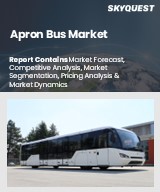
Apron Bus Market
Report ID: SQMIG25C2184
Report ID: SQMIG25C2184
[email protected]
USA +1 351-333-4748
Report ID:
SQMIG25C2184 |
Region:
Global |
Published Date: May, 2025
Pages:
189
|Tables:
176
|Figures:
79


Global Apron Bus Market size was valued at USD 524.22 Million in 2024 and is poised to grow from USD 577.75 Million in 2025 to USD 1257.5 Million by 2033, growing at a CAGR of 10.21% during the forecast period (2026–2033).
The Apron Buses Market is driven by the growing need for efficient and safe transportation on airport grounds. As air traffic rises and airport size expands, the need for reliable apron buses grows significantly. Moreover, high priority to enhancing passenger convenience and maximizing operation efficiency in every airport facility contributes to market growth, making apron buses a necessary component in current airport infrastructure and service operations.
Rising global demand for air travel is a key catalyst for the Apron Buses Market. With rising levels of passengers, particularly in fast-emerging markets like China, India, and Southeast Asia, the demand for convenient, affordable transfer between terminals and aircraft grows. Apron buses are a suitable, safe alternative. This shift is being spearheaded by growing urbanization, expanding low-cost carriers, and increasing disposable income, particularly within the expanding middle class in such economies.
In contrast, the up-front prohibitive cost of purchasing and owning apron buses, especially those with electric propulsion or new technologies, is an economic discouragement. Such a cost can be a barrier to adoption, especially by smaller or financially strapped airports. Cash availability usually slows the process of fleet upgrade or expansion, and it becomes challenging for smaller airports to upgrade their ground transportation facilities and keep up with changing airport infrastructure needs.
Apron buses provide less operational flexibility as they are limited to airside and possess individual infrastructure. To smaller airports or terminals with direct terminal-to-aircraft access utilizing jet bridges, apron buses are less utilized. This space and structure restraint minimizes their use, therefore becoming less convenient or redundant to small airport structures with fewer requirements of ground travel between gates and aircraft.
What’s the sustainability benefit of electrifying apron bus fleets?
Airports increasingly use electric and hybrid apron buses to minimize emissions and conform to stringent environmental controls. They emit zero emissions, are cost-effective to operate, and assist international sustainability initiatives. Munich and Frankfurt airports, for instance, have adopted electric variants, while Go-Ahead Group invested USD 38 million to acquire hydrogen buses for London Gatwick.
How are smart and autonomous technologies revolutionizing the apron bus industry?
Implementation of autonomous driving technology, GPS tracking, and real-time passenger information enhances operational efficiency and safety. The technologies enhance processes of boarding, minimize delays, and maximize overall passenger experience, enhancing the efficiency and fluidity of airport operations to both personnel and passengers.
Market snapshot - 2026-2033
Global Market Size
USD 475.66 Million
Largest Segment
Diesel
Fastest Growth
Diesel
Growth Rate
10.21% CAGR
To get more insights on this market click here to Request a Free Sample Report
The global Apron Bus Market is segmented on the basis of type, propulsion type, bus size, level of automation, application, end-use, and region. By type, the market is segmented into shuttle buses, intermodal buses, premium airlink buses, and others. By propulsion type, the market is segmented into diesel, electric, hybrid, and others. Based on bus size, the market is segmented into full size bus, mid-size bus, mini bus, and double decker bus. Based on level of automation, the market is segmented into manual, semi-automated, and autonomous. Based on application, the market is segmented into passenger transport, crew transport, cargo transport, and others. Based on end-use, the market is segmented into commercial airports, military airports, private and charter terminals, and others. By region, the market is segmented into North America, Europe, Asia Pacific, the Middle East and Africa, and Latin America.
Diesel-fueled apron buses continue to rule the market due to their low cost, dependability, and availability of diesel fuel. The buses are well rooted in airport operations with a definite solution for transporting passengers and airport staff. Readily available diesel fuel at most airports and lower initial outlays than electric or hybrid buses make diesel-fueled buses an ideal option for most operators. Also, better performance under any circumstances and non-regular operational hours of diesel buses are factors contributing to their market leadership. Even with more emphasis on environmentally friendly alternatives, apron buses run by diesel engines are the ones that still enjoy preference because of fuel efficiency, performance, and history.
Hybrid apron buses are the fastest-growing market segment because they benefit from bringing the best from both diesel and electric power. Hybrid buses offer a compromise in terms of being fuel-efficient without sacrificing emissions, so they make a good case for airports which wish to optimize sustainability without compromises on performance. Hybrid technology offers versatility by maximizing fuel use and minimizing environmental footprint, which is important to help ensure more stringent emission regulations. Also, hybrid buses have lower operating expenses over conventional diesel models while offering the necessary reliability to operate at airports. With increasing demand for greener and more energy-efficient alternatives, hybrid apron buses are increasingly becoming popular, making them a significant solution for the future of airport transport.
The passenger transport sector is prevalent in the apron bus industry due to increasing need for fast and reliable transit options within the airport terminals. With air travel on the rise by leaps and bounds, airports require secure buses to transport passengers from distant stands, terminals, and gates. They are required to facilitate smooth processes with minimal delays. Their ability to handle high volumes of passengers safely and efficiently makes them a critical component of airport efficiency. The increased focus on improving passenger experience and operational efficiency at airports also drives the importance of this segment further, hence making it an important contributor to the apron bus market.
Cargo transport is the fastest-growing segment in the apron bus market, fueled by expansion in e-commerce and increasing needs for effective cargo handling at airports. As global trade and air cargo increase, airports seek to optimize their logistics operations. Apron buses used for cargo transport play a central role in ensuring timely and efficient movement of goods within airport property. Moreover, some apron buses can serve both passenger and freight transport, offering a convenient solution for airports looking to consolidate their ground support equipment in addition to meeting diverse operational requirements.
To get detailed segments analysis, Request a Free Sample Report
Europe continues to be the leading region for the apron bus market, thanks to increased air travel and the continuous growth of airport facilities. European airports are switching towards environmentally friendly modes of transport from conventional diesel and gasoline-fueled apron buses to electric ones. The move fits within overall sustainability campaigns, with governments in Europe having set ambitious environmental goals. The use of hydrogen and electric buses is a fundamental component of these efforts, reducing carbon emissions and enhancing ground transport efficiency. Major European airports are at the forefront by adopting cutting-edge solutions to achieve these sustainability objectives.
Germany is Europe's leader in apron bus production due to its high-quality automotive engineering and production capabilities. Germany is at the forefront with electric and hybrid apron buses, and it facilitates green airport infrastructure developments to meet EU Green Deal standards. German manufacturers, such as COBUS Industries GmbH and TAM-Europe, are always updating their products with attention to clean energy, digitalization, and testing autonomous driving.
France's apron bus sector is heading towards operational and sustainable efficiency. Airports are also opting for hybrid and electric buses more and more to reduce carbon prints and achieve environmental goals. This is being driven by the advancement of fleet management technology, which enhances operational efficiency. The green transport solution emphasis shows France's concern in creating airport ground support equipment along with passenger experience optimization.
UK bus market of aprons is increasingly driven by a strong government policy towards decarbonization and clean transport. Programmes such as the Zero Emission Bus Regional Areas (ZEBRA) programme offers grants to operators and councils to supply zero-emission buses and facilitation technology. The policy framework encourages the uptake of hydrogen and electric buses, UK environmental target alignment and innovation in ground support equipment.
The Asia-Pacific apron bus market is expanding fast due to a variety of reasons. China, India, and Japan are all experiencing increased air travel, leading to increased demand for efficient ground transport services at airports. The expansion is also driven by high investment in airport infrastructure in the form of construction of new terminals and expansions of the current ones. Therefore, the need for apron buses that guarantee free flow of passengers among terminals and airplanes has become unavoidable. The region's emphasis on the environment and sustainability has also accelerated the implementation of electric and hybrid apron buses to align with global endeavors in reducing carbon emissions. All these places the Asia-Pacific region on the international apron bus market's center stage.
China's apron bus industry is expanding at a fast pace driven by growing airport infrastructure and domestic air traffic. OEMs such as Xiamen King Long, Yutong, and Xinfa Airport Equipment Ltd. are few among the prominent players in fulfilling domestic as well as international demand. The shift to electric and hybrid apron buses is in line with China's "Dual Carbon" policy, aimed at reducing emissions and promoting green airport operations, supported by national policy and the Civil Aviation Administration of China.
India's bus apron sector is expanding exponentially because of trends such as increasing airport infrastructure and ballooning air passenger traffic that require ground transportation efficiency. Hybrid and electric buses are gaining popularity as part of India's transition towards sustainability to reduce emissions. Technological innovation like real-time information systems and GPS tracking is improving the operational efficiency and customer satisfaction, and India is becoming a significant player in the green and advanced airport ground support equipment market.
Japan's apron bus market is growing rapidly with airport infrastructure growth and rising passenger traffic, especially in crowded global terminals. Congestion at gates and remote aircraft parking drive the need for efficient ground transportation. Hybrid and electric-powered apron buses are gaining popularity due to sustainability goals and strict emissions regulations. Government investment, airport modernization, and the promotion of smart technologies all drive the utilization of apron buses, enhancing efficiency and the passenger experience.
To know more about the market opportunities by region and country, click here to
Buy The Complete Report
Growth of Airport Facilities and Services to Accommodate Increasing Demand
Government Policies and Incentives Fueling Market Growth
Higher Jet Bridge Use Reduces Apron Bus Services Demand
Maintenance and operational downtime problems Affecting Efficiency and Performance
Request Free Customization of this report to help us to meet your business objectives.
The apron bus industry is competitive, and market leaders are prioritizing technological advancement, sustainability, and operational effectiveness. Market leaders such as BYD, Volvo, and COBUS Industries are investing in hybrid and electric apron buses to meet increasing environmental regulations. GPS tracking, autonomous driving features, and real-time passenger information systems are being adopted by most firms to improve user experience and efficiency of operations. In addition, airport operators are increasingly emphasizing sustainable solutions, providing room for new market entrants. Airport operators and manufacturers are collaborating on most instances, with manufacturers adjusting to accommodate individual airport needs. The industry is also driven by expanding airport infrastructure projects, providing a chance for apron bus adoption. Competitive forces are driven by price sensitivity, technological innovation, and quality of customer service.
How does the apron bus market get influenced by partnerships?
Airport operators, technology companies, and manufacturers are working together to develop solutions that will run more efficiently on apron buses. Such collaboration leads to innovation, system optimization, and smooth operation of airport ground transport, leading to improved passenger experience and operational efficiency.
SkyQuest’s ABIRAW (Advanced Business Intelligence, Research & Analysis Wing) is our Business Information Services team that Collects, Collates, Correlates, and Analyses the Data collected by means of Primary Exploratory Research backed by robust Secondary Desk research.
Apron bus market is captured by the rise in demand for safe, reliable ground transport in airports as unearthed by research by SkyQuest. Higher air traffic and expansion of airports, higher demand for reliable apron buses is notably in populated cities like India, China, and Southeast Asia. Apron buses make possible improved passenger experience and operational efficiency through provision of critical solutions for transporting passengers and crew between planes and terminals. However, costly initial investment in electric or advanced technology apron buses has implications, especially for smaller airports. Additionally, greater reliance on the utilization of the jet bridges diminishes utilization of the apron buses, especially for terminal-to-aircraft-linked airports. Environmental concerns bring adoption of electric and hybrid apron buses into play to allow airports to comply with environmental standards. Intelligent and autonomous technology is integrated to enhance performance in operating, minimizing delays and enhancing safety. Action by airports and manufacturers in collaboration drives the growth of markets, resulting in better systems and a better passenger experience.
| Report Metric | Details |
|---|---|
| Market size value in 2024 | USD 524.22 Million |
| Market size value in 2033 | USD 1257.5 Million |
| Growth Rate | 10.21% |
| Base year | 2024 |
| Forecast period | 2026-2033 |
| Forecast Unit (Value) | USD Million |
| Segments covered |
|
| Regions covered | North America (US, Canada), Europe (Germany, France, United Kingdom, Italy, Spain, Rest of Europe), Asia Pacific (China, India, Japan, Rest of Asia-Pacific), Latin America (Brazil, Rest of Latin America), Middle East & Africa (South Africa, GCC Countries, Rest of MEA) |
| Companies covered |
|
| Customization scope | Free report customization with purchase. Customization includes:-
|
To get a free trial access to our platform which is a one stop solution for all your data requirements for quicker decision making. This platform allows you to compare markets, competitors who are prominent in the market, and mega trends that are influencing the dynamics in the market. Also, get access to detailed SkyQuest exclusive matrix.
Table Of Content
Executive Summary
Market overview
Parent Market Analysis
Market overview
Market size
KEY MARKET INSIGHTS
COVID IMPACT
MARKET DYNAMICS & OUTLOOK
Market Size by Region
KEY COMPANY PROFILES
Methodology
For the Apron Bus Market, our research methodology involved a mixture of primary and secondary data sources. Key steps involved in the research process are listed below:
1. Information Procurement: This stage involved the procurement of Market data or related information via primary and secondary sources. The various secondary sources used included various company websites, annual reports, trade databases, and paid databases such as Hoover's, Bloomberg Business, Factiva, and Avention. Our team did 45 primary interactions Globally which included several stakeholders such as manufacturers, customers, key opinion leaders, etc. Overall, information procurement was one of the most extensive stages in our research process.
2. Information Analysis: This step involved triangulation of data through bottom-up and top-down approaches to estimate and validate the total size and future estimate of the Apron Bus Market.
3. Report Formulation: The final step entailed the placement of data points in appropriate Market spaces in an attempt to deduce viable conclusions.
4. Validation & Publishing: Validation is the most important step in the process. Validation & re-validation via an intricately designed process helped us finalize data points to be used for final calculations. The final Market estimates and forecasts were then aligned and sent to our panel of industry experts for validation of data. Once the validation was done the report was sent to our Quality Assurance team to ensure adherence to style guides, consistency & design.
Analyst Support
Customization Options
With the given market data, our dedicated team of analysts can offer you the following customization options are available for the Apron Bus Market:
Product Analysis: Product matrix, which offers a detailed comparison of the product portfolio of companies.
Regional Analysis: Further analysis of the Apron Bus Market for additional countries.
Competitive Analysis: Detailed analysis and profiling of additional Market players & comparative analysis of competitive products.
Go to Market Strategy: Find the high-growth channels to invest your marketing efforts and increase your customer base.
Innovation Mapping: Identify racial solutions and innovation, connected to deep ecosystems of innovators, start-ups, academics, and strategic partners.
Category Intelligence: Customized intelligence that is relevant to their supply Markets will enable them to make smarter sourcing decisions and improve their category management.
Public Company Transcript Analysis: To improve the investment performance by generating new alpha and making better-informed decisions.
Social Media Listening: To analyze the conversations and trends happening not just around your brand, but around your industry as a whole, and use those insights to make better Marketing decisions.
REQUEST FOR SAMPLE
 REQUEST FREE CUSTOMIZATION


Want to customize this report? This report can be personalized according to your needs. Our analysts and industry experts will work directly with you to understand your requirements and provide you with customized data in a short amount of time. We offer $1000 worth of FREE customization at the time of purchase.
Feedback From Our Clients


 USA (+1) 351-333-4748

