
Application Modernization Systems Integrator Market
Report ID: SQMIG45B2308
Report ID: SQMIG45B2308
[email protected]
USA +1 351-333-4748
Report ID:
SQMIG45B2308 |
Region:
Global |
Published Date: February, 2026
Pages:
157
|Tables:
121
|Figures:
77


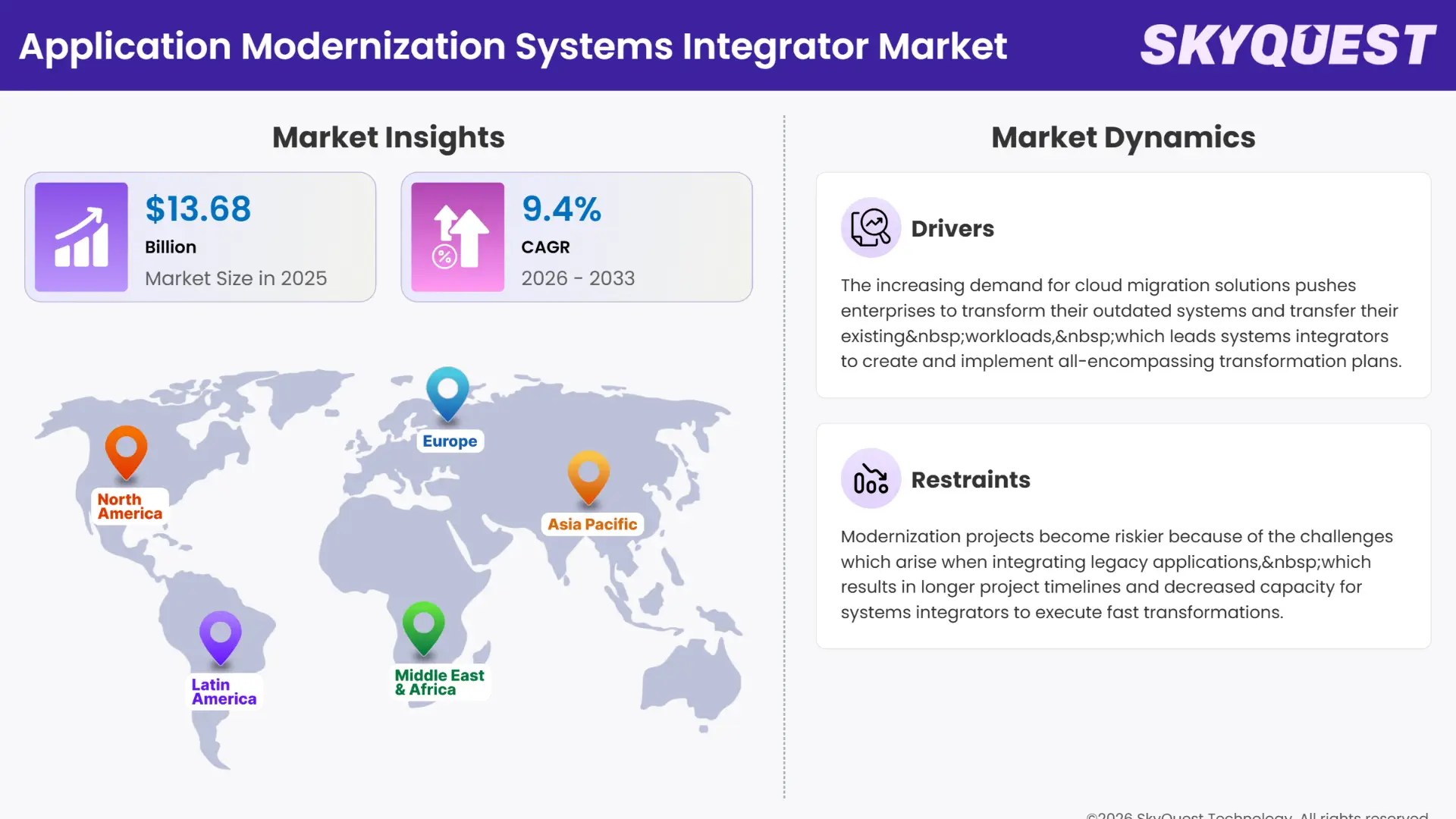
Global Application Modernization Systems Integrator Market size was valued at USD 12.5 Billion in 2024 and is poised to grow from USD 13.68 Billion in 2025 to USD 28.06 Billion by 2033, growing at a CAGR of 9.4% during the forecast period (2026-2033).
Key Takeaways: Market Trends & Insights
The global application modernization systems integrator market growth is driven from organizations needing outside help to transform their legacy systems for modern requirements. The market exists because businesses search for cloud-native scalability solutions while service providers use their combined skills in consulting and development and managed service delivery to meet this demand, which exists because outdated systems create both operational hazards and competitive disadvantages.
The market now demands containerization and microservices instead of lift-and-shift migrations because businesses require those technologies to achieve their scalability and developer speed objectives; for instance, financial services transitioned their main transaction systems to microservices while retailers created modular e-commerce systems to manage peak customer demand. The strategic value of integrators has increased because organizations need them to fulfill their requirements.
Moreover, the global application modernization systems integrator market penetration derives from organizations adopting cloud-native solutions which deliver financial benefits while supporting their business need for fast innovation. The technical capability of integrators becomes business outcomes because they build automated pipelines which handle compliance requirements to decrease market delivery time and operational expenses. The insurance industry uses Kubernetes to improve their claims processing speed while the retail sector uses serverless architecture to handle high seasonal demand, thus achieving measurable return on investment. The need for specific integration abilities expands because companies develop business relationships with hyperscale's while creating more service offerings.
How is AI Driving Demand for Application Modernization Systems Integrators?Application modernization systems integrators now use AI to change their own methods of conducting legacy system upgrades which now become organizational strategic programs. The project requires three major activities which include making code AI-compatible and transforming data pipelines to process model inputs and creating systems for governance and monitoring. Organizations currently working on production systems from their pilot projects deal with multiple challenges which include poor dependencies and their staff knowledge requirements and their need to follow regulated procedures. The systems integrators resolve the existing problems by using their legacy system knowledge and AI tools to develop adaptive roadmaps which handle migration processes and verify achievement results. The process enables engineers to automate regression testing while building intelligent APIs, which allows them to concentrate on developing more important design work.
To get more insights on this market click here to Request a Free Sample Report
The global application modernization systems integrator market is segmented based on modernization type, deployment model, organization size, end user, and region. By modernization type, the market includes legacy-to-cloud migration, re-platforming, re-architecting, re-hosting, and other approaches. Based on deployment models, it is categorized into public cloud, private cloud, and hybrid cloud. In terms of organization size, the market is divided into large enterprises and small and medium enterprises (SMEs). By end user, it encompasses banking, financial services & insurance (BFSI), IT & telecom, healthcare & life sciences, retail & e-commerce, and other industries. Geographically, the market is segmented into North America, Europe, Asia Pacific, Latin America, and the Middle East & Africa.
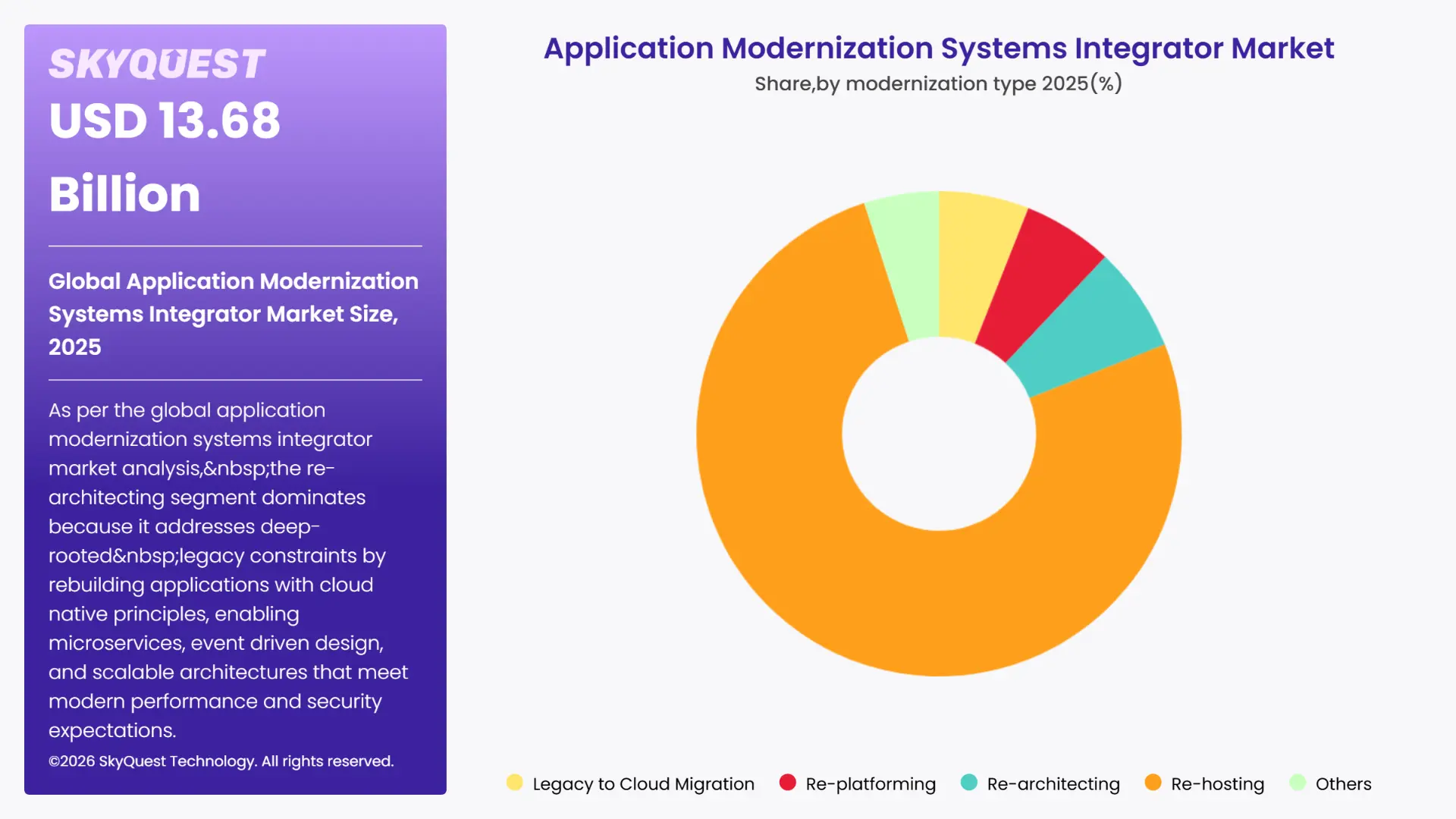
As per the global application modernization systems integrator market analysis, the re-architecting segment dominates because it addresses deep-rooted legacy constraints by rebuilding applications with cloud native principles, enabling microservices, event driven design, and scalable architectures that meet modern performance and security expectations. Organizations need specialized systems integrators who can help them build new software foundations through CI/CD and observability connections while decreasing their long-term maintenance needs which results in increasing demand for complete re-architecture projects as organizations search for enduring solutions that will last them well into the future. Organizations need to keep spending money on both integration projects and governance tasks because that represents an important strategy for the business.
However, the re-platforming stands out as the fastest growing modernization method because it lets businesses upgrade their systems by changing their existing systems through modernized platforms that require minimal code adjustments which creates low-risk migration and early advantages. The market for re-platforming develops because businesses need new tools combined with container technology while the industry grows its customer base through re-platforming.
According to the global application modernization systems integrator market forecast, the hybrid cloud segment leads the market because it enables service providers to connect their existing on-premisessystems with scalable cloud solutions which meet all security and latency and compliance needs while providing access to cloud-based financial advantages. Integrated systems enable organizations to create operational plans which involve multiple environments because they handle all aspects of unified system management while implementing plans for optimal workload distribution which maintains business operations. Organizations prefer hybrid cloud technology because it provides essential infrastructure for both large-scale system migrations and normal operational processes.
Whereas the public cloud services are anticipated to have the highest application modernization systems integrator market share because organizations use cloud-first strategies to modernize their systems through managed services and serverless computing and extensive service lists which help them transform their operations. Organizations develop cloud-native skills through their partnerships about upcoming delivery demands which create various business opportunities to handle application refactoring and migration automation and managed cloud system operations.
To get detailed segments analysis, Request a Free Sample Report
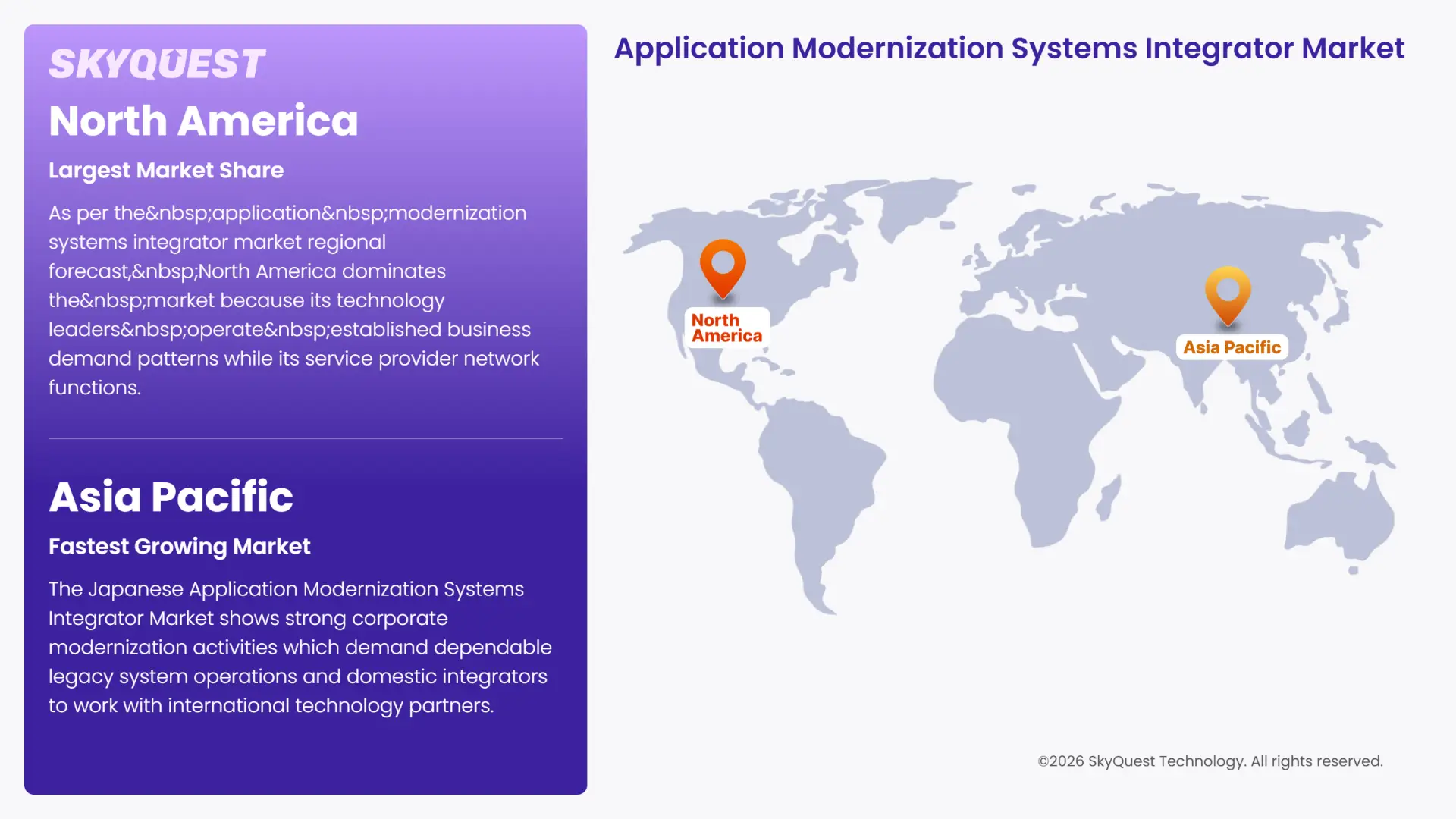
As per the application modernization systems integrator market regional forecast, North America dominates the market because its technology leaders operate established business demand patterns while its service provider network functions. The established vendors and integrators hold multiple legacy modernization solutions together with their cloud migration skills and consulting services capabilities, which enable them to implement major changes in various industries. The hybrid cloud framework usage combines security and compliance and interoperability requirements, which results in increased demand for integration services. The sophisticated buyer base requires specialized modernization plans together with managed services and strategic partnerships, which drives integrators to develop new solutions. The combination of venture capital access and research institution links enables companies to develop products and methodologies, while their talent pool and industry standards enable organizations to create delivery models and modernization methodologies that work across diverse application environments. The global integrators and local specialists work together to enhance their capacity for handling complex regulatory requirements and specific industry needs.
The United States application modernization systems integrator sector features leading integrators who operate at close range to each other while enterprises request an increased number of cloud native transformations together with businesses that have advanced DevOps and automation practices. The clients require organizations to develop complete modernization plans which combine legacy system refactoring together with re-platforming activities and managed service delivery. Integrators depend on strategic partnerships with hyperscale cloud providers and software companies to establish complete modernization solutions which also handle regulatory compliance and security requirements for various industry sectors.
The Canadian Application Modernization Systems Integrator Market develops through public sector and enterprise adoption of cloud technology, which secures cloud migration partnerships for integrators and technology firms. The major demand centers focus on three areas: modernizing outdated systems, moving to present-day systems, and delivering managed transformation services. The integrators develop advisory services together with their cloud native refactoring capabilities which provide delivery models that comply with industry requirements and enable cross border work through regional expertise.
Asia Pacific expands because digital transformation efforts increase, and businesses spend more on cloud systems development while many companies need to upgrade their critical applications to keep their market position. Local integrators and global vendors work together to create modernization methods that respect local customs and meet language requirements and regulatory obligations and localization standards. The increasing demand for integrator services results from businesses that rapidly adopt mobile first architectures together with containerization and platform-based services. The combination of government modernization directives and industry requirements for modernization creates major business opportunities which integrators can use to deliver consultancy services and migration solutions and managed services. The engineering workforce expansion together with hyperscale cloud provider partnerships enables organizations to use delivery models while driving localized innovation in important markets.
The Japanese Application Modernization Systems Integrator Market shows strong corporate modernization activities which demand dependable legacy system operations and domestic integrators to work with international technology partners. The demand focuses on three areas: rehosting and refactoring applications for cloud platforms and developing systems which work with existing enterprise systems. The integrators deliver migration solutions which treat system stability as their main priority while they begin to adopt automation and containerization technologies. The cultural factors in society promote enterprises to maintain long-term relationships with their vendors, while they require detailed modernization plans.
The South Korean Application Modernization Systems Integrator Market shows two major trends. Including modern architectural systems adoption, which runs at a fast pace, local technology companies deliver high performance systems based on their customers' needs. The enterprises use modernization to create digital services which work on mobile platforms while they deliver customer engagement through their platforms. Integrators develop cloud native refactoring solutions which combine local expertise with global best practices for microservices enablement and DevOps-driven automation. The organizations use strategic partnerships with cloud providers and local vendors to build dedicated transformation roadmaps.
The application modernization systems integrator market in Europe sees improving development through European nations which combine their digital infrastructure investments and enterprise buyer maturity progress and their network of dedicated integrators who offer specialized services. The regional requirements for data protection and interoperability and sector-specific compliance development create a need for modernization solutions which enable organizations to achieve innovative outcomes while meeting their regulatory obligations. Local legal and language needs to drive the development of hybrid cloud solutions and cloud migration methods and managed modernization solutions which integrators now provide. The knowledge exchange between integrators and cloud providers and technology partners creates cross-border partnerships which develop operational frameworks that can be expanded.
The German application modernization systems integrator market depends on strong industrial demand which requires security and data sovereignty together with specialized integrators who handle advanced manufacturing and engineering projects. The enterprise sector needs modernization solutions which will support their operational technology integration and cloud environment development and industry-specific automation needs. The modernization solutions of integrators include compliance-based delivery and structured modernization frameworks and hybrid cloud implementation methods.
The UK application modernization systems integrator market exists because financial institutions need cloud services and consulting companies to help organizations modernize their obsolete technologies. The enterprise sector requires integrators who can deliver advisory support together with technical implementation for their multi-cloud deployments. The integrators who work with organizations use security measures by design and compliance-focused migration methods and automatic delivery system development. Companies establish their modernization steps through partnerships with banks and insurance companies and technology vendors who provide regulatory guidance and customer experience insights.
The application modernization systems integrator market in France operates through active public sector programs and a vibrant business environment which prioritizes data protection and regional compliance standards. The integrators establish modernization pathways which combine progressive solutions with necessary legal standards through their services which include re-platforming and refactoring and managed solutions. The domestic software companies and cloud service providers collaborate through joint models to deliver solutions which meet their requirements for language and localization services. The modernization initiative aims to enhance digital customer interfaces and improve operational efficiency and streamline data platform connectivity.
To know more about the market opportunities by region and country, click here to
Buy The Complete Report
Accelerated Cloud Migration Demand
The increasing demand for cloud migration solutions pushes enterprises to transform their outdated systems and transfer their existing workloads, which leads systems integrators to create and implement all-encompassing transformation plans. The cloud architecture work leads to system refactoring and existing system integration through which integrators handle all vendor security and ecosystem control. The service portfolio expands through this demand because organizations need expert partners who can minimize their migration dangers while achieving faster value delivery. The rising cloud-driven initiatives create new chances for integrators to deliver advisory services as well as implementation and managed services throughout the entire modernization process.
Adoption of Agile Development Practices
The use of agile development methods enables organizations to transform their applications through iterative modernization while maintaining ongoing delivery which helps systems integrators deliver modernization solutions through modular services that require less operational interruptions. Organizations establish their operational framework through agile process implementation and toolchaindevelopment which supports DevOps automation to boost their operational capacity for frequent software releases and rapid feedback loops. They extend their consultancy capacity through agile methods which permit platform integration and managed service delivery while enabling teams to work together.
Complexity of Legacy Application Integration
Modernization projects become riskier because of the challenges which arise when integrating legacy applications, which results in longer project timelines and decreased capacity for systems integrators to execute fast transformations. The combined use of interdependencies and undocumented codebases together with tightly coupled architectures requires reverse engineering work which leads to the need for specialized knowledge. The clients select service partners who they think will disrupt their operations least while providing them with everything they need which results in decreased demand for immediate modernization work. The constraint which exists in the process leads to lower adoption speeds while increasing operational costs and project completion times which results in organizations choosing to make small updates instead of complete modernization thus restricting market growth until the next period.
Shortage of Skilled Modernization Talent
The systems integrators face project delivery and quality assurance problems because they lack skilled modernization experts who can handle complex upgrades. The specialized skills needed for cloud-native architecture design and refactoring work and migration tool management create risk management requirements that businesses need but which the market does not provide. The integrators will experience extended lead times together with higher staffing expenses and service delivery interruptions which will harm their ability to win customers while restricting their market expansion through decreased project output and slowed adoption rates.
Request Free Customization of this report to help us to meet your business objectives.
The global application modernization systems integration market now operates through major integration firms which pursue specific M&A activities while smaller companies develop platform innovations to secure contracts. Major systems integrators have executed deal bundles to add cloud and automation capabilities for example Accenture’s 2024 acquisitions and Cognizant’s targeted Azure capability buys while specialist firms and platform vendors form partnerships to commercialize automation like CloudFrame’s regional alliances and Trianz’s Concierto modernization offering.
Cloud-Native Adoption Surge: The introduction of intelligent operations will enable integrators to deliver a complete solution that combines automated process transformation through agentic AI with their existing legacy system control capabilities. The enterprise market increasingly adopts cloud-native architectures as organizations use these systems to speed up their product delivery while achieving better system performance and decreasing vendor dependency. The integrated development environment helps clients create runbooks while customers develop operational runbooks and create governance frameworks that do not favor vendors. The SI role shifts toward continuous platform enablement, long-term managed services and ecosystem orchestration, creating recurring engagement models centered on platform throughput, developer productivity and business-aligned feature velocity, and measurable outcome-driven metrics, which help differentiate the service.
AI-driven Modernization Services: Machine learning and artificial intelligence capabilities serve as the foundation for modern toolchains, which permit automated code analysis together with intelligent refactoring recommendations and pattern recognition across systems. Systems integrators use these capabilities together with human expertise to speed up assessment work while decreasing risk assessment, and they aid in selecting practical re-platforming options. Organizations use AI-enabled observability together with predictive operations to create strong systems, which enable them to solve problems. The shift to SIs has created opportunities for them to provide engineering teams who need additional support and companies that develop proprietary automation tools and their own consulting services, which help clients use model insights to build sustainable governance-compliant modernization roadmaps.
SkyQuest’s ABIRAW (Advanced Business Intelligence, Research & Analysis Wing) is our Business Information Services team that Collects, Collates, Correlates, and Analyses the Data collected by means ofPrimary Exploratory Research backed by robust Secondary Desk research.
As per SkyQuest analysis, the global application modernization systems integrator market exists under multiple driving forces, which include cloud-native adoption as enterprises search for scalable cost-effective platforms and AI-driven modernization services that use automation to handle refactoring and observability creation. Legacy application integration becomes complicated, which raises project expenses and increases the chance of project failure. North America leads the market through established customer demand and extensive integrator networks, while the re-architecting segment dominates because customers prefer permanent cloud-native redesigns instead of temporary solutions. The integration of these elements creates advantages for integrators who establish cloud partnerships together with their automation tools and their advisory delivery model.
| Report Metric | Details |
|---|---|
| Market size value in 2024 | USD 12.5 Billion |
| Market size value in 2033 | USD 28.06 Billion |
| Growth Rate | 9.4% |
| Base year | 2024 |
| Forecast period | 2026-2033 |
| Forecast Unit (Value) | USD Billion |
| Segments covered |
|
| Regions covered | North America (US, Canada), Europe (Germany, France, United Kingdom, Italy, Spain, Rest of Europe), Asia Pacific (China, India, Japan, Rest of Asia-Pacific), Latin America (Brazil, Rest of Latin America), Middle East & Africa (South Africa, GCC Countries, Rest of MEA) |
| Companies covered | |
| Customization scope | Free report customization with purchase. Customization includes:-
|
To get a free trial access to our platform which is a one stop solution for all your data requirements for quicker decision making. This platform allows you to compare markets, competitors who are prominent in the market, and mega trends that are influencing the dynamics in the market. Also, get access to detailed SkyQuest exclusive matrix.
Table Of Content
Executive Summary
Market overview
Parent Market Analysis
Market overview
Market size
KEY MARKET INSIGHTS
COVID IMPACT
MARKET DYNAMICS & OUTLOOK
Market Size by Region
KEY COMPANY PROFILES
Methodology
For the Application Modernization Systems Integrator Market, our research methodology involved a mixture of primary and secondary data sources. Key steps involved in the research process are listed below:
1. Information Procurement: This stage involved the procurement of Market data or related information via primary and secondary sources. The various secondary sources used included various company websites, annual reports, trade databases, and paid databases such as Hoover's, Bloomberg Business, Factiva, and Avention. Our team did 45 primary interactions Globally which included several stakeholders such as manufacturers, customers, key opinion leaders, etc. Overall, information procurement was one of the most extensive stages in our research process.
2. Information Analysis: This step involved triangulation of data through bottom-up and top-down approaches to estimate and validate the total size and future estimate of the Application Modernization Systems Integrator Market.
3. Report Formulation: The final step entailed the placement of data points in appropriate Market spaces in an attempt to deduce viable conclusions.
4. Validation & Publishing: Validation is the most important step in the process. Validation & re-validation via an intricately designed process helped us finalize data points to be used for final calculations. The final Market estimates and forecasts were then aligned and sent to our panel of industry experts for validation of data. Once the validation was done the report was sent to our Quality Assurance team to ensure adherence to style guides, consistency & design.
Analyst Support
Customization Options
With the given market data, our dedicated team of analysts can offer you the following customization options are available for the Application Modernization Systems Integrator Market:
Product Analysis: Product matrix, which offers a detailed comparison of the product portfolio of companies.
Regional Analysis: Further analysis of the Application Modernization Systems Integrator Market for additional countries.
Competitive Analysis: Detailed analysis and profiling of additional Market players & comparative analysis of competitive products.
Go to Market Strategy: Find the high-growth channels to invest your marketing efforts and increase your customer base.
Innovation Mapping: Identify racial solutions and innovation, connected to deep ecosystems of innovators, start-ups, academics, and strategic partners.
Category Intelligence: Customized intelligence that is relevant to their supply Markets will enable them to make smarter sourcing decisions and improve their category management.
Public Company Transcript Analysis: To improve the investment performance by generating new alpha and making better-informed decisions.
Social Media Listening: To analyze the conversations and trends happening not just around your brand, but around your industry as a whole, and use those insights to make better Marketing decisions.
REQUEST FOR SAMPLE
 REQUEST FREE CUSTOMIZATION
Global Application Modernization Systems Integrator Market size was valued at USD 12.5 Billion in 2024 and is poised to grow from USD 13.68 Billion in 2025 to USD 28.06 Billion by 2033, growing at a CAGR of 9.4% during the forecast period (2026-2033).
The competitive landscape for global application modernization systems integrators is consolidating around a few large integrators pursuing targeted M&A and specialist partnerships while smaller vendors push platform innovation to win deals. Major systems integrators have executed deal bundles to add cloud and automation capabilities, for example Accenture’s 2024 acquisitions and Cognizant’s targeted Azure capability buys, while specialist firms and platform vendors form partnerships to commercialize automation like CloudFrame’s regional alliances and Trianz’s Concierto modernization offering. 'Accenture', 'Cognizant', 'Capgemini', 'Deloitte', 'Infosys', 'Tata Consultancy Services', 'Wipro', 'HCL Technologies', 'DXC Technology', 'EY (Ernst & Young)', 'NTT DATA', 'Atos', 'Tech Mahindra', 'IBM Global Services', 'Booz Allen Hamilton', 'Fujitsu', 'Rackspace Technology', 'Unisys', 'SoftServe', 'LTI (Larsen & Toubro Infotech)'
Accelerated cloud migration demand pushes enterprises to modernize legacy applications and replatform workloads, driving systems integrators to design and execute comprehensive transformation programs. Integrators coordinate cloud architecture, refactoring, and integration with existing systems while managing vendor ecosystems and security considerations. This demand strengthens service portfolios and fuels sustained engagement as organizations seek expert partners to reduce migration risk and accelerate time to value. By prompting long-term modernization roadmaps and multiservice engagements, rising cloud-driven initiatives expand opportunities for integrators to offer advisory, implementation, and managed services across the modernization lifecycle.
Cloud-Native Adoption Surge: Enterprises increasingly prioritize cloud-native architectures to accelerate delivery, improve scalability and reduce lock-in. Systems integrators expand capabilities around containerization, microservices, platform engineering and managed cloud services, advising on migration patterns and establishing reusable platform components. Clients seek modular modernization roadmaps, operational runbooks and vendor-neutral governance frameworks. The SI role shifts toward continuous platform enablement, long-term managed services and ecosystem orchestration, creating recurring engagement models centered on platform throughput, developer productivity and business-aligned feature velocity and measurable outcome-driven metrics and differentiation.
North America Dominate the Global Application Modernization Systems Integrator Market?
The Application Modernization Systems Integrator market focuses on services that help organizations upgrade legacy applications using modern technologies such as cloud computing, microservices, and containerization. These integrators enable businesses to improve performance, scalability, and user experience.
The market is driven by increasing demand for business agility, rapid digital transformation, and the need to replace outdated legacy systems with scalable and efficient modern applications.


Want to customize this report? This report can be personalized according to your needs. Our analysts and industry experts will work directly with you to understand your requirements and provide you with customized data in a short amount of time. We offer $1000 worth of FREE customization at the time of purchase.
Feedback From Our Clients


 USA (+1) 351-333-4748

