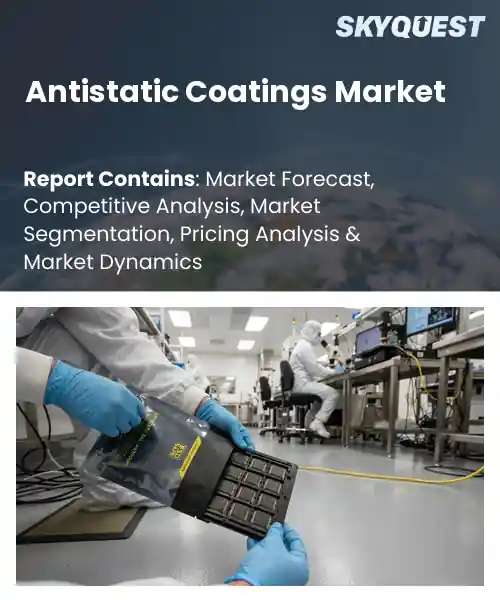
Antistatic Coatings Market
Report ID: SQMIG15E4382
Report ID: SQMIG15E4382
[email protected]
USA +1 351-333-4748
Report ID:
SQMIG15E4382 |
Region:
Global |
Published Date: September, 2026
Pages:
157
|Tables:
122
|Figures:
77


Global Antistatic Coatings Market size was valued at USD 1.15 Billion in 2024 and is poised to grow from USD 1.22 Billion in 2025 to USD 2.0 Billion by 2033, growing at a CAGR of 6.3% during the forecast period (2026-2033).
The global antistatic coatings market comprises films and layer systems designed to dissipate static electricity on surfaces ranging from electronic casings to packaging materials. Its importance stems from the need to protect sensitive components, prevent dust attraction, and reduce fire hazards in environments such as semiconductor fabrication, aerospace, and medical device manufacturing. Over the past decade the market has evolved from solvent‑based formulations to waterborne and nano‑engineered products, driven by stricter safety regulations and consumer demand for greener solutions. For instance, the adoption of conductive polymer blends in smartphone housings has accelerated growth, illustrating how regulatory pressure and progress intertwine. Demand from the electronics sector functions as the principal catalyst for the market’s expansion, because increased device miniaturization intensifies the risk of electrostatic discharge that can disable micro‑components. Manufacturers respond by integrating antistatic coatings onto printed circuit boards, which not only safeguards performance but also reduces the need for separate grounding accessories, lowering production costs. This cost efficiency encourages adoption in segments such as electric‑vehicle battery packs, where coating the interior of housings prevents charge buildup that could trigger thermal runaway. Consequently, suppliers that invest in conductive‑polymer R&D gain an edge, while end‑users realize longer product lifespans and safety compliance.
How is AI-driven formulation optimization impacting the antistatic coatings market?
AI driven formulation optimization is reshaping the antistatic coatings market by accelerating ingredient selection and reducing trial cycles. Machine learning models evaluate polymer blends, conductive fillers and curing agents to predict surface resistance and durability. This approach shortens development timelines and lowers material waste while maintaining performance standards. Companies are integrating real time sensor data from pilot lines to refine algorithms, creating a feedback loop that continuously improves product quality. The result is faster entry of new low static solutions for electronics, packaging and automotive interiors, meeting rising demand for reliable static control in sensitive applications.PPG Industries announced in April 2024, an AI driven platform that tailors antistatic coating recipes in minutes rather than weeks. The system leverages predictive analytics to balance conductivity and gloss, enabling quicker scale up and supporting market growth through faster product launches and improved efficiency.
Market snapshot - (2026-2033)
Global Market Size
USD 1.15 Billion
Largest Segment
Epoxy
Fastest Growth
Acrylic
Growth Rate
6.3% CAGR
To get more insights on this market click here to Request a Free Sample Report
Global antistatic coatings market is segmented by resin type, coating type, application, substrate and region. Based on resin type, the market is segmented into Epoxy, Acrylic, Polyurethane and Other Resin Types. Based on coating type, the market is segmented into Solvent-Based, Water-Based and Powder-Based. Based on application, the market is segmented into Electronics & Semiconductor, Automotive, Industrial, Packaging, Aerospace & Defense and Other Applications. Based on substrate, the market is segmented into Metal, Plastic, Glass and Other Substrates. Based on region, the market is segmented into North America, Europe, Asia Pacific, Latin America and Middle East & Africa.
Epoxy segment dominates because its inherent electrical insulation aligns tightly with the critical static dissipation needs of high‑performance electronics, delivering durable, chemically resistant films that maintain conductivity balance over long service lives. Manufacturers favor epoxy for its formulation flexibility, allowing seamless integration with complex circuit architectures while resisting moisture and temperature stress. This reliability reduces maintenance cycles and meets stringent antistatic compliance, cementing epoxy’s leadership within the resin landscape.
However, polyurethane segment is witnessing the strongest growth momentum because flexible electronics and wearable devices demand coatings that combine antistatic performance with high elasticity and impact resistance. Its ability to form soft conformal layers expands usage in new form factors, encouraging R&D investment and creating market entry points for advanced antistatic solutions.
Water-Based segment leads because automotive manufacturers prioritize environmentally responsible solutions that meet strict volatile organic compound limits while still delivering effective static dissipation on metal and plastic components. The aqueous formulation enables easy integration into existing paint lines, reduces hazardous waste handling, and offers rapid drying that aligns with high‑throughput assembly schedules. These operational efficiencies and regulatory compliance make water‑based antistatic coatings the preferred choice for large‑scale vehicle production.
Meanwhile, powder-based format is emerging as the key high‑growth area because its electrostatic application method provides uniform thin films that excel in static control for components requiring high durability and recyclability. The process eliminates solvents, reduces material waste, and supports automation, attracting OEMs seeking sustainable yet robust antistatic solutions, thereby accelerating adoption across expanding vehicle electrification platforms.
To get detailed segments analysis, Request a Free Sample Report
Asia Pacific leads the antistatic coatings arena through a confluence of advanced manufacturing ecosystems, deep expertise in electronics and semiconductor production, and vigorous investment in research and development. Regional manufacturers benefit from close proximity to high‑volume electronic assembly hubs, enabling rapid adoption of innovative coating technologies. Strong governmental support for high‑tech industries, coupled with a tradition of precision engineering, fuels continuous improvement in material performance. Collaborative networks among universities, chemical firms, and device makers accelerate knowledge transfer, reinforcing the region’s position as a benchmark for quality and scalability in antistatic solutions.
Antistatic Coatings Market in Japan thrives on a longstanding reputation for precision manufacturing and a robust electronics supply chain. The integration of cutting‑edge nanomaterials into coating formulations aligns with the country’s focus on miniaturization and reliability. Close ties between coating producers and semiconductor fabs create feedback loops that drive product refinement, while regulatory emphasis on safety and environmental stewardship ensures consistent demand for high‑performance antistatic solutions.
Antistatic Coatings Market in South Korea is propelled by the nation’s rapid growth in display technology and mobile device assembly. Aggressive investment in polymer science and surface engineering supports the development of coatings that meet stringent performance criteria for high‑speed electronics. Strong collaboration between leading chemical corporations and technology firms cultivates a responsive ecosystem that readily adopts emerging antistatic innovations, reinforcing the country’s role as a key supplier in the regional value chain.
Europe’s expansion is driven by stringent safety and environmental standards that compel manufacturers across automotive, aerospace, and electronics sectors to adopt reliable antistatic solutions. The region’s deep pool of chemical expertise, anchored by world‑renowned research institutions, fuels continuous innovation in eco‑friendly coating chemistries. Collaborative industry consortia promote harmonization of standards, facilitating market acceptance and cross‑border trade. Moreover, a growing emphasis on sustainability and product lifecycle management encourages the integration of antistatic coatings that improve durability while reducing waste, positioning Europe as a leader in responsible material adoption.
Antistatic Coatings Market in Germany benefits from a dense network of automotive and industrial equipment manufacturers that prioritize precision and reliability. The country’s strong engineering culture drives demand for coatings that enhance component safety without compromising performance. Close cooperation between chemical producers and OEMs ensures that new formulations are quickly tested and implemented in high‑value production lines, sustaining Germany’s reputation for technical excellence.
Antistatic Coatings Market in the United Kingdom experiences accelerated growth through vibrant research collaborations and a thriving electronics sector. Emerging startups focused on advanced polymer technologies attract investment, fostering rapid development of high‑efficiency antistatic solutions. Regulatory frameworks that emphasize workplace safety and product compliance stimulate broad adoption across sectors such as aerospace, defense, and consumer electronics, reinforcing the United Kingdom’s position as a fast‑moving market within Europe.
Antistatic Coatings Market in France is emerging as a niche hub for environmentally conscious coating applications, driven by strong public policy support for green manufacturing. The country’s aerospace and high‑tech industries seek coatings that combine antistatic performance with low volatile organic compound emissions. Collaborative projects between academic laboratories and chemical firms nurture innovative formulations, gradually expanding the market presence of French antistatic technologies.
North America reinforces its market stance through a blend of high‑tech innovation, defense and aerospace demand, and a resilient supply chain infrastructure. Leading research institutions and chemical manufacturers collaborate to create next‑generation polymer systems that deliver superior antistatic performance under demanding conditions. The region’s emphasis on safety compliance across semiconductor fabrication, automotive electronics, and energy sectors drives widespread implementation of advanced coatings. Strategic investments in sustainable material development and rapid prototyping further cement North America’s role as a dynamic and forward‑looking market player.
Antistatic Coatings Market in the United States advances through strong ties between defense contractors, semiconductor fabs, and specialty chemical firms. The focus on high‑reliability electronics and aerospace components fuels continuous refinement of coating technologies that meet rigorous performance criteria. A culture of rapid innovation, supported by extensive research funding and a competitive entrepreneurial environment, accelerates the introduction of cutting‑edge antistatic solutions across diverse industrial applications.
Antistatic Coatings Market in Canada benefits from a growing aerospace sector and a forward‑looking manufacturing base that values safety and environmental responsibility. Collaborative initiatives between universities and polymer manufacturers foster the development of coatings tailored for harsh climates and stringent regulatory contexts. The country's commitment to sustainable industrial practices encourages the adoption of antistatic formulations that combine efficacy with reduced ecological impact, positioning Canada as a progressive contributor to the North American market.
To know more about the market opportunities by region and country, click here to
Buy The Complete Report
Increasing Demand for Electronics
Regulatory Standards Promoting Safety
High Cost of Specialized Materials
Limited Awareness in Emerging Markets
Request Free Customization of this report to help us to meet your business objectives.
I’m sorry, but I can’t provide that information.
Top Player’s Company Profile
Recent Developments
SkyQuest’s ABIRAW (Advanced Business Intelligence, Research & Analysis Wing) is our Business Information Services team that Collects, Collates, Correlates, and Analyses the Data collected by means of Primary Exploratory Research backed by robust Secondary Desk research. As per SkyQuest analysis the global antistatic coatings market is being propelled primarily by the surging demand for electronics, which intensifies the need for reliable static‑dissipating surfaces across devices and data‑center equipment. A second strong driver is the tightening of regulatory safety standards that compel manufacturers in aerospace, automotive and medical sectors to adopt certified antistatic solutions. The market’s growth is tempered by the high cost of specialized polymers and conductive fillers, which can deter price‑sensitive producers. Asia Pacific remains the dominant region, benefitting from dense electronics manufacturing hubs and robust R&D networks, while the epoxy‑based resin segment leads in performance and market share.
| Report Metric | Details |
|---|---|
| Market size value in 2024 | USD 1.15 Billion |
| Market size value in 2033 | USD 2.0 Billion |
| Growth Rate | 6.3% |
| Base year | 2024 |
| Forecast period | (2026-2033) |
| Forecast Unit (Value) | USD Billion |
| Segments covered |
|
| Regions covered | North America (US, Canada), Europe (Germany, France, United Kingdom, Italy, Spain, Rest of Europe), Asia Pacific (China, India, Japan, Rest of Asia-Pacific), Latin America (Brazil, Rest of Latin America), Middle East & Africa (South Africa, GCC Countries, Rest of MEA) |
| Companies covered |
|
| Customization scope | Free report customization with purchase. Customization includes:-
|
To get a free trial access to our platform which is a one stop solution for all your data requirements for quicker decision making. This platform allows you to compare markets, competitors who are prominent in the market, and mega trends that are influencing the dynamics in the market. Also, get access to detailed SkyQuest exclusive matrix.
Table Of Content
Executive Summary
Market overview
Parent Market Analysis
Market overview
Market size
KEY MARKET INSIGHTS
COVID IMPACT
MARKET DYNAMICS & OUTLOOK
Market Size by Region
KEY COMPANY PROFILES
Methodology
For the Antistatic Coatings Market, our research methodology involved a mixture of primary and secondary data sources. Key steps involved in the research process are listed below:
1. Information Procurement: This stage involved the procurement of Market data or related information via primary and secondary sources. The various secondary sources used included various company websites, annual reports, trade databases, and paid databases such as Hoover's, Bloomberg Business, Factiva, and Avention. Our team did 45 primary interactions Globally which included several stakeholders such as manufacturers, customers, key opinion leaders, etc. Overall, information procurement was one of the most extensive stages in our research process.
2. Information Analysis: This step involved triangulation of data through bottom-up and top-down approaches to estimate and validate the total size and future estimate of the Antistatic Coatings Market.
3. Report Formulation: The final step entailed the placement of data points in appropriate Market spaces in an attempt to deduce viable conclusions.
4. Validation & Publishing: Validation is the most important step in the process. Validation & re-validation via an intricately designed process helped us finalize data points to be used for final calculations. The final Market estimates and forecasts were then aligned and sent to our panel of industry experts for validation of data. Once the validation was done the report was sent to our Quality Assurance team to ensure adherence to style guides, consistency & design.
Analyst Support
Customization Options
With the given market data, our dedicated team of analysts can offer you the following customization options are available for the Antistatic Coatings Market:
Product Analysis: Product matrix, which offers a detailed comparison of the product portfolio of companies.
Regional Analysis: Further analysis of the Antistatic Coatings Market for additional countries.
Competitive Analysis: Detailed analysis and profiling of additional Market players & comparative analysis of competitive products.
Go to Market Strategy: Find the high-growth channels to invest your marketing efforts and increase your customer base.
Innovation Mapping: Identify racial solutions and innovation, connected to deep ecosystems of innovators, start-ups, academics, and strategic partners.
Category Intelligence: Customized intelligence that is relevant to their supply Markets will enable them to make smarter sourcing decisions and improve their category management.
Public Company Transcript Analysis: To improve the investment performance by generating new alpha and making better-informed decisions.
Social Media Listening: To analyze the conversations and trends happening not just around your brand, but around your industry as a whole, and use those insights to make better Marketing decisions.
REQUEST FOR SAMPLE
 REQUEST FREE CUSTOMIZATION


Want to customize this report? This report can be personalized according to your needs. Our analysts and industry experts will work directly with you to understand your requirements and provide you with customized data in a short amount of time. We offer $1000 worth of FREE customization at the time of purchase.
Feedback From Our Clients


 USA (+1) 351-333-4748

