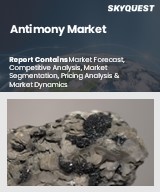
Antimony Market
Report ID: SQMIG15J2103
Report ID: SQMIG15J2103
[email protected]
USA +1 351-333-4748
Report ID:
SQMIG15J2103 |
Region:
Global |
Published Date: June, 2025
Pages:
184
|Tables:
93
|Figures:
71


Global Antimony Market size was valued at USD 2.89 Billion in 2024 and is poised to grow from USD 3.09 Billion in 2025 to USD 5.26 Billion by 2033, growing at a CAGR of 6.9% during the forecast period (2026–2033).
The number one mover behind the global antimony market is China's export restrictions that have hugely been upsetting world supply chains. In August 2024, China, which accounted for about half of global antimony output, declared export control over some products of antimony, such as the requirement to obtain permission through a license in order to export dual-use materials and a ban on the transfer of gold-antimony smelting and separation technology overseas without authorization. China justified these steps as being needed for national security purposes and for complying with international non-proliferation requirements.
The result was an instantaneous drop in global antimony supplies, causing a price spike. Prices had climbed to record levels by September 2024 and were expected to rise further as purchasers outside of China accumulated material in anticipation of the new export controls. This supply shortage has especially affected companies that depend on antimony in products like flame retardants, lead-acid batteries, and defense equipment and thus have already compelled Western business entities to try other sources as well as revise their supply chain approaches.
One of the most significant drivers of the antimony market is its vital contribution to the production of lead-acid batteries, particularly for electric vehicles (EVs). Antimony improves the performance and durability of such batteries, rendering it a necessity as the automotive sector transitions towards electrification. The increasing use of EVs has resulted in higher demand for antimony, thus propelling market growth. The trend supports global movements toward using environmentally friendly modes of transport and mitigating carbon footprint. Still, the increased demand widens the gap for available antimony supply, especially due to the Chinese restrictions on exportation, heightening the level of competition over accessible antimony resources.
Market snapshot - 2026-2033
Global Market Size
USD 2.7 billion
Largest Segment
Trioxides
Fastest Growth
Alloys
Growth Rate
6.9% CAGR
To get more insights on this market click here to Request a Free Sample Report
Global Antimony Market is segmented by Type, Application, End-Use Industry and region. Based on Type, the market is segmented into Metal Ingot, Antimony Trioxide, Antimony Pentoxide, Alloys and Other. Based on Application, the market is segmented into Flame Retardants, Lead Acid Batteries, Chemicals, Ceramics & Glass and Others. Based on End-Use Industry, the market is segmented into Chemical, Automotive, Electrical & Electronics and Others. Based on region, the market is segmented into North America, Europe, Asia Pacific, Latin America and Middle East & Africa.
How do its Properties make Antimony Trioxide Irreplaceable in Multiple Industries?
Antimony trioxide, a key compound in the global antimony market, is currently driving innovation, particularly in flame retardant and semiconductor applications. Its primary use as a flame retardant in plastics, textiles, and coatings makes it essential for industries seeking fire-resistant materials, especially in construction and automotive sectors. Additionally, antimony trioxide is crucial in manufacturing semiconductors and batteries, which has spurred significant R&D to improve its efficiency and environmental impact. The dominance of antimony trioxide in the market is largely due to its versatility, cost-effectiveness, and the continued demand for safer, fire-resistant materials. Its unique properties, such as enhancing the performance of materials under high heat, make it irreplaceable in many industries. Innovations in recycling antimony trioxide and extracting it from lower-grade ores are further expanding its applications, ensuring its continued relevance in the market despite the push for more sustainable practices.
How do Antimony Alloys Contribute to the Development of Renewable Energy Systems?
Alloys, particularly those containing antimony, are poised to become the fastest-growing segment in the global antimony market due to their critical applications in the automotive, electronics, and energy sectors. Antimony-based alloys are widely used in lead-acid batteries, which are integral to the growing demand for energy storage solutions, especially with the rise of electric vehicles (EVs) and renewable energy systems. These alloys enhance battery performance, increasing energy density and lifespan. Additionally, antimony alloys are used in soldering and manufacturing semiconductors, both of which are expanding rapidly due to advancements in electronics and technology. As industries focus on improving battery efficiency and electronic components, the demand for antimony alloys will continue to rise. Furthermore, their role in enhancing the durability and strength of various materials, coupled with the growing adoption of energy-efficient technologies, will accelerate their market growth in the coming years.
To get detailed segments analysis, Request a Free Sample Report
Why is North America Focusing on Diversifying its Antimony Supply Chains?
As per the global antimony market analysis, North America is dominating the industry, driven by the demand for flame retardants, energy storage solutions, and electronics. The region is focusing on diversifying supply chains and reducing dependence on Chinese imports. Increasing investments in antimony recycling, sustainable mining practices, and innovations in alloys for batteries and electronics are contributing to the market’s expansion. Rising demand for energy storage solutions, particularly in electric vehicles and renewable energy systems, is driving the growth of antimony applications in North America. Startups like Larvotto Resources and Stibium Mining Limited are emerging in North America, focusing on developing sustainable mining practices and enhancing the antimony supply chain.
The United States plays a crucial role in the North America’s antimony market, particularly in its demand for antimony in flame retardants, electronics, and energy storage applications. The U.S. is investing heavily in alternative sourcing and recycling technologies to mitigate supply chain vulnerabilities and reduce dependence on imports, especially from China. Additionally, ongoing research and development efforts aim to improve antimony extraction methods and expand its industrial applications.
Canada is actively involved in the North America’s antimony market, primarily through mining and exploration activities. The country is home to several antimony deposits and has been focusing on developing sustainable extraction practices. Canada’s emphasis on advancing antimony recycling and innovative mining techniques has positioned it as a key player in diversifying the global supply chain and reducing reliance on traditional producers.
What Role does R&D Play in Improving Antimony Extraction Processes in Europe?
Europe's antimony market is growing steadily, driven by demand in the automotive, electronics, and flame retardant industries. The region focuses on reducing reliance on Chinese imports and enhancing recycling efforts. With increasing attention to sustainable mining and environmental concerns, Europe is investing in R&D to improve antimony extraction processes. European companies are developing alternative sourcing solutions, creating a more diverse and resilient supply chain for the region. Europe’s focus on sustainable sourcing, recycling technologies, and reducing supply chain risks due to geopolitical tensions is driving the antimony market growth. Companies like ARC and Stibium Mining are emerging in Europe, advancing antimony recycling technologies and sustainable mining practices to address supply chain challenges and enhance local production.
France plays a significant role in the Europe’s antimony market through its involvement in antimony-based applications, particularly in flame retardants and electronics. The country is focusing on sustainable and innovative approaches, with investments in recycling and extraction technologies. France also contributes through its strong presence in research and development, aiming to improve antimony processing and reduce environmental impacts, supporting the shift toward a circular economy.
Italy contributes to the Europe’s antimony market by being a key player in the production of antimony trioxide for use in flame retardants and industrial applications. The country is also advancing antimony recycling technologies, helping to reduce reliance on primary sources. Italy’s strong manufacturing base in electronics and automotive industries creates a consistent demand for antimony alloys, further driving market growth in the region.
In what ways is the Growing Energy Storage and Electric Vehicle market Impacting Antimony Demand in Asia-Pacific?
Asia-Pacific is the largest producer and consumer of antimony, driven by industrial applications in electronics, flame retardants, and batteries. China dominates the supply chain, but countries like India and Japan are investing in sustainable mining and recycling technologies to reduce dependence on imports. The region’s focus on energy storage and electric vehicle markets is boosting demand for antimony, making it a key region for future market growth. Asia-Pacific's growing demand for electric vehicles, renewable energy systems, and electronics is driving the expansion of antimony usage in the region. Larvotto Resources and Stibium Mining are emerging in Asia-Pacific, focusing on sustainable mining, recycling technologies, and enhancing local production capabilities to address supply chain challenges.
South Korea plays a vital role in the Asia Pacific’s antimony market, primarily through its demand for antimony in the electronics and semiconductor industries. As a leader in technology and manufacturing, South Korea relies on antimony-based products such as flame retardants and soldering materials. The country also focuses on developing recycling technologies and alternative sources to reduce dependency on imports, ensuring a steady supply for its growing industries.
Indonesia is emerging as a significant player in the Asia Pacific’s antimony market, with ongoing exploration and mining activities. The country is working to capitalize on its natural antimony reserves and contribute to supply chain diversification. Additionally, Indonesia is focusing on increasing the production of antimony-based products for use in flame retardants, batteries, and other industrial applications, thereby enhancing its position in the regional and global markets.
To know more about the market opportunities by region and country, click here to
Buy The Complete Report
Growing Demand for Flame Retardants
Advancements in Energy Storage Solutions
Geopolitical Tensions and Trade Barriers
Antimony Market
Request Free Customization of this report to help us to meet your business objectives.
The global antimony market is competitive, with key players focusing on mining, extraction technologies, and recycling solutions. Major companies dominate the supply chain, while smaller startups emphasize sustainable practices and alternative sourcing. Industry leaders are working to improve extraction efficiency, reduce environmental impact, and diversify supply sources. International companies like China Northern Rare Earth Group High-Tech Co., Ltd., Yunnan Tin Company Limited, Trimbell Group, and Antimony Trading Ltd. play crucial roles in production and distribution. These companies are advancing technologies to secure the growing demand for antimony in electronics, flame retardants, and energy storage solutions, ensuring market competitiveness.
How are AI-Driven Predictive Analytics Helping in Antimony Trading?
Artificial Intelligence (AI) is having an indirect impact on the global antimony market by affecting the production of semiconductors and the physical commodity trading dynamics. In December 2024, China imposed export controls on key minerals such as antimony in retaliation for U.S. sanctions on China's ability to produce semiconductors. The action was aimed at protecting national security and pushing back against restrictions on China's access to high-end chip-making equipment that is needed to develop AI.
The export restrictions disrupted global supply chains, leading to increased competition for antimony resources. This shortage led traders to look for substitutes and implement AI-based predictive analytics to forecast market trends and make trading strategies more efficient. The capacity of AI to analyze massive amounts of data and detect patterns allowed for more informed decision-making, enabling stakeholders to navigate the complexities brought by supply shortages. The interaction of AI innovation, export controls, and market strategies showcases the complex interactions in international markets and the ripple effects of technology advancements.
What Role do these Startups Play in Diversifying the Global Antimony Supply?
The global antimony industry, which serves applications from flame retardants to military technologies, has experienced high activity levels, especially among startups that aim to secure and diversify supply chains. Recent geopolitical developments, notably China's export restrictions, have further intensified the need for innovation and alternative sourcing.
Established in the year 2019, Larvotto Resources, an Australian mining and resource exploration company, is actively engaged in developing antimony projects, notably the Hillgrove mine in New South Wales. The Hillgrove mine holds one of the world's top ten largest reserves of antimony. Larvotto intends to bring this mine on stream in 2026 and to markedly enhance global antimony supply, alleviating overdependence on long-term producers. Larvotto is investing in R&D aimed at optimizing antimony extraction operations with a view to enhancing efficiency in yield and lowering environmental costs. Their R&D projects are aimed at creating proprietary technology that is able to handle low-grade ores and thus render what was hitherto uneconomic reserves economically recoverable. That innovation will lead to diversifying global supply bases and stabilizing market fundamentals.
Established in the year 2018, ARC is a European startup dedicated to recycling antimony from used lead-acid batteries, aiming to create a closed-loop system for antimony usage. The main product of ARC is recycled antimony trioxide utilized for manufacturing flame retardants as well as for other industrial applications. Utilizing antimony reclaimed from end-of-life batteries minimizes primary mining and vulnerability to supply chain interruption. The technology for antimony recovery is its patented hydrometallurgical process which is used by the company, having less energy requirement and carbon footprint for effective recovery of the antimony material from spent batteries. It gives the fillip to circularity through utilization of waste for beneficial use materials.
Established in 2017, Stibium Mining Limited is an Australian entity with an emphasis on exploring and developing antimony projects within the Asia-Pacific. The firm's flagship operation is the Penhalonga Antimony Project in Zimbabwe, a source of traditional antimony production. Stibium plans to rejuvenate the operation, taking advantage of current-day mining practices in order to drive productivity and efficiency. Stibium is making investments in research to enhance the beneficiation process of antimony ores to gain more yield and quality. Their R&D activities also aim at minimizing the environmental footprint of mining operations by developing sustainable practices and technologies.
What Innovations will Help Stabilize the Antimony Supply Chain in the Mid-Term?
The global antimony market is vital in its usage for various sectors like electronics, flame retardants, lead-acid batteries, and defense technologies. Antimony has peculiar properties in terms of resisting fire, so it becomes an essential product during production for any goods that must have fire resistance, particularly the building and auto industries. Antimony is used to make semiconductors as well as in the making of batteries in which it is employed as an alloy.
Short-Term Impact: In the near term, geopolitical conflict and supply chain interruption, particularly from China, will tend to push prices for antimony upward and increase the urgency for alternative sourcing options. Startups such as Larvotto Resources and ARC will face the challenge of putting new supply sources online in a hurry, something that can speed investment in R&D to enhance extraction rates and recycling capacity.
Mid-Term Impact: Over the next few years, innovations in antimony recycling and sustainable mining practices will begin to stabilize supply chains and reduce dependence on traditional antimony sources. Startups will be at the forefront of developing technologies that render lower-grade ores economic, while the development of the Hillgrove mine will assist in securing a more diversified global supply, responding to increasing demand from flame retardants and defense markets.
Long-Term Impact: Over time, the industry will gain from a more diverse supply base that minimizes price volatility risk due to geopolitical uncertainties. Ongoing improvements in recycling technologies, and more efficient production techniques, will minimize environmental costs and help ensure a circular economy. This will ensure a steady, sustainable supply of antimony for industrial applications, driving long-term market growth.
SkyQuest’s ABIRAW (Advanced Business Intelligence, Research & Analysis Wing) is our Business Information Services team that Collects, Collates, Correlates, and Analyses the Data collected by means of Primary Exploratory Research backed by robust Secondary Desk research.
As per SkyQuest analysis, the global antimony industry is undergoing significant transformations driven by geopolitical tensions, particularly China's export restrictions, which have disrupted supply chains and led to higher prices. The demand for antimony is further fueled by its essential role in applications like flame retardants and electric vehicle batteries.
Startups and innovative companies are working to diversify supply chains through new mining ventures and recycling initiatives, which are expected to mitigate supply risks in the mid- to long-term. Research and development efforts focused on more sustainable extraction methods and recycling technologies will play a crucial role in stabilizing the market. As industries continue to evolve, the antimony market will benefit from more diversified, sustainable, and efficient supply sources.
| Report Metric | Details |
|---|---|
| Market size value in 2024 | USD 2.89 Billion |
| Market size value in 2033 | USD 5.26 Billion |
| Growth Rate | 6.9% |
| Base year | 2024 |
| Forecast period | 2026-2033 |
| Forecast Unit (Value) | USD Billion |
| Segments covered |
|
| Regions covered | North America (US, Canada), Europe (Germany, France, United Kingdom, Italy, Spain, Rest of Europe), Asia Pacific (China, India, Japan, Rest of Asia-Pacific), Latin America (Brazil, Rest of Latin America), Middle East & Africa (South Africa, GCC Countries, Rest of MEA) |
| Companies covered |
|
| Customization scope | Free report customization with purchase. Customization includes:-
|
To get a free trial access to our platform which is a one stop solution for all your data requirements for quicker decision making. This platform allows you to compare markets, competitors who are prominent in the market, and mega trends that are influencing the dynamics in the market. Also, get access to detailed SkyQuest exclusive matrix.
Table Of Content
Executive Summary
Market overview
Parent Market Analysis
Market overview
Market size
KEY MARKET INSIGHTS
COVID IMPACT
MARKET DYNAMICS & OUTLOOK
Market Size by Region
KEY COMPANY PROFILES
Methodology
For the Antimony Market, our research methodology involved a mixture of primary and secondary data sources. Key steps involved in the research process are listed below:
1. Information Procurement: This stage involved the procurement of Market data or related information via primary and secondary sources. The various secondary sources used included various company websites, annual reports, trade databases, and paid databases such as Hoover's, Bloomberg Business, Factiva, and Avention. Our team did 45 primary interactions Globally which included several stakeholders such as manufacturers, customers, key opinion leaders, etc. Overall, information procurement was one of the most extensive stages in our research process.
2. Information Analysis: This step involved triangulation of data through bottom-up and top-down approaches to estimate and validate the total size and future estimate of the Antimony Market.
3. Report Formulation: The final step entailed the placement of data points in appropriate Market spaces in an attempt to deduce viable conclusions.
4. Validation & Publishing: Validation is the most important step in the process. Validation & re-validation via an intricately designed process helped us finalize data points to be used for final calculations. The final Market estimates and forecasts were then aligned and sent to our panel of industry experts for validation of data. Once the validation was done the report was sent to our Quality Assurance team to ensure adherence to style guides, consistency & design.
Analyst Support
Customization Options
With the given market data, our dedicated team of analysts can offer you the following customization options are available for the Antimony Market:
Product Analysis: Product matrix, which offers a detailed comparison of the product portfolio of companies.
Regional Analysis: Further analysis of the Antimony Market for additional countries.
Competitive Analysis: Detailed analysis and profiling of additional Market players & comparative analysis of competitive products.
Go to Market Strategy: Find the high-growth channels to invest your marketing efforts and increase your customer base.
Innovation Mapping: Identify racial solutions and innovation, connected to deep ecosystems of innovators, start-ups, academics, and strategic partners.
Category Intelligence: Customized intelligence that is relevant to their supply Markets will enable them to make smarter sourcing decisions and improve their category management.
Public Company Transcript Analysis: To improve the investment performance by generating new alpha and making better-informed decisions.
Social Media Listening: To analyze the conversations and trends happening not just around your brand, but around your industry as a whole, and use those insights to make better Marketing decisions.
REQUEST FOR SAMPLE
 REQUEST FREE CUSTOMIZATION


Want to customize this report? This report can be personalized according to your needs. Our analysts and industry experts will work directly with you to understand your requirements and provide you with customized data in a short amount of time. We offer $1000 worth of FREE customization at the time of purchase.
Feedback From Our Clients


 USA (+1) 351-333-4748

