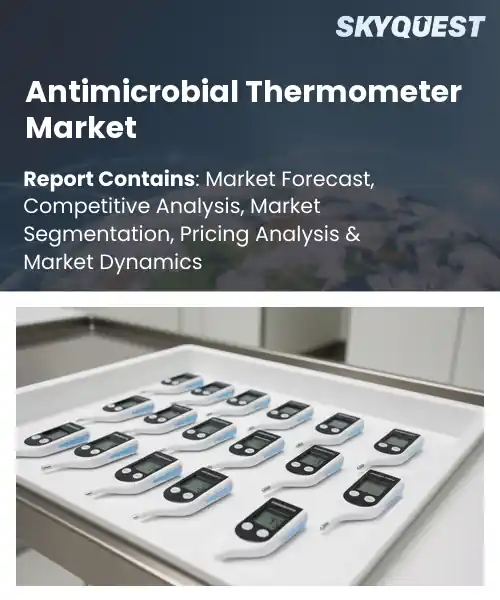
Antimicrobial Thermometer Market
Report ID: SQMIG35A4298
Report ID: SQMIG35A4298
[email protected]
USA +1 351-333-4748
Report ID:
SQMIG35A4298 |
Region:
Global |
Published Date: August, 2026
Pages:
157
|Tables:
118
|Figures:
77


Global Antimicrobial Thermometer Market size was valued at USD 318.6 Million in 2024 and is poised to grow from USD 338.99 Million in 2025 to USD 556.83 Million by 2033, growing at a CAGR of 6.4% during the forecast period (2026-2033).
Regulatory endorsement of antimicrobial thermometers acts as the pivotal growth catalyst because mandated hygiene standards compel hospitals to replace legacy devices with sterilizing alternatives. When agencies such as the FDA issue guidance favoring UV‑LED or antimicrobial‑coated probes, procurement teams accelerate adoption, leading to a decline in nosocomial infection rates. For example, a regional health network in Texas reported a 22 % reduction in bacterial outbreaks after integrating antimicrobial thermometers across its intensive‑care units. This outcome fuels demand from emerging markets where infection‑control infrastructure is developing, inviting manufacturers to tailor affordable models for clinics in Asia and Africa, thereby expanding market reach.
These trends underscore the sector’s relevance. The key trend driving the global antimicrobial thermometer sector expansion is the heightened awareness of cross‑contamination risks, especially after recent pandemics highlighted the need for rapid, hygienic diagnostic tools. Early adopters such as Cleveland Clinic introduced UV‑LED‑based probes in 2018, prompting a ripple effect across health systems that prioritized infection‑control budgets. Over the past six years the market has expanded from niche surgical tools to mainstream pediatric and home‑care products, driven by regulatory incentives and heightened awareness of hygiene. This evolution illustrates a cause‑and‑effect chain: increased infection awareness leads to stricter regulations, which in turn stimulate technological innovation and broader adoption across diverse care settings.
How is IoT Integration Driving Growth in the Antimicrobial Thermometer Market?
AI is impacting the global antimicrobial thermometer market by enabling smarter temperature analysis, predictive fever detection, and automated infection surveillance. Because AI can analyze temperature patterns alongside patient and clinical data, healthcare providers can identify abnormal fever trends earlier, increasing demand for connected, non-contact thermometers that reduce cross-contamination.
In June 2025, Kontakt.io launched an AI-powered temperature-monitoring solution providing continuous monitoring and real-time alerts for temperature-sensitive healthcare supplies. Additionally, AI-based infection-prevention systems can improve outbreak detection, indirectly increasing demand for hygienic temperature-monitoring technologies.
Market snapshot - (2026-2033)
Global Market Size
USD 318.6 Million
Largest Segment
Digital Thermometers
Fastest Growth
Forehead Thermometers
Growth Rate
6.4% CAGR
To get more insights on this market click here to Request a Free Sample Report
Global antimicrobial thermometer market is segmented by product type, antimicrobial material, end user, distribution channel and region. Based on product type, the market is segmented into digital thermometers, infrared thermometers, ear thermometers and forehead thermometers. Based on antimicrobial material, the market is segmented into silver ion coating, copper-based coating and antimicrobial polymer. Based on end user, the market is segmented into hospitals, clinics and home care. Based on distribution channel, the market is segmented into medical supply stores, pharmacies and online retail. Based on region, the market is segmented into North America, Europe, Asia Pacific, Latin America and Middle East & Africa.
Based on the global antimicrobial thermometer market growth, digital thermometers segment dominates because they provide precise, real time readings that integrate seamlessly with electronic health records, enabling rapid clinical decisions while minimizing cross contamination through single use probe covers. Their ease of calibration and durability make them preferred in high throughput environments, fostering trust among clinicians. Consequently, manufacturers prioritize advanced sensor technology and antimicrobial surface treatments, reinforcing the segment’s central role in safeguarding patient safety across care settings and operational efficiency.
However, infrared thermometers segment is witnessing the strongest growth momentum because contactless measurement aligns with heightened hygiene protocols and patient comfort expectations. The ability to obtain instant readings without physical contact drives adoption in diverse settings, spurring innovation in sensor accuracy and encouraging broader market penetration that fuels future expansion.
Silver ion coating segment leads because its broad spectrum antimicrobial action continuously disrupts bacterial cell membranes, reducing pathogen survival on device surfaces. This inherent efficacy requires minimal reapplication, aligning with stringent sterilization standards in clinical environments. Consequently, manufacturers embed silver ions during molding, creating durable low maintenance products that inspire confidence among healthcare providers and reinforce the material’s pivotal role in infection prevention across a wide range of temperature measurement devices and clinical specialties.
Meanwhile, antimicrobial polymer segment emerges as the key high growth area because its customizable formulation enables integration into flexible thermometer casings, supporting lightweight designs and rapid manufacturing cycles. Growing demand for disposable eco friendly devices drives investment in polymer research, expanding market opportunities and accelerating adoption across home care and point of care settings.
To get detailed segments analysis, Request a Free Sample Report
As per the global antimicrobial thermometer market share, North America benefits from a mature health‑care infrastructure that emphasizes patient safety and infection control, creating strong demand for advanced temperature monitoring solutions. Robust research and development ecosystems, supported by leading academic institutions and innovative manufacturers, accelerate product enhancements such as integrated antimicrobial surfaces and digital connectivity. Reimbursement frameworks and strict regulatory standards encourage adoption across hospitals, outpatient clinics, and long‑term care facilities. Additionally, well‑established distribution networks and a focus on high‑value clinical outcomes reinforce market leadership, allowing the region to set industry benchmarks and shape global procurement preferences.
Antimicrobial thermometer market in the United States is propelled by extensive hospital networks that prioritize cutting‑edge infection‑prevention technologies. Strong collaboration between device innovators and clinical research bodies fosters rapid integration of antimicrobial materials and smart data analytics. Regulatory pathways that emphasize safety and efficacy further accelerate market entry, while insurance coverage models support widespread deployment across acute and chronic care settings. The emphasis on patient‑centered care and continuous quality improvement sustains a dynamic demand environment.
Antimicrobial thermometer market in Canada is shaped by a publicly funded health system focused on preventive care and cost‑effective solutions. Provincial health authorities drive procurement strategies that favor devices with proven antimicrobial efficacy, aligning with national infection‑control guidelines. Collaborative research initiatives between universities and industry accelerate adaptation of emerging technologies, while an emphasis on rural health outreach expands market reach beyond major urban centers. The integration of digital health platforms further enhances monitoring capabilities, reinforcing the market’s growth trajectory.
Based on global antimicrobial thermometer regional forecast, Europe’s expansion is driven by stringent infection‑control regulations and a strong public commitment to patient safety across member states. Harmonized standards facilitate cross‑border adoption of antimicrobial thermometer technologies, while government‑backed initiatives encourage investment in hospital modernization. A thriving network of specialized manufacturers and research consortia promotes continual product innovation, particularly in surface‑coating technologies and wireless monitoring. Health‑care providers increasingly prioritize integrated solutions that combine temperature accuracy with antimicrobial protection, reinforcing market momentum. Collaborative procurement frameworks and sustainability agendas further amplify demand, positioning Europe as a leading hub for advanced clinical temperature monitoring.
Antimicrobial thermometer market in Germany is anchored by a robust medical device sector that emphasizes high‑quality engineering and rigorous testing. Strong ties between industry and academic research foster rapid incorporation of novel antimicrobial materials and sensor technologies. National health guidelines that underline infection prevention drive adoption in tertiary hospitals and specialty clinics. Reimbursement policies that reward preventive technologies support widespread deployment, while export‑oriented manufacturers reinforce Germany’s reputation as a benchmark for reliability and performance.
Antimicrobial thermometer market in the United Kingdom is accelerating due to proactive NHS initiatives that prioritize infection‑control investments. Collaborative programs between governmental health agencies and technology firms accelerate the rollout of smart, antimicrobial‑enabled devices across acute and community settings. Emphasis on digital health integration and data‑driven patient monitoring creates a fertile environment for next‑generation thermometers. Policy frameworks that encourage cost‑effective, evidence‑based solutions further stimulate market uptake, positioning the United Kingdom as a fast‑moving segment within Europe.
Antimicrobial thermometer market in France is emerging as health authorities emphasize modernisation of clinical equipment to combat healthcare‑associated infections. National health agencies promote adoption of devices that combine precise temperature measurement with antimicrobial surface treatments. Partnerships between French biotech firms and international manufacturers accelerate technology transfer and local production. Growing awareness of patient safety in both public hospitals and private clinics fuels interest, setting the stage for expanded market presence.
As per global antimicrobial thermometer regioanal outlook, Asia Pacific is strengthening its position through rapid adoption of advanced healthcare technologies and increasing focus on infection prevention in densely populated regions. Government health programmes prioritize modern equipment upgrades, encouraging hospitals to integrate antimicrobial thermometer solutions that reduce cross‑contamination risks. Strong manufacturing capabilities in key economies enable cost‑effective production and rapid scaling of innovative designs, while collaborative research initiatives advance material science and digital integration. Rising consumer awareness of hygiene standards and expanding private‑clinic networks further drive demand, positioning the region as a dynamic growth engine in the global landscape.
Antimicrobial thermometer market in Japan benefits from a technologically sophisticated health system that values precision and safety. Close cooperation between medical device manufacturers and research institutes accelerates development of antimicrobial coatings and IoT‑enabled thermometers. National guidelines that stress infection control in both acute and elderly care facilities promote widespread adoption. Emphasis on high‑quality standards and patient‑centric design keeps Japan at the forefront of market innovation.
Antimicrobial thermometer market in South Korea is propelled by aggressive digital health strategies and a strong focus on reducing hospital‑acquired infections. Government incentives support integration of antimicrobial technologies within smart hospital ecosystems. Rapid commercialization of locally engineered antimicrobial materials, coupled with a vibrant start‑up culture, drives continuous product enhancements. Broad implementation across tertiary hospitals and an expanding network of specialized clinics underscores South Korea’s growing market influence.
To know more about the market opportunities by region and country, click here to
Buy The Complete Report
Integration Of IoT is Accelerating
Increasing Adoption Of Remote Monitoring
Regulatory Approval Processes remain Stringent
High Cost Of Advanced Sensors
Request Free Customization of this report to help us to meet your business objectives.
The competitive landscape in the global antimicrobial thermometer market outlook is shaped by manufacturers accelerating product differentiation through antimicrobial coatings, with Philips partnering with NanoGuard to embed silver‑nanoparticle technology in its digital line, while Braun secured a licensing deal with BioShield to integrate a proprietary antimicrobial polymer, both moves aimed at capturing hospital procurement budgets that prioritize infection‑control features.
Top Player’s Company Profile
Recent Developments
SkyQuest’s ABIRAW (Advanced Business Intelligence, Research & Analysis Wing) is our Business Information Services team that Collects, Collates, Correlates, and Analyses the Data collected by means of Primary Exploratory Research backed by robust Secondary Desk research.
As per SkyQuest analysis, the global antimicrobial thermometer industry is propelled primarily by heightened infection‑control awareness that pushes hospitals to adopt devices with built‑in antimicrobial coatings, while the integration of IoT connectivity serves as a second driver by enabling remote temperature tracking and real‑time alerts. The digital thermometer segment leads the market because its precise sensors and single‑use probe covers align with clinical workflow demands. North America dominates due to mature healthcare infrastructure, strong regulatory support and advanced R&D ecosystems. However, stringent regulatory approval processes act as a restraint, extending development timelines and raising costs for new sensor‑rich products, tempering overall growth.
| Report Metric | Details |
|---|---|
| Market size value in 2024 | USD 318.6 Million |
| Market size value in 2033 | USD 556.83 Million |
| Growth Rate | 6.4% |
| Base year | 2024 |
| Forecast period | (2026-2033) |
| Forecast Unit (Value) | USD Million |
| Segments covered |
|
| Regions covered | North America (US, Canada), Europe (Germany, France, United Kingdom, Italy, Spain, Rest of Europe), Asia Pacific (China, India, Japan, Rest of Asia-Pacific), Latin America (Brazil, Rest of Latin America), Middle East & Africa (South Africa, GCC Countries, Rest of MEA) |
| Companies covered |
|
| Customization scope | Free report customization with purchase. Customization includes:-
|
To get a free trial access to our platform which is a one stop solution for all your data requirements for quicker decision making. This platform allows you to compare markets, competitors who are prominent in the market, and mega trends that are influencing the dynamics in the market. Also, get access to detailed SkyQuest exclusive matrix.
Table Of Content
Executive Summary
Market overview
Parent Market Analysis
Market overview
Market size
KEY MARKET INSIGHTS
COVID IMPACT
MARKET DYNAMICS & OUTLOOK
Market Size by Region
KEY COMPANY PROFILES
Methodology
For the Antimicrobial Thermometer Market, our research methodology involved a mixture of primary and secondary data sources. Key steps involved in the research process are listed below:
1. Information Procurement: This stage involved the procurement of Market data or related information via primary and secondary sources. The various secondary sources used included various company websites, annual reports, trade databases, and paid databases such as Hoover's, Bloomberg Business, Factiva, and Avention. Our team did 45 primary interactions Globally which included several stakeholders such as manufacturers, customers, key opinion leaders, etc. Overall, information procurement was one of the most extensive stages in our research process.
2. Information Analysis: This step involved triangulation of data through bottom-up and top-down approaches to estimate and validate the total size and future estimate of the Antimicrobial Thermometer Market.
3. Report Formulation: The final step entailed the placement of data points in appropriate Market spaces in an attempt to deduce viable conclusions.
4. Validation & Publishing: Validation is the most important step in the process. Validation & re-validation via an intricately designed process helped us finalize data points to be used for final calculations. The final Market estimates and forecasts were then aligned and sent to our panel of industry experts for validation of data. Once the validation was done the report was sent to our Quality Assurance team to ensure adherence to style guides, consistency & design.
Analyst Support
Customization Options
With the given market data, our dedicated team of analysts can offer you the following customization options are available for the Antimicrobial Thermometer Market:
Product Analysis: Product matrix, which offers a detailed comparison of the product portfolio of companies.
Regional Analysis: Further analysis of the Antimicrobial Thermometer Market for additional countries.
Competitive Analysis: Detailed analysis and profiling of additional Market players & comparative analysis of competitive products.
Go to Market Strategy: Find the high-growth channels to invest your marketing efforts and increase your customer base.
Innovation Mapping: Identify racial solutions and innovation, connected to deep ecosystems of innovators, start-ups, academics, and strategic partners.
Category Intelligence: Customized intelligence that is relevant to their supply Markets will enable them to make smarter sourcing decisions and improve their category management.
Public Company Transcript Analysis: To improve the investment performance by generating new alpha and making better-informed decisions.
Social Media Listening: To analyze the conversations and trends happening not just around your brand, but around your industry as a whole, and use those insights to make better Marketing decisions.
REQUEST FOR SAMPLE
 REQUEST FREE CUSTOMIZATION
Global Antimicrobial Thermometer Market size was valued at USD 318.6 Million in 2024 and is poised to grow from USD 338.99 Million in 2025 to USD 556.83 Million by 2033, growing at a CAGR of 6.4% during the forecast period (2026-2033).
The competitive landscape is shaped by manufacturers accelerating product differentiation through antimicrobial coatings, with Philips partnering with NanoGuard to embed silver‑nanoparticle technology in its digital line, while Braun secured a licensing deal with BioShield to integrate a proprietary antimicrobial polymer, both moves aimed at capturing hospital procurement budgets that prioritize infection‑control features. 'Terumo Corporation', 'Omron Healthcare Co., Ltd.', 'Microlife Corporation', 'Braun GmbH', 'Easywell Biomedicals, Inc.', 'Berrcom', 'Exergen Corporation', 'American Diagnostic Corporation', 'Welch Allyn', 'Rossmax International Ltd.', 'Geratherm Medical AG', 'Citizen Systems Japan Co., Ltd.', 'Beurer GmbH', 'Kinsa Inc.', 'Vicks', 'iHealth Labs Inc.', 'Trister Corporation', 'Radiant Innovation Inc.', 'AViTA Corporation', 'Nureca Limited'
Integration of IoT is accelerating as manufacturers embed connectivity modules within antimicrobial thermometers, enabling continuous data transmission to healthcare platforms. This capability supports proactive infection control by allowing clinicians to monitor temperature trends remotely and receive alerts for abnormal readings. Seamless integration also facilitates aggregation of population health data, informing pandemic response strategies. As hospitals prioritize digital interoperability, the enhanced operational efficiency and improved patient safety associated with connected devices drive greater demand for smart antimicrobial thermometers across global markets.
Integrated Digital Health Platforms: Healthcare providers increasingly adopt integrated digital health platforms that unify temperature monitoring with electronic medical records, remote patient monitoring, and predictive analytics. Antimicrobial thermometers equipped with wireless connectivity feed data into centralized dashboards, enabling clinicians to track infection risk trends and automate alerts. This seamless data flow supports proactive infection control, reduces manual entry errors, and enhances patient throughput. As hospitals prioritize holistic digital ecosystems, demand accelerates for thermometers that can communicate securely across interoperable networks while maintaining antimicrobial integrity.
Why does North America Dominate the Global Antimicrobial Thermometer Market? |@12


Want to customize this report? This report can be personalized according to your needs. Our analysts and industry experts will work directly with you to understand your requirements and provide you with customized data in a short amount of time. We offer $1000 worth of FREE customization at the time of purchase.
Feedback From Our Clients


 USA (+1) 351-333-4748

