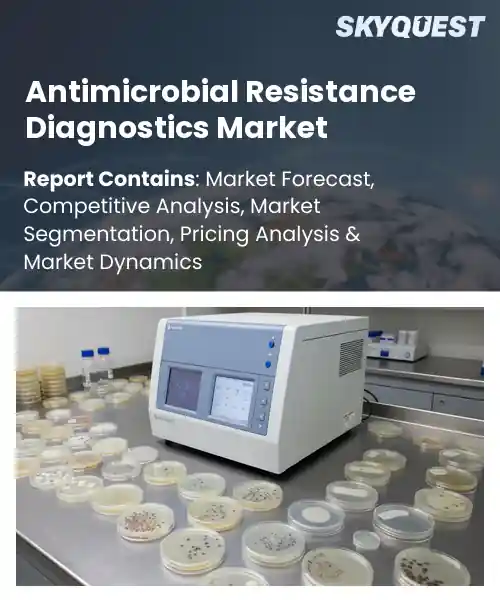
Antimicrobial Resistance Diagnostics Market
Report ID: SQMIG35J2379
Report ID: SQMIG35J2379
[email protected]
USA +1 351-333-4748
Report ID:
SQMIG35J2379 |
Region:
Global |
Published Date: June, 2026
Pages:
157
|Tables:
119
|Figures:
77


Global Antimicrobial Resistance Diagnostics Market size was valued at USD 4.52 Billion in 2024 and is poised to grow from USD 4.92 Billion in 2025 to USD 9.85 Billion by 2033, growing at a CAGR of 8.82% during the forecast period (2026-2033).
The driving force behind the market for antimicrobial resistance diagnostics is the growing worldwide problem of antibiotic resistance among microbes, changing medical approaches and policies. Antimicrobial resistance diagnostics include assays, technologies, and tools for pathogen and resistance detection that allow for specific treatment and proper stewardship. The need for antimicrobial resistance diagnostics lies in the fact that empirically selected broad-spectrum antibiotics cause antimicrobial resistance, increased mortality, and additional expenses. Traditionally, this sphere progressed from slow phenotypic culture and sensitivity tests to rapid technologies such as PCR, MALDI-TOF mass spectrometry, and next-generation sequencing, like in the example of hospitals' laboratories' detection of MRSA and Enterobacteriaceae producing carbapenemases.
Given the advancements in diagnostics, regulatory incentive along with the impact on the practice is one of the important drivers of the global growth of the market since favorable compensation and guidelines lead to fewer obstacles to adoption as well as investment into the industry. Rapid diagnosis and point-of-care testing result in quick treatment and thus minimize misuse of antibiotics, shorten length of stay in hospitals, and decrease subsequent costs, forming a positive cycle that drives innovations. For instance, sepsis panels based on PCR in ICU settings have resulted in reduced time to treatment and lower mortality rates according to scientific literature, and integrated surveillance systems like GLASS provide new market opportunities.
How is AI Enhancing Diagnostic Accuracy in the Antimicrobial Resistance Diagnostics Market?
Improvements in antimicrobial resistance diagnostics market are achieved through the application of machine learning algorithms together with genomic and proteomic information for resolving ambiguous laboratory results. This includes pattern recognition in sequencing and mass spectra analysis, prediction of resistance markers prior to culture, and decision support systems that alert of resistant bacteria. Current status in the area suggests that more laboratories are turning to AI technology to enhance susceptibility testing procedures and facilitate physician decision-making. Market forces including increased antibiotic resistance as well as need for quicker clinical diagnosis are forcing diagnostics companies to cooperate with AI firms. The application of AI in sequencing and MALDI spectra demonstrates advances achieved in prediction capabilities. Biotia May 2026 - In May 2026, Biotia commercialized BIOTIA DX Resistance along with its CLP urine assay providing an example of AI-based resistance profiling and how AI improves prediction capabilities.
Market snapshot - (2026-2033)
Global Market Size
USD 4.52 Billion
Largest Segment
Phenotypic Tests (Culture & Sensitivity)
Fastest Growth
Rapid Diagnostic Tests (RDTs)
Growth Rate
8.82% CAGR
To get more insights on this market click here to Request a Free Sample Report
Global antimicrobial resistance diagnostics market is segmented by test type, technology, pathogen, end-user and region. Based on test type, the market is segmented into Genotypic Tests (PCR, NGS), Phenotypic Tests (Culture & Sensitivity) and Rapid Diagnostic Tests (RDTs). Based on technology, the market is segmented into PCR-Based, Microarray-Based and Mass Spectrometry (MALDI-TOF). Based on pathogen, the market is segmented into Bacteria (MRSA, ESBL), Fungi and Mycobacteria (TB). Based on end-user, the market is segmented into Hospitals, Clinical Laboratories and Public Health Labs. Based on region, the market is segmented into North America, Europe, Asia Pacific, Latin America and Middle East & Africa.
The Genotypic Tests section is most prominent since genotypic methods involve the direct detection of resistance determinants through clinical samples, which provide swift and accurate molecular profiles that help make informed therapeutic choices. The broad range of multiplexing and sequencing methods allows for the discovery of both established and novel resistance factors, which aids surveillance and assay development. Such molecular information provides more precise information that facilitates better antimicrobial stewardship decisions and helps minimize the use of empirical therapies, thus propelling innovations by diagnostics companies.
On the contrary, Rapid Diagnostic Tests are showing the greatest potential as far as there is an increased interest in POC diagnostics and improvements in terms of cartridge-based and lateral flow tests facilitate a fast clinical decision-making process. The ease of testing and faster results contribute to the use of these kits by clinicians, which stimulates business collaborations.
Mass Spectrometry (MALDI-TOF) section is the most prominent since mass spectrometry provides quick identification of organisms with a small number of reagent costs per sample, fast throughput capabilities that ease work in laboratories, and facilitate rapid access to specific treatment. Linking to laboratory information systems and further research of resistance proteomic markers add more value for clinics. Efficiency, reproducibility, and automation capability make the technology a preferable option for diagnostics in laboratories aiming to improve efficiency.
As for the PCR-Based technologies, they show significant growth prospects due to constant development of multiplex assays, real-time detection, and better automation. New indications from authorities and panels for the detection of resistance genes increase popularity among clinicians. POC applications and molecular diagnostics integration provide an impetus for market expansion and development of additionaldiagnostics services.
To get detailed segments analysis, Request a Free Sample Report
The dominance of North America in the antimicrobial resistance diagnostics market is fueled by a combination of superior laboratory facilities, an environment that houses the ecosystem of diagnostics firms, and regulatory support that aids the commercialization process. Well-developed public health systems and antibiotic stewardship programs result in the need for rapid and accurate diagnostic tests. There is synergybetween industry players, academic centers, and reference laboratories that ensures that new diagnostics become commercially viable through proper clinical validation and scale up of production. Health care providers place great emphasis on diagnostic procedures that can be incorporated into the electronic health record systems.
Market Dynamics in the United States Antimicrobial Resistance Diagnostics Market is marked by high concentration of clinical laboratories, advanced diagnostic capabilities, and good hospital linkages. US consumers favor rapid tests along with other molecular diagnostic methods because of the presence of strong reimbursement schemes and stewardship programs. This aids in favour of revenue generation. The joint effort of the industry, research institutions, and health care providers leads to quick introduction of innovative diagnostic platforms.
Antimicrobial Resistance Diagnostics Market in Canada exhibits a cohesive approach in its healthcare system with coordinated approaches towards surveillance and stewardship initiatives for both community and hospitals. The emphasis on modernizing laboratory facilities coupled with partnering with public laboratories is an effort that will result in the adoption of rapid susceptibility testing. Compatibility of procurement and decision-making support by clinicians facilitate this process, whereas collaboration with research institutions helps in validating such diagnostic assays.
There is substantial growth of the antimicrobial resistance diagnostics market in Europe, attributable to an integrated approach to public health measures, including regulatory alignment, as well as greater focus on national surveillance and stewardship programs that emphasize the value of diagnostic-led interventions. Healthcare organizations are supporting diagnostics that allow for more targeted drug treatment options while minimizing antimicrobial overuse. There is investment in laboratory infrastructure and data sharing across borders to improve standards and ensure validation procedures. Partnership between industry, academic medical centers, and governmental institutions expedites implementation of standardized diagnostic tests. Policies and funding mechanisms, coupled with stakeholder initiatives that define antimicrobial resistance as a social problem, foster market growth.
Market for Antimicrobial Resistance Diagnostics in Germany is supported by an excellent diagnostic manufacturing sector, highly equipped hospital labs, and stringent clinical protocols that stress on microbial stewardship. There is cooperation between public health bodies and research centers in harmonizing susceptibility testing and strengthening surveillance systems. Systems have been put in place to facilitateintegration of new molecular and phenotypic platforms in the system.
Market for Antimicrobial Resistance Diagnostics in the United Kingdom demonstrates an accelerated adoption of new diagnostic technologies through the use of commissioning frameworks that prioritize results-based stewardship. Adoption of point-of-care diagnostics along clinical pathways and correlation with the surveillance objectives fast-track adoption. Partnerships between public and private sectors, involving pilots in both acute and community sectors, generate real-world evidence to scale adoption. The government’s focus on innovation procurement and clinical engagement facilitates diffusion of new diagnostics.
The Antimicrobial Resistance Diagnostics Market in France is developing through strategic investments in laboratory networks, regional surveillance efforts, and regional stewardship programs. Attention on the harmonization of testing methods and inclusion of rapid molecular diagnostics in hospital processes to aid clinical decision-making has been emphasized. Cooperation among public laboratories, clinicians, and diagnostic companies improves method standardization and access. The focus on regional procurement strategies and implementation of pilot projects drives market growth in tertiary hospitals.
The Asia Pacific region is increasingly asserting itself in the market for antimicrobial resistance diagnostics through improvements in diagnostic infrastructure, increased local production, and public health strategies that emphasize surveillance and testing. Regional markets emphasize implementation of scalable molecular platforms and point of care devices suited to different healthcare settings. Research conducted by both industry and academics expedites the localization and validation of tests. Harmonization of regulatory frameworks and approval processes facilitate quicker access to diagnostic products. Training for laboratory technicians and investment in improved connectivity allow diagnostics to be seamlessly integrated into clinical decision-making and surveillance databases. Collaborations among public and private entities validate the usefulness of the diagnostic tests and lead to larger scale procurement of such tests.
The Antimicrobial Resistance Diagnostics Market in Japan is driven by innovations within the country, strong laboratory infrastructure, and partnership between diagnostics manufacturers and research facilities. The focus on molecular diagnostics and automation is helping integrate these tools into hospitals’ workflows. Surveillance programs at the national level and the involvement of clinicians are creating a need for rapid susceptibility tests and stewardship tools. Regulations and financing are helping translate innovations to clinical practice, and international cooperation is allowing technology to transfer.
South Korean Antimicrobial Resistance Diagnostics Market is characterized by strong laboratory capabilities, application of molecular diagnostics, and partnerships between technology companies and university-affiliated hospitals. The healthcare regulatory system favors the incorporation of diagnostics into surveillance and stewardship initiatives, leading to use in both community and hospital care settings. A focus on local production and development creates an environment for scaling, whereas digital health interoperability makes the linking of diagnostic tests with clinical decision support possible.
To know more about the market opportunities by region and country, click here to
Buy The Complete Report
Expansion of Rapid Diagnostic Adoption
Fast and accurate diagnostic systems facilitate targeted antibiotic treatment by rapidly identifying pathogens and resistance genes, avoiding empirical treatments and selecting the right medications, thereby raising the level of confidence and the need for sophisticated diagnostics among clinicians; the improvement in diagnostic processes in clinical laboratories and at the point of care encourages their adoption and stimulates development among manufacturers; with clinicians valuing diagnostics-based antimicrobial stewardship practices, market acceptance grows because it is seen as benefiting both patient management and the preservation of antibiotics' efficacy.
Government Support for Stewardship Programs
Antimicrobial stewardship policy programs and strategies ensure a constant need for diagnostics to support surveillance, appropriate prescription, and resistance surveillance, leading to the acquisition and deployment of diagnostics by healthcare systems; investment and purchasing policies show the potential for long-term viability in the market to innovators and investors; and as regulatory guidelines call for diagnostics to confirm diagnosis and monitor patients, laboratories and healthcare providers will deploy new AMR diagnostics to ensure compliance, creating opportunities for growth in the market.
High Development and Validation Costs
The extensive effort that must go into research, assay optimization, clinical validation, and compliance with regulations demands significant funding from the developers, thus hindering smaller companies from entering the field while delaying diversification; health insurers or health care buyers may prove hesitant about employing novel diagnostic tests that lack reimbursement paths, leading to delayed market adoption and expectations regarding the returns on investment; lengthy development periods and the requirement for advanced laboratory equipment add more barriers to scale, leaving less room for available solutions in an expanding market despite clinical needs.
Limited Standardization Across Platforms
The inconsistency of testing format, varying target panels, and inconsistent interpretation standards among different diagnostic systems make interoperability difficult and make it hard to compare results from different institutions, which decreases clinicians' willingness to replace older methods; since there is a lack of standards on performance and reporting, laboratories find it difficult to choose an assay while payers are hesitant to assess the value of the product, delaying decision-making in the procurement process; these factors discourage the adoption of the technology, limiting the economies of scale for manufacturers and hindering coordinated surveillance efforts.
Request Free Customization of this report to help us to meet your business objectives.
The competitive environment in the AMR diagnostics market worldwide is characterized by intense technological advancements, regulatory approvals, and consolidation. Incumbents seek strategic mergers and partnerships while the entrants launch advanced phenotypic or genotypic AST systems. This includes AST Revolution’s acquisition and re-launch of Accelerate Diagnostics’ offerings, FDA approval of the new generation phenotypic AST system by Selux, and acquisitions along with genotypic collaborations by bioMérieux.
SkyQuest’s ABIRAW (Advanced Business Intelligence, Research & Analysis Wing) is our Business Information Services team that Collects, Collates, Correlates, and Analyses the Data collected by means ofPrimary Exploratory Research backed by robust Secondary Desk research.
As per SkyQuest analysis, the factors mainly contributing to the growth of the global market of antimicrobial resistance diagnostic tests include the increasing burden of drug-resistant infections globally, which results in the increased demand for such testing methods that allow targeted treatment of patients; however, high costs of creation and verification limit the entrance of new players into the market and hinder diversification of products. North America is the market leader because of well-developed laboratory facilities and a favorable policy regarding antimicrobial stewardship, whereas genotypic tests are the leading segment in the industry thanks to their fast and accurate identification of resistance markers.
| Report Metric | Details |
|---|---|
| Market size value in 2024 | USD 4.52 Billion |
| Market size value in 2033 | USD 9.85 Billion |
| Growth Rate | 8.82% |
| Base year | 2024 |
| Forecast period | (2026-2033) |
| Forecast Unit (Value) | USD Billion |
| Segments covered |
|
| Regions covered | North America (US, Canada), Europe (Germany, France, United Kingdom, Italy, Spain, Rest of Europe), Asia Pacific (China, India, Japan, Rest of Asia-Pacific), Latin America (Brazil, Rest of Latin America), Middle East & Africa (South Africa, GCC Countries, Rest of MEA) |
| Companies covered |
|
| Customization scope | Free report customization with purchase. Customization includes:-
|
To get a free trial access to our platform which is a one stop solution for all your data requirements for quicker decision making. This platform allows you to compare markets, competitors who are prominent in the market, and mega trends that are influencing the dynamics in the market. Also, get access to detailed SkyQuest exclusive matrix.
Table Of Content
Executive Summary
Market overview
Parent Market Analysis
Market overview
Market size
KEY MARKET INSIGHTS
COVID IMPACT
MARKET DYNAMICS & OUTLOOK
Market Size by Region
KEY COMPANY PROFILES
Methodology
For the Antimicrobial Resistance Diagnostics Market, our research methodology involved a mixture of primary and secondary data sources. Key steps involved in the research process are listed below:
1. Information Procurement: This stage involved the procurement of Market data or related information via primary and secondary sources. The various secondary sources used included various company websites, annual reports, trade databases, and paid databases such as Hoover's, Bloomberg Business, Factiva, and Avention. Our team did 45 primary interactions Globally which included several stakeholders such as manufacturers, customers, key opinion leaders, etc. Overall, information procurement was one of the most extensive stages in our research process.
2. Information Analysis: This step involved triangulation of data through bottom-up and top-down approaches to estimate and validate the total size and future estimate of the Antimicrobial Resistance Diagnostics Market.
3. Report Formulation: The final step entailed the placement of data points in appropriate Market spaces in an attempt to deduce viable conclusions.
4. Validation & Publishing: Validation is the most important step in the process. Validation & re-validation via an intricately designed process helped us finalize data points to be used for final calculations. The final Market estimates and forecasts were then aligned and sent to our panel of industry experts for validation of data. Once the validation was done the report was sent to our Quality Assurance team to ensure adherence to style guides, consistency & design.
Analyst Support
Customization Options
With the given market data, our dedicated team of analysts can offer you the following customization options are available for the Antimicrobial Resistance Diagnostics Market:
Product Analysis: Product matrix, which offers a detailed comparison of the product portfolio of companies.
Regional Analysis: Further analysis of the Antimicrobial Resistance Diagnostics Market for additional countries.
Competitive Analysis: Detailed analysis and profiling of additional Market players & comparative analysis of competitive products.
Go to Market Strategy: Find the high-growth channels to invest your marketing efforts and increase your customer base.
Innovation Mapping: Identify racial solutions and innovation, connected to deep ecosystems of innovators, start-ups, academics, and strategic partners.
Category Intelligence: Customized intelligence that is relevant to their supply Markets will enable them to make smarter sourcing decisions and improve their category management.
Public Company Transcript Analysis: To improve the investment performance by generating new alpha and making better-informed decisions.
Social Media Listening: To analyze the conversations and trends happening not just around your brand, but around your industry as a whole, and use those insights to make better Marketing decisions.
REQUEST FOR SAMPLE
 REQUEST FREE CUSTOMIZATION
Global Antimicrobial Resistance Diagnostics Market size was valued at USD 4.52 Billion in 2024 and is poised to grow from USD 4.92 Billion in 2025 to USD 9.85 Billion by 2033, growing at a CAGR of 8.82% during the forecast period (2026-2033).
Competitive dynamics in the global AMR diagnostics market are driven by rapid technology innovation, regulatory clearances, and strategic consolidation. Established firms pursue targeted acquisitions and collaborations while challengers commercialize faster phenotypic and genomic AST methods. For example, AST Revolution relaunched Accelerate Diagnostics assets, Selux secured FDA clearance for its next generation phenotyping AST platform, and bioMérieux expanded through acquisitions and genomic partnerships to broaden AMR capabilities. 'bioMérieux SA', 'Thermo Fisher Scientific', 'Becton Dickinson', 'Roche Diagnostics', 'Abbott Laboratories', 'Cepheid (Danaher)', 'Luminex', 'GenMark Diagnostics', 'OpGen Inc.', 'Vela Diagnostics', 'ELITechGroup', 'Bruker Corporation (MALDI-TOF)', 'Hologic Inc.', 'Accelerate Diagnostics', 'Specific Diagnostics', 'T2 Biosystems', 'Shenzhen Mindray', 'Sysmex Corporation', 'DiaSorin SpA', 'Meridian Bioscience'
Rapid, precise diagnostic platforms enable targeted antimicrobial therapy by identifying causative pathogens and resistance markers promptly, reducing empirical treatment reliance and guiding appropriate drug selection, which increases clinical confidence and demand for advanced diagnostics; improved diagnostic workflows in clinical laboratories and point-of-care settings foster greater integration into care pathways, encouraging investment and development by manufacturers; as clinicians and institutions increasingly value diagnostics that inform stewardship, market uptake rises because diagnostic-led care is perceived as improving patient management and preserving antimicrobial effectiveness.
Point-Of-Care Expansion: Adoption of compact, user-friendly diagnostics outside central labs is reshaping market demand by prioritizing rapid, actionable results at the bedside and in outpatient settings. This shift supports earlier targeted therapy, strengthens antimicrobial stewardship, and expands testing reach into community and resource-limited environments. Manufacturers are optimizing workflows, usability, and connectivity for clinical decision support. Payers and providers increasingly value instruments that reduce time to appropriate treatment and integrate seamlessly with electronic systems, creating sustained demand for decentralized solutions and capacity building.
Why does North America Dominate the Global Antimicrobial Resistance Diagnostics Market? |@12


Want to customize this report? This report can be personalized according to your needs. Our analysts and industry experts will work directly with you to understand your requirements and provide you with customized data in a short amount of time. We offer $1000 worth of FREE customization at the time of purchase.
Feedback From Our Clients


 USA (+1) 351-333-4748

