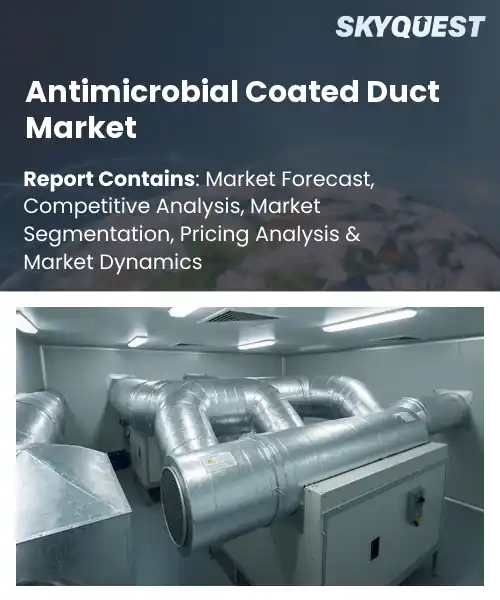
Antimicrobial Coated Duct Market
Report ID: SQMIG15F2308
Report ID: SQMIG15F2308
[email protected]
USA +1 351-333-4748
Report ID:
SQMIG15F2308 |
Region:
Global |
Published Date: February, 2026
Pages:
157
|Tables:
118
|Figures:
77


Global Antimicrobial Coated Duct Market size was valued at USD 650.3 Million in 2024 and is poised to grow from USD 678.91 Million in 2025 to USD 958.12 Million by 2033, growing at a CAGR of 4.4% during the forecast period (2026-2033).
The global antimicrobial coated duct market growth focuses on HVAC duct systems which have been treated with biocidal and bioresistant coatings that prevent the growth of bacteria and fungi and viruses. The market exists because duct systems function as pathways which distribute harmful airborne particles that compromise the well-being of building occupants and the cleanliness of the premises and the productivity of the space, which leads owners to invest in protection methods. Indoor air quality awareness has increased during the last ten years, which resulted in the expansion of demand from specialized healthcare and pharmaceutical markets to broad commercial and educational and residential markets after air quality standards and safety regulations developed. Public health worries have driven an increase in hospital facility installations which healthcare regulators currently monitor through their new regulations.
Regulatory agencies have established tighter requirements which force building designers to implement antimicrobial solutions that fulfill indoor air quality standards, while green building regulations create market growth drivers which push manufacturers to develop affordable antimicrobial solutions. The market for HVAC systems will grow through building retrofits because the increased urbanization and commercial construction activities require developers to upgrade their HVAC systems in existing buildings, which will be particularly beneficial for developing markets that need maintenance solutions which keep equipment in good condition without needing frequent cleaning.
How is IoT Enhancing Performance Monitoring in the Antimicrobial Coated Duct Market?
The global antimicrobial coated duct market outlook changes using IoT for performance monitoring by installing environmental and structural sensors in ductwork which monitor air quality and humidity and particulate levels and coating conditions. Continuous data streams enable condition-based maintenance along with fast fault detection and compliance documentation for high-security locations that include hospitals and laboratories. The market is shifting toward integrated solutions that combine durable antimicrobial coatings with cloud analytics and remote device management to validate long-term protection and reduce unplanned service. The organization implements wireless sensors and edge gateways to help their users achieve better operational performance through networked systems which handle their data collection and monitoring processes.
Market snapshot - 2026-2033
Global Market Size
USD 650.3 Million
Largest Segment
Metal Coated
Fastest Growth
Hybrid Coated
Growth Rate
4.4% CAGR
To get more insights on this market click here to Request a Free Sample Report
The global antimicrobial coated duct market is segmented by material type, application area, coating technology, end-user industry, and region. Based on material type, the market is segmented into Metal Coated, Plastic Coated, and Hybrid Coated. Based on application area, the market is segmented into Residential Use, Commercial Use, and Industrial Use. Based on coating technology, the market is segmented into Electrostatic Coating, Spray Coating, and Powder Coating. Based on end-user industry, the market is segmented into the Healthcare Sector, Food Processing, HVAC Systems, and Others. Based on region, the market is segmented into North America, Europe, Asia Pacific, Latin America, and Middle East & Africa.
As per the global antimicrobial coated duct market analysis, the Metal Coated segment leads the market because its metal surfaces provide the mechanical strength and long-term stability needed for duct systems to support lasting antimicrobial coatings which resist cleaning and airflow pressure. The materials have thermal and fire protection capabilities which meet building code requirements and facility operational needs, which makes them the top choice for design professionals. The established HVAC fabrication and installation procedures create confidence among project teams to select and purchaseproducts because of their ability to work with existing systems. The system reliability cuts operational expenses while it makes future maintenance activities easier to plan.
However, the Hybrid Coated segment is the fastest expanding market section because it creates antimicrobial protection solutions through its combination of metal strength and polymer protection against rusting. The market for multilayer coatings is growing quickly because they provide advanced performance while their new installation methods enable easy retrofitting and specification creation for spaces which need both strong protective measures and effective cleaning ability
According to the global antimicrobial coated duct market forecast, the Healthcare Sector segment dominates this market because hospitals and clinical facilities need to maintain clean air systems and limit infections, which causes hospitals to buy antimicrobial coated ducts for their essential ventilation needs. The stringent facility accreditation standards and procurement protocols favor proven antimicrobial technologies, which encourage investments in durable duct coatings that need minimal maintenance. The need to safeguard patients at risk of infection along with the requirement to maintain sterile environments leads facility engineers and managers to choose antimicrobial solutions for their infection control program.
Whereas the Food Processing category is anticipated to have the maximum antimicrobial coated duct market share because businesses need to fulfill sanitation standards while controlling production airflows to prevent cross contamination between different areas. The demand for coatings which maintain their performance during washing and extreme temperature on various processing equipment has created opportunities for product development and specialized system design through regulatory force and customer safety guidelines.
To get detailed segments analysis, Request a Free Sample Report
The institutional demand, together with regulatory requirements for indoor air quality and the developed building services system of North America creates a situation which requires advanced HVAC systems. The established manufacturers together with research institutions develop new products while large commercial healthcare and industrial property owners maintain regular purchasing patterns for antimicrobial coated duct systems. The combination of ongoing replacement requirements and strict maintenance needs leads to continuous purchase and usage of antimicrobial products. The distribution networks together with integrated supply chains enable companies to achieve fast market entry while facility managers and designers prefer verified antimicrobial coatings because they know infection prevention methods. The technology market operates through needs which enable companies to lead while regulatory needs and customer purchase power create conditions under which companies can maintain their product development.
The United States antimicrobial coated duct sector shows strong demand which healthcare and commercial real estate and institutional buyers need to maintain effective air quality and control infections. The consultants and contractors in the industry show a preference to use certified antimicrobial coatings which established HVAC manufacturers to make available as their recommended products. The combination of a strong retrofit market and performance driven maintenance practices in large building portfolios enables ongoing product adoption. The project execution process benefits from distribution networks and local manufacturing capacity because they deliver effective results while public and private sector tendering practices establish direct paths for market entry and duct coating solution scaling.
Healthcare environments and commercial buildings limit their duct hygiene implementation to spaces which prioritize indoor air quality according to Canada Antimicrobial Coated Duct Market requirements. The public sector establishes fundamental market demand through its government purchasing and public infrastructure projects which local manufacturers and service providers use to create their supply chain for installation work. Organizations need to maximize their assets through energy efficiency as they strive to maintain permanent asset performance which leads them to implement antimicrobial coatings during renovation work and new building projects. Market interactions require organizations to work with technology providers who produce evidence-based solutions which enhance their indoor air quality verification.
Europe faces expansion through increasing regulatory requirements which need indoor environmental quality control and ongoing renovation work for its old buildings and its public and private sector projects which specify long-lasting hygiene solutions. The market requires manufacturing sites and engineering capabilities to operate antimicrobial coatings which use various duct materials and installation methods across different markets. The standardization of international certification systems enables designers to trust products while common certification requirements have created real-life examples which urban transit systems and healthcare facilities use to demonstrate their value. The partnership between coating innovators and HVAC OEMs and property owners speeds up product commercialization while building certifications that prioritize occupant health to create business advantages for antimicrobial ductwork.
The German antimicrobial coated duct industry relies on its extensive industrial supply chain and advanced engineering expertise to produce superior products through its development and testing procedures. The building regulations together with technical norms require that all hygienic solutions be used in healthcare facilities and industrial spaces. The local manufacturers together with consulting engineers establish the performance standards which they need to meet to use energy efficient HVAC systems. The market operates under a strong set of values which emphasize both long-term asset management and technical validation, creating an environment where advanced antimicrobial coating solutions achieve success.
The United Kingdom Antimicrobial Coated Duct Market experiences fast growth because the active refurbishment sector has increased its focus on improving occupant health through public sector procurement activities. The principal contractors and consulting engineers show a trend to select verified antimicrobial treatments for ductwork which exist in high foot traffic areas. The specialist installers create new solutions through their work with facility managers which leads to faster testing of products at both pilot and full-scale new sites. The market needs a service environment which provides clear evidence of indoor air quality improvement together with operational capacity to maintain service delivery.
French antimicrobial coated duct market development progresses through public infrastructure investment and social housing renovation which focuses on enhancing indoor environmental conditions. The local manufacturers together with system integrators develop duct hygiene solutions which meet national building performance standards. The construction projects for transport hubs and healthcare facilities use pilot deployments to develop specification references for industry growth. The market expands through supplier initiatives together with consultant activities and public authority partnerships which deliver practical evidence-based solutions for verifying air quality.
The European market experiences growth because the existing regulations for indoor environmental quality have become more stringent and the building maintenance work for old structures has reached its peak and the public and private sector projects now require permanent hygiene solutions. Companies use its manufacturing and engineering resources to develop antimicrobial coatings that match the specific needs of various duct substrates and installation methods used in different market fields. The establishment of cross border standards together with certification frameworks enables specifiers to trust products which leads to wider product acceptance while urban transit projects and healthcare facilities create practical demonstrations that drive faster adoption. The partnership between coatings innovators HVAC OEMs and property owners accelerates product launch while building certification programs which prioritize occupant health establish a business case for using antimicrobial treated ductwork.
The German Antimicrobial Coated Duct Market depends on its industrial supply chain and engineering expertise to create and test top quality products. Building regulations and technical norms encourage specification of hygiene enhancing solutions in healthcare and industrial facilities. Local manufacturers and consulting engineers act as influential gatekeepers, promoting rigorous performance standards and integration with energy efficient HVAC designs. The market is shaped by a strong culture of long-term asset management and technical validation, which favors advanced antimicrobial coating solutions.
Antimicrobial Coated Duct Market in United Kingdom is marked by rapid uptake driven by an active refurbishment sector and renewed focus on building occupant health in public procurement. Specification trends among principal contractors and consulting engineers increasingly include verified antimicrobial treatments for ductwork in high footfall environments. Innovation from specialist installers and close collaboration with facility managers accelerates pilot projects and broader adoption. Market momentum is supported by a services ecosystem that values demonstrable indoor air quality improvements alongside operational resilience.
Antimicrobial Coated Duct Market in France is emerging through targeted investment in public infrastructure and social housing renovation where quality of indoor environment is gaining prominence. Local manufacturers and system integrators are scaling solutions for duct hygiene while aligning with national building performance priorities. Pilot deployments in transport hubs and healthcare projects provide reference cases that support specification growth. Market expansion is aided by collaborative initiatives among suppliers, consultants, and public authorities focused on practical and verifiable air quality outcomes.
Asia Pacific experiences development through three driving factors at work which are increasing construction projects and people becoming more aware of infection control measures for construction sites and the country developing its manufacturing capabilities which work together with international technology transfers. Urban areas experience rapid growth while hospitals and commercial buildings and transportation systems receive major financial backing, which creates a need for antimicrobial products. Local businesses create their own product solutions by combining international partners' certification methods with their own product testing operations. The public health building policy framework together with advancing developer purchasing capabilities enables the development of wider building design criteria which works together with smart building system installation to increase value for antimicrobial duct systems through their duct products.
The Japanese Antimicrobial Coated Duct Market establishes itself through two main requirements because customers expect product quality to meet their needs while the testing methods used for products match the requirements of advanced HVAC system integration. Domestic manufacturers focus on precise engineering standards which create long-lasting solutions that meet the needs of clean rooms and healthcare environments and high specification of commercial facilities. The market demands products that work with smart building control systems and maintenance procedures leading suppliers to create validated systems which they back with service agreements that ensure system performance and system reliability.
The Antimicrobial Coated Duct Market in South Korea experiences a rapid transformation because urban redevelopment projects and advanced commercial building designs create a need for better indoor air quality. The close partnership between technology developers and electronics manufacturing companies enables them to develop new techniques for applying and monitoring coatings. Public awareness and government guided building programs promote specification of hygiene focused HVAC components, while export oriented manufacturers leverage domestic installations as showcases to support regional expansion and collaboration with international partners.
To know more about the market opportunities by region and country, click here to
Buy The Complete Report
Rising Demand for Healthcare Hygiene
Procurement teams and facility managers prefer antimicrobial coated duct systems in hospitals and clinical facilities because these systems deliver public health advantages through their ability to decrease microbial growth and maintain clean air handling systems. As a result of this preference specifiers now include coated duct solutions during their evaluation process for both new building projects and renovation activities, which results in manufacturers increasing their production capacity while developing new product formulas and expanding their distribution network. The heightened emphasis on healthcare hygiene leads to increased demand for antimicrobial duct solutions from institutional buyers.
Stringent Indoor Air Quality Regulations
Designers and building owners adopt indoor air quality standards because buildings require materials that enhance their ventilation systems, while antimicrobial duct coatings function as practical solutions to protect air distribution systems from biological contamination. Health authorities design project specifications which push organizations to adopt new technologies when they need to create their design standards. The regulatory environment establishes a consistent stream of demand because manufacturing companies and product vendors need to meet market requirements for antimicrobial solutions.
High Installation and Retrofit Costs
Building owners and contractors face budget challenges until they learn about project expenses which include standard costs of antimicrobial coating materials and specialized contractor operations to apply duct interior coatings. The existing HVAC system must undergo retrofitting which results in operational interruptions, and this situation creates difficulties working with scheduled maintenance tasks and operational tasks. Cost-sensitive stakeholders choose to postpone their approval process for antimicrobial coated ductwork because they want to avoid market difficulties which limit supplier engagement despite life cycle advantages.
Limited Long Term Performance Data
Specifiers and facility managers together with regulatory bodies struggle to assess maintenance needs and life cycle advantages of coated duct materials because the industry lacks proven evidence which demonstrates long-term performance. Stakeholders show caution about the coating wear and effectiveness changes which occur during real operational conditions because they lack independent validation, which leads some organizations to select familiar alternatives or to delay their investments until they have established performance records and trustworthy case studies.
Request Free Customization of this report to help us to meet your business objectives.
The global antimicrobial coated duct market sees its competitive landscape transform through technology-based product introductions and companies forming partnerships and businesses making specific acquisition decisions. Polygiene acquired SteriTouch to gain access to their technology, which includes HVAC solutions from Burke Industrial Coatings and MKT's Agion duct products. Startups achieve their growth targets through manufacturing partnerships which enable them to run pilot programs that develop new surface chemistries based on nano ceramic and copper materials.
Integration with Smart Buildings: The implementation of antimicrobial coated ducts with intelligent building systems is growing because it provides links between air quality control and building management systems and their predictive maintenance functions. The users want three things from the system which includes direct monitoring of microbial threat levels while keeping all cleaning operations running according to occupancy sensor signals. The combination of these elements provides facility managers with two benefits which include creating healthier indoor spaces and improving their operational efficiency while it enables service providers to deliver service options and guarantees that protect both occupant health and their obligation to meet commercial project and infrastructure regulations.
Sustainability and Material Innovation: Sustainable development has become the primary driver for scientists to create new antimicrobial duct coatings that use recyclable materials and environmentally friendly binding agents and safe active agents. Eco-friendly products enhance commercial products through their reduced environmental impact during their entire production cycle and their easier material disposal process. Buyers now base their HVAC component decisions on supplier data, which shows the suppliers' dedication to circular product design and ethical material acquisition practices and their complete disclosure of all chemical substances. Vendors can create a unique selling point through their demonstration of material stewardship together with their established supply chain connections which meet sustainability targets and green product development standards.
SkyQuest’s ABIRAW (Advanced Business Intelligence, Research & Analysis Wing) is our Business Information Services team that Collects, Collates, Correlates, and Analyses the Data collected by means ofPrimary Exploratory Research backed by robust Secondary Desk research.
As per SkyQuest analysis, the need for better indoor air quality and better hygiene practices and better infection control methods has led to an increasing demand for antimicrobial coated duct products in the market. The market is expanding because business buildings and food processing companies, and healthcare facilities are increasingly adopting this technology. The new coating techniques and materials development work together to enhance material resistance against germs. The market is growing because HVAC systems are now being installed in both residential and commercial building spaces. The growing markets of Latin America and Asia Pacific will create major growth potential. The market will achieve sustainable development because new ideas and better health and safety rule comprehension have emerged.
| Report Metric | Details |
|---|---|
| Market size value in 2024 | USD 650.3 Million |
| Market size value in 2033 | USD 958.12 Million |
| Growth Rate | 4.4% |
| Base year | 2024 |
| Forecast period | 2026-2033 |
| Forecast Unit (Value) | USD Million |
| Segments covered |
|
| Regions covered | North America (US, Canada), Europe (Germany, France, United Kingdom, Italy, Spain, Rest of Europe), Asia Pacific (China, India, Japan, Rest of Asia-Pacific), Latin America (Brazil, Rest of Latin America), Middle East & Africa (South Africa, GCC Countries, Rest of MEA) |
| Companies covered |
Recent Developments in the Antimicrobial Coated Duct Market
|
| Customization scope | Free report customization with purchase. Customization includes:-
|
To get a free trial access to our platform which is a one stop solution for all your data requirements for quicker decision making. This platform allows you to compare markets, competitors who are prominent in the market, and mega trends that are influencing the dynamics in the market. Also, get access to detailed SkyQuest exclusive matrix.
Table Of Content
Executive Summary
Market overview
Parent Market Analysis
Market overview
Market size
KEY MARKET INSIGHTS
COVID IMPACT
MARKET DYNAMICS & OUTLOOK
Market Size by Region
KEY COMPANY PROFILES
Methodology
For the Antimicrobial Coated Duct Market, our research methodology involved a mixture of primary and secondary data sources. Key steps involved in the research process are listed below:
1. Information Procurement: This stage involved the procurement of Market data or related information via primary and secondary sources. The various secondary sources used included various company websites, annual reports, trade databases, and paid databases such as Hoover's, Bloomberg Business, Factiva, and Avention. Our team did 45 primary interactions Globally which included several stakeholders such as manufacturers, customers, key opinion leaders, etc. Overall, information procurement was one of the most extensive stages in our research process.
2. Information Analysis: This step involved triangulation of data through bottom-up and top-down approaches to estimate and validate the total size and future estimate of the Antimicrobial Coated Duct Market.
3. Report Formulation: The final step entailed the placement of data points in appropriate Market spaces in an attempt to deduce viable conclusions.
4. Validation & Publishing: Validation is the most important step in the process. Validation & re-validation via an intricately designed process helped us finalize data points to be used for final calculations. The final Market estimates and forecasts were then aligned and sent to our panel of industry experts for validation of data. Once the validation was done the report was sent to our Quality Assurance team to ensure adherence to style guides, consistency & design.
Analyst Support
Customization Options
With the given market data, our dedicated team of analysts can offer you the following customization options are available for the Antimicrobial Coated Duct Market:
Product Analysis: Product matrix, which offers a detailed comparison of the product portfolio of companies.
Regional Analysis: Further analysis of the Antimicrobial Coated Duct Market for additional countries.
Competitive Analysis: Detailed analysis and profiling of additional Market players & comparative analysis of competitive products.
Go to Market Strategy: Find the high-growth channels to invest your marketing efforts and increase your customer base.
Innovation Mapping: Identify racial solutions and innovation, connected to deep ecosystems of innovators, start-ups, academics, and strategic partners.
Category Intelligence: Customized intelligence that is relevant to their supply Markets will enable them to make smarter sourcing decisions and improve their category management.
Public Company Transcript Analysis: To improve the investment performance by generating new alpha and making better-informed decisions.
Social Media Listening: To analyze the conversations and trends happening not just around your brand, but around your industry as a whole, and use those insights to make better Marketing decisions.
REQUEST FOR SAMPLE
 REQUEST FREE CUSTOMIZATION
Global Antimicrobial Coated Duct Market size was valued at USD 650.3 Million in 2024 and is poised to grow from USD 678.91 Million in 2025 to USD 958.12 Million by 2033, growing at a CAGR of 4.4% during the forecast period (2026-2033).
Competitive dynamics in the global antimicrobial coated duct market are shaped by technology driven product launches, strategic partnerships and selective acquisitions. Examples include Polygiene's purchase of SteriTouch, HVAC offerings such as Burke Industrial Coatings' Silver Bullet AM and MKT's Agion coated duct products. Startups scale through manufacturing partnerships and pilot programs, driving innovation in nano ceramic and copper based surface chemistries. 'Auctus Bio', 'BioCote Limited', 'Copper + Self Cleaning Solutions', 'Eco Shield Products', 'Hohenstein Institute', 'HumiSeal', 'Microban International', 'Nanovere Technologies', 'Puradigm', 'Trewin Environmental', 'Aegion Corporation', 'Antimicrobial Coatings LLC', 'Ecolab Inc.', 'EverShield', 'INTERTEK', 'SaniLayer', 'SurfaceGuard Technologies', 'Tamlite Lighting', 'Troy Chemical Corporation', 'Zera Coatings'
The increasing emphasis on infection prevention and patient safety in hospitals and clinical facilities has led procurement teams and facility managers to favor antimicrobial coated duct systems, which are perceived to reduce microbial colonization risks and support cleaner air handling environments. This preference encourages specifiers to include coated duct solutions during new construction and refurbishment projects, prompting manufacturers to scale production, innovate product formulations, and expand distribution. As a result, heightened healthcare hygiene priorities translate directly into stronger demand for antimicrobial duct offerings across institutional buyers.
Integration With Smart Buildings: Integration of antimicrobial coated ducts with smart building systems is accelerating adoption by aligning air quality management with connected HVAC controls and predictive maintenance workflows. Stakeholders emphasize seamless interoperability, remote monitoring of microbial risk indicators, and automated cleaning cycles coordinated with occupancy sensors. This convergence enhances value propositions for facility managers seeking healthier indoor environments and operational efficiencies while enabling service providers to offer service models and assurances that prioritize occupant wellbeing and regulatory compliance in commercial projects and infrastructure.
The institutional demand, together with regulatory requirements for indoor air quality and the developed building services system of North America creates a situation which requires advanced HVAC systems.


Want to customize this report? This report can be personalized according to your needs. Our analysts and industry experts will work directly with you to understand your requirements and provide you with customized data in a short amount of time. We offer $1000 worth of FREE customization at the time of purchase.
Feedback From Our Clients


 USA (+1) 351-333-4748

