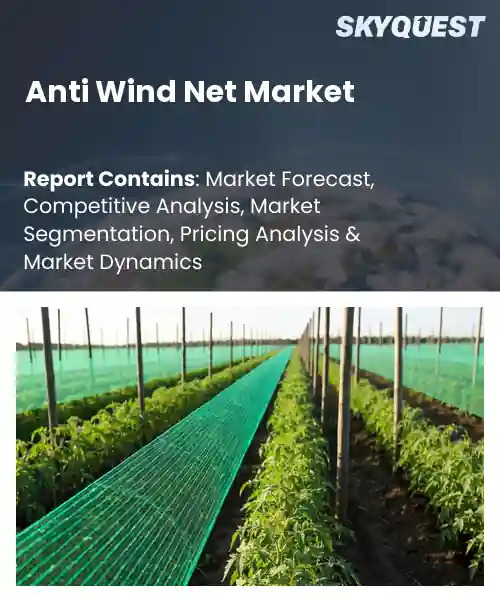
Anti Wind Net Market
Report ID: SQMIG20C2198
Report ID: SQMIG20C2198
[email protected]
USA +1 351-333-4748
Report ID:
SQMIG20C2198 |
Region:
Global |
Published Date: April, 2026
Pages:
157
|Tables:
113
|Figures:
77


Global Anti Wind Net Market size was valued at USD 1.2 Billion in 2024 and is poised to grow from USD 1.29 Billion in 2025 to USD 2.3 Billion by 2033, growing at a CAGR of 7.5% during the forecast period (2026-2033).
The primary driver of the anti wind net market is the rising frequency and intensity of extreme wind events linked to climate change, prompting farmers and infrastructure managers to invest in engineered wind barriers. Anti wind nets are meshes installed to reduce wind speed, prevent soil erosion, and shield crops and structures from debris; they matter because they protect yield, lower repair costs, and enable land use in marginal areas. Over time the market shifted from woven sacks and reed fences to high-strength polyethylene with UV stabilizers, adoption surged after damaging storms in Mediterranean vineyards and typhoon-affected regions of Asia.A central factor shaping global market growth is rapid material innovation that lowers lifecycle costs and broadens functionality, which unlocks new applications and buyer segments. Advances in UV-stabilized polyethylene and composite filaments extend service life and reduce replacement cycles so agricultural cooperatives and coastal authorities favor permanent installations over temporary measures. As deployment increases, manufacturers achieve scale, driving price reductions that encourage municipalities to specify anti wind nets for erosion control along roads and protect construction sites, and private growers to invest in higher-value perennial crops. These dynamics create commercial opportunities in retrofit solutions, sensor integration, and installation services globally.
How is IoT improving performance monitoring in the anti-wind net market?
IoT is improving performance monitoring in the anti wind net market by embedding low power sensors into nets to measure wind load strain and microclimate conditions. Data streams feed cloud platforms where analytics flag wear points and abnormal stress so operators can plan maintenance and adjust deployment. The market context includes rising demand from greenhouse and livestock operators who need resilient, low maintenance systems under more volatile weather. Practical instances include sensorized nets that issue maintenance alerts and systems that automatically adjust tension to reduce failure risk, shifting asset care from reactive fixes toward proactive lifecycle management.VES-Artex November 2023, the company unveiled an IoT enabled automatic windproof curtain system that showed how embedded sensing supports predictive maintenance and automated response. That innovation highlights how sensorized nets can raise operational efficiency and encourage broader adoption by reducing surprise failures and lowering long term upkeep.
Market snapshot - (2026-2033)
Global Market Size
USD 1.2 Billion
Largest Segment
Synthetic Fiber
Fastest Growth
Synthetic Fiber
Growth Rate
7.5% CAGR
To get more insights on this market click here to Request a Free Sample Report
Global anti wind net market is segmented by material type, application area, net design, end user and region. Based on material type, the market is segmented into Synthetic Fiber and Natural Fiber. Based on application area, the market is segmented into Agriculture and Construction. Based on net design, the market is segmented into Fixed Design and Movable Design. Based on end user, the market is segmented into Industrial and Home Users. Based on region, the market is segmented into North America, Europe, Asia Pacific, Latin America and Middle East & Africa.
Synthetic Fiber segment dominates because its engineered polymers provide superior tensile strength and consistent durability under prolonged wind exposure, enabling longer service life and reduced maintenance cycles. Manufacturers favor these materials for predictable mechanical properties, UV stability, and ease of mass production, which together lower lifecycle costs and support scalable supply chains. This reliability drives procurement preferences among installers and developers focused on resilient, low maintenance wind protection solutions.
However, Natural Fiber is emerging as the fastest growing area due to growing demand for biodegradable, low carbon materials and consumer preference for sustainable agricultural inputs. Innovations in treatment and hybridization improve strength and weather resistance, encouraging adoption where environmental credentials and compostability create new applications and procurement mandates, accelerating market opportunities.
Movable Design segment leads because its portability and modular attachments enable rapid deployment and reconfiguration across variable wind exposure zones, reducing installation time and operational disruption. The ability to retract or reposition nets supports targeted protection during peak wind events and eases cleaning and repair, lowering upkeep burdens. These practical advantages appeal to contractors and facility managers seeking adaptable, space efficient wind mitigation solutions that integrate with existing infrastructure and maintenance schedules.
However, Fixed Design is experiencing the strongest growth momentum as demand rises for permanent, low profile protections that require minimal realignment and provide continuous shelter for long term installations. Advances in durable anchoring systems and material integration simplify certification and insurer acceptance, driving uptake by asset owners focused on stable, predictable wind mitigation and long term infrastructure protection.
To get detailed segments analysis, Request a Free Sample Report
Asia Pacific dominates the global Anti Wind Net market due to strong integration of coastal infrastructure needs, concentrated manufacturing capability, and strategic focus on protective agricultural and coastal applications. Regional manufacturers benefit from established textile and polymer supply chains, enabling rapid customization and scale for varied climatic conditions. High adoption is supported by a dense network of distribution channels and proactive collaboration between industry stakeholders and local authorities to address wind related crop and infrastructure vulnerabilities. Innovation centers in the region prioritize material performance and installation efficiency, and service ecosystems deliver installation, maintenance, and lifecycle support. Market players leverage local expertise to tailor solutions for smallholder and industrial users, reinforcing market depth and adoption across diverse geographies.
Anti Wind Net Market in Japan is characterized by advanced material research, strong manufacturing base, and a focus on high performance solutions for coastal and agricultural protection. Collaboration between technology suppliers, system integrators, and end users drives iterative product refinement, emphasizing durability and ease of installation across terrain. Established channels for testing and demonstration foster trust among commercial operators and community stakeholders, supporting uptake of specialized anti wind net systems.
Anti Wind Net Market in South Korea focuses on modular designs, rapid deployment, and integrated manufacturing and installation. Local firms emphasize corrosion resistant materials and adaptability to coastal wind profiles, delivering protection for industrial and agricultural sites. Coordination among suppliers, installers, and regional agencies enables demonstration projects and feedback. This pragmatic orientation toward product and service delivery fosters adoption in urban fringe and coastal communities seeking reliable wind mitigation solutions.
Europe is experiencing rapid expansion of the Anti Wind Net market driven by a convergence of resilience planning, agricultural protection priorities, and growing emphasis on infrastructure safeguarding. Demand is propelled by public policy that prioritizes risk mitigation and by funding mechanisms that support pilot deployments and retrofits. Robust supplier ecosystems combine material innovation with service models that simplify specification, installation, and maintenance for diverse end users. Cross border collaboration among manufacturers, research institutions, and trade associations accelerates technology diffusion and standardization. Market channels in the region favor professional installation and integrated solutions, while increasing visibility of successful deployments encourages broader adoption across both commercial operators and municipal planners. These dynamics position Europe as a fertile environment for market scale up and product maturation.
Anti Wind Net Market in Germany is anchored by a mature industrial base, engineering expertise, and procurement channels favoring durable solutions. Manufacturers benefit from proximity to polymer and textile suppliers and rigorous product qualification. Integration of consultancy and installation services supports projects across coastal, agricultural, and infrastructure applications. Collaboration among industry associations, research centers, and regional authorities reinforces reliability expectations and builds confidence among buyers and encourages strategic procurement planning.
Anti Wind Net Market in United Kingdom exhibits an emerging profile driven by manufacturers, pilot programs, and growing municipal interest in protective solutions for coastal and periurban assets. Emphasis is placed on adaptable systems that can be scaled for commercial needs, alongside installation and monitoring services. Strong ties between research institutions and startups accelerate prototype testing and readiness, while procurement channels increasingly favor proven solutions that balance performance and support.
Anti Wind Net Market in France is marked by rapid adoption fueled by resilience priorities, demonstration programs, and industrial investment in performance textiles. Local manufacturers blend design flexibility with sustainable materials and adaptable installation suited to varied coastal and inland wind conditions. Engagement between regional authorities, research centers, and private developers streamlines specification and deployment of robust systems. Market momentum exists across projects with interest from agricultural and infrastructure stakeholders.
North America is strengthening its position in the Anti Wind Net market through a combination of supply chain development, product innovation, and expanding service capabilities tailored to large scale installation and maintenance needs. Manufacturers are leveraging advanced materials and modular designs to address diverse climatic zones and operational contexts, while installers and service providers are professionalizing delivery models to reduce complexity for end users. Cross border collaboration between industry, research institutions, and municipal planners supports knowledge sharing and pilot deployments that validate performance across varied settings. Private sector focus on lifecycle services and warranty frameworks, together with growing interest from agricultural and infrastructure stakeholders, enhances market credibility. These developments are creating a more integrated ecosystem that improves accessibility, specification confidence, and long term adoption.
Anti Wind Net Market in United States is supported by diverse application demand and a mature service ecosystem that enables large scale installation and maintenance. Manufacturers prioritize scalable, resilient materials adapted to coastal and inland wind exposures. Coordination among integrators, research organizations, and municipal planners advances trialing and specification confidence. The market benefits from established supply chains and interest in turnkey solutions that simplify adoption for infrastructure and agricultural projects.
Anti Wind Net Market in Canada emphasizes cold climate performance, corrosion resistance, and modular designs that support flexible deployment across coastal and agricultural applications. Local providers combine material adaptation with installation services that address remote sites. Collaboration with research institutes and provincial agencies drives validation and specification of tailored solutions, while cross border supplier networks provide access to product portfolios. This orientation supports steady adoption among municipal and farm stakeholders.
To know more about the market opportunities by region and country, click here to
Buy The Complete Report
Protected Cultivation Adoption
Advances In Netting Materials
Perceived High Initial Costs
Competition From Alternative Solutions
Request Free Customization of this report to help us to meet your business objectives.
Competition in the global anti wind net market is intensifying as established manufacturers and regional entrants battle on product specs, distribution, and cost. Demand for UV stabilized HDPE and quick local supply drives consolidation and distribution partnerships; incumbents pursue M&A and product line innovation, for example Ginegar and Garware expanding protective net portfolios, while newer players target niche applications and export channels.
Top Player’s Company Profile
Recent Developments
SkyQuest’s ABIRAW (Advanced Business Intelligence, Research & Analysis Wing) is our Business Information Services team that Collects, Collates, Correlates, and Analyses the Data collected by means of Primary Exploratory Research backed by robust Secondary Desk research. As per SkyQuest analysis, the global anti wind net market is expanding as growers and infrastructure owners respond to rising extreme wind events linked to climate change, which serves as a primary driver, while perceived high upfront procurement and installation costs remain a key restraint. Asia Pacific is the dominating region thanks to strong manufacturing, coastal needs and distribution networks, and synthetic fiber leads as the dominating segment due to superior tensile strength and UV stability. A secondary driver accelerating adoption is rapid material innovation that reduces lifecycle costs and broadens applications, enabling new procurement by municipalities, growers and construction managers.
| Report Metric | Details |
|---|---|
| Market size value in 2024 | USD 1.2 Billion |
| Market size value in 2033 | USD 2.3 Billion |
| Growth Rate | 7.5% |
| Base year | 2024 |
| Forecast period | (2026-2033) |
| Forecast Unit (Value) | USD Billion |
| Segments covered |
|
| Regions covered | North America (US, Canada), Europe (Germany, France, United Kingdom, Italy, Spain, Rest of Europe), Asia Pacific (China, India, Japan, Rest of Asia-Pacific), Latin America (Brazil, Rest of Latin America), Middle East & Africa (South Africa, GCC Countries, Rest of MEA) |
| Companies covered |
|
| Customization scope | Free report customization with purchase. Customization includes:-
|
To get a free trial access to our platform which is a one stop solution for all your data requirements for quicker decision making. This platform allows you to compare markets, competitors who are prominent in the market, and mega trends that are influencing the dynamics in the market. Also, get access to detailed SkyQuest exclusive matrix.
Table Of Content
Executive Summary
Market overview
Parent Market Analysis
Market overview
Market size
KEY MARKET INSIGHTS
COVID IMPACT
MARKET DYNAMICS & OUTLOOK
Market Size by Region
KEY COMPANY PROFILES
Methodology
For the Anti Wind Net Market, our research methodology involved a mixture of primary and secondary data sources. Key steps involved in the research process are listed below:
1. Information Procurement: This stage involved the procurement of Market data or related information via primary and secondary sources. The various secondary sources used included various company websites, annual reports, trade databases, and paid databases such as Hoover's, Bloomberg Business, Factiva, and Avention. Our team did 45 primary interactions Globally which included several stakeholders such as manufacturers, customers, key opinion leaders, etc. Overall, information procurement was one of the most extensive stages in our research process.
2. Information Analysis: This step involved triangulation of data through bottom-up and top-down approaches to estimate and validate the total size and future estimate of the Anti Wind Net Market.
3. Report Formulation: The final step entailed the placement of data points in appropriate Market spaces in an attempt to deduce viable conclusions.
4. Validation & Publishing: Validation is the most important step in the process. Validation & re-validation via an intricately designed process helped us finalize data points to be used for final calculations. The final Market estimates and forecasts were then aligned and sent to our panel of industry experts for validation of data. Once the validation was done the report was sent to our Quality Assurance team to ensure adherence to style guides, consistency & design.
Analyst Support
Customization Options
With the given market data, our dedicated team of analysts can offer you the following customization options are available for the Anti Wind Net Market:
Product Analysis: Product matrix, which offers a detailed comparison of the product portfolio of companies.
Regional Analysis: Further analysis of the Anti Wind Net Market for additional countries.
Competitive Analysis: Detailed analysis and profiling of additional Market players & comparative analysis of competitive products.
Go to Market Strategy: Find the high-growth channels to invest your marketing efforts and increase your customer base.
Innovation Mapping: Identify racial solutions and innovation, connected to deep ecosystems of innovators, start-ups, academics, and strategic partners.
Category Intelligence: Customized intelligence that is relevant to their supply Markets will enable them to make smarter sourcing decisions and improve their category management.
Public Company Transcript Analysis: To improve the investment performance by generating new alpha and making better-informed decisions.
Social Media Listening: To analyze the conversations and trends happening not just around your brand, but around your industry as a whole, and use those insights to make better Marketing decisions.
REQUEST FOR SAMPLE
 REQUEST FREE CUSTOMIZATION


Want to customize this report? This report can be personalized according to your needs. Our analysts and industry experts will work directly with you to understand your requirements and provide you with customized data in a short amount of time. We offer $1000 worth of FREE customization at the time of purchase.
Feedback From Our Clients


 USA (+1) 351-333-4748

