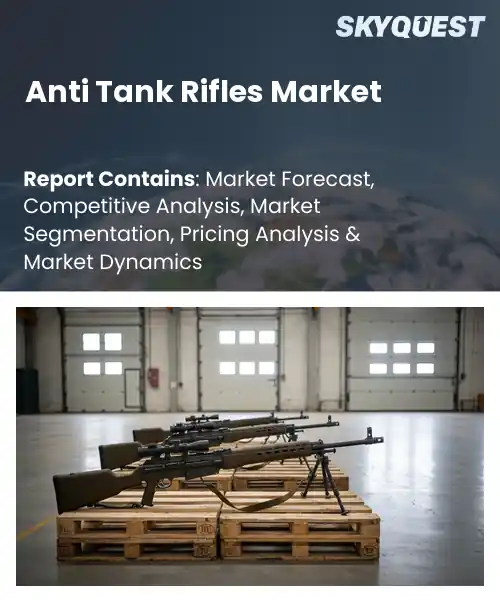
Anti Tank Rifles Market
Report ID: SQMIG20A2698
Report ID: SQMIG20A2698
[email protected]
USA +1 351-333-4748
Report ID:
SQMIG20A2698 |
Region:
Global |
Published Date: June, 2026
Pages:
157
|Tables:
168
|Figures:
79


Global Anti Tank Rifles Market size was valued at USD 1142.6 Million in 2024 and is poised to grow from USD 1214.58 Million in 2025 to USD 1980.13 Million by 2033, growing at a CAGR of 6.3% during the forecast period (2026-2033).
The global anti tank rifles industry consists of specialized firearms designed to defeat armored vehicles, and its relevance stems from the persistent demand for portable, high‑penetration solutions in asymmetric warfare. The primary driver is the proliferation of low‑intensity conflicts where conventional tank units are scarce, prompting insurgent groups to seek affordable yet lethal weapons.
The next pivotal factor shaping market expansion is the integration of optics and composite barrels, which reduce recoil and extend range, thereby increasing operational appeal for infantry. As nations modernize fleets, demand for rifles that neutralize armored threats without logistical burden rises, creating opportunities for manufacturers to command pricing on modular platforms such as the Israeli IMI Tavor‑AT. Real‑world deployments in the Syrian civil war and Ukraine show how enhanced penetration combined with improved ergonomics enables engagement, prompting defense budgets to allocate funds toward research and production. Consequently, supply chains adapt, fostering a competitive landscape where innovation drives revenue significant growth.
How is AI-driven targeting automation influencing the anti tank rifles market?
AI-driven targeting automation is reshaping the anti tank rifles market by embedding real‑time image processing, predictive fire‑control algorithms, and networked battlefield data into the weapon system. These technologies enable shooters to acquire moving armored targets faster and adjust aim points on the fly, reducing the time between detection and engagement. Manufacturers are integrating AI modules that learn from each shot, refining accuracy over successive engagements and lowering the training burden for operators. The market is responding with a surge of prototypes that combine lightweight optics, AI‑enhanced ballistic calculators, and modular power supplies, making the rifles more adaptable to diverse combat scenarios while maintaining reliability under harsh conditions.
In August 2025 a leading defense contractor announced an AI‑guided anti‑tank rifle prototype, highlighting how automated targeting reduces engagement cycles and supports the market’s push toward smarter, more efficient infantry anti‑armor solutions.
Market snapshot - (2026-2033)
Global Market Size
USD 1142.6 Million
Largest Segment
Fastest Growth
Growth Rate
6.3% CAGR
To get more insights on this market click here to Request a Free Sample Report
Global anti tank rifles market is segmented by rifle type, caliber type, end user, application, procurement type, sales channel, and region. Based on rifle type, the market is segmented into bolt-action rifles, semi-automatic rifles, single-shot anti-tank rifles, and magazine-fed anti-tank rifles. Based on caliber type, the market is segmented into 12.7 mm, 14.5 mm, 20 mm, and above 20 mm. Based on end user, the market is segmented into military, special forces, border security forces, and law enforcement agencies. Based on application, the market is segmented into anti-material operations, anti-armor operations, long-range precision engagement, and infrastructure/equipment neutralization. Based on procurement type, the market is segmented into new procurement and upgrade & replacement. Based on sales channel, the market is segmented into direct government contracts, defense contractors/system integrators, and foreign military sales (FMS). Based on sales channel, no specific sub-segments were identified. Based on region, the market is segmented into North America, Europe, Asia Pacific, Latin America and Middle East & Africa.
Bolt action rifle segment dominates with large anti tank rifles market share because it offers unparalleled precision and mechanical reliability that are critical for engaging heavily armored targets at extended ranges. The simple manual operation reduces failure points, ensuring consistent performance under harsh battlefield conditions. Operators value the ease of maintenance and the ability to field‑strip quickly, which reinforces procurement preferences and sustains its leadership in the anti tank rifles market throughout modern engagements and globally today.
As per anti tank rifles market outlook, semi automatic rifle segment is witnessing the strongest growth momentum because advances in recoil mitigation and modular design enable higher rates of fire while retaining accuracy. Emerging combat doctrines emphasizing rapid target engagement drive demand, and lighter materials improve maneuverability. This acceleration expands market opportunities and influences future procurement strategies.
12.7mm caliber segment leads because its kinetic energy and penetration capability reliably defeat contemporary armored threats, making it the preferred choice for many armed forces. The proven lethality against a wide range of targets simplifies logistics and training, encouraging sustained investment. Its compatibility with existing platforms further entrenches its position as the core offering in the anti tank rifles market across diverse operational environments and missions worldwide for users.
As per anti tank rifles market analysis, 14.5mm caliber segment is emerging as a high‑growth area because its larger projectile offers greater armor penetration for next‑generation combat vehicles. Advances in barrel technology and recoil mitigation improve deployability, while doctrinal shifts toward longer‑range engagements raise demand. This momentum fuels new development programs and broadens market scope.
To get detailed segments analysis, Request a Free Sample Report
North America leads the anti tank rifles market because it combines a deep‑rooted defense industrial ecosystem with sustained commitment to modernizing ground forces. The United States defense establishment drives extensive research and development programmes that produce highly reliable, precision‑engineered systems, while close collaboration with premier manufacturers ensures rapid integration of emerging technologies. Robust procurement frameworks and long‑term supply contracts provide stability for suppliers and enable economies of scale. Canada complements this strength through active participation in joint NATO initiatives and by investing in compatible platforms that align with North American standards. The region’s focus on operational readiness, interoperability, and continuous upgrade cycles reinforces its position as the dominant marketplace for anti tank rifles worldwide. Additionally, the emphasis on joint training exercises and shared logistics networks amplifies the demand for versatile anti tank solutions across both countries.
As per anti tank rifles market regional outlook, United States is shaped by a concerted push for next‑generation firepower that prioritises weight reduction and digital integration. Leading manufacturers collaborate closely with armed forces to field rifles that can be seamlessly mounted on a variety of platforms, from dismounted infantry squads to light armored vehicles. Emphasis on modular design and rapid sustainment cycles drives continuous product refinement and enhances battlefield versatility and supports allied interoperability.
As per anti tank rifles market regional forecast, Canada benefits from close alignment with North American standards and involvement in training programmes. Domestic procurement policies encourage integration of compatible rifles that can operate alongside allied forces, fostering seamless logistics and ammunition sharing. Canadian defence contractors focus on adaptability to harsh climates, ensuring that weapons remain reliable across diverse terrains. This approach reinforces Canada role as a key contributor to the regional anti tank ecosystem.
Europe’s anti tank rifles market is propelled by a cohesive blend of strategic alliances, ambitious modernization agendas, and robust domestic manufacturing capabilities. Collective security commitments within the alliance drive member states to upgrade infantry firepower, emphasizing precision, portability and interoperability across borders. Germany’s deep engineering expertise and established supply chains set a benchmark for quality, while the United Kingdom leverages its advanced research institutions to accelerate product evolution. France’s emerging focus on innovative lightweight solutions adds diversity to the regional offering. Shared procurement frameworks and joint training exercises further harmonize specifications, creating a unified demand environment. The convergence of political resolve, technology sharing and a commitment to maintain a credible deterrent posture fuels the rapid expansion of Europe’s anti tank rifles sector.
As per anti tank rifles industry analysis, Germany remains the cornerstone of European capability, driven by a tradition of precision engineering and a network of specialized suppliers. Domestic defence programmes prioritize integration of high‑performance rifles with mechanised infantry units, ensuring consistency across land forces. Collaborative projects with neighbouring allies reinforce standardisation while fostering technology transfer. The focus on reliability, modularity and advanced optics sustains Germany reputation as a dominant supplier within the continent.
United Kingdom is characterised by innovation, fuelled by research institutions and flexible procurement practices. The armed forces pursue lightweight, linked rifles that can be quickly fielded to support operations. Partnerships with leading manufacturers accelerate adoption of next‑generation barrel and sight technologies. Emphasis on export potential and exercises with alliance partners amplifies market visibility, positioning United Kingdom as the fastest growing contributor to Europe’s anti tank ecosystem.
France is emerging as a focal point for lightweight and modular weapon solutions, driven by a shift toward mobile infantry doctrines. Domestic programmes encourage integration of rifles equipped with optics and accessory mounting systems. Collaboration with European research hubs accelerates technology transfer, while participation in allied exercises nurtures interoperability. The French approach balances cost efficiency with performance, expanding its footprint within the European anti tank landscape.
Asia Pacific is progressively strengthening its anti tank rifles position through a combination of heightened regional security concerns and focused investment in indigenous capabilities. Nations such as Japan and South Korea are channeling resources into compact, high‑precision systems that complement their broader mechanised defence strategies. Close cooperation with domestic manufacturers accelerates the adoption of cutting‑edge materials and digital fire‑control solutions, while joint exercises with allied forces ensure alignment with NATO‑standard performance criteria. Export‑oriented policies and participation in regional defense exhibitions broaden market exposure, fostering a reputation for reliability and technological sophistication. This multifaceted approach enhances the region’s ability to meet evolving threat environments and cements its growing influence within the global anti tank rifles arena.
Japan emphasizes precision engineering and strict reliability standards, reflecting the nation’s broader defence philosophy. Domestic firms collaborate closely with the self‑defence forces to develop rifles that integrate optics and ergonomic designs for rapid target acquisition. Emphasis on lightweight materials and low recoil enhances manoeuvrability in varied terrain. Joint testing with allies reinforces compatibility, while export‑oriented initiatives aim to showcase Japan technological prowess on the global stage.
South Korea is shaped by a defence posture and a commitment to innovation. Local manufacturers work with the armed forces to produce rifles that combine penetration capability with reduced weight, suited for deployment across varied terrain. Integration of sighting systems and communication modules enhances situational awareness. Development programs with allied nations promote standardisation, while export strategies target markets seeking reliable, technologically advanced modern anti tank solutions.
To know more about the market opportunities by region and country, click here to
Buy The Complete Report
Increasing Battlefield Threats
Advancements In Portable Optics
Stringent Export Regulations
High Training And Maintenance Requirements
Request Free Customization of this report to help us to meet your business objectives.
The anti tank rifles market is being reshaped by aggressive product‑innovation cycles, strategic M&A and cross‑border partnerships that accelerate fielding of next‑gen kinetic weapons. For example, Anduril Industries leveraged its AI‑targeting suite through a partnership with a leading NATO supplier, while Helsing secured a joint‑development agreement with a European armor‑manufacturer to embed machine‑learning fire‑control into new anti‑tank platforms, intensifying competition on performance and cost.
SkyQuest’s ABIRAW (Advanced Business Intelligence, Research & Analysis Wing) is our Business Information Services team that Collects, Collates, Correlates, and Analyses the Data collected by means of Primary Exploratory Research backed by robust Secondary Desk research.
As per SkyQuest analysis, the global anti tank rifles market growth is being propelled primarily by increasing battlefield threats that drive procurement of portable high‑penetration weapons, while advancements in lightweight optics and AI‑enhanced targeting serve as a second growth catalyst, enhancing accuracy and operator confidence, and manufacturers also pursue modular designs that allow quick caliber swaps, broadening appeal across varied missions. Stringent export regulations constitute the main restraint, limiting access to high‑value overseas buyers. North America dominates the market, benefitting from a mature defense industrial base and sustained government contracts. Within product categories, bolt‑action rifles remain the leading segment because of their unmatched precision and mechanical reliability, reinforcing the overall market.
| Report Metric | Details |
|---|---|
| Market size value in 2024 | USD 1142.6 Million |
| Market size value in 2033 | USD 1980.13 Million |
| Growth Rate | 6.3% |
| Base year | 2024 |
| Forecast period | (2026-2033) |
| Forecast Unit (Value) | USD Million |
| Segments covered |
|
| Regions covered | North America (US, Canada), Europe (Germany, France, United Kingdom, Italy, Spain, Rest of Europe), Asia Pacific (China, India, Japan, Rest of Asia-Pacific), Latin America (Brazil, Rest of Latin America), Middle East & Africa (South Africa, GCC Countries, Rest of MEA) |
| Companies covered |
|
| Customization scope | Free report customization with purchase. Customization includes:-
|
To get a free trial access to our platform which is a one stop solution for all your data requirements for quicker decision making. This platform allows you to compare markets, competitors who are prominent in the market, and mega trends that are influencing the dynamics in the market. Also, get access to detailed SkyQuest exclusive matrix.
Table Of Content
Executive Summary
Market overview
Parent Market Analysis
Market overview
Market size
KEY MARKET INSIGHTS
COVID IMPACT
MARKET DYNAMICS & OUTLOOK
Market Size by Region
KEY COMPANY PROFILES
Methodology
For the Anti Tank Rifles Market, our research methodology involved a mixture of primary and secondary data sources. Key steps involved in the research process are listed below:
1. Information Procurement: This stage involved the procurement of Market data or related information via primary and secondary sources. The various secondary sources used included various company websites, annual reports, trade databases, and paid databases such as Hoover's, Bloomberg Business, Factiva, and Avention. Our team did 45 primary interactions Globally which included several stakeholders such as manufacturers, customers, key opinion leaders, etc. Overall, information procurement was one of the most extensive stages in our research process.
2. Information Analysis: This step involved triangulation of data through bottom-up and top-down approaches to estimate and validate the total size and future estimate of the Anti Tank Rifles Market.
3. Report Formulation: The final step entailed the placement of data points in appropriate Market spaces in an attempt to deduce viable conclusions.
4. Validation & Publishing: Validation is the most important step in the process. Validation & re-validation via an intricately designed process helped us finalize data points to be used for final calculations. The final Market estimates and forecasts were then aligned and sent to our panel of industry experts for validation of data. Once the validation was done the report was sent to our Quality Assurance team to ensure adherence to style guides, consistency & design.
Analyst Support
Customization Options
With the given market data, our dedicated team of analysts can offer you the following customization options are available for the Anti Tank Rifles Market:
Product Analysis: Product matrix, which offers a detailed comparison of the product portfolio of companies.
Regional Analysis: Further analysis of the Anti Tank Rifles Market for additional countries.
Competitive Analysis: Detailed analysis and profiling of additional Market players & comparative analysis of competitive products.
Go to Market Strategy: Find the high-growth channels to invest your marketing efforts and increase your customer base.
Innovation Mapping: Identify racial solutions and innovation, connected to deep ecosystems of innovators, start-ups, academics, and strategic partners.
Category Intelligence: Customized intelligence that is relevant to their supply Markets will enable them to make smarter sourcing decisions and improve their category management.
Public Company Transcript Analysis: To improve the investment performance by generating new alpha and making better-informed decisions.
Social Media Listening: To analyze the conversations and trends happening not just around your brand, but around your industry as a whole, and use those insights to make better Marketing decisions.
REQUEST FOR SAMPLE
 REQUEST FREE CUSTOMIZATION
Global Anti Tank Rifles Market size was valued at USD 1142.6 Million in 2024 and is poised to grow from USD 1214.58 Million in 2025 to USD 1980.13 Million by 2033, growing at a CAGR of 6.3% during the forecast period (2026-2033).
The anti‑tank rifle segment is being reshaped by aggressive product‑innovation cycles, strategic M&A and cross‑border partnerships that accelerate fielding of next‑gen kinetic weapons; for example, Anduril Industries leveraged its AI‑targeting suite through a partnership with a leading NATO supplier, while Helsing secured a joint‑development agreement with a European armor‑manufacturer to embed machine‑learning fire‑control into new anti‑tank platforms, intensifying competition on performance and cost. 'Barrett Firearms Manufacturing, Inc.', 'Denel Land Systems', 'Steyr Arms GmbH', 'PGM Précision SAS', 'Desert Tech LLC', 'CheyTac USA LLC', 'Serbu Firearms, Inc.', 'Accuracy International Ltd.', 'Knight's Armament Company', 'Armalite, Inc.', 'Sako Ltd.', 'Zastava Arms', 'NORINCO Group', 'Kalashnikov Concern JSC', 'Lobaev Arms', 'SSG Precision Optronics Pvt. Ltd.', 'Istiglal IST-14 Manufacturer Group', 'General Dynamics Ordnance and Tactical Systems', 'FN Herstal S.A.', 'Rheinmetall AG'
The rise of heavily armored vehicles and fortified positions on modern battlefields has heightened demand for weapons capable of neutralizing such threats. Anti‑tank rifles provide infantry units with the ability to engage armored targets at extended ranges, enhancing tactical flexibility and force protection. This capability encourages armed forces to integrate these systems into their arsenals, driving procurement programs and stimulating research into improved penetration performance, thereby supporting overall market growth. Additionally, the perceived cost‑effectiveness of rifles compared with heavier missile systems reinforces their attractiveness for many defense budgets.
Advanced Optics Integration: Modern anti‑tank rifles are incorporating high‑resolution thermal and night‑vision scopes, laser rangefinders, and ballistic computers, enabling operators to engage armored targets at extended distances and under diverse conditions. This sensor fusion improves first‑shot accuracy and reduces collateral risk, making the weapons more attractive to forces prioritizing precision. Manufacturers are partnering with optics specialists to develop lightweight, rugged modules that can be retrofitted onto legacy platforms, driving demand for upgraded systems across both established armies and emerging security forces globally today.
Why does North America Dominate the Global Anti Tank Rifles Market? |@12


Want to customize this report? This report can be personalized according to your needs. Our analysts and industry experts will work directly with you to understand your requirements and provide you with customized data in a short amount of time. We offer $1000 worth of FREE customization at the time of purchase.
Feedback From Our Clients


 USA (+1) 351-333-4748

