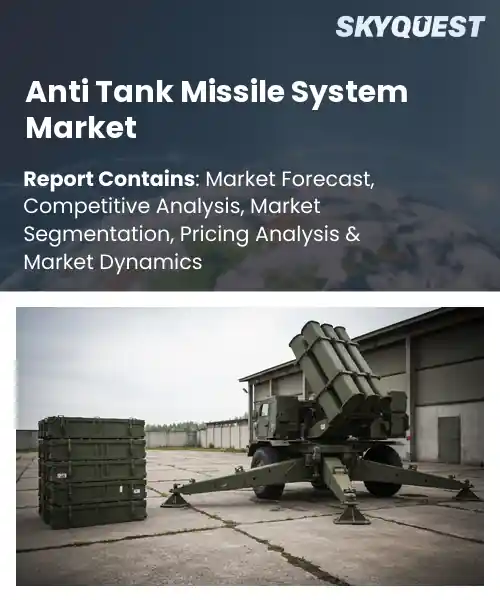
Anti Tank Missile System Market
Report ID: SQMIG20D2704
Report ID: SQMIG20D2704
[email protected]
USA +1 351-333-4748
Report ID:
SQMIG20D2704 |
Region:
Global |
Published Date: June, 2026
Pages:
157
|Tables:
171
|Figures:
79


Global Anti Tank Missile System Market size was valued at USD 6.4 Billion in 2024 and is poised to grow from USD 6.8 Billion in 2025 to USD 11.1 Billion by 2033, growing at a CAGR of 6.23% during the forecast period (2026-2033).
Network-centric warfare integration is a pivotal driver for the anti-tank missile system market growth, because it lets missiles pick up mid‑course corrections from drones, ground sensors, and those command networks that are always in the background. That connectivity can bump up hit probability versus moving armor, so many forces are swapping older launchers for upgrade kits that enable a mix of missile families. The U.S. Army’s use of the Integrated Visual Augmentation System to cue Hellfire‑type rounds, kicked off contracts for fire‑control units, while Saudi Arabia’s purchase of Turkey’s KAPLAN‑STK system, suggests there is real market hunger for these solution packages. So firms that embed data links and targeting logic are positioned to snag more export orders tied to defense budgets that now emphasize digitalization.
In addition, the primary driver for the anti-tank missile system market penetration is an escalating demand for precision strike means, specifically to counter armored threats that keep spreading across high intensity and hybrid battle sets. Countries like Poland and Australia are modernizing infantry units with lightweight man portable launchers, and then offer this cascade effect where logistics chains have to adapt, to new ammunition types , and the training pipeline too. That shift makes suppliers invest in scalable production lines, which helps push unit costs down , and opens doors for cost effective export bundles aimed at emerging defense markets across Southeast Asia and the Middle East. In the end, the overlap of tactical need and economic scalability is reshaping the anti‑tank missile ecosystem, and it’s keeping momentum through diversified procurement approaches.
AI driven guidance is reshaping anti-tank missile system market outlook by fusing sensor feeds, terrain mapping, and target recognition in real time, or close to it. Machine learning techniques can anticipate how a vehicle is moving, so the missile can nudge its flight path mid course, to improve the chance of intercept. With integrated onboard processors, the system can lean less on external laser designators, and launches can be done from more concealed positions even under messy weather conditions. There’s also a practical logistics angle; software updates can enhance performance without swapping hardware, which helps extend the usable life of existing stockpiles. As defense forces increasingly prioritize precision and lower collateral risk, AI enabled seekers are turning into a key differentiator, and that is driving procurement interest while pushing manufacturers to bake smarter control loops into both newer and legacy platforms.
Market snapshot - (2026-2033)
Global Market Size
USD 6.4 Billion
Largest Segment
Fastest Growth
Growth Rate
6.23% CAGR
To get more insights on this market click here to Request a Free Sample Report
The global anti-tank missile system market is segmented by missile/warhead configuration, guidance technology, launch platform, range, propulsion type, end user, and region. Based on missile/warhead configuration, the market is segmented into HEAT Warhead and Tandem Charge Missile. Based on guidance technology, the market is segmented into Wire-Guided, Laser-Guided, Infrared (IR)-Guided, Radar-Guided, and Fire-and-Forget Guidance systems. Based on launch platform, the market is segmented into Land-Based, Airborne, and Naval platforms. Based on range, the market is segmented into Short Range (Up to 2.5 km), Medium Range (2.5–5 km), and Long Range (Above 5 km). Based on propulsion type, the market is segmented into Solid-Fuel Rocket Motors, Tandem Rocket Motors, and Others. Based on end user, the market is segmented into Military, Paramilitary, and Homeland Security organizations. Based on region, the market is segmented into North America, Europe, Asia Pacific, Latin America, and the Middle East & Africa.
As per the anti-tank missile system market analysis, the Laser-guided segment takes the lead because it gives operators precise, real-time target tracking, and that fits how battlefield networks are being built now. With that, they can hit moving armored threats even when visibility is not great, and somehow it lowers collateral risk while boosting kill probability. So a lot of forces pick it, and the whole thing leans on line of sight coupling with fire control systems, which makes it easier to plug into existing platforms. That’s why it stays central within the anti-tank missile system market, even when people talk about other guidance types.
However, the infrared (IR)-guided segment is showing the strongest growth momentum, because the seeker means no continuous target illumination is required. That means engagements can happen from concealed positions, and operators are less exposed for fewer seconds. Sensor resolution keeps improving, and AI-driven tracking makes the weapon work across more combat situations, so adoption is getting faster. This also creates fresh openings for platform integration and export, which buyers obviously notice.
According to the anti-tank missile system market forecast, the HEAT warhead segment dominates, basically because it can deliver high penetration against modern composite armor using a shaped charge. The charge forms this focused explosive jet that goes after armor, so it tends to create a lethal effect on many types of armored platforms. Procurement teams like it because its design is straightforward, it is proven, and it still works with a wide variety of launch platforms. So it becomes the default procurement selection for many armed forces, and it keeps a strong spot in the anti-tank missile system market.
On the other hand, the tandem charge missile segment is turning into the main high growth area, since it can defeat explosive reactive armor. It does that by using a precursor charge that clears or disrupts protective layers before the main warhead arrives. improvements in charge sequencing and lighter materials broaden where it can be used , including on lighter vehicles and for quick deployment units. That combination seems to spark more procurement interest and more integration opportunities too.
To get detailed segments analysis, Request a Free Sample Report
As per the anti-tank missile system market regional forecast, North America keeps holding that top spot in the market, mostly because there’s this push and pull of advanced research, solid defense buying rules, and technology that’s deeply tied into both aerospace plus land systems, all at once. The United States rides on a well matured industrial setup, where innovation is not just talked about but practiced, with high‑performance testing grounds and steady cooperation between government bodies and private companies. Canada adds its own value by building strategic alignments, leaning on skilled engineering people, and staying very focused on interoperability with NATO rules. On top of that there are joint training activities that “stress test” the systems in real-ish operational settings, which boosts trust for end users and keeps steering ongoing improvements for missile guidance tech. And there’s also that export orientation supported by logistics networks, which widens the reach and lets North American products set reference benchmarks worldwide, even when competition is intense.
United States Anti Tank Missile System Market
In the United States, the anti tank missile system sector benefits from an integrated defense industrial base, where major manufacturers end up collaborating with research institutions. There’s a heavy focus on modular layouts and improved seeker technologies, so the upgrades stay more systematic. Testing facilities then act like the reality check, verifying reliability across different terrain. Cooperation with allied forces helps interoperability, and there’s this strong prototyping culture that speeds up the movement from early idea to actual fielded ability, which is why the United States is often seen as a key source for advanced anti‑tank solutions.
Canada Anti Tank Missile System Market
The Canadian anti tank missile system industry leverages deep engineering know how, plus a close alignment with NATO standards, to support systems that work smoothly with allied equipment. When domestic defense companies pair up with academic research centers, it helps spur innovation in guidance and propulsion. Government procurement approaches also lean into modularity and cost effectiveness, so the solutions can stay scalable. For exports, the attention goes toward compatibility with allied platforms, and that positions Canada as a dependable partner delivering integrated anti‑tank missile options across a variety of operational situations.
The European anti tank missile system market penetration is driven rapidly, and a big part of the acceleration comes from defense modernization efforts, joint research programs and, importantly, interoperability requirements across allied forces. Countries like Germany, the United Kingdom, and France are investing in next‑generation guidance and propulsion technologies, basically to keep up with shifting battlefield pressure. The European Defence Agency helps with joint development programs that concentrate knowledge and resources, so innovation cycles become quicker. NATO doctrine alignment also matters, because it pushes systems toward shared performance expectations, which supports cross border procurement and coordinated training exercises. Finally, there’s attention to sustainable manufacturing and modular architectures, letting the systems be adapted and slotted into different platforms without too much friction. That combination keeps Europe looking like a lively and competitive market for anti tank missile capabilities.
Germany Anti Tank Missile System Market
The German anti-tank missile system market is backed by a solid engineering heritage and a structured defense procurement style. Domestic manufacturers work in close rhythm with research institutes to sharpen seeker accuracy and improve propulsion efficiency. Defense policies then keep emphasizing modularity and lifecycle support, not just “build it and done”. With integration into European standards, systems align well with allied platforms, and participation in joint exercises helps validate performance in practical contexts. All of this supports Germany’s position as a notable supplier of high‑performance anti‑tank solutions.
United Kingdom Anti Tank Missile System Market
In the United Kingdom, the anti tank missile system market share is enhanced by intense research collaborations and the drive for rapid insertion of new technology. British firms use advanced sensor development along with adaptive guidance algorithms, aiming for missile configurations that respond quickly when conditions change. Government acquisition strategies tend to emphasize flexibility, plus support for export ready designs, which helps keep strong ties with NATO partners. Multinational trials keep validating performance across different combat scenarios, so the UK keeps gaining momentum as a fast growing hub for innovative anti‑tank missile capabilities.
France Anti Tank Missile System Market
The French anti tank missile system market outlook is shaped by cooperative development and a continued commitment to modular design. French defense companies work closely with national research laboratories, focusing on improving missile agility and electronic counter‑measure resilience. Procurement policies encourage integration into broader European defense architectures, which supports joint operations and shared logistics, with less mismatch. Export initiatives also target compatible platforms inside allied forces, while continuous testing across varied environments helps protect reliability. As a result, France is becoming an increasingly visible contributor within the continent’s anti‑tank missile ecosystem.
Asia Pacific is strengthening its position in the anti tank missile system market by mixing indigenous development, some strategic partnerships and also a heavy push on technology transfer. A few nations like Japan and South Korea are putting serious money into advanced seeker techs and propulsion systems, just to cut down on reliance from external suppliers . Regional teamwork with allies, plus showing up in multinational exercises, helps interoperability along and speeds up the whole maturity of local know-how. On the government side, incentives are nudging the private sector toward newer ideas, and defense doctrines basically lean toward modularity and adaptability , so the systems work across different terrain. All of these steps together are putting the region in a spot where it can be a serious source of high performance anti tank solutions, able to handle both regional security needs and global export openings.
Japan Anti Tank Missile System Market
The Anti Tank Missile System Market in Japan is pulled forward by a strong emphasis on precision engineering, and the way it integrates with platforms too. Japanese defense companies tend to work tightly with government agencies to tune guidance accuracy better, and to increase resilience against counter measures. Procurement choices generally prefer solutions that can be adapted for land , as well as naval use. At the same time export programs are aligned around compatibility with allied forces. Testing across varied operating settings helps confirm reliability, which is why Japan keeps showing up as a major contributor to the region’s anti tank missile capability.
South Korea Anti Tank Missile System Market
The Anti Tank Missile System Market in South Korea is marked by a blend of innovation, plus cooperation between government institutions and defense manufacturers. The main effort is on advanced seeker technology, and on improving propulsion efficiency , so the missile platforms become more responsive. Defense procurement also leans into modular design, and it keeps export potential in view, so products can line up with allied standards. Rigorous trials in different terrain types keep validating performance, while joint drills with regional partners improve interoperability. Taken together, these moves establish South Korea as a steadily rising force in the anti tank missile arena.
To know more about the market opportunities by region and country, click here to
Buy The Complete Report
Increased Battlefield Threat Perception
Adoption Of Precision Strike Technologies
High Development And Procurement Costs
Stringent Export Control Regulations
Request Free Customization of this report to help us to meet your business objectives.
The anti-tank missile system market is shaped by tough rivalry , between long running defense prime contractors and newer tech driven companies. This back and forth pushes faster uptake of AI guided seekers, modular warhead layouts, and launch platforms that are a bit hard to notice , low observable style. In the same vibe, recent things like Raytheon buying a smaller guidance software provider and MBDA teaming up with a European aerospace university show M&A and joint R&D working together, to speed up the arrival of next generation missiles , and also to lock in export agreements.
Top Player’s Company Profile
Recent Developments in the Anti-Tank Missile System Market
SkyQuest’s ABIRAW (Advanced Business Intelligence, Research & Analysis Wing) is our Business Information Services team that Collects, Collates, Correlates, and Analyses the Data collected by means of Primary Exploratory Research backed by robust Secondary Desk research.
As per SkyQuest analysis, the anti-tank missile market is being pushed mainly by networked warfare integration, which allows these missiles to obtain mid-course corrections from drones and command networks and also tends to improve the probability of a hit. Another driver is the wider adoption of precision-strike capabilities, since these can improve accuracy against moving armored targets while also trying to limit collateral impact, not always perfectly but better. The laser-guided missile segment stays the biggest, largely due to real-time target tracking and smoother platform integration overall. North America leads, largely because of its deep research base, strong defense spending, and wide export channels. Still, high development and procurement costs act like a restraint , slowing down some acquisition programmes, especially the ones with tight timelines.
| Report Metric | Details |
|---|---|
| Market size value in 2024 | USD 6.4 Billion |
| Market size value in 2033 | USD 11.1 Billion |
| Growth Rate | 6.23% |
| Base year | 2024 |
| Forecast period | (2026-2033) |
| Forecast Unit (Value) | USD Billion |
| Segments covered |
|
| Regions covered | North America (US, Canada), Europe (Germany, France, United Kingdom, Italy, Spain, Rest of Europe), Asia Pacific (China, India, Japan, Rest of Asia-Pacific), Latin America (Brazil, Rest of Latin America), Middle East & Africa (South Africa, GCC Countries, Rest of MEA) |
| Companies covered |
|
| Customization scope | Free report customization with purchase. Customization includes:-
|
To get a free trial access to our platform which is a one stop solution for all your data requirements for quicker decision making. This platform allows you to compare markets, competitors who are prominent in the market, and mega trends that are influencing the dynamics in the market. Also, get access to detailed SkyQuest exclusive matrix.
Table Of Content
Executive Summary
Market overview
Parent Market Analysis
Market overview
Market size
KEY MARKET INSIGHTS
COVID IMPACT
MARKET DYNAMICS & OUTLOOK
Market Size by Region
KEY COMPANY PROFILES
Methodology
For the Anti Tank Missile System Market, our research methodology involved a mixture of primary and secondary data sources. Key steps involved in the research process are listed below:
1. Information Procurement: This stage involved the procurement of Market data or related information via primary and secondary sources. The various secondary sources used included various company websites, annual reports, trade databases, and paid databases such as Hoover's, Bloomberg Business, Factiva, and Avention. Our team did 45 primary interactions Globally which included several stakeholders such as manufacturers, customers, key opinion leaders, etc. Overall, information procurement was one of the most extensive stages in our research process.
2. Information Analysis: This step involved triangulation of data through bottom-up and top-down approaches to estimate and validate the total size and future estimate of the Anti Tank Missile System Market.
3. Report Formulation: The final step entailed the placement of data points in appropriate Market spaces in an attempt to deduce viable conclusions.
4. Validation & Publishing: Validation is the most important step in the process. Validation & re-validation via an intricately designed process helped us finalize data points to be used for final calculations. The final Market estimates and forecasts were then aligned and sent to our panel of industry experts for validation of data. Once the validation was done the report was sent to our Quality Assurance team to ensure adherence to style guides, consistency & design.
Analyst Support
Customization Options
With the given market data, our dedicated team of analysts can offer you the following customization options are available for the Anti Tank Missile System Market:
Product Analysis: Product matrix, which offers a detailed comparison of the product portfolio of companies.
Regional Analysis: Further analysis of the Anti Tank Missile System Market for additional countries.
Competitive Analysis: Detailed analysis and profiling of additional Market players & comparative analysis of competitive products.
Go to Market Strategy: Find the high-growth channels to invest your marketing efforts and increase your customer base.
Innovation Mapping: Identify racial solutions and innovation, connected to deep ecosystems of innovators, start-ups, academics, and strategic partners.
Category Intelligence: Customized intelligence that is relevant to their supply Markets will enable them to make smarter sourcing decisions and improve their category management.
Public Company Transcript Analysis: To improve the investment performance by generating new alpha and making better-informed decisions.
Social Media Listening: To analyze the conversations and trends happening not just around your brand, but around your industry as a whole, and use those insights to make better Marketing decisions.
REQUEST FOR SAMPLE
 REQUEST FREE CUSTOMIZATION
Global Anti Tank Missile System Market size was valued at USD 6.4 Billion in 2024 and is poised to grow from USD 6.8 Billion in 2025 to USD 11.1 Billion by 2033, growing at a CAGR of 6.23% during the forecast period (2026-2033).
The anti‑tank missile system market is shaped by intense rivalry among legacy defense contractors and emerging tech‑driven firms, with competition spurring rapid adoption of AI‑guided seekers, modular warhead designs and low‑observable launch platforms. Recent moves such as Raytheon’s acquisition of a niche guidance‑software firm and MBDA’s partnership with a European aerospace university illustrate how M&A and collaborative R&D are being used to accelerate fielding of next‑generation missiles and secure export contracts. 'RTX Corporation', 'Lockheed Martin Corporation', 'MBDA Group', 'Rafael Advanced Defense Systems Ltd.', 'Israel Aerospace Industries Ltd.', 'Bharat Dynamics Limited', 'Thales S.A.', 'Saab AB', 'Roketsan A.S.', 'Denel Dynamics SOC Ltd.', 'Kongsberg Defence & Aerospace AS', 'LIG Nex1 Co., Ltd.', 'Hanwha Aerospace Co., Ltd.', 'General Dynamics Corporation', 'Northrop Grumman Corporation', 'Boeing Company', 'Tactical Missiles Corporation JSC', 'Norinco Group', 'EDGE Group PJSC', 'Mitsubishi Heavy Industries, Ltd.'
Integrated Networked Warfare: Modern armed forces are increasingly adopting network‑centric combat concepts, where anti‑tank missile systems are linked to battlefield management platforms, reconnaissance drones, and command‑and‑control nodes. This digital integration enables real‑time target acquisition, dynamic re‑tasking, and collaborative fire control across dispersed units. As a result, missile operators receive fused sensor data, predictive engagement cues, and post‑strike analysis, improving kill probability while reducing exposure. Suppliers are therefore prioritizing open architecture designs, secure data links, and software‑defined capabilities to meet these interoperable requirements today.
Why does North America Dominate the Global Anti Tank Missile System Market? |@12


Want to customize this report? This report can be personalized according to your needs. Our analysts and industry experts will work directly with you to understand your requirements and provide you with customized data in a short amount of time. We offer $1000 worth of FREE customization at the time of purchase.
Feedback From Our Clients


 USA (+1) 351-333-4748

