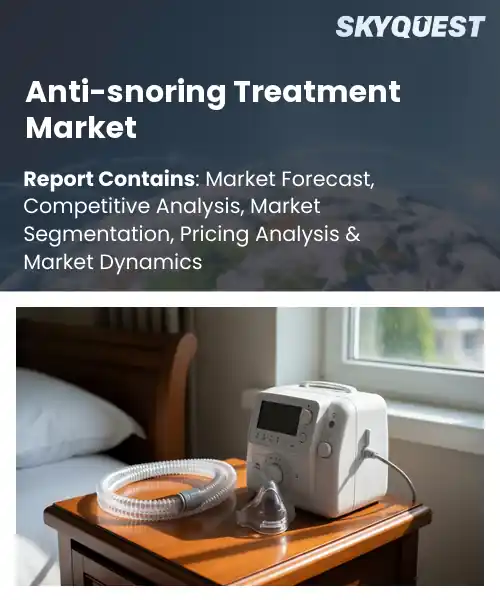
Anti-snoring Treatment Market
Report ID: SQMIG35A4030
Report ID: SQMIG35A4030
[email protected]
USA +1 351-333-4748
Report ID:
SQMIG35A4030 |
Region:
Global |
Published Date: June, 2026
Pages:
157
|Tables:
125
|Figures:
77


Global Anti-Snoring Treatment Market size was valued at USD 1.9 Billion in 2024 and is poised to grow from USD 2.09 Billion in 2025 to USD 4.41 Billion by 2033, growing at a CAGR of 9.8% during the forecast period (2026-2033).
The primary driver of the anti-snoring treatment market is the rising prevalence and diagnosis of sleep disordered breathing, which has expanded demand for both conservative and device solutions. The market includes oral appliances, continuous positive airway pressure machines, positional therapy tools, nasal dilators and surgical options, and it matters because snoring links to cardiovascular disease, daytime dysfunction and diminished quality of life. Over the past decade, greater consumer awareness, sensor miniaturization and telemedicine-enabled sleep clinics have reshaped offerings, for example custom mandibular advancement splints produced from 3D scans and app-connected CPAP devices that track adherence, thereby improving accessibility and persistence.
Building on increased accessibility and persistence, technological integration is the pivotal factor driving growth in the global anti-snoring market because connectivity enables personalized therapy, real-time monitoring and data-driven compliance programs that reduce abandonment. When manufacturers embed Bluetooth sensors and AI sleep analysis into oral devices or CPAP units, clinicians can adjust therapy remotely and payers can justify reimbursements through demonstrated outcomes, which spurs adoption in sleep clinics and direct-to-consumer channels. For instance telemonitored mandibular advancement devices have raised adherence rates in community clinics, leading to expanded insurance coverage and new revenue for telehealth platforms, creating iterative incentives for further innovation.
How is AI enabling personalized care in the anti-snoring treatment market?
AI is enabling personalized care in the anti snoring market by combining passive sensing, signal analysis and adaptive therapy. Key aspects include audio and breathing pattern capture, machine learning that classifies snore types and nightly variability, and algorithms that recommend or adjust mandibular devices and CPAP comfort settings for each patient. The market is shifting from one size fits all solutions to integrated home based care that links wearables, telemonitoring and clinician review.
Examples include smart oral appliances with nightly monitoring and AI guided CPAP coaching which shorten time to optimal treatment and make follow up more efficient. ResMed May 2026, ResMed announced a partnership with Oura to combine wearable sleep data and AI driven assessments that identify sleep issues early and connect users to tailored care, supporting market growth by improving detection, personalization and treatment adherence.
Market snapshot - (2026-2033)
Global Market Size
USD 1.9 Billion
Largest Segment
Positive Airway Pressure (PAP) Devices
Fastest Growth
Neurostimulation Devices
Growth Rate
9.8% CAGR
To get more insights on this market click here to Request a Free Sample Report
Global anti-snoring treatment market is segmented by product type, treatment indication, distribution channel, end user and region. Based on product type, the market is segmented into Oral Appliances, Positive Airway Pressure (PAP) Devices, Nasal Devices, Surgical Treatment Devices & Procedures, Neurostimulation Devices, Positional Therapy Devices and Pharmacological Treatments. Based on treatment indication, the market is segmented into Primary Snoring, Obstructive Sleep Apnea (OSA)-Associated Snoring, Nasal Congestion-Related Snoring, Obesity-Related Snoring and Sleep Position-Related Snoring. Based on distribution channel, the market is segmented into Hospitals & Sleep Clinics, Retail Pharmacies, E-commerce, Specialty Medical Device Stores and Direct-to-Consumer (DTC) Channels. Based on end user, the market is segmented into Adults, Geriatric Population and Pediatric Population. Based on region, the market is segmented into North America, Europe, Asia Pacific, Latin America and Middle East & Africa.
Oral Appliances segment dominates because oral devices offer a noninvasive, patient friendly option that fits primary care and dental workflows, driving broad clinical adoption. Their customizability and relative ease of fitting cause clinicians to prefer them for mild to moderate cases, increasing referrals and insurer acceptance. This clinical familiarity combined with better patient adherence and fewer side effects creates sustained demand and positions them as the default first line therapy in many treatment pathways.
However, Neurostimulation Devices are emerging as the most rapidly expanding area due to technological advances and regulatory momentum enabling targeted neuromuscular control of airway collapse. Their minimally invasive profiles and appeal to patients intolerant of traditional therapies drive investment and clinical trials, accelerating adoption and opening new treatment niches.
Hospitals & Sleep Clinics segment leads because these clinical settings provide comprehensive diagnosis, titration, and multidisciplinary care that underpin most treatment pathways. Centralized access to sleep studies and specialist assessment drives clinician led prescriptions and ensures complex cases receive appropriate device selection and follow up. The trust and reimbursement frameworks associated with clinical care enable higher value interventions and sustained patient management, reinforcing their role as the primary point of care for snoring related disorders.
However, e commerce is the fastest growing channel as online sales and telehealth reduce barriers to product discovery and purchase. Digital platforms distribute oral devices, nasal aids, and DTC innovations while enabling patient reviews and subscription models that encourage repeat buying. This easier access expands reach and stimulates novel product development.
To get detailed segments analysis, Request a Free Sample Report
North America dominates the global anti-snoring treatment market due to a combination of advanced clinical infrastructure, strong commercial ecosystems, and high awareness among healthcare providers and consumers. Established networks of sleep clinics and otolaryngology specialists facilitate adoption of both conservative and device-based therapies, while well developed reimbursement frameworks and private payer engagement support market access. Robust presence of multinational and domestic manufacturers drives continuous product refinement and localized commercialization strategies. Investment in clinical research and collaborative initiatives between academic centers and industry accelerates evidence generation that further legitimizes interventions. Consumer demand is reinforced by focused public health messaging and digital channels that increase diagnosis rates and encourage treatment seeking. Altogether, these systemic strengths create a mature market environment that sustains leadership in innovation, product uptake, and distribution.
Anti-snoring Treatment Market in United States benefits from integrated healthcare networks, concentrated clinical expertise, and strong commercial activity. Providers emphasize early diagnosis and multidisciplinary management, supporting diverse therapy adoption. Commercial channels are bolstered by active distribution partnerships and marketing investments that raise consumer awareness. Ongoing clinical collaboration and localized product adaptation help optimize patient pathways and reinforce preferential selection of advanced device and therapy options within care protocols and outcomes.
Anti-snoring Treatment Market Canada combines specialty clinic engagement with steady adoption of home-based diagnostic pathways. Provincial healthcare frameworks influence reimbursement dialogue and clinical integration. Manufacturers focus on tailored distribution and clinician education to align with payer practices. Patient advocacy and targeted digital outreach raise treatment awareness, while collaboration between hospitals and industry supports evidence development and localized clinical guidance that assists physician decision making and streamlines care delivery and access.
The rapid expansion of anti-snoring treatment market in Europe is driven by a convergence of heightened clinical awareness, diversified reimbursement approaches, and active manufacturer engagement across established healthcare systems. Strong networks of sleep medicine specialists and otorhinolaryngology clinics facilitate translation of clinical evidence into routine care, while cross-border collaboration among research centers fosters innovation in device design and therapeutic approaches. Reimbursement innovations and private payer initiatives in several markets lower barriers to uptake, and vigorous commercial strategies by local and international firms expand distribution. Increasing patient awareness through targeted campaigns and digital health platforms stimulates demand for both office-based and home-use solutions. Regulatory alignment and professional guideline updates further support clinician confidence, accelerating market acceptance and product differentiation across the region.
Anti-snoring Treatment Market Germany is characterized by clinical leadership in sleep medicine and clear pathways for integrating therapies into practice. Specialty centers and research institutions generate evidence that informs clinician adoption. Payer engagement and structured reimbursement discussions support access through formal care pathways. Manufacturers focus on regulatory alignment and clinician training to meet clinical expectations. Professional collaboration and concentrated commercial channels position Germany as a primary market for product introduction.
Anti-snoring Treatment Market United Kingdom is expanding through private healthcare initiatives, strong consumer engagement, and supportive regulatory channels that ease introduction of innovative devices. Sleep medicine and ENT clinicians adopt new diagnostics and treatment approaches, while telehealth and referral platforms extend access beyond major centers. Commercial strategies focus on partnerships with specialist clinics and outreach to clinicians. Reimbursement pilots and localized programs assist integration of novel solutions into care pathways.
Anti-snoring Treatment Market France is emerging, driven by growing clinical interest and evolving reimbursement discussions. Specialty clinics and academic centers refine diagnostic protocols and assess device and conservative treatment options. Manufacturers focus on product adaptation and clinician education to meet regulatory and payer expectations. Targeted patient outreach increases awareness, while regional pilot initiatives generate local evidence that bolsters clinician confidence and supports gradual expansion of treatment pathways and service provision.
Asia Pacific is strengthening its position in the anti-snoring treatment market through a combination of technological innovation, expanding clinical capacity, and growing commercial focus from domestic and regional manufacturers. Markets in the region emphasize integration of digital diagnostics, telemedicine-enabled pathways, and home-based monitoring that complement traditional clinic services, widening access to care. Regulatory and reimbursement dialogues are evolving to accommodate novel devices and remote care models, while local companies pursue partnerships with global players to accelerate commercialization and scale distribution. Clinical research and academic collaborations contribute regionally relevant evidence, and focused awareness campaigns increase patient engagement. Stakeholders invest in clinician training and local manufacturing capacity to improve availability and service readiness. Together, these developments support a more competitive and diversified regional market presence with tailored solutions for varied healthcare settings.
Anti-snoring Treatment Market Japan is supported by advanced clinical infrastructure and strong medical device innovation, with clinician networks integrating sophisticated monitoring and device options into care pathways. Telemedicine and home diagnostic solutions broaden access beyond major centers. Local manufacturers emphasize precision engineering and regulatory compliance while partnering with international firms to tailor products. Ongoing reimbursement dialogue and clinician education facilitate wider clinical adoption and informed treatment decisions and service readiness.
Anti-snoring Treatment Market South Korea leverages strong technology adoption, medical device industry, and clinical expertise to advance treatment availability. Rapid integration of digital health tools and home monitoring complements clinic services, enabling efficient diagnostic pathways. Local manufacturers and startups collaborate with hospitals to validate novel devices and refine experience. Policy dialogues around reimbursement and clinician training programs encourage greater clinical acceptance, while focused consumer outreach increases awareness and treatment seeking.
To know more about the market opportunities by region and country, click here to
Buy The Complete Report
Rising Patient Awareness
Technological Advancements In Devices
Reimbursement and Coverage Challenges
Limited Clinical Adoption Rates
Request Free Customization of this report to help us to meet your business objectives.
Competitive intensity in the global anti snoring treatment market is driven by consolidation for diagnostic and distribution scale, regulatory clearances that unlock novel therapies, and product differentiation through technology. Leading firms pursue targeted acquisitions to control testing and care pathways while innovators secure approvals and clinical partnerships to validate alternatives to CPAP. Examples include ResMed acquiring a diagnostic provider, Signifier winning FDA authorization for a daytime tongue stimulator, and Nyxoah deepening clinician partnerships.
Top Player’s Company Profile
Recent Developments
SkyQuest’s ABIRAW (Advanced Business Intelligence, Research & Analysis Wing) is our Business Information Services team that Collects, Collates, Correlates, and Analyses the Data collected by means of Primary Exploratory Research backed by robust Secondary Desk research. As per SkyQuest analysis, rising prevalence and improved diagnosis of sleep disordered breathing is a key driver propelling demand for anti-snoring solutions globally, while limited reimbursement and inconsistent coverage remain a major restraint that can slow adoption. North America continues to dominate the market due to advanced clinical infrastructure and robust payer and commercial ecosystems, and oral appliances lead the product landscape as the preferred noninvasive, patient-friendly first line therapy. A secondary driver is rapid technological integration including AI, connectivity and telemonitoring that enables personalized, remote care and higher adherence, encouraging clinic and direct-to-consumer channels to expand offerings and reach new patient segments.
| Report Metric | Details |
|---|---|
| Market size value in 2024 | USD 1.9 Billion |
| Market size value in 2033 | USD 4.41 Billion |
| Growth Rate | 9.8% |
| Base year | 2024 |
| Forecast period | (2026-2033) |
| Forecast Unit (Value) | USD Billion |
| Segments covered |
|
| Regions covered | North America (US, Canada), Europe (Germany, France, United Kingdom, Italy, Spain, Rest of Europe), Asia Pacific (China, India, Japan, Rest of Asia-Pacific), Latin America (Brazil, Rest of Latin America), Middle East & Africa (South Africa, GCC Countries, Rest of MEA) |
| Companies covered |
|
| Customization scope | Free report customization with purchase. Customization includes:-
|
To get a free trial access to our platform which is a one stop solution for all your data requirements for quicker decision making. This platform allows you to compare markets, competitors who are prominent in the market, and mega trends that are influencing the dynamics in the market. Also, get access to detailed SkyQuest exclusive matrix.
Table Of Content
Executive Summary
Market overview
Parent Market Analysis
Market overview
Market size
KEY MARKET INSIGHTS
COVID IMPACT
MARKET DYNAMICS & OUTLOOK
Market Size by Region
KEY COMPANY PROFILES
Methodology
For the Anti-snoring Treatment Market, our research methodology involved a mixture of primary and secondary data sources. Key steps involved in the research process are listed below:
1. Information Procurement: This stage involved the procurement of Market data or related information via primary and secondary sources. The various secondary sources used included various company websites, annual reports, trade databases, and paid databases such as Hoover's, Bloomberg Business, Factiva, and Avention. Our team did 45 primary interactions Globally which included several stakeholders such as manufacturers, customers, key opinion leaders, etc. Overall, information procurement was one of the most extensive stages in our research process.
2. Information Analysis: This step involved triangulation of data through bottom-up and top-down approaches to estimate and validate the total size and future estimate of the Anti-snoring Treatment Market.
3. Report Formulation: The final step entailed the placement of data points in appropriate Market spaces in an attempt to deduce viable conclusions.
4. Validation & Publishing: Validation is the most important step in the process. Validation & re-validation via an intricately designed process helped us finalize data points to be used for final calculations. The final Market estimates and forecasts were then aligned and sent to our panel of industry experts for validation of data. Once the validation was done the report was sent to our Quality Assurance team to ensure adherence to style guides, consistency & design.
Analyst Support
Customization Options
With the given market data, our dedicated team of analysts can offer you the following customization options are available for the Anti-snoring Treatment Market:
Product Analysis: Product matrix, which offers a detailed comparison of the product portfolio of companies.
Regional Analysis: Further analysis of the Anti-snoring Treatment Market for additional countries.
Competitive Analysis: Detailed analysis and profiling of additional Market players & comparative analysis of competitive products.
Go to Market Strategy: Find the high-growth channels to invest your marketing efforts and increase your customer base.
Innovation Mapping: Identify racial solutions and innovation, connected to deep ecosystems of innovators, start-ups, academics, and strategic partners.
Category Intelligence: Customized intelligence that is relevant to their supply Markets will enable them to make smarter sourcing decisions and improve their category management.
Public Company Transcript Analysis: To improve the investment performance by generating new alpha and making better-informed decisions.
Social Media Listening: To analyze the conversations and trends happening not just around your brand, but around your industry as a whole, and use those insights to make better Marketing decisions.
REQUEST FOR SAMPLE
 REQUEST FREE CUSTOMIZATION
Global Anti-Snoring Treatment Market size was valued at USD 1.9 Billion in 2024 and is poised to grow from USD 2.09 Billion in 2025 to USD 4.41 Billion by 2033, growing at a CAGR of 9.8% during the forecast period (2026-2033).
Competitive intensity in the global anti snoring treatment market is driven by consolidation for diagnostic and distribution scale, regulatory clearances that unlock novel therapies, and product differentiation through technology. Leading firms pursue targeted acquisitions to control testing and care pathways while innovators secure approvals and clinical partnerships to validate alternatives to CPAP. Examples include ResMed acquiring a diagnostic provider, Signifier winning FDA authorization for a daytime tongue stimulator, and Nyxoah deepening clinician partnerships. 'ResMed', 'SomnoMed', 'Fisher & Paykel Healthcare', 'Koninklijke Philips', 'Apnea Sciences', 'Tomed GmbH', 'ProSomnus Sleep Technologies', 'Signifier Medical Technologies', 'Airway Management', 'Panthera Dental', 'Glidewell', 'Vivos Therapeutics', 'The Pure Sleep Company', 'ZQuiet', 'Smart Nora', 'Braebon Medical Corporation', 'MPowrx Health and Wellness Products', 'Whole You', 'Bleep LLC', 'Innovative Health Technologies'
Personalized Consumer Solutions: Growing consumer preference for personalized, minimally invasive anti-snoring products fosters market expansion through tailored oral appliances, adjustable devices, and app-linked customization. Manufacturers emphasize user comfort, aesthetic design, and ease of use to differentiate offerings and build brand loyalty. Retail channels and D2C models support rapid iteration informed by customer feedback, encouraging product diversification. This trend shifts focus from one-size-fits-all clinical fitting toward lifestyle-aligned solutions accessible outside traditional sleep clinics, creating opportunities for cross-sector partnerships and marketing to distinct patient segments.
Why does North America Dominate the Global Anti-snoring Treatment Market? |@12


Want to customize this report? This report can be personalized according to your needs. Our analysts and industry experts will work directly with you to understand your requirements and provide you with customized data in a short amount of time. We offer $1000 worth of FREE customization at the time of purchase.
Feedback From Our Clients


 USA (+1) 351-333-4748

