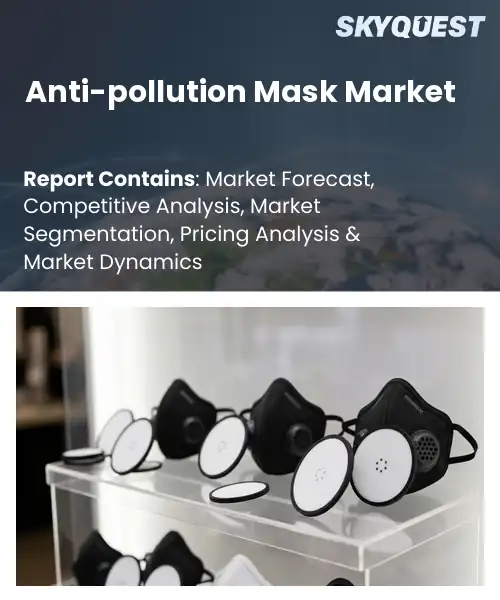
Anti-pollution Mask Market
Report ID: SQMIG30E2093
Report ID: SQMIG30E2093
[email protected]
USA +1 351-333-4748
Report ID:
SQMIG30E2093 |
Region:
Global |
Published Date: May, 2026
Pages:
157
|Tables:
128
|Figures:
77


Global Anti-Pollution Mask Market size was valued at USD 10.4 Billion in 2024 and is poised to grow from USD 13.24 Billion in 2025 to USD 91.3 Billion by 2033, growing at a CAGR of 27.3% during the forecast period (2026-2033).
The global anti-pollution mask market growth is driving rapidly as cities get worse air, and people are more aware about public health which then changes what consumers want and how governments respond. It includes single use surgical filter options, certified respirators like N95 and KN95, and reusable masks that look more modern and use replaceable cartridges, targeting commuters, industrial workers and the more vulnerable groups. The reason it matters is clear: studies keep showing that fine particle exposure is tied to respiratory issues and cardiovascular disease, so authorities and employers end up publishing guidance and sometimes mandates. Before all this, demand spiked during smog events in places such as Beijing and Delhi, and then later grew worldwide during the COVID-19 period, so innovation sped up and mainstream acceptance got stronger.
Moreover, Technological improvement and changing compliance standards are the major factors behind global anti-pollution mask market penetration, because better filtration performance and more comfortable ergonomic designs make people keep using masks over time. As companies roll out electrostatic meltblown layers, active carbon inserts, and valve-free respirator structures that align with NIOSH and EN149 requirements, employers and daily urban commuters feel safer switching away from disposable choices toward longer-cycle counterparts. This tends to raise lifetime value, and it also pushes subscriptions, bulk contracts, and corporate procurement.
AI can help anti-pollution masks run more efficiently by blending tiny sensor parts with edge AI, and cloud analytics that can follow breathing patterns alongside the particle count, around the user. The key bits are usually airflow control that shifts while inhaling, real time feedback, so the seal and overall comfort get better, and early alerts that hint when the filters should be swapped. Now, the market is also seeing consumer wearables and electronic purifiers that combine respiration monitoring with particle detection and automated fan handling, all in one. Demand is especially strong among urban users and health-minded customers who want protection but also something like actionable data. For example, there are sensor-enabled smart masks that record breathing behavior, and there are wearable purifiers that modulate flow based on how active someone is.
Market snapshot - (2026-2033)
Global Market Size
USD 10.4 Billion
Largest Segment
Disposable Masks
Fastest Growth
Smart Anti-pollution Masks
Growth Rate
27.3% CAGR
To get more insights on this market click here to Request a Free Sample Report
Global anti-pollution mask market is segmented by product type, filter type, distribution channel, end user and region. Based on product type, the market is segmented into Disposable Masks, Reusable Masks, Respirator Masks, Smart Anti-pollution Masks and Others. Based on filter type, the market is segmented into PM2.5 Filters, Activated Carbon Filters, HEPA Filters, Electrostatic Filters, Multi-layer Combination Filters and Others. Based on distribution channel, the market is segmented into Online Retail, Pharmacies & Drug Stores, Supermarkets & Hypermarkets, Specialty Stores, Industrial & Institutional Sales and Others. Based on end user, the market is segmented into Individual Consumers, Industrial Workers, Healthcare Professionals, Construction & Mining Workers, Automotive & Manufacturing Workforce and Others. Based on region, the market is segmented into North America, Europe, Asia Pacific, Latin America and Middle East & Africa.
As per the anti-pollution mask market analysis, the Reusable Masks segment leads, more or less, because consumers care about long term value and sustainability, so demand shifts toward durable designs with replaceable filters and an ergonomic fit, or at least that’s what the market seems to say. Manufacturers therefore put money into durable materials, snug seals, and aesthetic options that can be tuned, which ends up boosting repeat orders and brand loyalty. Institutional and retail buyers also lean in harder since they think about product lifecycle management and waste reduction, so reusable options get framed as the go-to route for everyday protection, and a more premium, comfortable user experience.
However, Disposable Masks are popping up as the fastest growing area. It’s mostly about convenience, the feeling of improved hygiene, and wide retail distribution that makes it easier for casual users to try them, even if they were not exactly looking. Innovations using biodegradable materials, simpler filtration upgrades, and co-marketing with everyday consumer goods keep widening the appeal. This helps them move quickly across different user groups, and it creates scalable volume opportunities for manufacturers and retailers.
According to the anti-pollution mask market forecast, the HEPA Filters segment dominates, because their proven ability to trap ultrafine particulate matter builds trust with safety focused consumers and with professional buyers. So products with HEPA show up as a default preference. Regulatory acceptance, and compatibility across multiple mask architectures, lets manufacturers verify and certify performance, which supports higher price positioning. When the messaging is straightforward about high efficiency capture, it encourages institutional procurement and pushes industry standards up, leading to broad adoption across many product lines and different use cases.
Whereas the Multilayer Combination Filters category is predicted to have the largest anti-pollution mask market share, mainly due to their ability to combine particulate capture, gas handling, and odor control in compact assemblies. That tends to attract users who want multifunctional protection without carrying extra bulk. Material upgrades continue; modular filter cartridges make swapping easier, and cross compatibility with changing mask designs keeps adoption moving. Manufacturers can then handle different pollution profiles more confidently and also build new product tiers as well as smaller niche applications.
To get detailed segments analysis, Request a Free Sample Report
As per the anti-pollution mask market regional forecast, Asia Pacific dominates, mostly because so much of the population lives in cities, and those places keep getting stuck with air quality issues, and people are more aware of respiratory health than before, and mask use is culturally familiar too. On top of that, in several big economies the domestic manufacturing ecosystem is strong, so companies can move quickly on new filtration materials and more ergonomic, comfortable designs. With established supply chains and big-scale production, they also get lower per-unit costs, which makes exporting easier. Add the regulatory rules and public education in multiple markets, and there is a broader acceptance of masks for polluted environments across different age groups and demographics. Then there are the retail channels, including e-commerce that’s advanced, which helps products spread fast and supports new formats. Research groups and private firms collaborating, it speeds up technology transfer, and the region ends up looking like both a major demand hub and a global supplier of lots of varied anti-pollution mask solutions.
Japan Anti-pollution Mask Market
The Anti-pollution Mask sector in Japan has solid consumer acceptance, tied to urban air problems and very high expectations around product quality. Local manufacturers push advanced filtration, a comfortable ergonomic fit, and a discreet look so it works for everyday city routines. Healthcare procurement and also corporate purchasing tend to steer premium specifications, while different retail spaces, along with e-commerce, keep the product easy to find. There’s also collaboration between industry and research institutions, which supports innovation and keeps Japan’s role as a technology and design leader strong across the regional market.
South Korea Anti-pollution Mask Market
The Anti-pollution Mask Market in South Korea shows high urban awareness, and people care about multifunctional products, especially ones that mix filtration with comfort and a more lifestyle, cosmetic-friendly look. Local companies lean into textile innovation and design trends to align masks with personal preferences, and because product cycles are quick, and branding is aggressive, differentiation happens faster. Distribution happens through omnichannel retail, like physical stores and online marketplaces. Public health programs, and corporate procurement, help keep demand steady and encourage continued product upgrades and refinement.
The quick anti-pollution mask market penetration in North America is basically pushed by people becoming more aware of how air quality can affect health, and there is this bigger push toward personal wellbeing and workplace safety. Also, when those episodic pollution events pop up, they get a lot of attention, and somehow that often leads to short-term demand spikes. Lots of consumers want face masks that can provide dependable filtration but still feel comfortable, and look modern too, so brands try to deliver improved materials and more straightforward, user-friendly features. On the institutional side, buyers like healthcare organizations and corporate procurement teams, tend to back up a steadier channel for higher-end products. And because North America has a mature retail and digital ecosystem, people can find and buy these things fast, without much friction. Meanwhile, innovation hubs and cross-border supply relationships help adapt global technologies to local preferences. Different user groups and demand for sustainable materials influence product tiers, and that also feeds into R and D decisions.
United States Anti-pollution Mask Market
The Anti-pollution Mask industry in the United States is shaped by occasional air quality emergencies, more public focus on respiratory protection, and institutional purchasing. Consumers look for masks with verified filtration, but also comfort while wearing, so brands highlight material science and try to match certification requirements. Occupational safety rules, along with healthcare-related demand, support a professional segment. At the same time, retail variety and strong direct-to-consumer marketing help adoption spread across urban and suburban communities.
Canada Anti-pollution Mask Market
The Anti-pollution Mask Market in Canada varies by region in terms of air quality concerns, but consumers consistently put emphasis on respiratory protection. Producers and sellers focus on comfortable designs, clear certification, and more sustainable materials. Public health organizations and employers keep demand coming for certified options. Retail networks are solid, and cross-border supply links help maintain product availability. Cooperation between industry and local health authorities also strengthens messaging, and it supports uptake during episodes of poor air quality across major areas.
Europe is reinforcing its role through a mix of tight product standards, more consumer attention to health alongside sustainability, and active involvement by public institutions aiming at cleaner urban air. In return, manufacturers and brands are reacting with certified filtration technologies, recyclable materials, and overall design choices that quietly match regional lifestyle preferences. The distribution of backbone across countries, together with cross-border regulatory alignment, makes it easier for products to be more available and seen as trustworthy. Meanwhile, cooperation among research centers, industry groups, and public health authorities speeds up evidence-based messaging and product validation.
Germany Anti-pollution Mask Market
The Anti-pollution Mask Market in Germany is largely driven forward by strict standards and strong industrial demand, and an informed customer group that values certified performance. Local producers usually stress engineering-led filtration solutions, material sturdiness, and ergonomic design, which work for professional needs and everyday routines, at the same time. Sourcing from industrial and healthcare sectors keeps demand steady for higher specification masks, while retail and specialized channels introduce more consumer-oriented models. Sustainability concerns and technical validation by institutions help the market feel credible.
United Kingdom Anti-pollution Mask Market
The Anti-pollution Mask Market in the United Kingdom highlights people's concern about city air, and also their interest in design-driven, functional products that fit commuting schedules. Brands combine validated filtration with visual appeal and comfort, using a lively retail environment and online platforms to reach buyers fast. Institutional demand from healthcare and workplace-related sectors anchors the professional portion, while sustainability and product transparency influence what people buy. Partnerships with research centers and certification entities add to the confidence factor for consumers.
France Anti-pollution Mask Market
The Anti-pollution Mask in Market France sits right in the middle of strong public health awareness and that very local cultural attention to style, so demand tilts toward masks that deliver certified protection but also look a bit more refined. Designers, along with manufacturers, start working together to tuck filtration technology into fashion-like formats, and in parallel, healthcare organizations or municipal procurement add pressure, so technical needs stay satisfied. On the sales side, retail outlets and specialist channels offer a spectrum from lifestyle-minded versions to more professional-grade solutions, depending on what people need. Sustainability priorities, together with clear labeling routines, keep trust climbing steadily and help wider adoption move forward.
To know more about the market opportunities by region and country, click here to
Buy The Complete Report
Rising Urban Air Pollution Levels
Growing Public Health Awareness
High Product Costs
Regulatory Approval Complexities
Request Free Customization of this report to help us to meet your business objectives.
Competition in the global anti pollution mask sphere revolves around product differentiation and this broader idea of ecosystem control, mainly because city air keeps getting worse and customers want protection they can measure. Companies then chase technical novelties and distribution arrangements, like AirPop’s Halo smart sensor and Xiaomi Youpin listings, LG’s PuriCare wearable rollout, and the more “startup playbook” side with IP and platform moves such as Adevair’s Securio.
Top Player’s Company Profile
Recent Developments in the Anti-Pollution Mask Market
3M announced a new Vision C5 facepiece option for the 3M Scott X3-21 Pro SCBA in July 2025, and this expanded their tactical respiratory portfolio. The changes are aimed at tactical operators, including a wider field of view and improved communications, which matches 3M’s ongoing approach of adapting industrial-grade respiratory systems for law enforcement and defense operational needs.
SkyQuest’s ABIRAW (Advanced Business Intelligence, Research & Analysis Wing) is our Business Information Services team that Collects, Collates, Correlates, and Analyses the Data collected by means of Primary Exploratory Research backed by robust Secondary Desk research.
As per SkyQuest analysis, the global anti-pollution mask market is driven by rising city air pollution as a main catalyst and backed by rising public health awareness as a second factor. Still, higher product costs are a clear restraint that can slow down uptake in price-sensitive places. Asia Pacific stays out front because of large urban populations, strong manufacturing capacity, and a broadly accepted mask culture. Meanwhile, the reusable masks category leads to the product lineup, fueled by sustainability, long-term value, and filters that can be swapped out. Ongoing upgrades in filtration, smart wearables and e-commerce distribution will nudge adoption forward, while also opening doors for more differentiated, special offerings.
| Report Metric | Details |
|---|---|
| Market size value in 2024 | USD 10.4 Billion |
| Market size value in 2033 | USD 91.3 Billion |
| Growth Rate | 27.3% |
| Base year | 2024 |
| Forecast period | (2026-2033) |
| Forecast Unit (Value) | USD Billion |
| Segments covered |
|
| Regions covered | North America (US, Canada), Europe (Germany, France, United Kingdom, Italy, Spain, Rest of Europe), Asia Pacific (China, India, Japan, Rest of Asia-Pacific), Latin America (Brazil, Rest of Latin America), Middle East & Africa (South Africa, GCC Countries, Rest of MEA) |
| Companies covered |
|
| Customization scope | Free report customization with purchase. Customization includes:-
|
To get a free trial access to our platform which is a one stop solution for all your data requirements for quicker decision making. This platform allows you to compare markets, competitors who are prominent in the market, and mega trends that are influencing the dynamics in the market. Also, get access to detailed SkyQuest exclusive matrix.
Table Of Content
Executive Summary
Market overview
Parent Market Analysis
Market overview
Market size
KEY MARKET INSIGHTS
COVID IMPACT
MARKET DYNAMICS & OUTLOOK
Market Size by Region
KEY COMPANY PROFILES
Methodology
For the Anti-pollution Mask Market, our research methodology involved a mixture of primary and secondary data sources. Key steps involved in the research process are listed below:
1. Information Procurement: This stage involved the procurement of Market data or related information via primary and secondary sources. The various secondary sources used included various company websites, annual reports, trade databases, and paid databases such as Hoover's, Bloomberg Business, Factiva, and Avention. Our team did 45 primary interactions Globally which included several stakeholders such as manufacturers, customers, key opinion leaders, etc. Overall, information procurement was one of the most extensive stages in our research process.
2. Information Analysis: This step involved triangulation of data through bottom-up and top-down approaches to estimate and validate the total size and future estimate of the Anti-pollution Mask Market.
3. Report Formulation: The final step entailed the placement of data points in appropriate Market spaces in an attempt to deduce viable conclusions.
4. Validation & Publishing: Validation is the most important step in the process. Validation & re-validation via an intricately designed process helped us finalize data points to be used for final calculations. The final Market estimates and forecasts were then aligned and sent to our panel of industry experts for validation of data. Once the validation was done the report was sent to our Quality Assurance team to ensure adherence to style guides, consistency & design.
Analyst Support
Customization Options
With the given market data, our dedicated team of analysts can offer you the following customization options are available for the Anti-pollution Mask Market:
Product Analysis: Product matrix, which offers a detailed comparison of the product portfolio of companies.
Regional Analysis: Further analysis of the Anti-pollution Mask Market for additional countries.
Competitive Analysis: Detailed analysis and profiling of additional Market players & comparative analysis of competitive products.
Go to Market Strategy: Find the high-growth channels to invest your marketing efforts and increase your customer base.
Innovation Mapping: Identify racial solutions and innovation, connected to deep ecosystems of innovators, start-ups, academics, and strategic partners.
Category Intelligence: Customized intelligence that is relevant to their supply Markets will enable them to make smarter sourcing decisions and improve their category management.
Public Company Transcript Analysis: To improve the investment performance by generating new alpha and making better-informed decisions.
Social Media Listening: To analyze the conversations and trends happening not just around your brand, but around your industry as a whole, and use those insights to make better Marketing decisions.
REQUEST FOR SAMPLE
 REQUEST FREE CUSTOMIZATION
Global Anti-Pollution Mask Market size was valued at USD 10.4 Billion in 2024 and is poised to grow from USD 13.24 Billion in 2025 to USD 91.3 Billion by 2033, growing at a CAGR of 27.3% during the forecast period (2026-2033).
Competition in the global anti pollution mask market centers on product differentiation and ecosystem control, driven by worsening urban air quality and consumer demand for measurable protection. Firms pursue technical innovation and distribution partnerships, for example AirPop’s Halo smart sensor and Xiaomi Youpin listings, LG’s PuriCare wearable launch, and startup IP and platform plays such as Adevair’s Securio. '3M Company', 'Honeywell International Inc.', 'Kimberly-Clark Corporation', 'Ansell Limited', 'Alpha Pro Tech, Ltd.', 'Moldex-Metric, Inc.', 'Uvex Group', 'Cambridge Mask Co', 'Respro Ltd.', 'Totobobo Pte. Ltd.', 'Vogmask', 'RZ Industries', 'Shanghai Dasheng Health Products Manufacture Co., Ltd.', 'Winner Medical Co., Ltd.', 'Kowa Company, Ltd.', 'Makrite Industries, Inc.', 'JSP Limited', 'Venus Safety & Health Pvt. Ltd.', 'Prestige Ameritech', 'Hakugen Earth Co., Ltd.'
Rising urban air pollution aggravates respiratory concerns among populations, prompting increased interest in protective measures and sustained use of anti-pollution masks. As visibility of smog and reports of poor air quality grow, consumers seek practical, day-to-day solutions to reduce exposure during commutes and outdoor activities. This perceived need encourages both individual purchases and institutional procurement for workforce protection, supporting product diversification and retail distribution expansion. Manufacturers respond with marketed features that emphasize filtration and comfort, which further stimulates adoption and expands the addressable market in urban centers.
𝗨𝗿𝗯𝗮𝗻 𝗛𝗲𝗮𝗹𝘁𝗵 𝗔𝘄𝗮𝗿𝗲𝗻𝗲𝘀𝘀 𝗨𝗽𝘁𝗶𝗰𝗸: Rising public concern about air quality and respiratory health is driving broader consumer acceptance of anti pollution masks across urban populations. Employers and service providers increasingly view masks as part of workplace safety and customer reassurance practices, while lifestyle trends emphasize protection during commuting and outdoor exercise. This evolving perception supports demand for varied form factors and comfort driven innovations, creating opportunities for brands to differentiate through fit comfort, material sustainability, and design aesthetics that integrate seamlessly into routines.
Why does Asia Pacific Dominate the Global Anti-pollution Mask Market? |@12


Want to customize this report? This report can be personalized according to your needs. Our analysts and industry experts will work directly with you to understand your requirements and provide you with customized data in a short amount of time. We offer $1000 worth of FREE customization at the time of purchase.
Feedback From Our Clients


 USA (+1) 351-333-4748

