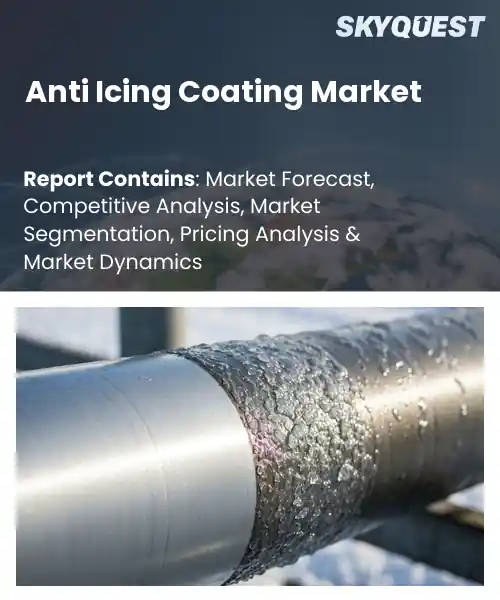
Anti Icing Coating Market
Report ID: SQMIG15E3920
Report ID: SQMIG15E3920
[email protected]
USA +1 351-333-4748
Report ID:
SQMIG15E3920 |
Region:
Global |
Published Date: July, 2026
Pages:
157
|Tables:
116
|Figures:
77


Global Anti Icing Coating Market size was valued at USD 2.75 Billion in 2024 and is poised to grow from USD 3.45 Billion in 2025 to USD 21.42 Billion by 2033, growing at a CAGR of 25.62% during the forecast period (2026-2033).
The global anti‑icing coating market is about those specialized polymeric or ceramic mixes that get brushed, sprayed, or otherwise laid onto aircraft surfaces, wind‑turbine blades, power‑line conductors and marine structures, so ice doesn’t decide to stay and grow there. People care a lot because safety mandates are pushing it, plus the whole operational efficiency angle, and then there’s the regulatory pressure which tries to cut the downtime that ice causes. The main push comes from more demand for dependable air transport, along with renewable‑energy buildouts, so more assets are constantly sitting in freezing weather, not just once in a while.
In addition, climate regulations meeting polymer chemistry improvements are another major factor driving the anti-icing coating market growth. Like when emissions limits basically leave offshore wind operators without patience for energy‑intensive heaters, they look for anti‑icing films that can keep blade efficiency steady. In a 2023 Danish turbine trial they reportedly saw 12% more annual output after using a silica‑enhanced coating. Also, in Canada, utility companies have tried nano‑structured paints on high‑voltage lines and managed to reduce weather‑linked outages by around 30%. Those on‑site wins lower the perceived risk, so companies spend more on R&D, the market gets wider globally, and extra industries start benefiting too: aerospace maintenance, materials logistics, and even consulting services.
AI is changing performance prediction for anti‑icing coatings by combining material science with advanced analytics that are, frankly, very good at patterns. Machine‑learning models take in lab results, field trial data, and environmental variables, then they forecast what the coating will do when temperatures swing, when moisture shows up, and when mechanical stress starts stacking up. Instead of only guessing, the models help spot small formulation adjustments, like tiny changes in structure or finish that can boost durability and reduce ice adhesion. Engineers can iterate faster than the older trial‑and‑error method, and that speeds up everything. Also, real‑time sensor inputs from aircraft systems or wind‑turbine blades can feed those models, so it offers a feedback loop where predictions get refined continuously. Overall it shortens development cycles, reduces material waste, and gives manufacturers more confidence that new products will satisfy strict safety requirements, while still working across different climate realities.
Market snapshot - (2026-2033)
Global Market Size
USD 2.75 Billion
Largest Segment
Silicone-Based Coatings
Fastest Growth
Nano-Composite Coatings
Growth Rate
25.62% CAGR
To get more insights on this market click here to Request a Free Sample Report
The global anti-icing coating market is segmented by material chemistry type, substrate compatibility, end-use industry, distribution channel and region. Based on material chemistry type, the market is segmented into Fluoropolymer Coatings, Silicone-Based Coatings and Nano-Composite Coatings. Based on substrate compatibility, the market is segmented into Metallic Substrates and Composite & Polymer Substrates. Based on end-use industry, the market is segmented into Aerospace & Defense, Renewable Energy, Automotive & Transportation and Telecommunications & Infrastructure. Based on distribution channel, the market is segmented into Direct and Indirect. Based on region, the market is segmented into North America, Europe, Asia Pacific, Latin America and Middle East & Africa.
As per the anti-icing coating market analysis, the Fluoropolymer coatings segment dominates because their intrinsically low surface energy creates this durable, water‑repellent layer that resists ice adhesion even when there are extreme temperature swings. Their chemical stability and resistance to ultraviolet degradation make them especially suited for high‑performance uses where reliability is basically non‑negotiable. Those properties seem to line up well with what customers ask for: long‑lasting, low-upkeep solutions. And that’s why they keep reinforcing their leadership in the market, like it’s obvious.
Meanwhile, nano‑composite coatings are gaining the strongest growth momentum in the anti icing coating market since researchers mix nanoscale particles with polymer matrices. The idea is to improve heat‑transfer performance and also add self‑healing capabilities. It tackles new performance expectations such as lighter weight, and quicker de‑icing cycles . So it’s opening new opportunities across areas that want advanced functionality beyond what traditional coatings usually deliver.
According to the anti-icing coating market forecast, the aerospace & defense segment stands out because mission‑critical platforms require total reliability, and any ice buildup can threaten safety, stealth, and day‑to‑day operational readiness. Anti icing coatings put on aircraft skins , rotor blades , and missile components have to pass strict certification requirements. That’s pushing manufacturers to focus on solutions that are already proven, and that can guarantee performance in hostile conditions. This emphasis keeps driving sustained investment, and it keeps strengthening the sector’s central role in shaping market direction.
On the other side, the renewable energy segment is emerging as the main high‑growth area, mostly due to offshore wind farms and solar installations that must keep operating in cold, icy conditions. Operators increasingly use anti icing coatings to hold turbine efficiency steady and reduce downtime from ice buildup. The sector’s quick rollouts, plus regulatory encouragement for cleaner energy, amplify the demand, and it accelerates overall market expansion. It also helps foster innovation that’s more tailored to renewable infrastructure, which feels like the real catalyst here.
To get detailed segments analysis, Request a Free Sample Report
As per the anti-icing coating market regional forecast, North America holds a top spot because of a mix of strong aerospace production, lots of civil and military flying going on, plus strict safety rules that push for real good ice mitigation ideas. The region also has advanced research centers and this whole mindset around new material development, which helps generate high‑performance coating recipes. Then there are partnerships between coating makers and major airlines, they help keep things steady in the supply chain, while certification pathways that are already mature make it easier to get products accepted in the market. Also, there are so many big airports spread across different weather belts, that keeps the need for dependable anti‑icing tech from slowing down, and it reinforces that dominance in both quantity and tech leadership.
United States Anti Icing Coating Market
In the United States, the Anti-Icing Coating sector keeps growing due to a dense web of commercial carriers, plus a history of defense aviation programs that want top level ice protection. When big chemical companies work with research universities, formulation progress speeds up, and FAA guidance stays tight so performance stays predictable. With huge runway infrastructure across different weather zones demand keeps moving, and the regulatory atmosphere that’s proactive pushes more money toward safer, more efficient anti‑icing options.
Canada Anti Icing Coating Market
In Canada, the Anti-Icing Coating Market outlook is influenced by how wide and northern the country is, and how much focus there is on safe winter operations for passenger flights and cargo schedules too. Provincial aviation offices have close ties with coating manufacturers, so solutions can be tuned for harsh winter conditions. At the same time, environmental responsibility is a big priority, so low‑VOC and eco‑friendly coatings get more attention. Plus, joint research with academic groups helps with steady product refinements, which still match Canadian air transport standards that are demanding.
Europe is expanding fast, largely because the regulatory setup is fairly aligned, so safety expectations across member states end up more consistent, and that supports broad use of high‑quality anti‑icing solutions. Also, Europe has a mature aerospace scene, with older aircraft makers, and a dense group of short‑haul operators, which basically sustains steady demand for practical ice management tech. Government incentives for R&D, plus a connected network of universities and specialty chemical firms, helps innovation in eco‑minded coating chemistry move quicker. And because climates vary a lot across the continent, the market stays relevant in many places, so Europe ends up acting like a lively hub for both adoption and development.
Germany Anti Icing Coating Market
The German Anti-Icing Coating industry is supported by a strong engineering background and a cluster of aerospace suppliers that care about accuracy and dependable output. Industry groups working hand in hand with research institutes refine coating effectiveness again and again, while strict European safety rules keep compliance high. Because winter flight operations happen across many regional airports, demand stays consistent. There’s also a strong emphasis on sustainable chemistry, so coating development lines up with wider environmental goals.
United Kingdom Anti Icing Coating Market
In the United Kingdom, the Anti Icing Coating Market shows a quicker adoption pace, driven by a blend of long‑standing airlines and newer low‑cost carriers. Joint projects linking British universities and specialty coating manufacturers speed up the arrival of updated formulations, aimed at both performance and ecological worries, without losing focus. UK regulators offer fairly clear direction, which helps companies enter the market sooner. And the weather swings across the British Isles keep creating continuing demand for dependable anti‑icing solutions.
France Anti Icing Coating Market
The French Anti-Icing Coating Market is gaining attention as a point of focus for smaller aviation niches, plus regional networks that fly a lot over mountainous and coastal routes. Partnerships between French chemical companies and aerospace engineering schools help build coating solutions that try to balance operational efficiency with a smaller environmental footprint. Support from the government for green tech also nudges investment, and France’s role in the broader European air transport system makes advanced ice protection systems feel especially important.
Asia Pacific is getting stronger, through expanding air travel demand, greater exposure to harsh winter weather in some sub regions, and proactive governmental policies that stress aviation safety. The regions fast growth in commercial aviation and cargo flights together makes a workable place for next generation anti icing technologies to show up. Cooperative research between multinational coating producers and local universities speeds up the creation of mixtures, that can handle very different climatic needs, and at the same time growing environmental awareness is pushing industry toward low impact chemistries. Also, strategic money for upgrading airport infrastructure makes anti icing solutions part of everyday operating rules, so Asia Pacific ends up looking more and more like a major influence in the market.
Japan Anti Icing Coating Market
In Japan, the anti-icing coating market uses a complex aerospace setup, plus a long standing culture of precision engineering, to provide high performance ice mitigation products. Joint research initiatives between major Japanese universities and coating companies concentrate on improving service life, while keeping environmental impact as low as possible. Japans airport network is broad, and many airports deal with heavy snowfall, so demand stays consistent, plus strict civil aviation rules mean that only top class solutions get deployed across the fleet.
South Korea Anti Icing Coating Market
In South Korea, the anti-icing coating market penetration is supported by a lively blend of low cost carriers and advanced aircraft makers, both of which care about safety and day to day operational efficiency. Local research institutes alongside chemical firms collaborate to speed up testing of new coating chemistries, especially ones designed for the regions changeable winter conditions. Government encouragement of eco friendly innovation helps the shift toward cleaner anti icing formulations, while airport capacity expansions keep the market moving forward steadily.
To know more about the market opportunities by region and country, click here to
Buy The Complete Report
Increasing Flight Safety Regulations
Expanding Commercial Aircraft Fleet
High Production Cost Challenges
Stringent Environmental Compliance Requirements
Request Free Customization of this report to help us to meet your business objectives.
The global anti-icing coatings market is driven by heavy competition, between well known chemical manufacturers and upstart specialty firms. Lately, there are more M&A movement, like when a major aerospace supplier picked up a smaller polymer developer, and then there are strategic collaborations that connect coating makers with top airline maintenance teams. All of this seems to speed up the way technology is adopted. Meanwhile, companies are putting money into nanostructured coating improvements, to push durability higher and to shrink application expenses , and that keeps shaping how the market behaves.
Top Player’s Company Profile
Recent Developments in the Anti-Icing Coating Market
SkyQuest’s ABIRAW (Advanced Business Intelligence, Research & Analysis Wing) is our Business Information Services team that Collects, Collates, Correlates, and Analyses the Data collected by means of Primary Exploratory Research backed by robust Secondary Desk research.
As per SkyQuest analysis, the global anti‑icing coating market is being driven mainly by tougher flight‑safety rules that force airlines and OEMs to use certified coating solutions. On top of that, the quick increase in the commercial aircraft fleet becomes a second accelerator, simply because it grows the number of surfaces that actually need protection. Still, high production costs are acting as the biggest restraint, and they slow adoption in regions where buyers are more price‑sensitive. North America, meanwhile, dominates in both market size and tech leadership, mostly because it has a well‑established aerospace base and a strong research ecosystem around it. In the product side, fluoropolymer coatings are taking the largest share, largely due to their low surface energy, as well as durability. All these pieces together shape a market that looks set for solid growth, and maybe even faster than people expect.
| Report Metric | Details |
|---|---|
| Market size value in 2024 | USD 2.75 Billion |
| Market size value in 2033 | USD 21.42 Billion |
| Growth Rate | 25.62% |
| Base year | 2024 |
| Forecast period | (2026-2033) |
| Forecast Unit (Value) | USD Billion |
| Segments covered |
|
| Regions covered | North America (US, Canada), Europe (Germany, France, United Kingdom, Italy, Spain, Rest of Europe), Asia Pacific (China, India, Japan, Rest of Asia-Pacific), Latin America (Brazil, Rest of Latin America), Middle East & Africa (South Africa, GCC Countries, Rest of MEA) |
| Companies covered |
|
| Customization scope | Free report customization with purchase. Customization includes:-
|
To get a free trial access to our platform which is a one stop solution for all your data requirements for quicker decision making. This platform allows you to compare markets, competitors who are prominent in the market, and mega trends that are influencing the dynamics in the market. Also, get access to detailed SkyQuest exclusive matrix.
Table Of Content
Executive Summary
Market overview
Parent Market Analysis
Market overview
Market size
KEY MARKET INSIGHTS
COVID IMPACT
MARKET DYNAMICS & OUTLOOK
Market Size by Region
KEY COMPANY PROFILES
Methodology
For the Anti Icing Coating Market, our research methodology involved a mixture of primary and secondary data sources. Key steps involved in the research process are listed below:
1. Information Procurement: This stage involved the procurement of Market data or related information via primary and secondary sources. The various secondary sources used included various company websites, annual reports, trade databases, and paid databases such as Hoover's, Bloomberg Business, Factiva, and Avention. Our team did 45 primary interactions Globally which included several stakeholders such as manufacturers, customers, key opinion leaders, etc. Overall, information procurement was one of the most extensive stages in our research process.
2. Information Analysis: This step involved triangulation of data through bottom-up and top-down approaches to estimate and validate the total size and future estimate of the Anti Icing Coating Market.
3. Report Formulation: The final step entailed the placement of data points in appropriate Market spaces in an attempt to deduce viable conclusions.
4. Validation & Publishing: Validation is the most important step in the process. Validation & re-validation via an intricately designed process helped us finalize data points to be used for final calculations. The final Market estimates and forecasts were then aligned and sent to our panel of industry experts for validation of data. Once the validation was done the report was sent to our Quality Assurance team to ensure adherence to style guides, consistency & design.
Analyst Support
Customization Options
With the given market data, our dedicated team of analysts can offer you the following customization options are available for the Anti Icing Coating Market:
Product Analysis: Product matrix, which offers a detailed comparison of the product portfolio of companies.
Regional Analysis: Further analysis of the Anti Icing Coating Market for additional countries.
Competitive Analysis: Detailed analysis and profiling of additional Market players & comparative analysis of competitive products.
Go to Market Strategy: Find the high-growth channels to invest your marketing efforts and increase your customer base.
Innovation Mapping: Identify racial solutions and innovation, connected to deep ecosystems of innovators, start-ups, academics, and strategic partners.
Category Intelligence: Customized intelligence that is relevant to their supply Markets will enable them to make smarter sourcing decisions and improve their category management.
Public Company Transcript Analysis: To improve the investment performance by generating new alpha and making better-informed decisions.
Social Media Listening: To analyze the conversations and trends happening not just around your brand, but around your industry as a whole, and use those insights to make better Marketing decisions.
REQUEST FOR SAMPLE
 REQUEST FREE CUSTOMIZATION
Global Anti Icing Coating Market size was valued at USD 2.75 Billion in 2024 and is poised to grow from USD 3.45 Billion in 2025 to USD 21.42 Billion by 2033, growing at a CAGR of 25.62% during the forecast period (2026-2033).
The global anti‑icing coating market is shaped by intense competition among established chemical manufacturers and emerging specialty firms. Recent M&A activity, such as the acquisition of a niche polymer developer by a major aerospace supplier, and strategic partnerships linking coating producers with leading airline maintenance providers, are accelerating technology adoption. Companies are investing in nanostructured coating innovations to improve durability and reduce application costs, directly influencing market dynamics. 'PPG Industries', 'Akzo Nobel', 'The Sherwin-Williams Company', 'RPM International', 'Axalta Coating Systems', 'BASF SE', 'Dow Inc', 'Henkel', 'Sika AG', 'Hempel', 'Jotun', 'Kansai Paint', 'Nippon Paint Holdings', 'Lord Corporation', 'Aero Space Coatings', 'Fraunhofer-Gesellschaft', 'NEI Corporation', 'Oceanit Laboratories', 'Cytonix', 'Helios Group'
Regulatory bodies worldwide are mandating stricter anti‑icing performance standards for aircraft operating in cold climates, prompting airlines and manufacturers to adopt advanced coating solutions that ensure runway readiness and flight safety. This regulatory pressure drives procurement cycles, accelerates product development, and creates a reliable revenue stream for coating suppliers, as compliance verification becomes an integral part of certification processes and operational checklists. Consequently, market participants experience sustained demand growth linked directly to safety‑centric policy enforcement and enhances overall operational reliability for airlines worldwide.
Renewable Energy Integration: The aviation and maritime sectors are increasingly adopting renewable power sources, prompting manufacturers to formulate anti‑icing coatings compatible with electric propulsion systems and alternative fuels. This shift drives demand for formulations that maintain performance under varying temperature profiles while supporting sustainability goals, encouraging R&D investment and collaboration between coating producers and green technology providers to create environmentally aligned anti‑icing solutions.
Why does North America Dominate the Global Anti Icing Coating Market? |@12


Want to customize this report? This report can be personalized according to your needs. Our analysts and industry experts will work directly with you to understand your requirements and provide you with customized data in a short amount of time. We offer $1000 worth of FREE customization at the time of purchase.
Feedback From Our Clients


 USA (+1) 351-333-4748

