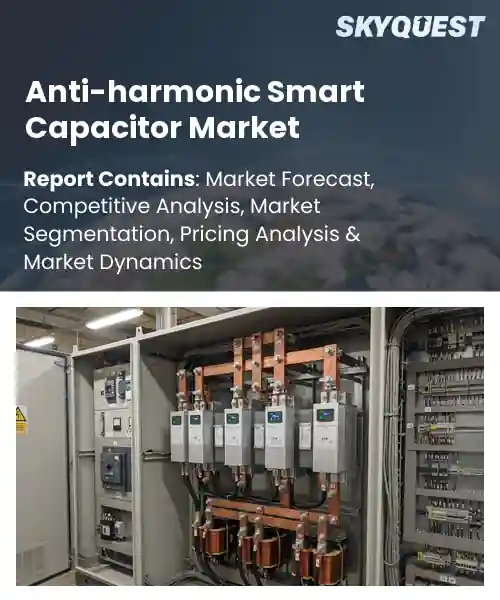
Anti-harmonic Smart Capacitor Market
Report ID: SQMIG20D2861
Report ID: SQMIG20D2861
[email protected]
USA +1 351-333-4748
Report ID:
SQMIG20D2861 |
Region:
Global |
Published Date: August, 2026
Pages:
157
|Tables:
153
|Figures:
68


Global Anti-Harmonic Smart Capacitor Market size was valued at USD 2.18 Billion in 2024 and is poised to grow from USD 2.36 Billion in 2025 to USD 4.44 Billion by 2033, growing at a CAGR of 8.2% during the forecast period (2026-2033).
The anti harmonic smart capacitor market refers to advanced energy storage components that actively suppress resonant disturbances in power grids while delivering adaptive capacitance. Its significance lies in safeguarding renewable integration and preventing voltage spikes that could damage sensitive equipment. The primary driver behind this niche is the accelerating adoption of distributed generation, especially solar and wind farms, which introduce fluctuating frequencies that traditional capacitors cannot mitigate. Over the past decade manufacturers have refined semiconductor based sensing algorithms, illustrated by the 2018 launch of a self tuning capacitor by NovaTech that reduced harmonic distortion by 40 percent, now expanding globally. Regulatory pressure to meet grid stability standards represents the next pivotal factor shaping market expansion, because compliance clauses compel utilities to adopt intelligent mitigation devices. When authorities introduce tighter harmonic limits, operators experience increased outage costs, prompting investment in smart capacitors that can dynamically adjust reactance and isolate problematic frequencies. A notable case involves a European transmission company that integrated anti harmonic modules across its offshore wind interconnectors, achieving a 25 percent reduction in fault induced maintenance visits and a measurable boost in turbine availability. These outcomes create a loop where savings trigger wider rollout and enable grid balancing services.
How are AI and IoT integrations reshaping the anti‑harmonic smart capacitor market?
AI and IoT are turning anti‑harmonic smart capacitors into self‑optimizing components. AI algorithms analyze real‑time voltage and current patterns, allowing capacitors to adjust their reactive power output on the fly. IoT connectivity streams this data to cloud platforms where machine learning models predict load spikes and recommend preventive actions. The result is a tighter feedback loop that reduces losses, extends device life and simplifies grid management. Manufacturers are embedding sensors and edge processors directly into capacitor modules, creating products that can be monitored remotely and tuned without manual intervention. This convergence of intelligence and connectivity is reshaping design standards and opening new service models for utilities and industrial users.Recent industry announcements describe AI‑enabled IoT platforms that enhance capacitor performance, illustrating how the combined technologies drive efficiency and support market expansion.
Market snapshot - (2026-2033)
Global Market Size
USD 2.18 Billion
Largest Segment
Smart Capacitor Banks
Fastest Growth
Hybrid Capacitor Banks
Growth Rate
8.2% CAGR
To get more insights on this market click here to Request a Free Sample Report
Global anti-harmonic smart capacitor market is segmented by product type, voltage rating, harmonic mitigation, application, end user and region. Based on product type, the market is segmented into Fixed Capacitor Banks, Automatic Capacitor Banks, Smart Capacitor Banks, Hybrid Capacitor Banks and Others. Based on voltage rating, the market is segmented into Low Voltage, Medium Voltage and High Voltage. Based on harmonic mitigation, the market is segmented into Detuned Capacitor Banks, Tuned Filter Capacitor Banks, Active Harmonic Filter Integrated Capacitors and Other Harmonic Mitigation Systems. Based on application, the market is segmented into Industrial Facilities, Commercial Buildings, Utilities, Renewable Energy Systems, Transportation and Others. Based on end user, the market is segmented into Manufacturing, Oil & Gas, Power & Energy, Commercial & Institutional, Transportation and Others. Based on region, the market is segmented into North America, Europe, Asia Pacific, Latin America and Middle East & Africa.
Active Harmonic Filter Integrated Capacitors segment dominates because they combine power factor correction with active harmonic suppression in a single device, offering comprehensive distortion control. Their ability to adapt to varying harmonic spectra reduces the need for multiple discrete filters, simplifying system design and lowering lifecycle costs. This integrated approach meets the growing demand for compact, efficient solutions, positioning it as the go to technology for sophisticated power quality management in modern.
On the other hand, Detuned Capacitor Banks segment is emerging as the key high growth area as industries retrofit legacy plants with cost effective passive solutions. Their simplicity and proven reliability attract facilities seeking immediate harmonic reduction without complex control systems, driving rapid adoption and creating new opportunities for market expansion.
Smart Capacitor Banks segment dominates because manufacturers prioritize embedded intelligence that continuously monitors power quality and automatically adjusts reactive power. This capability reduces maintenance overhead and enhances system reliability, making it the preferred choice for facilities seeking seamless harmonic mitigation. The integration of IoT connectivity and predictive analytics drives its leadership, as operators value real time visibility and the ability to preemptively address distortion before it escalates in operational contexts.
Meanwhile, Automatic Capacitor Banks segment is witnessing the strongest growth momentum as utilities adopt programmable solutions that can be remotely dispatched to match fluctuating load profiles. The flexibility to schedule capacitor engagement reduces energy losses and supports grid stability, encouraging broader uptake and fueling future market expansion across diverse applications.
To get detailed segments analysis, Request a Free Sample Report
North America maintains a leading edge in the Anti-harmonic Smart Capacitor market due to a mature ecosystem of research institutions, robust venture capital networks, and clear regulatory pathways that encourage innovative energy storage solutions. The United States benefits from a concentration of advanced electronics manufacturers and a culture of rapid prototyping, while Canada offers strong governmental support for clean technology and an extensive grid infrastructure that facilitates pilot deployments. Collaboration between academia and industry accelerates technology transfer, and a skilled workforce underpins continuous product refinement. Additionally, the region’s emphasis on sustainability aligns with broader corporate commitments, reinforcing demand for high‑performance, low‑harmonic components across multiple sectors.
United States Anti-harmonic Smart Capacitor Market
Anti-harmonic Smart Capacitor Market in the United States is propelled by extensive R&D ecosystems centered around leading universities and corporate innovation hubs. Strong intellectual property frameworks encourage commercialization, while major electronics manufacturers integrate anti‑harmonic technologies into next‑generation devices. Government incentives for clean energy adoption further stimulate adoption across automotive, aerospace, and grid‑storage segments, creating a vibrant pipeline of applications and partnerships that reinforce market leadership.
Canada Anti-harmonic Smart Capacitor Market
Anti-harmonic Smart Capacitor Market in Canada benefits from proactive federal programs that fund clean‑technology projects and from a highly collaborative research community linking universities with industry consortia. The nation’s expansive renewable‑energy grid provides testbeds for advanced capacitor solutions, and regulatory alignment with North American standards eases cross‑border product deployment. These factors together nurture a supportive environment for both startups and established firms.
The Asia Pacific region is experiencing rapid expansion of the Anti-harmonic Smart Capacitor market driven by intense industrial modernization and a strategic focus on resilient power systems. Japan’s longstanding expertise in precision electronics and South Korea’s aggressive investment in semiconductor manufacturing create a fertile ground for advanced capacitor innovation. Both economies prioritize energy efficiency and harmonic mitigation in dense urban environments, prompting adoption across smart‑city infrastructure, high‑speed rail, and consumer electronics. Governmental policies that encourage low‑emission technologies, coupled with a surge in collaborations between research institutes and multinational corporations, accelerate the development and scaling of anti‑harmonic solutions throughout the region.
Japan Anti-harmonic Smart Capacitor Market
Anti-harmonic Smart Capacitor Market in Japan is anchored by world‑renowned expertise in high‑frequency components and a culture of meticulous engineering. Close ties between leading universities and legacy electronics firms enable swift translation of research into commercial products. National initiatives that target reduced electrical distortion in manufacturing and transportation sectors drive demand, while Japan’s emphasis on reliability ensures rigorous testing standards that raise the overall quality and adoption rate of anti‑harmonic technologies.
South Korea Anti-harmonic Smart Capacitor Market
Anti-harmonic Smart Capacitor Market in South Korea is fueled by a dynamic semiconductor ecosystem and strong governmental support for green technology deployment. Major electronics conglomerates integrate anti‑harmonic features into mobile devices, automotive platforms, and renewable‑energy converters, leveraging the country’s high‑speed production capabilities. Collaborative research programs between universities and industry accelerate material breakthroughs, while policy incentives encourage widespread implementation across smart‑grid and smart‑home applications.
Europe is strengthening its position in the Anti-harmonic Smart Capacitor market through coordinated research agendas, stringent environmental standards, and a thriving network of specialized manufacturers. Germany’s precision engineering heritage, the United Kingdom’s focus on digital innovation, and France’s commitment to energy transition collectively create a multifaceted ecosystem that nurtures advanced capacitor development. Cross‑border collaborations within the European Union streamline regulatory compliance and facilitate the sharing of best practices, while a growing emphasis on grid stability and harmonic reduction in industrial processes drives market demand. These strategic initiatives reinforce Europe’s role as a hub for high‑performance, low‑harmonic energy storage solutions.
Germany Anti-harmonic Smart Capacitor Market
Anti-harmonic Smart Capacitor Market in Germany benefits from a strong tradition of mechanical and electrical engineering excellence combined with a robust Mittelstand that specializes in component manufacturing. Collaborative clusters that unite research institutes, automotive suppliers, and energy firms accelerate technology validation and scale‑up. National sustainability goals prioritize harmonic mitigation in industrial power systems, prompting widespread adoption of anti‑harmonic capacitors in manufacturing plants and renewable‑energy installations.
United Kingdom Anti-harmonic Smart Capacitor Market
Anti-harmonic Smart Capacitor Market in the United Kingdom is driven by an active fintech and smart‑infrastructure sector that demands high‑precision power components. Research universities partner closely with startups and established electronics firms to explore novel dielectric materials and integration techniques. Policy frameworks that target carbon‑neutral objectives encourage the deployment of anti‑harmonic solutions in data centers, electric‑vehicle charging networks, and public‑transport electrification projects.
France Anti-harmonic Smart Capacitor Market
Anti-harmonic Smart Capacitor Market in France is shaped by a national emphasis on energy transition and the presence of leading research laboratories focused on power electronics. Collaborative initiatives linking government agencies, academic centers, and industrial players promote the development of low‑harmonic capacitor technologies for grid‑balancing and renewable‑energy integration. This coordinated approach supports a growing ecosystem of manufacturers and end‑users committed to reducing electrical distortion across the French energy landscape.
To know more about the market opportunities by region and country, click here to
Buy The Complete Report
Increasing Demand for Energy Efficiency
Adoption of Smart Grid Infrastructure
High Production Cost Complexity
Regulatory Uncertainty Across Regions
Request Free Customization of this report to help us to meet your business objectives.
The anti‑harmonic smart capacitor market is defined by a handful of established leaders leveraging strategic M&A to acquire niche graphene‑based technology firms, while emerging entrants form partnerships with AI‑driven power‑management platforms to accelerate integration of adaptive capacitance controls. Recent collaborations between legacy component manufacturers and advanced‑materials startups illustrate a clear move toward hybrid supercapacitor designs that address AI‑power and grid‑storage demands.
Top Player’s Company Profile
Recent Developments
SkyQuest’s ABIRAW (Advanced Business Intelligence, Research & Analysis Wing) is our Business Information Services team that Collects, Collates, Correlates, and Analyses the Data collected by means of Primary Exploratory Research backed by robust Secondary Desk research. As per SkyQuest analysis, the anti‑harmonic smart capacitor market is being propelled primarily by the growing demand for energy‑efficient solutions across automotive, aerospace and renewable‑energy sectors, while the parallel surge in smart‑grid deployments adds a second driver by requiring real‑time voltage stabilization and harmonic suppression. North America remains the dominant region, benefitting from a mature R&D ecosystem, strong venture capital and clear regulatory pathways that accelerate adoption. Within the product mix, smart capacitor banks lead the segment thanks to built‑in intelligence, IoT connectivity and predictive analytics that simplify maintenance. However, the market faces a restraint in the form of high production‑cost complexity, which limits economies of scale and slows uptake in price‑sensitive applications.
| Report Metric | Details |
|---|---|
| Market size value in 2024 | USD 2.18 Billion |
| Market size value in 2033 | USD 4.44 Billion |
| Growth Rate | 8.2% |
| Base year | 2024 |
| Forecast period | (2026-2033) |
| Forecast Unit (Value) | USD Billion |
| Segments covered |
|
| Regions covered | North America (US, Canada), Europe (Germany, France, United Kingdom, Italy, Spain, Rest of Europe), Asia Pacific (China, India, Japan, Rest of Asia-Pacific), Latin America (Brazil, Rest of Latin America), Middle East & Africa (South Africa, GCC Countries, Rest of MEA) |
| Companies covered |
|
| Customization scope | Free report customization with purchase. Customization includes:-
|
To get a free trial access to our platform which is a one stop solution for all your data requirements for quicker decision making. This platform allows you to compare markets, competitors who are prominent in the market, and mega trends that are influencing the dynamics in the market. Also, get access to detailed SkyQuest exclusive matrix.
Table Of Content
Executive Summary
Market overview
Parent Market Analysis
Market overview
Market size
KEY MARKET INSIGHTS
COVID IMPACT
MARKET DYNAMICS & OUTLOOK
Market Size by Region
KEY COMPANY PROFILES
Methodology
For the Anti-harmonic Smart Capacitor Market, our research methodology involved a mixture of primary and secondary data sources. Key steps involved in the research process are listed below:
1. Information Procurement: This stage involved the procurement of Market data or related information via primary and secondary sources. The various secondary sources used included various company websites, annual reports, trade databases, and paid databases such as Hoover's, Bloomberg Business, Factiva, and Avention. Our team did 45 primary interactions Globally which included several stakeholders such as manufacturers, customers, key opinion leaders, etc. Overall, information procurement was one of the most extensive stages in our research process.
2. Information Analysis: This step involved triangulation of data through bottom-up and top-down approaches to estimate and validate the total size and future estimate of the Anti-harmonic Smart Capacitor Market.
3. Report Formulation: The final step entailed the placement of data points in appropriate Market spaces in an attempt to deduce viable conclusions.
4. Validation & Publishing: Validation is the most important step in the process. Validation & re-validation via an intricately designed process helped us finalize data points to be used for final calculations. The final Market estimates and forecasts were then aligned and sent to our panel of industry experts for validation of data. Once the validation was done the report was sent to our Quality Assurance team to ensure adherence to style guides, consistency & design.
Analyst Support
Customization Options
With the given market data, our dedicated team of analysts can offer you the following customization options are available for the Anti-harmonic Smart Capacitor Market:
Product Analysis: Product matrix, which offers a detailed comparison of the product portfolio of companies.
Regional Analysis: Further analysis of the Anti-harmonic Smart Capacitor Market for additional countries.
Competitive Analysis: Detailed analysis and profiling of additional Market players & comparative analysis of competitive products.
Go to Market Strategy: Find the high-growth channels to invest your marketing efforts and increase your customer base.
Innovation Mapping: Identify racial solutions and innovation, connected to deep ecosystems of innovators, start-ups, academics, and strategic partners.
Category Intelligence: Customized intelligence that is relevant to their supply Markets will enable them to make smarter sourcing decisions and improve their category management.
Public Company Transcript Analysis: To improve the investment performance by generating new alpha and making better-informed decisions.
Social Media Listening: To analyze the conversations and trends happening not just around your brand, but around your industry as a whole, and use those insights to make better Marketing decisions.
REQUEST FOR SAMPLE
 REQUEST FREE CUSTOMIZATION


Want to customize this report? This report can be personalized according to your needs. Our analysts and industry experts will work directly with you to understand your requirements and provide you with customized data in a short amount of time. We offer $1000 worth of FREE customization at the time of purchase.
Feedback From Our Clients


 USA (+1) 351-333-4748

