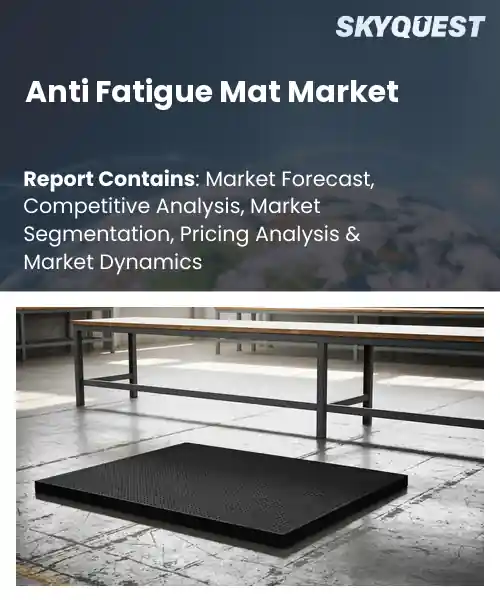
Anti Fatigue Mat Market
Report ID: SQMIG20B2214
Report ID: SQMIG20B2214
[email protected]
USA +1 351-333-4748
Report ID:
SQMIG20B2214 |
Region:
Global |
Published Date: July, 2026
Pages:
157
|Tables:
189
|Figures:
79


Global Anti Fatigue Mat Market size was valued at USD 2.1 Billion in 2024 and is poised to grow from USD 2.21 Billion in 2025 to USD 3.29 Billion by 2033, growing at a CAGR of 5.1% during the forecast period (2026-2033).
The global anti‑fatigue mat market has become a critical niche within workplace ergonomics, driven mainly by increased awareness of occupational health and the cost of employee downtime. Standing on hard surfaces for long periods causes musculoskeletal strain, prompting firms to adopt cushioning solutions. Originally limited to manufacturing floors, the market expanded as open‑plan offices, retail checkout lines, and healthcare facilities recognized the benefits. A 2018 OSHA study reported a 15 % drop in back‑pain incidents after installing polymer mats in a Texas distribution center. This shift highlights how employers now use mats to boost comfort and lower injury‑related expenses significantly overall. The principal growth catalyst for global anti‑fatigue mat market is the expanding regulatory environment that mandates ergonomic standards across sectors. When governments introduce safety guidelines, companies must comply, leading to procurement of mats to meet floor‑hardness limits and reduce worker fatigue. This regulatory pressure has spurred innovation, with manufacturers developing antimicrobial, anti‑static, and recyclable designs that address environmental concerns. A notable example is a European logistics firm that adopted reusable silicone mats after a 2022 EU directive, cutting cleaning costs by 30 % while enhancing employee satisfaction. Consequently, the market anticipates accelerated adoption worldwide, driven policy incentives and evolving workplace‑wellness strategies.
How is AI-driven ergonomics influencing the anti‑fatigue mat market?
AI‑driven ergonomics is reshaping the anti‑fatigue mat market by embedding sensors and adaptive algorithms that monitor user posture and pressure distribution. These smart mats collect real‑time data, allowing manufacturers to fine‑tune surface hardness and cushioning to reduce strain during prolonged standing. The technology also enables predictive maintenance alerts, helping facilities manage wear and replace mats before performance drops. Companies are integrating cloud analytics to offer dashboards that track employee comfort trends, turning a simple floor accessory into a data‑rich health tool. This convergence of ergonomics and AI is attracting interest from industrial, healthcare, and office sectors seeking measurable productivity gains and wellness improvements.Wearwell September 2023, launched an AI‑enabled mat line that automatically adjusts firmness based on detected posture, demonstrating how intelligent ergonomics can accelerate market growth and operational efficiency.
Market snapshot - (2026-2033)
Global Market Size
USD 2.1 Billion
Largest Segment
Foam Anti-fatigue Mats
Fastest Growth
Gel-filled Anti-fatigue Mats
Growth Rate
5.1% CAGR
To get more insights on this market click here to Request a Free Sample Report
Global anti fatigue mat market is segmented by product type, material type, application, end-use industry, distribution channel, installation type and region. Based on product type, the market is segmented into Foam Anti-fatigue Mats, Rubber Anti-fatigue Mats, Gel-filled Anti-fatigue Mats, Vinyl Anti-fatigue Mats, Polyurethane Anti-fatigue Mats, Modular Anti-fatigue Mats and Others. Based on material type, the market is segmented into Rubber, Polyurethane, PVC/Vinyl, Foam, Gel Composite and Others. Based on application, the market is segmented into Industrial Workstations, Manufacturing Facilities, Commercial Kitchens, Retail Stores, Healthcare Facilities, Laboratories, Residential Use and Others. Based on end-use industry, the market is segmented into Manufacturing, Food Service, Healthcare, Retail & Commercial, Warehousing & Logistics, Offices and Others. Based on distribution channel, the market is segmented into Direct Sales, Industrial Distributors, Specialty Flooring Retailers, E-commerce and Others. Based on installation type, the market is segmented into Loose-laid Mats, Interlocking Mats and Custom-fit Mats. Based on region, the market is segmented into North America, Europe, Asia Pacific, Latin America and Middle East & Africa.
Foam anti‑fatigue mats segment dominates because its affordable composition and ease of installation make it go‑to solution for a wide range of workplaces. The material’s resilience provides effective pressure distribution, reducing worker fatigue while standing for extended periods. Its compatibility with diverse surface types and ability to be cut to dimensions enhance versatility, prompting facility planners to favor foam mats across industrial, commercial, and residential applications, cementing its market leadership.
Meanwhile, gel‑filled anti‑fatigue mats are witnessing the strongest growth because advances in encapsulated gel technology deliver superior shock absorption and ergonomic comfort without compromising durability. These mats attract premium‑segment buyers in medical and high‑end retail settings, fueling rapid market expansion and opening new opportunities for innovative product lines today globally.
Polyurethane material segment dominates because it offers a unique blend of durability and flexibility that meets the rigorous demands of high‑traffic environments while providing superior cushioning for prolonged standing. Its resistance to chemicals, moisture, and temperature fluctuations makes it preferred in manufacturing, food service, and healthcare settings. Consequently, designers and facility managers prioritize polyurethane mats to reduce fatigue, enhance safety, and lower maintenance costs, reinforcing its market leadership overall position.
Meanwhile, gel composite material segment emerges as the fastest growing because recent innovations have produced lightweight yet highly resilient mats that absorb shock more efficiently. These products appeal to emerging ergonomic standards in retail and residential spaces, driving rapid adoption and expanding the overall market opportunity for future growth today.
To get detailed segments analysis, Request a Free Sample Report
The dominance of North America stems from a mature workplace safety culture that prioritizes ergonomic solutions across diverse sectors. Robust regulatory frameworks encourage the adoption of anti fatigue products to mitigate injury risk and enhance productivity. Companies in this region often integrate advanced material technologies and design innovations, reinforcing market leadership. A strong distribution network coupled with heightened consumer awareness drives consistent demand from both commercial and home office environments. Collaborative partnerships between manufacturers and occupational health specialists further embed anti fatigue solutions into standard workplace design, solidifying the region’s pre‑eminence.
Anti Fatigue Mat Market activity in the United States is propelled by a pervasive emphasis on employee wellness and the presence of large‑scale distribution channels. Leading manufacturers invest heavily in research to develop resilient materials that address the varied needs of industrial, commercial, and residential settings. Integration of anti fatigue solutions into corporate wellness programs enhances adoption rates, while the extensive retail presence supplies broad accessibility for end users seeking ergonomic support.
Anti Fatigue Mat Market growth in Canada benefits from progressive occupational health guidelines and widespread awareness of ergonomic best practices. The market sees active participation from domestic producers who focus on sustainable material sourcing, aligning with environmental priorities. Collaboration between health agencies and manufacturers promotes education on the benefits of anti fatigue products, encouraging adoption across manufacturing floors, retail environments, and office spaces throughout the country.
Europe’s rapid expansion is driven by stringent health and safety directives that compel businesses to adopt ergonomic solutions across the continent. The region’s strong commitment to sustainability encourages the use of eco‑friendly materials, positioning anti fatigue mats as a preferred choice for environmentally conscious firms. Growing awareness of employee well‑being, coupled with the rise of flexible work arrangements, fuels demand in both traditional industrial settings and emerging home office spaces. Collaborative innovation between European research institutions and manufacturers accelerates product development, ensuring that solutions meet high performance and regulatory standards, thereby reinforcing Europe’s competitive edge in the market.
Anti Fatigue Mat Market dynamics in Germany are shaped by a robust engineering tradition and a proactive approach to occupational health. Manufacturers leverage advanced polymer technologies to deliver durable, high‑performance solutions that cater to automotive, logistics, and office sectors. Close alignment with national safety regulations drives widespread implementation, while strong industry associations promote continuous education on ergonomic benefits, supporting sustained market growth.
Anti Fatigue Mat Market momentum in the United Kingdom is fueled by rapidly evolving workplace health initiatives and a vibrant retail ecosystem. Companies prioritize employee comfort as a strategic advantage, leading to increased incorporation of anti fatigue solutions in office refurbishments and industrial facilities. Emerging startups bring innovative designs that resonate with a market seeking both functionality and aesthetic appeal, accelerating adoption across diverse business environments.
Anti Fatigue Mat Market adoption in France is emerging alongside heightened focus on workplace ergonomics and regulatory encouragement. French manufacturers emphasize sustainable sourcing and product recyclability, aligning with broader environmental objectives. Educational campaigns by professional bodies raise awareness of the health benefits associated with anti fatigue mats, prompting gradual uptake in manufacturing plants, retail outlets, and modern office spaces across the nation.
Asia Pacific is strengthening its position through a convergence of rapid industrial expansion and growing recognition of worker health imperatives. Increasing investment in modern manufacturing facilities creates demand for ergonomic flooring solutions that mitigate fatigue and boost efficiency. Governments across the region are introducing guidelines that favor ergonomic best practices, encouraging businesses to integrate anti fatigue products. Technological advancements in material science, driven by regional research hubs, enable the production of cost‑effective yet high‑quality mats, making them accessible to a broad spectrum of enterprises. This combination of policy support, industrial growth, and innovation is elevating the Asia Pacific footprint in the global market.
Anti Fatigue Mat Market progression in Japan is anchored by a strong culture of precision and employee well‑being. Companies integrate anti fatigue solutions into high‑tech manufacturing lines and corporate office spaces, emphasizing longevity and comfort. Domestic producers focus on lightweight, moisture‑resistant materials that suit the country’s climate and space constraints, fostering widespread acceptance across diverse industry sectors.
Anti Fatigue Mat Market development in South Korea is propelled by a dynamic manufacturing sector and proactive occupational health policies. Firms adopt ergonomic flooring to support intensive production schedules and enhance worker satisfaction. Innovation centers collaborate with material suppliers to create resilient, cost‑efficient mats, facilitating rapid diffusion throughout factories, retail environments, and emerging coworking spaces.
To know more about the market opportunities by region and country, click here to
Buy The Complete Report
Increasing Workplace Ergonomics Awareness
Adoption Of Standing Desk Culture
High Initial Cost Perception
Limited Awareness Of Benefits
Request Free Customization of this report to help us to meet your business objectives.
The anti‑fatigue mat market is shaped by intense rivalry among manufacturers that are leveraging strategic M&A and distribution partnerships to broaden product portfolios and geographic reach. Recent examples include a leading rubber‑based mat producer acquiring a specialty foam specialist to integrate cushioning technologies, and another major player forming a joint venture with a workplace‑safety distributor to accelerate entry into the North‑American office segment. These moves reflect a focus on differentiated ergonomics, sustainable material sourcing, and digital‑enabled supply chains to outpace competitors.
Top Player’s Company Profile
Recent Developments
SkyQuest’s ABIRAW (Advanced Business Intelligence, Research & Analysis Wing) is our Business Information Services team that Collects, Collates, Correlates, and Analyses the Data collected by means of Primary Exploratory Research backed by robust Secondary Desk research. As per SkyQuest analysis, the global anti‑fatigue mat market is expanding at a 5.1 % CAGR, propelled primarily by growing workplace ergonomics awareness that pushes firms to invest in cushioning solutions for standing workers. A second driver is the surge in standing‑desk adoption, which creates complementary demand for mats that soften prolonged standing. North America leads the market, thanks to mature safety regulations and robust distribution channels, while foam anti‑fatigue mats retain the largest share because of their affordability and ease of installation. However, high initial cost perception remains a restraint, especially for small‑scale buyers, tempering faster penetration in cost‑sensitive segments.
| Report Metric | Details |
|---|---|
| Market size value in 2024 | USD 2.1 Billion |
| Market size value in 2033 | USD 3.29 Billion |
| Growth Rate | 5.1% |
| Base year | 2024 |
| Forecast period | (2026-2033) |
| Forecast Unit (Value) | USD Billion |
| Segments covered |
|
| Regions covered | North America (US, Canada), Europe (Germany, France, United Kingdom, Italy, Spain, Rest of Europe), Asia Pacific (China, India, Japan, Rest of Asia-Pacific), Latin America (Brazil, Rest of Latin America), Middle East & Africa (South Africa, GCC Countries, Rest of MEA) |
| Companies covered |
|
| Customization scope | Free report customization with purchase. Customization includes:-
|
To get a free trial access to our platform which is a one stop solution for all your data requirements for quicker decision making. This platform allows you to compare markets, competitors who are prominent in the market, and mega trends that are influencing the dynamics in the market. Also, get access to detailed SkyQuest exclusive matrix.
Table Of Content
Executive Summary
Market overview
Parent Market Analysis
Market overview
Market size
KEY MARKET INSIGHTS
COVID IMPACT
MARKET DYNAMICS & OUTLOOK
Market Size by Region
KEY COMPANY PROFILES
Methodology
For the Anti Fatigue Mat Market, our research methodology involved a mixture of primary and secondary data sources. Key steps involved in the research process are listed below:
1. Information Procurement: This stage involved the procurement of Market data or related information via primary and secondary sources. The various secondary sources used included various company websites, annual reports, trade databases, and paid databases such as Hoover's, Bloomberg Business, Factiva, and Avention. Our team did 45 primary interactions Globally which included several stakeholders such as manufacturers, customers, key opinion leaders, etc. Overall, information procurement was one of the most extensive stages in our research process.
2. Information Analysis: This step involved triangulation of data through bottom-up and top-down approaches to estimate and validate the total size and future estimate of the Anti Fatigue Mat Market.
3. Report Formulation: The final step entailed the placement of data points in appropriate Market spaces in an attempt to deduce viable conclusions.
4. Validation & Publishing: Validation is the most important step in the process. Validation & re-validation via an intricately designed process helped us finalize data points to be used for final calculations. The final Market estimates and forecasts were then aligned and sent to our panel of industry experts for validation of data. Once the validation was done the report was sent to our Quality Assurance team to ensure adherence to style guides, consistency & design.
Analyst Support
Customization Options
With the given market data, our dedicated team of analysts can offer you the following customization options are available for the Anti Fatigue Mat Market:
Product Analysis: Product matrix, which offers a detailed comparison of the product portfolio of companies.
Regional Analysis: Further analysis of the Anti Fatigue Mat Market for additional countries.
Competitive Analysis: Detailed analysis and profiling of additional Market players & comparative analysis of competitive products.
Go to Market Strategy: Find the high-growth channels to invest your marketing efforts and increase your customer base.
Innovation Mapping: Identify racial solutions and innovation, connected to deep ecosystems of innovators, start-ups, academics, and strategic partners.
Category Intelligence: Customized intelligence that is relevant to their supply Markets will enable them to make smarter sourcing decisions and improve their category management.
Public Company Transcript Analysis: To improve the investment performance by generating new alpha and making better-informed decisions.
Social Media Listening: To analyze the conversations and trends happening not just around your brand, but around your industry as a whole, and use those insights to make better Marketing decisions.
REQUEST FOR SAMPLE
 REQUEST FREE CUSTOMIZATION


Want to customize this report? This report can be personalized according to your needs. Our analysts and industry experts will work directly with you to understand your requirements and provide you with customized data in a short amount of time. We offer $1000 worth of FREE customization at the time of purchase.
Feedback From Our Clients


 USA (+1) 351-333-4748

