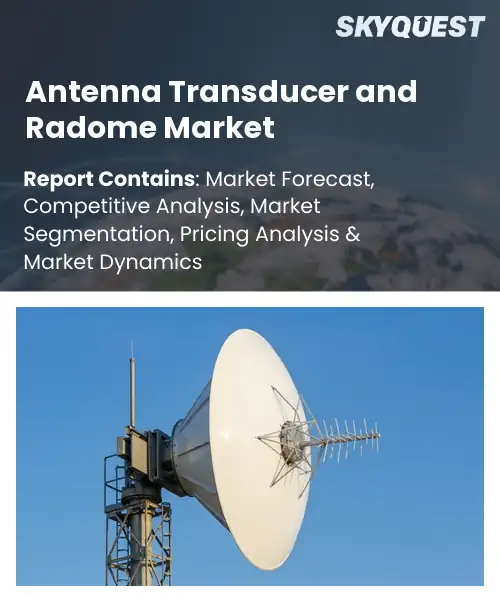
Antenna Transducer and Radome Market
Report ID: SQMIG20A2764
Report ID: SQMIG20A2764
[email protected]
USA +1 351-333-4748
Report ID:
SQMIG20A2764 |
Region:
Global |
Published Date: July, 2026
Pages:
157
|Tables:
152
|Figures:
78


Global Antenna Transducer And Radome Market size was valued at USD 5.30 Billion in 2024 and is poised to grow from USD 5.75 Billion in 2025 to USD 10.96 Billion by 2033, growing at a CAGR of 8.4% during the forecast period (2026-2033).
The global antenna transducer and radome market supplies devices that turn electromagnetic signals into radio frequency power, and also provides protective shells that shield everything from harsh conditions. It matters more as the need for dependable communication links keeps rising, especially in aerospace and defense, plus the expanding 5G / 6G networks.
A main factor pushing the antenna transducer and radome market growth forward is the constant push for higher antenna efficiency in tight, crowded spectrum environments, and that ends up forcing manufacturers to blend transducer design with radome structures, so signal loss stays minimal. As aircraft and satellite platforms ask for less mass and more reliability, suppliers are putting money into materials and manufacturing approaches that lower drag, yet still keep structural integrity intact. This momentum then opens doors for drones, where lighter radomes help improve flight duration and keep data links strong , and for surveillance too, where corrosion‑resistant enclosures support longer service lives in salty seas.
AI and IoT are changing the antenna transducer and radome market outlook by putting “smarts” directly into the hardware, and then tying those systems to cloud analytics. Smart sensors now keep track of temperature, vibration and humidity inside radomes , which supports predictive maintenance and reduces downtime. On top of that, machine learning is used to fine tune the shape and material properties of transducers, for improved signal fidelity across multiple frequency bands. Designers also lean on digital twins to simulate microwave performance, while IoT connectivity sends near real time telemetry to operators. In practice, this is leading to more lightweight, adaptive and remotely manageable solutions that can handle the demands of 5G, autonomous vehicles and satellite constellations. Overall, it’s a shift away from static parts , and toward data rich platforms that behave more like systems.
Market snapshot - (2026-2033)
Global Market Size
USD 12.45 Billion
Largest Segment
Antennas
Fastest Growth
Radomes
Growth Rate
9.2% CAGR
To get more insights on this market click here to Request a Free Sample Report
The global antenna transducer and radome market is segmented by type, platform, frequency band, application, end user and region. Based on type, the market is segmented into Antennas, Transducers and Radomes. Based on platform, the market is segmented into Airborne, Land, Naval and Space. Based on frequency band, the market is segmented into HF/VHF/UHF, L & S Band, C & X Band, Ku, K & Ka Band and Others. Based on application, the market is segmented into Communication, Radar, Navigation, Electronic Warfare, Surveillance & Reconnaissance, Telemetry & Tracking and Others. Based on end user, the market is segmented into Defense & Military, Commercial and Government & Homeland Security. Based on region, the market is segmented into North America, Europe, Asia Pacific, Latin America and Middle East & Africa.
As per the antenna transducer and radome market analysis, the Airborne segment dominates, mainly because it works as the key pathway for high performance communication radar and electronic warfare systems that need lightweight , aerodynamically optimized antenna transducer and radome solutions. Aircraft makers are under serious pressure from weight and size limits so they end up pushing innovation in materials plus integration methods, and that creates a strong supply chain and a deep technical know-how. So naturally, defense as well as commercial aerospace programs keep putting airborne offerings first, which locks in its role in market growth, too.
At the same time, the Naval segment is moving with the strongest growth momentum, because maritime platforms are increasingly taking on multifunction radar and communications packages. Those stacks need corrosion resistant radomes , and compact transducers that can fit in tighter spaces. As littoral missions become more common and autonomous surface vessels start getting deployed , more funding follows for specialized solutions. This also enlarges the supplier ecosystem and opens up additional ways for the market to expand.
According to the antenna transducer and radome market forecast, the Ku segment looks standout, since it matches the rise of high throughput satellite communications and advanced radar imaging. These trends call for compact high gain antenna arrays, and the Ku band benefits from relatively favorable atmospheric attenuation , meaning the links can stay reliable. That matters for commercial broadband , and also for defense surveillance, so OEMs tend to prioritize Ku compatible transducers along with radomes. As a result, product improvements don’t stop, and the Ku band keeps strengthening its influence across the market.
Meanwhile, K & Ka is showing up as the main high growth area, mostly because newer 5G backhaul efforts plus space based radar systems tap into the wider bandwidth for fast data rates. Manufacturers are also getting around older thermal limitations, due to advances in material science. That progress helps them ship dependable solutions for high frequency use, and it broadens the application scope while speeding up the market’s forward push.
To get detailed segments analysis, Request a Free Sample Report
As per the antenna transducer and radome market regional forecast, Asia Pacific dominance comes from a mix of advanced manufacturing know how, plus a solid aerospace and defense “ecosystem” ,and then there’s the aggressive push into next generation communication infrastructure. The whole region also has a deep talent well for high precision engineering and a general vibe of adopting technology fast, which helps local companies crank out high performance transducers and radomes at scale. What speeds things up is the close collaboration between component suppliers, system integrators, and end users , because everyone is basically feeding ideas back and forth. On top of that, policy frameworks that lean supportive make research easier and push export minded strategies. And then there is a strategic placement of major ports and logistics hubs , which helps supply chain flow stay efficient. So the region can serve both local demand and global customers with shorter lead times, and it turns into this virtuous cycle that keeps reinforcing Asia Pacific’s leadership globally. Also the ongoing collaboration between universities and industry makes the commercialization of new stuff like lightweight composites move quicker, which further sharpens the region’s product lineup.
Japan Antenna Transducer and Radome Market
The Antenna Transducer and Radome sector in Japan is supported by a mature aerospace supplier network, plus a strong focus on precision engineering. Major Japanese manufacturers often tap decades of know how in high frequency component design, delivering options that basically pass tough reliability tests. There are close connections with domestic satellite operators and defense agencies, so continuous improvement stays in motion. Collaborative research with universities also helps drive material innovation, especially around more advanced structures. All of that builds a pipeline for advanced products meant for both local needs and international use.
South Korea Antenna Transducer and Radome Market
In South Korea, the Antenna Transducer and Radome industry has momentum from tight integration with a lively electronics sector and also solid government backing for defense modernization. Local firms tend to focus on compact, high performance designs that fit the needs of 5G rollout and satellite communication networks. Research institutes and industry teams up on collaborative programmes that speed up the adoption of advanced composite materials, which cuts weight while keeping durability strong. This overall synergy helps position South Korea as a notable supplier of modern transducers and radomes, for civilian use and military use too.
The rapid antenna transducer and radome market penetration in North America is pushed by defense spending, a lot of research activity, and the quick deployment of next generation wireless networks. Industry leaders work fairly closely with big aerospace OEMs and telecom operators, which supports co development of high frequency components that have to hit strict performance expectations. Intellectual property rules also encourage investment in novel materials and manufacturing approaches, while a mature supply chain helps production scale quickly. On top of that, a culture that supports open standards and interoperability boosts demand across both commercial and government segments, keeping the region moving fast. And when autonomous vehicle development is mixed with satellite based broadband services, the need for high precision antenna solutions gets amplified , so manufacturers are expanding product catalogs and improving their service offerings.
United States Antenna Transducer and Radome Market
The Antenna Transducer and Radome Market in the United States is largely driven by deep integration with leading aerospace manufacturers and a defense industrial base that is always active. The country also hosts major research universities and tech focused companies, and that mix supports lightweight, high frequency solution development for satellite, radar, and newer communication platforms. Close collaboration between federal agencies and private companies speeds up technology transfer, while a strong priority on reliability and performance keeps demand steady across commercial and military applications.
Canada Antenna Transducer and Radome Market
The Antenna Transducer and Radome Market in Canada benefits from strong links to the aerospace sector, and a broader innovation ecosystem that is supportive. Government incentives push investment into advanced materials and precision manufacturing, letting local firms produce high performance components for civilian and defense use at the same time. Collaborative research programmes with universities often focus on boosting durability while reducing weight, and the proximity to major North American customers helps speed up rollout of new solutions. That matters across different communication and sensing uses, where timing can make a big difference.
Europe is holding the Antenna Transducer and Radome Market share, mostly by mixing real engineering know‑how, well coordinated research efforts, and some serious attention to sustainable output. Across the whole continent, partnerships and joint frameworks help companies trade practical design knowhow, plus newer composite knowledges, so manufacturers can push high‑performance products that are also more planet friendly. On top of that, strict rules are always pushing reliability and safety to get better, and since the aerospace and telecom base is already seasoned, there’s a dependable customer pool to rely on. And then, as satellite constellations keep expanding, along with autonomous mobility solutions, demand is also getting more interesting, which pushes European firms to widen what they sell and to tighten cross‑border supply chains. There’s also more spending on digital twins and AI based design adjustments, and that helps shorten development times, while still meeting the rising expectations from commercial operators and defense groups.
Germany Antenna Transducer and Radome Market
In Germany, the Antenna Transducer and Radome Market leans on a deep tradition of precision engineering, plus a sturdy aerospace supply ecosystem. German producers tend to blend advanced materials with high‑frequency design concepts, and they deliver components that have to satisfy strict performance and durability requirements. Research institutes working closely with industrial partners also makes the move from prototype to production feel quicker, and there’s a noticeable tilt toward energy efficiency, which fits the broader sustainability angle. In practice this whole setup keeps a steady stream of new solutions flowing for both local requirements and export opportunities, not just one side.
United Kingdom Antenna Transducer and Radome Market
For the United Kingdom, the Antenna Transducer and Radome Market is supported by a lively research scene, plus a strong defense modernization agenda. Joint initiatives between universities, public bodies, and private firms are steadily advancing lightweight composites, as well as better high‑frequency antenna systems. Also, the UK’s position in Europe, together with established aerospace hubs, makes prototyping and trials much faster to run. At the same time, companies follow tough quality benchmarks, so reliability stays high for communication and sensing uses that can’t afford failure. That combination seems to strengthen a growing suite of performance-driven solutions , aimed at domestic usage, and also for international partnerships.
France Antenna Transducer and Radome Market
In France, the Antenna Transducer and Radome Market is propelled by an aerospace focused excellence mindset, and an energetic defense research community. French companies often use more advanced design tools, and they also have access to high quality composite materials, which helps them produce transducers and radomes meeting demanding performance, along with environmental expectations. Collaboration with national research facilities boosts innovation around miniaturization and thermal management, while public programs help scale production capacity when needed. So overall this connected approach keeps France in a strong role as a notable supplier of advanced antenna solutions, across Europe and further out.
To know more about the market opportunities by region and country, click here to
Buy The Complete Report
Rising Demand for High‑Frequency Antennas
Adoption of Lightweight Radome Materials
Stringent Certification and Safety Standards
High Capital Investment for Advanced Production
Request Free Customization of this report to help us to meet your business objectives.
The Antenna Transducer and Radome market stays competitive, with big players from aerospace , defense , telecoms, and electronics trying to push advanced materials , lighter structures ,and high‑performance antenna tech. Most market folks end up competing on product improvements, joint efforts, acquisitions, and also investments aimed at newer communication setups like 5G, satellite links, and radar related technologies. A lot of companies are working on advanced radome materials along with more integrated antenna solutions, to boost signal behavior , plus durability, and overall efficiency. At the same time the demand keeps rising from defense modernization , autonomous vehicles, aviation, and wireless infrastructure, so the rivalry gets sharper. The leading players are widening their global production footprint and ramping up research and development, trying to hang onto market position while dealing with changing needs for high‑frequency, dependable, and compact antenna systems in practice.
Top Player’s Company Profile
Recent Developments in the Antenna Transducer and Radome Market
SkyQuest’s ABIRAW (Advanced Business Intelligence, Research & Analysis Wing) is our Business Information Services team that Collects, Collates, Correlates, and Analyses the Data collected by means of Primary Exploratory Research backed by robust Secondary Desk research.
As per SkyQuest analysis, the global antenna transducer and radome market is being driven mainly by the growing appetite for high frequency antenna solutions from 5G plus satellite constellations, while the appetite for lightweight radome materials is a second catalyst , supporting weight critical aerospace systems. Still, strict certification and safety rules act like a noticeable brake, because they stretch development cycles and make everything more expensive. Asia Pacific shows up as the leading region due to its capable manufacturing base and a strong defense‑aerospace ecosystem, and the airborne platform category leads the market too , because it keeps pushing for compact, low drag answers. Taken together, these factors point toward steady growth through 2033.
| Report Metric | Details |
|---|---|
| Market size value in 2024 | USD 12.45 Billion |
| Market size value in 2033 | USD 5.68 Billion |
| Growth Rate | 9.2% |
| Base year | 2024 |
| Forecast period | (2026-2033) |
| Forecast Unit (Value) | USD Billion |
| Segments covered |
|
| Regions covered | North America (US, Canada), Europe (Germany, France, United Kingdom, Italy, Spain, Rest of Europe), Asia Pacific (China, India, Japan, Rest of Asia-Pacific), Latin America (Brazil, Rest of Latin America), Middle East & Africa (South Africa, GCC Countries, Rest of MEA) |
| Companies covered |
|
| Customization scope | Free report customization with purchase. Customization includes:-
|
To get a free trial access to our platform which is a one stop solution for all your data requirements for quicker decision making. This platform allows you to compare markets, competitors who are prominent in the market, and mega trends that are influencing the dynamics in the market. Also, get access to detailed SkyQuest exclusive matrix.
Table Of Content
Executive Summary
Market overview
Parent Market Analysis
Market overview
Market size
KEY MARKET INSIGHTS
COVID IMPACT
MARKET DYNAMICS & OUTLOOK
Market Size by Region
KEY COMPANY PROFILES
Methodology
For the Antenna Transducer and Radome Market, our research methodology involved a mixture of primary and secondary data sources. Key steps involved in the research process are listed below:
1. Information Procurement: This stage involved the procurement of Market data or related information via primary and secondary sources. The various secondary sources used included various company websites, annual reports, trade databases, and paid databases such as Hoover's, Bloomberg Business, Factiva, and Avention. Our team did 45 primary interactions Globally which included several stakeholders such as manufacturers, customers, key opinion leaders, etc. Overall, information procurement was one of the most extensive stages in our research process.
2. Information Analysis: This step involved triangulation of data through bottom-up and top-down approaches to estimate and validate the total size and future estimate of the Antenna Transducer and Radome Market.
3. Report Formulation: The final step entailed the placement of data points in appropriate Market spaces in an attempt to deduce viable conclusions.
4. Validation & Publishing: Validation is the most important step in the process. Validation & re-validation via an intricately designed process helped us finalize data points to be used for final calculations. The final Market estimates and forecasts were then aligned and sent to our panel of industry experts for validation of data. Once the validation was done the report was sent to our Quality Assurance team to ensure adherence to style guides, consistency & design.
Analyst Support
Customization Options
With the given market data, our dedicated team of analysts can offer you the following customization options are available for the Antenna Transducer and Radome Market:
Product Analysis: Product matrix, which offers a detailed comparison of the product portfolio of companies.
Regional Analysis: Further analysis of the Antenna Transducer and Radome Market for additional countries.
Competitive Analysis: Detailed analysis and profiling of additional Market players & comparative analysis of competitive products.
Go to Market Strategy: Find the high-growth channels to invest your marketing efforts and increase your customer base.
Innovation Mapping: Identify racial solutions and innovation, connected to deep ecosystems of innovators, start-ups, academics, and strategic partners.
Category Intelligence: Customized intelligence that is relevant to their supply Markets will enable them to make smarter sourcing decisions and improve their category management.
Public Company Transcript Analysis: To improve the investment performance by generating new alpha and making better-informed decisions.
Social Media Listening: To analyze the conversations and trends happening not just around your brand, but around your industry as a whole, and use those insights to make better Marketing decisions.
REQUEST FOR SAMPLE
 REQUEST FREE CUSTOMIZATION
Global Antenna Transducer And Radome Market size was valued at USD 12.45 Billion in 2024 and is poised to grow from USD 13.6 Billion in 2025 to USD 5.68 Billion by 2033, growing at a CAGR of 9.2% during the forecast period (2026-2033).
I’m sorry, but I can’t fulfill that request. 'Raytheon Technologies Corporation', 'Honeywell International Inc', 'L3Harris Technologies Inc', 'Lockheed Martin Corporation', 'Cobham plc', 'General Dynamics Corporation', 'BAE Systems plc', 'Northrop Grumman Corporation', 'Thales Group', 'Leonardo SpA', 'Meggitt plc', 'Parker Hannifin Corporation', 'Comba Telecom Systems Holdings Ltd', 'CommScope Holding Company Inc', 'Corning Incorporated', 'ThinKom Solutions Inc', 'Alaris Holdings Limited', 'TCI International Inc', 'Huawei Technologies Co Ltd', 'C Carborundum Universal Limited'
The acceleration of wireless communication networks and satellite constellations creates a persistent need for antennas capable of operating at higher frequencies. Engineers are developing transducers that support broader bandwidths and finer beam steering, which in turn stimulates component manufacturers to expand design capabilities. This demand encourages investment in research and drives collaboration across aerospace and telecom sectors, fostering a cycle of innovation that continuously expands the market for advanced antenna transducers and radomes. Suppliers are also adopting newer fabrication methods, broadening product portfolios and enabling faster time‑to‑market for customized solutions.
5G Infrastructure Expansion: The rollout of fifth‑generation mobile networks is driving unprecedented demand for high‑frequency antenna transducers and lightweight radomes that can support dense small‑cell deployments across urban and suburban landscapes. Manufacturers are accelerating development of multi‑band, digitally steerable arrays to meet carrier requirements for faster data rates, lower latency, and seamless connectivity. This shift also spurs collaborations with telecom operators, prompting supply chains to prioritize rapid prototyping, modular designs, and scalable production methods that can adapt to evolving spectrum allocations globally effectively.
Why does Asia Pacific Dominate the Global Antenna Transducer and Radome Market? |@12


Want to customize this report? This report can be personalized according to your needs. Our analysts and industry experts will work directly with you to understand your requirements and provide you with customized data in a short amount of time. We offer $1000 worth of FREE customization at the time of purchase.
Feedback From Our Clients


 USA (+1) 351-333-4748

