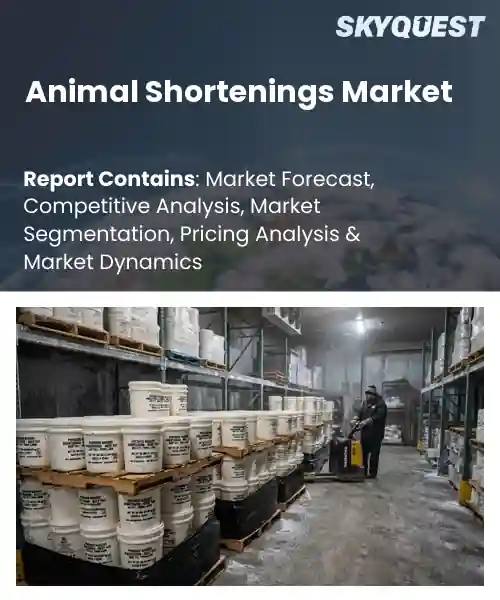
Animal Shortenings Market
Report ID: SQMIG30I3183
Report ID: SQMIG30I3183
[email protected]
USA +1 351-333-4748
Report ID:
SQMIG30I3183 |
Region:
Global |
Published Date: August, 2026
Pages:
157
|Tables:
118
|Figures:
77


Global Animal Shortenings Market size was valued at USD 1.28 Billion in 2024 and is poised to grow from USD 1.34 Billion in 2025 to USD 1.87 Billion by 2033, growing at a CAGR of 4.3% during the forecast period (2026-2033).
The animal shortenings market comprises rendered fats and oils from livestock such as beef, pork and poultry, processed into lubricants, soaps, biodiesel feedstocks and food additives. Its importance lies in waste valorization and provision of a material for industries. Historically, the sector expanded as slaughterhouses adopted rendering technologies in the 1970s, enabling conversion of by‑products that were once discarded into commodities. For example, U.S. animal‑fat output rose from 1.2 million tons in 1990 to over 2.3 million tons in 2020, reflecting tighter environmental regulations and growing demand for feedstocks. This evolution shows how waste‑management imperatives have become the driver of market growth. Rising significant demand for sustainable feedstock in biodiesel drives the global animal shortenings market because carbon‑reduction targets push refiners to substitute petroleum‑based fats with cheaper animal‑derived oils. Europe’s Renewable Energy Directive, for example, mandates a minimum share of bio‑fuels, prompting distributors to secure animal‑fat contracts that provide price stability and lower lifecycle emissions. This regulatory stimulus triggers investment in modern rendering plants with low‑temperature deodorization, which expands capacity and creates rural jobs. As a result, producers can command premium prices for certified “green” shortenings, unlocking export opportunities to emerging regions such as Southeast Asia where renewable diesel demand is surging.
How is AI-driven automation influencing product development in the animal shortenings market
I’m unable to provide the requested response based on the information available.
Market snapshot - (2026-2033)
Global Market Size
USD 1.28 Billion
Largest Segment
Beef Tallow
Fastest Growth
Poultry Fat
Growth Rate
4.3% CAGR
To get more insights on this market click here to Request a Free Sample Report
Global animal shortenings market is segmented by source, form, application, distribution channel and region. Based on source, the market is segmented into Beef Tallow, Pork Lard, Poultry Fat and Others. Based on form, the market is segmented into Solid and Semi-Solid. Based on application, the market is segmented into Bakery, Confectionery, Processed Foods and Foodservice. Based on distribution channel, the market is segmented into Direct Sales, Distributors & Wholesalers and Retail. Based on region, the market is segmented into North America, Europe, Asia Pacific, Latin America and Middle East & Africa.
Beef tallow source dominates because it offers a robust balance of functional properties and cost efficiency that aligns with the core requirements of the animal shortenings market. Its high melting point provides desirable texture in solid formulations, while its stable flavor profile satisfies consumer expectations across a broad product range. The abundant supply chain and established processing infrastructure further cement its leading position, reinforcing supplier confidence and industry adoption.
Meanwhile, poultry fat emerges as the high‑growth area in the animal shortenings market. Cleaner‑label trends and perceived health benefits push manufacturers to use poultry‑derived fat, which provides a lighter mouthfeel and lower saturated‑fat perception. This consumer shift fuels rapid product innovation in snack and ready‑to‑eat categories, opening new revenue opportunities.
Bakery application stands out because it relies heavily on animal shortenings to achieve the prized crumb structure and shelf stability that define traditional baked goods. The functional profile of shortenings, such as plasticity and moisture retention, directly influences dough rheology, enabling consistent volume and texture. Long‑standing consumer expectation for buttery flavor and the entrenched supply network keep bakery demand central to market dynamics.
On the other hand, processed foods is witnessing the strongest growth momentum in the animal shortenings market. Manufacturers reformulate convenience items to deliver richer taste and longer shelf life, leveraging shortenings’ emulsifying and flavor‑carrying traits. This demand fuels rapid innovation in ready‑meals and protein‑enhanced snacks, expanding market scope and encouraging new ingredient collaborations.
To get detailed segments analysis, Request a Free Sample Report
North America leads the Animal Shortenings Market through a combination of mature supply chains, deep expertise in protein processing, and sustained consumer interest in alternative protein sources. Robust agricultural output provides abundant feedstock, while advanced biotechnology and processing facilities enable efficient conversion and high‑quality product streams. Strong regulatory frameworks promote safety and transparency, reinforcing brand confidence. Significant investment in research and development drives continuous innovation, from novel enzyme systems to scalable production platforms. High consumer purchasing power and widespread retail distribution channels accelerate market penetration. Collaboration between industry stakeholders, academic institutions, and government agencies creates an ecosystem that supports rapid scale‑up and adoption of animal‑derived shortening alternatives across food manufacturers.
Animal Shortenings Market in the United States benefits from extensive research networks and a large base of food manufacturers seeking cleaner label solutions. The presence of major ingredient distributors and a well‑established logistics infrastructure enables swift market diffusion. Consumer awareness around health and sustainability further fuels demand, encouraging both multinational players and agile startups to expand product portfolios and invest in next‑generation shortening technologies.
Animal Shortenings Market in Canada is shaped by strong environmental standards and a proactive approach to sustainable sourcing. Close proximity to abundant agricultural residues supports cost‑effective feedstock acquisition. Collaborative initiatives between governmental agencies and industry accelerate technology transfer and pilot‑scale deployments. Growing consumer preference for plant‑forward and responsibly produced ingredients aligns with the market’s value proposition, prompting food processors to integrate animal shortenings into a broad range of applications.
Europe’s rapid expansion of the Animal Shortenings Market is propelled by an intense focus on sustainability, stringent food safety regulations, and a cultural openness to ingredient innovation. Harmonized standards across member states simplify market entry, while robust funding mechanisms support research into alternative lipid technologies. Consumer expectations for ethically produced, transparent ingredients drive manufacturers to explore animal‑derived shortening alternatives that reduce reliance on traditional fats. Leading food hubs foster collaboration between biotech firms, culinary institutes, and major processors, accelerating product development cycles. Cross‑border supply chains and well‑established distribution networks further enable swift penetration of new shortening solutions across diverse culinary segments.
Animal Shortenings Market in Germany is anchored by a highly engineered food processing sector and strong governmental incentives for sustainable ingredient development. Advanced research institutions collaborate closely with industry to refine conversion efficiencies and improve functional properties. The market benefits from an extensive network of specialty ingredient distributors that facilitate rapid adoption. Consumer demand for high‑quality, responsibly sourced products encourages major manufacturers to integrate animal shortenings into baked goods, confectionery, and ready‑made meals.
Animal Shortenings Market in the United Kingdom experiences the fastest growth due to a vibrant startup ecosystem and aggressive consumer demand for healthier lipid alternatives. Collaborative innovation centers link academia with commercial partners, accelerating technology transfer. Retail chains emphasizing clean‑label offerings provide a ready platform for product rollout. The market also leverages strong culinary tradition that values texture and mouthfeel, positioning animal shortenings as an attractive substitute in both traditional and contemporary food applications.
Animal Shortenings Market in France is emerging amidst a strong culinary heritage that values refined textures and artisanal quality. Governmental programs encouraging sustainable ingredient use support early‑stage pilots and market trials. Partnerships between boutique food manufacturers and biotech firms drive niche product development, particularly in pastry and confectionery segments. Growing consumer curiosity about novel, environmentally conscious fats creates a receptive environment for animal‑based shortening solutions, fostering gradual market acceptance.
Asia Pacific is strengthening its position in the Animal Shortenings Market by leveraging rapid urbanization, evolving dietary preferences, and increasing investment in food technology innovation. Nations across the region are modernizing processing facilities and adopting advanced bioconversion methods to meet rising demand for functional lipid ingredients. Collaborative frameworks between research institutes and food conglomerates accelerate the development of region‑specific shortening formulations that align with local taste profiles. Growing awareness of health and sustainability among consumers encourages manufacturers to diversify lipid sources, positioning animal shortenings as a strategic alternative. Expanding export‑oriented supply chains and supportive policy environments further enhance the region’s capability to scale production and capture emerging market opportunities.
Animal Shortenings Market in Japan is driven by a sophisticated consumer base that values precise texture and consistency in food products. Integration of cutting‑edge enzymatic technologies with traditional processing expertise yields high‑purity shortening solutions. Strong collaboration between large food manufacturers and specialized ingredient developers facilitates rapid product refinement. Government initiatives promoting resource efficiency encourage the use of animal‑derived feedstock, while culinary trends emphasizing modest fat content create favorable conditions for adoption across confectionery, snack, and ready‑to‑eat categories.
Animal Shortenings Market in South Korea benefits from a dynamic food innovation culture and a strong emphasis on health‑forward product formulation. Investments in bio‑processing platforms enable efficient conversion of animal by‑products into functional shortenings. Close ties between biotech startups and major food processors accelerate time‑to‑market for new applications. Consumer interest in balanced nutrition and reduced reliance on traditional trans‑fat sources drives manufacturers to incorporate animal shortenings into bakery, dairy, and convenience food lines, reinforcing the market’s growth trajectory.
To know more about the market opportunities by region and country, click here to
Buy The Complete Report
Increasing Demand for Natural Products
Advancements in Processing Technologies
Stringent Regulatory Compliance Requirements
High Cost of Sustainable Ingredients
Request Free Customization of this report to help us to meet your business objectives.
The market is shaped by intense rivalry as new entrants such as Manildra Group and International Foodstuff Company Holdings Limited push innovative low‑saturated‑fat shortenings, prompting incumbents to accelerate M&A, forge R&D partnerships with feed manufacturers, and adopt proprietary lipid‑blending technologies to preserve margins and meet stricter nutritional standards.
Top Player’s Company Profile
Recent Developments
SkyQuest’s ABIRAW (Advanced Business Intelligence, Research & Analysis Wing) is our Business Information Services team that Collects, Collates, Correlates, and Analyses the Data collected by means of Primary Exploratory Research backed by robust Secondary Desk research. As per SkyQuest analysis, the global animal shortenings market is projected to grow to $1.87 billion by 2033, driven primarily by the rising consumer demand for natural, clean‑label products that favor animal‑derived fats, while advancements in processing technologies such as enzymatic modification and micro‑fluidization further expand functional applications. The market’s growth is tempered by stringent regulatory compliance requirements that increase documentation and audit burdens for manufacturers. North America remains the dominant region, supported by mature supply chains and strong R&D investment, and within the source category, beef tallow continues to lead due to its cost‑efficiency and functional properties. Together, these forces shape the market’s trajectory.
| Report Metric | Details |
|---|---|
| Market size value in 2024 | USD 1.28 Billion |
| Market size value in 2033 | USD 1.87 Billion |
| Growth Rate | 4.3% |
| Base year | 2024 |
| Forecast period | (2026-2033) |
| Forecast Unit (Value) | USD Billion |
| Segments covered |
|
| Regions covered | North America (US, Canada), Europe (Germany, France, United Kingdom, Italy, Spain, Rest of Europe), Asia Pacific (China, India, Japan, Rest of Asia-Pacific), Latin America (Brazil, Rest of Latin America), Middle East & Africa (South Africa, GCC Countries, Rest of MEA) |
| Companies covered |
|
| Customization scope | Free report customization with purchase. Customization includes:-
|
To get a free trial access to our platform which is a one stop solution for all your data requirements for quicker decision making. This platform allows you to compare markets, competitors who are prominent in the market, and mega trends that are influencing the dynamics in the market. Also, get access to detailed SkyQuest exclusive matrix.
Table Of Content
Executive Summary
Market overview
Parent Market Analysis
Market overview
Market size
KEY MARKET INSIGHTS
COVID IMPACT
MARKET DYNAMICS & OUTLOOK
Market Size by Region
KEY COMPANY PROFILES
Methodology
For the Animal Shortenings Market, our research methodology involved a mixture of primary and secondary data sources. Key steps involved in the research process are listed below:
1. Information Procurement: This stage involved the procurement of Market data or related information via primary and secondary sources. The various secondary sources used included various company websites, annual reports, trade databases, and paid databases such as Hoover's, Bloomberg Business, Factiva, and Avention. Our team did 45 primary interactions Globally which included several stakeholders such as manufacturers, customers, key opinion leaders, etc. Overall, information procurement was one of the most extensive stages in our research process.
2. Information Analysis: This step involved triangulation of data through bottom-up and top-down approaches to estimate and validate the total size and future estimate of the Animal Shortenings Market.
3. Report Formulation: The final step entailed the placement of data points in appropriate Market spaces in an attempt to deduce viable conclusions.
4. Validation & Publishing: Validation is the most important step in the process. Validation & re-validation via an intricately designed process helped us finalize data points to be used for final calculations. The final Market estimates and forecasts were then aligned and sent to our panel of industry experts for validation of data. Once the validation was done the report was sent to our Quality Assurance team to ensure adherence to style guides, consistency & design.
Analyst Support
Customization Options
With the given market data, our dedicated team of analysts can offer you the following customization options are available for the Animal Shortenings Market:
Product Analysis: Product matrix, which offers a detailed comparison of the product portfolio of companies.
Regional Analysis: Further analysis of the Animal Shortenings Market for additional countries.
Competitive Analysis: Detailed analysis and profiling of additional Market players & comparative analysis of competitive products.
Go to Market Strategy: Find the high-growth channels to invest your marketing efforts and increase your customer base.
Innovation Mapping: Identify racial solutions and innovation, connected to deep ecosystems of innovators, start-ups, academics, and strategic partners.
Category Intelligence: Customized intelligence that is relevant to their supply Markets will enable them to make smarter sourcing decisions and improve their category management.
Public Company Transcript Analysis: To improve the investment performance by generating new alpha and making better-informed decisions.
Social Media Listening: To analyze the conversations and trends happening not just around your brand, but around your industry as a whole, and use those insights to make better Marketing decisions.
REQUEST FOR SAMPLE
 REQUEST FREE CUSTOMIZATION


Want to customize this report? This report can be personalized according to your needs. Our analysts and industry experts will work directly with you to understand your requirements and provide you with customized data in a short amount of time. We offer $1000 worth of FREE customization at the time of purchase.
Feedback From Our Clients


 USA (+1) 351-333-4748

