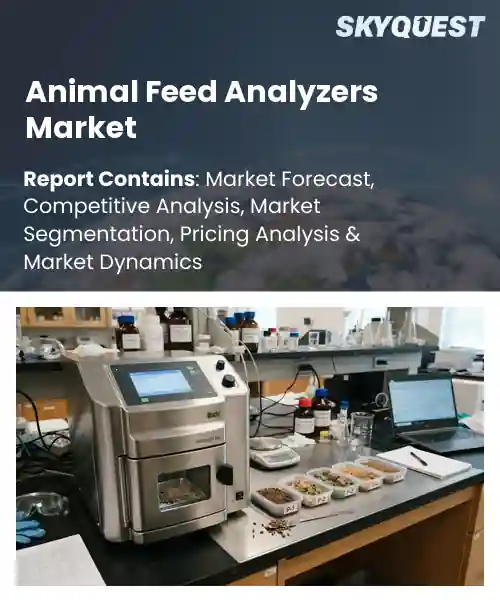
Animal Feed Analyzers Market
Report ID: SQMIG45J2867
Report ID: SQMIG45J2867
[email protected]
USA +1 351-333-4748
Report ID:
SQMIG45J2867 |
Region:
Global |
Published Date: August, 2026
Pages:
157
|Tables:
146
|Figures:
78


Global Animal Feed Analyzers Market size was valued at USD 492.8 Million in 2024 and is poised to grow from USD 525.32 Million in 2025 to USD 875.97 Million by 2033, growing at a CAGR of 6.6% during the forecast period (2026-2033).
The global animal feed analyzer market comprises hardware and software solutions that quantify nutrient composition of feedstuffs in real time, enabling producers to adjust formulations for optimal animal performance. Its importance stems from rising demand for protein‑rich foods, tighter regulatory scrutiny on feed safety, and the need to reduce feed waste. Historically the market was dominated by laboratory‑based wet chemistry, but advances in near‑infrared spectroscopy and IoT connectivity have shifted the industry toward on‑site, rapid testing. For example, a Brazilian poultry integrator adopted handheld NIR devices in 2022, cutting formulation errors by 15 percent and improving feed conversion ratios overall significantly. Building on this shift, the growth catalyst for the animal feed analyzer market is integration of data analytics with nutrition strategies, which transforms raw measurement into actionable insight. When farms connect analyzers to cloud platforms, they can adjust rations in response to animal growth metrics, thereby lowering feed costs and minimizing nitrogen excretion. A dairy cooperative in the Netherlands demonstrated a 12 percent reduction in milk‑production expenses after linking NIR data with herd‑management software. Consequently, equipment manufacturers are expanding service models to include subscription‑based calibration and AI‑driven recommendation engines, creating recurring revenue streams while fostering wider adoption across emerging markets.
How is AI transforming the animal feed analyzers market?
AI is reshaping animal feed analyzers by embedding machine‑learning models that interpret spectroscopic data in real time, enabling precise nutrient breakdown without extensive lab work. Sensors now capture moisture, protein and fiber levels, while cloud‑based algorithms compare results against optimal feed formulas, guiding producers toward consistent animal health outcomes. The technology reduces reliance on skilled technicians, shortens turnaround from sampling to decision, and integrates with farm management platforms for seamless data flow. As producers seek higher efficiency and sustainability, AI‑driven analyzers become central to meeting quality standards while lowering operational costs, making the market more dynamic and responsive to evolving nutritional demands.In June 2024, an AI‑enhanced feed analyzer was launched, cutting manual testing time and sharpening nutrient profiling, which accelerates formulation decisions and fuels market growth.
Market snapshot - (2026-2033)
Global Market Size
USD 492.8 Million
Largest Segment
Near-Infrared Analyzers
Fastest Growth
XRF Analyzers
Growth Rate
6.6% CAGR
To get more insights on this market click here to Request a Free Sample Report
Global animal feed analyzers market is segmented by analyzer type, parameter, application, end user, operation and region. Based on analyzer type, the market is segmented into Near-Infrared Analyzers, XRF Analyzers, Moisture Analyzers and Protein & Fat Analyzers. Based on parameter, the market is segmented into Protein, Moisture, Fat, Fiber and Ash. Based on application, the market is segmented into Feed Manufacturing, Livestock Farms and Research Laboratories. Based on end user, the market is segmented into Feed Manufacturers, Testing Laboratories and Research Institutes. Based on operation, the market is segmented into Benchtop and Portable. Based on region, the market is segmented into North America, Europe, Asia Pacific, Latin America and Middle East & Africa.
Near-Infrared Analyzers segment dominates because it delivers rapid, non destructive analysis of multiple nutrients, enabling feed manufacturers to adjust formulations in real time. The technology’s ability to provide accurate protein, moisture, and fat readings without sample preparation reduces labor costs and improves throughput. Consequently, producers favor these systems to meet tight production schedules and quality assurance requirements, reinforcing their leadership in the animal feed analyzers market.
However, XRF Analyzers are witnessing the strongest growth momentum as they enable precise mineral and ash profiling, which is increasingly demanded for regulatory compliance and feed safety. Innovations in portable X ray technology and expanding use in trace element monitoring are accelerating adoption, creating new opportunities for market expansion.
Protein segment dominates because protein content is the primary driver of animal growth performance and feed efficiency, making it the most critical quality attribute for manufacturers. Accurate protein measurement guides formulation decisions, supports nutritional labeling, and ensures compliance with industry standards, prompting extensive investment in reliable protein analysis technologies across the market. The high stakes associated with animal health and productivity drive continuous demand for precise protein testing, reinforcing its leading position.
Meanwhile, Fiber parameter is emerging as the key high growth area as producers seek to improve gut health and feed digestibility. Growing research on functional feeds and consumer demand for sustainable animal products are prompting increased fiber analysis, spurring innovation in assay methods and expanding market opportunities for fiber measurement solutions.
To get detailed segments analysis, Request a Free Sample Report
Asia Pacific leverages a confluence of expansive livestock production, rapidly modernizing agricultural practices, and strong governmental emphasis on food security. The region benefits from a large base of poultry and aquaculture operations that demand precise nutrition management, prompting early adoption of advanced analytical technologies. Robust R&D ecosystems in Japan and South Korea drive continuous innovation, delivering highly accurate, user‑friendly instruments that meet stringent quality standards. Moreover, collaborative initiatives between feed manufacturers and technology providers accelerate integration of automation and data‑driven decision making. The combined effect of market scale, technological leadership, and policy support creates a self‑reinforcing cycle that sustains the region’s pre‑eminence in the global animal feed analyzer landscape.
Animal Feed Analyzers Market in Japan is propelled by a sophisticated feed industry that prioritizes premium quality and traceability. Manufacturers invest heavily in precision instrumentation to align with rigorous safety regulations and consumer expectations for high‑value protein sources. Integration of digital connectivity within analytical devices enables real‑time monitoring, supporting efficient formulation and waste reduction. Collaborative research between academic institutions and equipment vendors further reinforces Japan’s reputation for cutting‑edge sensor technology, fostering a market environment where advanced analytics become a standard operational component.
Animal Feed Analyzers Market in South Korea reflects a dynamic blend of high‑tech manufacturing expertise and a growing demand for efficient livestock production. Government incentives encourage adoption of smart farming solutions, positioning analyzers as essential tools for optimizing feed efficiency and environmental compliance. Local firms specialize in compact, robust devices suited for both large‑scale operations and emerging smallholder farms. Emphasis on data integration and predictive analytics drives continuous improvement in feed formulation, reinforcing South Korea’s role as an innovative hub within the broader Asia Pacific ecosystem.
North America experiences vigorous expansion due to heightened focus on sustainable feed utilization and stringent nutritional standards across livestock sectors. Producers increasingly rely on real‑time compositional data to enhance feed conversion rates, reduce waste, and meet regulatory expectations for animal welfare and environmental impact. Strong investment in automation and precision agriculture is complemented by a collaborative ecosystem of feed processors, technology providers, and research institutions that accelerate product development. Consumer demand for responsibly produced protein further compels feed manufacturers to adopt advanced analytical solutions, ensuring consistency and traceability. The convergence of innovation, regulatory pressure, and market demand creates a fertile environment for rapid growth of animal feed analyzer adoption throughout the region.
Animal Feed Analyzers Market in the United States is shaped by extensive commercial livestock operations that demand high‑throughput, accurate analysis to sustain competitiveness. Emphasis on cost efficiency drives integration of automated sampling and cloud‑based data platforms, allowing producers to adjust formulations swiftly. Partnerships between major feed companies and instrumentation firms foster continuous improvement in sensor precision and user experience. Additionally, strong research funding supports development of next‑generation spectroscopy and imaging techniques, reinforcing the United States’ position as a leading adopter of advanced feed analytics.
Animal Feed Analyzers Market in Canada benefits from a blend of large‑scale grain production and a diverse livestock sector that values precise nutrient management. Federal programs encouraging technological adoption in agriculture promote the deployment of sophisticated analyzers across dairy, poultry, and beef farms. Emphasis on environmental stewardship motivates producers to leverage accurate feed composition data for reducing emissions and optimizing feed efficiency. Collaborative networks among universities, equipment manufacturers, and farmer associations drive localized innovation, ensuring that Canadian operations remain at the forefront of feed analysis best practices.
Europe consolidates its market position through a strategic focus on regulatory compliance, sustainability, and collaborative research across member states. Stringent feed safety directives compel manufacturers to adopt high‑resolution analytical tools that guarantee consistent quality and traceability. The region’s mature agri‑technology sector benefits from strong public‑private partnerships, fostering the development of modular, low‑energy analyzers that align with environmental targets. Cross‑border initiatives and harmonized standards enable seamless technology transfer, while an emphasis on digital integration and predictive modeling enhances feed formulation efficiency. By weaving together policy support, innovative engineering, and a unified market approach, Europe reinforces its role as a sophisticated and resilient hub for animal feed analyzer advancement.
Animal Feed Analyzers Market in Germany is driven by a robust industrial base that emphasizes precision engineering and rigorous quality assurance. Feed producers adopt sophisticated spectroscopy solutions to meet exacting European safety standards and to support high‑value animal protein sectors such as swine and poultry. Strong collaboration between technical universities and equipment manufacturers accelerates the rollout of AI‑enhanced analytical platforms, enabling predictive adjustments in feed recipes. Sustainability initiatives further motivate German operators to leverage accurate nutrient data for minimizing waste and reducing the carbon footprint of feed production.
Animal Feed Analyzers Market in the United Kingdom reflects a keen interest in leveraging data‑driven insights to improve feed efficiency and animal health. Post‑Brexit regulatory adaptations encourage producers to adopt advanced analytical devices that ensure compliance with both domestic and export requirements. Integration of cloud‑enabled sensors supports real‑time monitoring across diverse farming operations, from intensive livestock units to emerging free‑range enterprises. Collaborative research programs between agritech startups and academic institutions foster rapid prototyping of portable, user‑friendly analyzers tailored to the UK market.
Animal Feed Analyzers Market in France is closely linked to a strong tradition of agricultural innovation and a vibrant dairy and pork industry. National quality standards propel feed manufacturers to implement high‑accuracy instruments that guarantee consistent nutrient profiles. Government incentives for digital agriculture encourage the deployment of connected analytical systems that streamline formulation processes. Partnerships with research centers focus on developing environmentally benign technologies, reinforcing France’s commitment to sustainable feed production while enhancing overall industry competitiveness.
To know more about the market opportunities by region and country, click here to
Buy The Complete Report
Increasing Feed Quality Standards
Adoption of Automated Production Lines
High Initial Investment Cost
Regulatory Compliance Complexity
Request Free Customization of this report to help us to meet your business objectives.
The competitive landscape of the animal feed analyzers market is shaped by aggressive pricing and rapid technology roll‑outs from new entrants, which pressure incumbents to accelerate innovation and form strategic alliances. Companies such as GraiNit and STEP Systems GmbH are leveraging AI‑driven sensor platforms and modular hardware to offer lower‑cost, high‑precision solutions, prompting established firms to pursue partnerships and acquire niche technology providers to maintain market share.
Top Player’s Company Profile
Recent Developments
SkyQuest’s ABIRAW (Advanced Business Intelligence, Research & Analysis Wing) is our Business Information Services team that Collects, Collates, Correlates, and Analyses the Data collected by means of Primary Exploratory Research backed by robust Secondary Desk research. As per SkyQuest analysis the global animal feed analyzers market is being propelled primarily by increasing feed quality standards that push producers to adopt advanced, real‑time compositional testing, while a second driver of widespread automation in feed production lines integrates inline analyzers for continuous quality control. The market is led by Near‑Infrared analyzers, which dominate due to their rapid, non‑destructive multi‑nutrient profiling, and Asia Pacific emerges as the dominant region thanks to its large livestock base, rapid tech adoption and supportive policies. However, high initial investment costs for sophisticated equipment act as a restraint, slowing adoption among smaller operations and tempering overall growth.
| Report Metric | Details |
|---|---|
| Market size value in 2024 | USD 492.8 Million |
| Market size value in 2033 | USD 875.97 Million |
| Growth Rate | 6.6% |
| Base year | 2024 |
| Forecast period | (2026-2033) |
| Forecast Unit (Value) | USD Million |
| Segments covered |
|
| Regions covered | North America (US, Canada), Europe (Germany, France, United Kingdom, Italy, Spain, Rest of Europe), Asia Pacific (China, India, Japan, Rest of Asia-Pacific), Latin America (Brazil, Rest of Latin America), Middle East & Africa (South Africa, GCC Countries, Rest of MEA) |
| Companies covered |
|
| Customization scope | Free report customization with purchase. Customization includes:-
|
To get a free trial access to our platform which is a one stop solution for all your data requirements for quicker decision making. This platform allows you to compare markets, competitors who are prominent in the market, and mega trends that are influencing the dynamics in the market. Also, get access to detailed SkyQuest exclusive matrix.
Table Of Content
Executive Summary
Market overview
Parent Market Analysis
Market overview
Market size
KEY MARKET INSIGHTS
COVID IMPACT
MARKET DYNAMICS & OUTLOOK
Market Size by Region
KEY COMPANY PROFILES
Methodology
For the Animal Feed Analyzers Market, our research methodology involved a mixture of primary and secondary data sources. Key steps involved in the research process are listed below:
1. Information Procurement: This stage involved the procurement of Market data or related information via primary and secondary sources. The various secondary sources used included various company websites, annual reports, trade databases, and paid databases such as Hoover's, Bloomberg Business, Factiva, and Avention. Our team did 45 primary interactions Globally which included several stakeholders such as manufacturers, customers, key opinion leaders, etc. Overall, information procurement was one of the most extensive stages in our research process.
2. Information Analysis: This step involved triangulation of data through bottom-up and top-down approaches to estimate and validate the total size and future estimate of the Animal Feed Analyzers Market.
3. Report Formulation: The final step entailed the placement of data points in appropriate Market spaces in an attempt to deduce viable conclusions.
4. Validation & Publishing: Validation is the most important step in the process. Validation & re-validation via an intricately designed process helped us finalize data points to be used for final calculations. The final Market estimates and forecasts were then aligned and sent to our panel of industry experts for validation of data. Once the validation was done the report was sent to our Quality Assurance team to ensure adherence to style guides, consistency & design.
Analyst Support
Customization Options
With the given market data, our dedicated team of analysts can offer you the following customization options are available for the Animal Feed Analyzers Market:
Product Analysis: Product matrix, which offers a detailed comparison of the product portfolio of companies.
Regional Analysis: Further analysis of the Animal Feed Analyzers Market for additional countries.
Competitive Analysis: Detailed analysis and profiling of additional Market players & comparative analysis of competitive products.
Go to Market Strategy: Find the high-growth channels to invest your marketing efforts and increase your customer base.
Innovation Mapping: Identify racial solutions and innovation, connected to deep ecosystems of innovators, start-ups, academics, and strategic partners.
Category Intelligence: Customized intelligence that is relevant to their supply Markets will enable them to make smarter sourcing decisions and improve their category management.
Public Company Transcript Analysis: To improve the investment performance by generating new alpha and making better-informed decisions.
Social Media Listening: To analyze the conversations and trends happening not just around your brand, but around your industry as a whole, and use those insights to make better Marketing decisions.
REQUEST FOR SAMPLE
 REQUEST FREE CUSTOMIZATION


Want to customize this report? This report can be personalized according to your needs. Our analysts and industry experts will work directly with you to understand your requirements and provide you with customized data in a short amount of time. We offer $1000 worth of FREE customization at the time of purchase.
Feedback From Our Clients


 USA (+1) 351-333-4748

