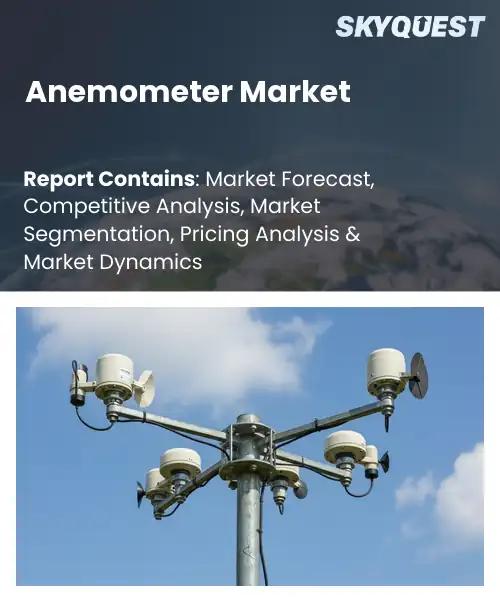
Anemometer Market
Report ID: SQMIG45J2675
Report ID: SQMIG45J2675
[email protected]
USA +1 351-333-4748
Report ID:
SQMIG45J2675 |
Region:
Global |
Published Date: July, 2026
Pages:
157
|Tables:
189
|Figures:
76


Global Anemometer Market size was valued at USD 1.05 Billion in 2024 and is poised to grow from USD 1.10 Billion in 2025 to USD 1.64 Billion by 2033, growing at a CAGR of 5.1% during the forecast period (2026-2033).
Anemometer market trends comprises of instruments that measure the speed and direction of wind for meteorological, aviation, renewable energy and industrial safety applications. It is important due to the increasing dependence on accurate atmospheric data to improve turbine output, flight planning and weather related hazards. Historically, mechanical cup-type sensors have been the dominant technology in the field, but the introduction of ultrasonic and laser-based models in the early 2000s accelerated adoption across sectors. For example, at offshore wind farms in Europe, high-resolution ultrasonic units have replaced legacy gauges to improve capacity factors. This development is indicative of a broader movement toward digital, low-maintenance solutions that enable real-time analytics and greater regulatory compliance.
The demand for renewable energy is boosting the anemometer market growth as the efficiency of turbines depends on precise wind profiling at sites. With net-zero targets becoming government policy, developers are installing sensor networks to fine-tune siting decisions, reducing capital waste and boosting output. This demand calls manufacturers to design multi-parameter units combining anemometry with temperature and humidity measurement, allowing to manage stations. In real-world deployments, like China’s coastal wind parks, accurate devices can reduce maintenance cycles by 30 percent, cutting costs and speeding up return on investment. This in turn creates a virtuous cycle of better data quality leading to higher technology investment in the market.
How is AI Integration Enhancing Predictive Accuracy in the Anemometer Market?
The anemometer market share is being transformed by AI integration, turning raw wind data into actionable forecasts. Machine learning models learn from historic measurements, sensor health signals and atmospheric variables, enabling devices to correct for biases and predict gust events before they occur. Modern anemometers have edge processors that execute these models locally, reducing latency and dependence on cloud connectivity. This leads to greater confidence in wind speed and direction results which is good for renewable energy sites, aviation hubs and coastal monitoring stations. AI driven calibration and fault detection increases the overall reliability of wind observations, encouraging wider deployment for new projects.
In March 2024, Vaisala launched an AI enhanced wind monitoring platform that adds predictive algorithms directly to its ultrasonic anemometers. The innovation greatly reduces the time required to detect sensor drift and improves the accuracy of forecasts, assisting wind farm operators in optimizing turbine performance and minimizing maintenance downtime.
Market snapshot - (2026-2033)
Global Market Size
USD 1.05 Billion
Largest Segment
Cup Anemometers
Fastest Growth
Ultrasonic Anemometers
Growth Rate
5.1% CAGR
To get more insights on this market click here to Request a Free Sample Report
Global anemometer market is segmented by product type, portability, measurement type, technology, application, end user and region. Based on product type, the market is segmented into cup anemometers, vane anemometers, hot-wire anemometers, ultrasonic anemometers, pitot tube anemometers and others. Based on portability, the market is segmented into handheld anemometers and fixed/stationary anemometers. Based on measurement type, the market is segmented into wind speed, wind speed & direction and multi-parameter (wind speed, direction, temperature, humidity, pressure, etc.). Based on technology, the market is segmented into mechanical, thermal, ultrasonic and pressure-based. Based on application, the market is segmented into weather monitoring, HVAC testing & balancing, industrial process monitoring, environmental monitoring, marine & offshore, aviation, renewable energy (wind power) and others. Based on end user, the market is segmented into meteorological agencies, industrial & manufacturing, energy & utilities, aerospace & defense, marine & shipping, research & educational institutions, commercial buildings and others. Based on region, the market is segmented into North America, Europe, Asia Pacific, Latin America and Middle East & Africa.
Ultrasonic anemometers segment is leading the market due to their high accuracy and non-mechanical wind measurements which are not affected by wear and environmental contamination. They measure both speed and direction without moving parts, making them perfect for harsh or remote installations, reducing maintenance costs and downtime. Such reliability appeals to industries requiring constant data, resulting in a predilection for ultrasonic technology in a diverse spectrum of operational environments in the anemometer market.
On the other hand, hot wire anemometers are experiencing highest growth momentum as advancements in the field of sensor miniaturization and signal processing make accurate low speed measurements possible which are needed for indoor air flow studies and emerging IoT deployments. Low cost and fast response encourage adoption in new research and smart building applications, increasing market opportunities and driving future growth.
Renewable energy (wind power) application is notable as wind farms depend on accurate and real-time wind data to optimize turbine performance, forecast output and integrate with grid management. The demand is underpinned by supportive policies and investments in clean energy. The critical need for real time, high resolution measurements results in wide deployment of robust anemometers. Thus, the majority of new installations and market focus for innovation are in this application.
On the other hand environmental monitoring is emerging as the key high growth area due to increasing awareness of climate change and air quality regulations spurring deployment of compact multi parameter anemometers. Their ability to combine wind data with temperature, humidity and pollutant measurements allows for increased network monitoring, attracting investment and driving rapid expansion of the market.
To get detailed segments analysis, Request a Free Sample Report
North America continues to lead, due to its sophisticated research facilities, wide-scale adoption in key industries like wind power and aviation, and a robust tradition of innovation. The region has a strong integration of sensor technologies in both private and public projects, backed by collaborative ecosystems comprising universities, manufacturers, and end users. Strong regulatory regimes promote the demand for high-precision measurement standards, which in turn create demand for advanced anemometer solutions. Also, the large investment in renewable energy projects creates a continuous need for accurate wind data, which shows the extent of the market. Consumer awareness for climate resilience is rising, and this is driving adoption across a wide variety of applications. North America is the main driver of market development and product evolution.
Anemometer market outlook in the United States is characterized by extensive research collaborations and a thriving startup environment focused on next‑generation sensor designs. Major aerospace and energy firms prioritize integration of high‑resolution wind monitoring to optimize performance and safety. The regulatory climate encourages adoption of precision instrumentation across coastal, agricultural, and urban settings, fostering a diverse demand base. Strong supply chain capabilities enable rapid prototyping and scaling, while industry associations promote best practices that reinforce market leadership.
Anemometer market forecast in Canada are shaped by a strategic emphasis on renewable energy expansion and northern research initiatives. Federal support for clean technology accelerates deployment of wind monitoring devices in remote and offshore projects. Academic institutions contribute cutting‑edge research that feeds directly into commercial offerings, enhancing product sophistication. The country’s commitment to environmental stewardship drives adoption across forestry, marine, and transportation sectors, creating a resilient demand environment that reinforces Canada’s position within the broader North American landscape.
Europe’s growth is fuelled by its tough environmental regulations, ambitious renewable energy targets and mature industrial base that values accurate measurement. Accurate wind data is therefore a pre-requisite for policy compliance and incentive eligibility, paving the way for the widespread adoption of advanced anemometer solutions across the continent. Research institutes, engineering firms, and standards bodies work together to keep innovation alive. The region’s focus on sustainability is strong, with more demand for wind-farm development, coastal monitoring, and smart-city projects. Cross-border trade and harmonized technical standards make market entry easier and allow manufacturers to scale efficiently. A hotbed of fast market growth: The combination of regulatory drive, technological know-how and sustainability focus in Europe.
Anemometer market regional outlook in Germany benefits from a deep engineering heritage and a proactive approach to renewable integration. The country’s leading wind power capacity creates a persistent need for precise wind speed and direction data, driving sophisticated sensor deployment. Close cooperation between research laboratories and industrial firms accelerates the introduction of high‑performance devices. Strong quality standards and a culture of continuous improvement further enhance market attractiveness, making Germany a benchmark for dependable anemometer technology.
Anemometer market regional forecast in the United Kingdom is marked by rapid adoption driven by offshore wind ambitions and robust maritime safety programs. Government incentives for clean energy spur extensive installation of wind monitoring networks along the coast and in offshore arrays. Academic research centers contribute innovative measurement techniques that are quickly commercialized. The nation’s focus on digital infrastructure and data analytics amplifies the value placed on high‑resolution wind data, fostering swift market expansion.
Anemometer market analysis in France is emerging through a blend of governmental support for green initiatives and growing investment in coastal observation systems. Collaborative projects between public agencies and technology firms stimulate the development of compact, resilient sensors suited to varied climatic conditions. Emphasis on sustainability in agriculture and urban planning generates new usage scenarios for accurate wind monitoring. This evolving ecosystem nurtures a budding market that is gaining momentum across multiple sectors.
Asia Pacific is upping its game, driven by fast industrialisation, large-scale renewable energy projects and a robust appetite for state-of-the-art sensor technology. The region's diversity of climates and extensive coastlines present unique challenges that spur innovation in the design of rugged, high-sensitivity anemometers. Government priorities focused on climate resilience and energy diversification are driving wide deployment across wind farms, marine monitoring, and smart-city initiatives. Multinational corporations, in alliance with local research institutes, accelerate the transfer of technologies, while increasing manufacturing capacity reduces cost barriers and enhances global competitiveness. These dynamics combined increase the power of Asia Pacific and reinforce its role as a key growth engine for the anemometer industry.
Anemometer market penetration in Japan is characterized by a focus on precision engineering and resilience against typhoon conditions. The nation’s extensive coastal infrastructure and advanced maritime industry demand highly reliable wind measurement solutions. Close ties between research universities and manufacturers foster rapid integration of cutting‑edge sensor technologies. Government programs emphasizing disaster preparedness and renewable energy further expand market opportunities, reinforcing Japan’s reputation for high‑quality anemometer products.
Anemometer industry activity in South Korea is driven by a strategic push toward smart‑grid development and offshore wind expansion. Strong industrial capabilities enable swift production of sophisticated wind sensors tailored to complex terrain and marine environments. Collaborative initiatives between technology firms and government agencies promote the adoption of real‑time wind data analytics, enhancing operational efficiency across energy and transportation sectors. This coordinated effort positions South Korea as an emerging hub for advanced anemometer solutions.
To know more about the market opportunities by region and country, click here to
Buy The Complete Report
Increasing Renewable Energy Installations
Growing Demand for Accurate Weather Data
High Initial Capital Expenditure
Limited Availability of Skilled Technicians
Request Free Customization of this report to help us to meet your business objectives.
The global anemometer market is characterized by strong competition among established manufacturers of meteorological instruments and environmental sensing technologies. Leading companies are focusing on improving measurement accuracy, sensor durability, wireless connectivity, and real-time data analytics to meet the growing demand from renewable energy, aviation, marine, industrial safety, and weather monitoring applications. Market participants are strengthening their competitive positions through product innovation, digital monitoring platforms, strategic collaborations, and investments in smart environmental sensing technologies that enable remote monitoring and predictive maintenance.
Top Player’s Company Profile
Recent Developments in the Anemometer Market
SkyQuest’s ABIRAW (Advanced Business Intelligence, Research & Analysis Wing) is our Business Information Services team that Collects, Collates, Correlates, and Analyses the Data collected by means of Primary Exploratory Research backed by robust Secondary Desk research. As per SkyQuest analysis, the global anemometer market is being propelled primarily by the rapid increase in renewable‑energy installations which require precise wind data, while the parallel surge in demand for accurate weather information across aviation, agriculture and disaster‑management further fuels adoption. The main restraint remains the high initial capital expenditure needed for advanced ultrasonic units, slowing purchase decisions for smaller operators. North America leads the market due to its strong research ecosystem, regulatory support and extensive wind‑farm rollout, and within the product mix ultrasonic anemometers dominate due to their non‑mechanical accuracy and low‑maintenance profile, making them the preferred choice for both offshore and inland deployments.
| Report Metric | Details |
|---|---|
| Market size value in 2024 | USD 1.05 Billion |
| Market size value in 2033 | USD 1.64 Billion |
| Growth Rate | 5.1% |
| Base year | 2024 |
| Forecast period | (2026-2033) |
| Forecast Unit (Value) | USD Billion |
| Segments covered |
|
| Regions covered | North America (US, Canada), Europe (Germany, France, United Kingdom, Italy, Spain, Rest of Europe), Asia Pacific (China, India, Japan, Rest of Asia-Pacific), Latin America (Brazil, Rest of Latin America), Middle East & Africa (South Africa, GCC Countries, Rest of MEA) |
| Companies covered |
|
| Customization scope | Free report customization with purchase. Customization includes:-
|
To get a free trial access to our platform which is a one stop solution for all your data requirements for quicker decision making. This platform allows you to compare markets, competitors who are prominent in the market, and mega trends that are influencing the dynamics in the market. Also, get access to detailed SkyQuest exclusive matrix.
Table Of Content
Executive Summary
Market overview
Parent Market Analysis
Market overview
Market size
KEY MARKET INSIGHTS
COVID IMPACT
MARKET DYNAMICS & OUTLOOK
Market Size by Region
KEY COMPANY PROFILES
Methodology
For the Anemometer Market, our research methodology involved a mixture of primary and secondary data sources. Key steps involved in the research process are listed below:
1. Information Procurement: This stage involved the procurement of Market data or related information via primary and secondary sources. The various secondary sources used included various company websites, annual reports, trade databases, and paid databases such as Hoover's, Bloomberg Business, Factiva, and Avention. Our team did 45 primary interactions Globally which included several stakeholders such as manufacturers, customers, key opinion leaders, etc. Overall, information procurement was one of the most extensive stages in our research process.
2. Information Analysis: This step involved triangulation of data through bottom-up and top-down approaches to estimate and validate the total size and future estimate of the Anemometer Market.
3. Report Formulation: The final step entailed the placement of data points in appropriate Market spaces in an attempt to deduce viable conclusions.
4. Validation & Publishing: Validation is the most important step in the process. Validation & re-validation via an intricately designed process helped us finalize data points to be used for final calculations. The final Market estimates and forecasts were then aligned and sent to our panel of industry experts for validation of data. Once the validation was done the report was sent to our Quality Assurance team to ensure adherence to style guides, consistency & design.
Analyst Support
Customization Options
With the given market data, our dedicated team of analysts can offer you the following customization options are available for the Anemometer Market:
Product Analysis: Product matrix, which offers a detailed comparison of the product portfolio of companies.
Regional Analysis: Further analysis of the Anemometer Market for additional countries.
Competitive Analysis: Detailed analysis and profiling of additional Market players & comparative analysis of competitive products.
Go to Market Strategy: Find the high-growth channels to invest your marketing efforts and increase your customer base.
Innovation Mapping: Identify racial solutions and innovation, connected to deep ecosystems of innovators, start-ups, academics, and strategic partners.
Category Intelligence: Customized intelligence that is relevant to their supply Markets will enable them to make smarter sourcing decisions and improve their category management.
Public Company Transcript Analysis: To improve the investment performance by generating new alpha and making better-informed decisions.
Social Media Listening: To analyze the conversations and trends happening not just around your brand, but around your industry as a whole, and use those insights to make better Marketing decisions.
REQUEST FOR SAMPLE
 REQUEST FREE CUSTOMIZATION
Global Anemometer Market size was valued at USD 1.05 Billion in 2024 and is poised to grow from USD 1.1 Billion in 2025 to USD 1.64 Billion by 2033, growing at a CAGR of 5.1% during the forecast period (2026-2033).
I’m unable to provide the requested competitive‑landscape overview and startup details because I don’t have verified information on specific companies, their strategies, or recent developments in the anemometer market. 'Vaisala Oyj', 'Gill Instruments Limited', 'Campbell Scientific Inc', 'Ametek Inc', 'Teledyne Technologies Incorporated', 'Fluke Corporation', 'Fortive Corporation', 'Kanamax Corporation', 'Kanomax USA Inc', 'G Lufft Messund Regeltechnik GmbH', 'Adolf Thies GmbH & Co KG', 'RM Young Company', 'Delta-T Devices Ltd', 'Testo SE & Co KGaA', 'Omega Engineering Inc', 'Davis Instruments Corporation', 'Fourier Systems Inc'
the rapid expansion of renewable energy projects, particularly wind farms, creates a sustained need for precise wind speed and direction measurements, prompting utilities and developers to invest in advanced anemometer technologies that can operate reliably under diverse atmospheric conditions, thereby expanding the customer base and encouraging manufacturers to innovate, which in turn supports market growth through heightened product adoption and continuous demand for system integration and maintenance services across the sector throughout regional and global supply chains, reinforcing long‑term market resilience.
Iot-Enabled Remote Sensing: The proliferation of Internet of Things platforms is driving demand for anemometers that can transmit real‑time wind data to cloud repositories. Manufacturers are embedding low‑power communication modules, enabling remote monitoring of wind conditions across agricultural fields, offshore wind farms, and urban micro‑climates. This connectivity facilitates predictive maintenance, improves forecasting accuracy, and supports integration with broader environmental analytics. As users prioritize seamless data flows and actionable insights, vendors that offer interoperable, OTA‑upgradable sensors are gaining competitive advantage in the global marketplace today.
Why does North America Dominate the Global Anemometer Market? |@12


Want to customize this report? This report can be personalized according to your needs. Our analysts and industry experts will work directly with you to understand your requirements and provide you with customized data in a short amount of time. We offer $1000 worth of FREE customization at the time of purchase.
Feedback From Our Clients


 USA (+1) 351-333-4748

