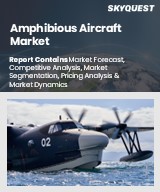
Amphibious Aircraft Market
Report ID: SQMIG20A2331
Report ID: SQMIG20A2331
[email protected]
USA +1 351-333-4748
Report ID:
SQMIG20A2331 |
Region:
Global |
Published Date: May, 2025
Pages:
184
|Tables:
146
|Figures:
77


Global Amphibious Aircraft Market size was valued at USD 178.08 Million in 2024 and is poised to grow from USD 198.2 Million in 2025 to USD 466.74 Million by 2033, growing at a CAGR of 11.3% during the forecast period (2026–2033).
The global amphibious aircraft market is witnessing consistent growth, primarily fueled by growing demand on offshore applications where conventional runways are not available. The ability to travel on land and water makes them especially valuable for destinations with poor infrastructure such as coastal and island locations. Increased interest from commercial aviation sectors—particularly for tourist, regional transport, and emergency services—remains to fuel market momentum as well. Maritime surveillance, environmental monitoring, and defense purchases are also fueling growth, as governments and agencies seek to have flexible platforms to support various mission profiles.
Applications such as inter-island freight and eco-tourism are presenting themselves as market opportunities for market players, specifically countries that own an archipelagic topography. Amphibian planes are also finding their way in the delivery of cargoes, relief operations, and adventure holidays to out-of-way places. Additionally, increasing global defense spending and requirements for next-generation seaplanes for humanitarian and tactical missions are driving investment. Advances in technology, including the application of hybrid-electric propulsion with enhanced fuel efficiency, are enabling manufacturers to create cleaner and more efficient planes.
However, despite the optimistic outlook, many are still existing. Deterring high capital and maintenance costs and stringent control requirements for regulation stifling bulk consumption. Two main operational media—air and water—increase design complexity, pushing cost of ownership overall. Besides, few specialist makers and sellers limit entry and reduce the speed of innovations in global markets.
But the industry has promising growth in the long term. Regional air mobility projects, coastal facility construction, and sustainability projects are increasing demand. As manufacturers invest in lightweight composite technology, AI navigation systems, and improved safety capabilities, amphibian aircraft are predicted to become efficient and widely used in commercial, defense, and emergency use.
Why Are Defense and Naval Forces Increasing Their Investment in Amphibious Aircraft?
Military applications are the principal growth driver of the amphibious aircraft market. Amphibious aircraft enable strategic mobility for coastal surveillance, anti-submarine operations, troop deployment, and resupply logistics in remote maritime zones. Long coastlines or archipelagic nations such as the U.S., China, and Japan are acquiring advanced amphibious aircraft in quantities to enhance their fleets. With increasing geopolitical tensions and heightened attention to seaborne defense, defense departments are looking for multi-role fighters with the capability to fly in extreme environments. The trend is prompting manufacturers to become more innovative in terms of payload capacity, fuel efficiency, and sophisticated avionics configured specifically for war-fighting applications.
Market snapshot - 2026-2033
Global Market Size
USD 160 Million
Largest Segment
Fixed Wing
Fastest Growth
Rotary Wing
Growth Rate
11.3% CAGR
To get more insights on this market click here to Request a Free Sample Report
The global cloud-based contact center market is segmented on the basis of Aircraft Type, Engine Type, Seating Capacity, Range, End Use, and region. By Aircraft Type, the market is segmented Fixed Wing, and Rotary Wing. By Engine Type, the market is segmented into Turboprop, and Turbine. By Seating Capacity, the market is segmented into Less than 10, 10-20, 20-50, and Over 50. By Range, the market is segmented into Less than 250 km, 250-500 km, 500-1,000 km, and Over 1,000 km. By End Use, the market is segmented into Civil Aviation, General Aviation, and Military Aviation. By region, the market is segmented into North America, Europe, Asia Pacific, the Middle East and Africa, and Latin America.
Fixed wing amphibious aircraft is having the highest share in the market as it has greater range, payload capacity, and operational efficiency. The aircrafts are mostly used in applications such as maritime petrol, cargo transport, firefighting and search and rescue missions. Since fixed wing amphibious aircraft can land and take off on water and runways as well, they are extremely versatile, particularly in remote and coastal operations. Fixed wing types are also a favorite among defense forces as well as commercial operators for traveling long distances fast with improved fuel efficiency. Their well-established use among both military as well as civilian markets solidifies their stronghold market position, and as such, fixed wing airplanes make up the largest segment by aircraft type in the worldwide amphibious aircraft market.
Rotary wing segment is the fastest growing in the amphibious aircraft market. Vertical takeoff and landing (VTOL) facility of helicopter-type amphibious aircraft makes them the best option for operations where there are limited or harsh surroundings without runways. Their handling capacity and capability of hovering on water make them desirable in defense, emergency rescue, and transport of oil and gas offshore. While city air mobility and demand for lightweight, multi-purpose aircraft grow, the popularity of rotary winged amphibious airplanes keeps growing higher. Rotorcraft design developments and amphibian modifications are accelerating this segment to become the most rapidly growing portion of the market by aircraft type.
Turboprop engines account for the largest segment of the global amphibious aircraft market because of their efficiency, dependability, and ability to conduct short-to-medium haul missions. The turboprop engine excels most when performing low-speed, low-altitude flights, making them the best suited for surveillance missions, fighting forest fires, and sea coast transport. Turboprop-powered amphibious aircraft are also cheaper to operate and maintain, and these traits are appealing to both military and civilian consumers. Their ability to perform on short runways as well as on unprepared surfaces only contributes to their usability. Combining operational flexibility with lower cost of ownership, turboprop engines are far and away the most widely used option employed in the amphibious aircraft market.
Turbine engines are the fastest growing segment in the market for amphibious aircraft. Turbine-powered amphibious aircraft provide higher power output, speed, and performance than conventional turboprops, and they are well-suited to a greater variety of high-demand missions. The engines are picking up in defense, emergency medical response, and offshore markets where there is a need for improved performance and payload capacity. Apart from that, advancements in turbine engine technology are making fuel efficiency better and reducing the maintenance needs, thereby they are more compatible for commercial applications. With more demand for higher-powered and high-performance amphibious aircraft, the market for turbine engines is experiencing grand growth due to innovation and expanding mission requirements in various industries.
To get detailed segments analysis, Request a Free Sample Report
Asia-Pacific region is the largest market for amphibious aircraft, boosted by its immense archipelagos, long coastlines, and growing need for multi-purpose aviation solutions. Governments such as those in China, Japan, and Australia are all spending significantly in amphibian aircraft for use for search and rescue missions, as well as intraregional connectivity and tourist purposes. This market segment further gets support through the region's dynamic economic activities and focus towards strengthening maritime surveillance capabilities. In addition, the occurrence of notable manufacturers like ShinMaywa Industries and Seawind Aircraft highlights the region's prominent position in the international amphibious aircraft market.
North America is the fastest growing region in the amphibious aircraft market and has a c AGR of around 11.2% during the forecasted period. There is a rising demand for versatile aircraft which should be capable of operating on both land and water, in particular formation such as search and rescue, firefighting and maritime Patrol, contributing towards the market growth. The region has extensive coastline and diverse terrains which makes it necessary to adopt aviation solutions. Moreover, there are major key players in this region such as Textron Inc., VIKING Air Ltd., and ICON Aircraft, Inc. and have considerable defense spending which is further contributing towards the region's market expansion.
Europe is the third-largest market for amphibious aircraft, with a market size of USD 55.35 million in 2023 and an estimated CAGR of 11.3% from the forecast period 2023-2030. The maritime surveillance, search and rescue, and fire-fighting operations focus in the region generate demand for amphibious aircraft. Germany, France, and the United Kingdom are investing in upgrading their emergency response and defense mechanisms, which also boosts market growth. One significant development is the 2018 agreement between France and Russia to re-motorize Be-200 amphibious aircraft, indicating Europe's determination to develop its amphibious aircraft technology.
To know more about the market opportunities by region and country, click here to
Buy The Complete Report
Expanding Use in Disaster Relief and Humanitarian Missions
Military and Strategic Maritime Applications
High Initial Cost and Maintenance Expenses
Limited Infrastructure and Operational Challenges
Request Free Customization of this report to help us to meet your business objectives.
The global amphibious aircraft market is witnessing a boost, and developments are guided by strategy and strategic expansions. Organizations are directing efforts towards the optimization of operation performance, security, and environmental acceptability for the realization of different applications among search and rescue, combat for fire, traveling, and distant logistics.
For instance, Seamax Aircraft is a Brazilian company that manufactures the Seamax M-22, a light sport amphibious airplane. The M-22 is for recreational use and has been certified by the Brazilian National Civil Aviation Agency (ANAC). Seamax has increased its capacity for production by opening a factory in the United States to boost its footprint in the North American market.
These advancements accentuate a competitive environment where businesses are utilizing technological innovation, strategic alliances, and market diversification to solidify their positions within the global amphibious aircraft industry.
Is the Growth of Ecotourism and Island Connectivity Boosting Commercial Use?
Expanding ecotourism and demand for better access to remote islands are creating new business opportunities for amphibious aircraft. Such airplanes are most ideal for short ranges between unpenetrated or hard-to-reach areas, offering a unique combination of convenience and scenic flight. Tour operators, local airlines, and private charter airlines are increasingly utilizing amphibious aircraft to support tourist activities at tourist destinations such as the Maldives, Alaska, and Southeast Asia. As international tourism is coming back from the pandemic and tourists are looking for niche, adventure-based tourism products, the commercial amphibious aviation market is likely to grow steadily.
How Are Technological Advancements Improving Amphibious Aircraft Efficiency and Safety?
The continuous growing technological Innovations are considerably advancing the performance, safety, and sustainability of amphibious aircraft. The development in light weight composite materials, digital avionics, and more efficient propulsion systems are helping in improving fuel efficiency, range, and maneuverability. The manufacturers are adopting hybrid electric and electric propulsion systems for reducing operational costs and meeting environmental goals. The advanced GPS, autopilot, and water landing stabilization Technologies are improving operational safety in different conditions. Therefore, the advancements are not only attracting government and commercial buyers but also making new possibilities for new mission profiles leading towards market growth and adoption.
SkyQuest’s ABIRAW (Advanced Business Intelligence, Research & Analysis Wing) is our Business Information Services team that Collects, Collates, Correlates, and Analyses the Data collected by means of Primary Exploratory Research backed by robust Secondary Desk research.
As per SkyQuest analysis, Countries are investing in amphibious aircraft to conduct maritime patrols, certain rescue operations, and rapid deployment capabilities for increasing and enhancing their naval forces' versatility and reach. Amphibious aircrafts allow access to remote islands and coastal areas and thus boost tourism and offer essential services to underdeveloped regions. The operating and maintenance costs of amphibious planes are high, which might discourage potential buyers and restrict market growth. The fixed wing segment is having the highest share whereas the rotary wing segment is growing at a quick pace. Asia Pacific having the highest share is dominated by country such as China, Japan, and Australia.The region has vast coast Line and Island territories which is driving demand for amphibious aircraft in both military and civilian sectors. North America is growing at a quick rate due to Rising defense budgets and a growing interest in tourism. A major trend is the development of electric and hybrid propulsion systems which aims to reduce environmental impact and operational costs. AAI is driving innovation with the Albatross G111T seaplane, intended for military or civilian use, ranging from firefighting to carrying passengers. Their emphasis on affordable, adaptive solutions aids the growth of the market.
| Report Metric | Details |
|---|---|
| Market size value in 2024 | USD 178.08 Million |
| Market size value in 2033 | USD 466.74 Million |
| Growth Rate | 11.3% |
| Base year | 2024 |
| Forecast period | 2026-2033 |
| Forecast Unit (Value) | USD Million |
| Segments covered |
|
| Regions covered | North America (US, Canada), Europe (Germany, France, United Kingdom, Italy, Spain, Rest of Europe), Asia Pacific (China, India, Japan, Rest of Asia-Pacific), Latin America (Brazil, Rest of Latin America), Middle East & Africa (South Africa, GCC Countries, Rest of MEA) |
| Companies covered |
|
| Customization scope | Free report customization with purchase. Customization includes:-
|
To get a free trial access to our platform which is a one stop solution for all your data requirements for quicker decision making. This platform allows you to compare markets, competitors who are prominent in the market, and mega trends that are influencing the dynamics in the market. Also, get access to detailed SkyQuest exclusive matrix.
Table Of Content
Executive Summary
Market overview
Parent Market Analysis
Market overview
Market size
KEY MARKET INSIGHTS
COVID IMPACT
MARKET DYNAMICS & OUTLOOK
Market Size by Region
KEY COMPANY PROFILES
Methodology
For the Amphibious Aircraft Market, our research methodology involved a mixture of primary and secondary data sources. Key steps involved in the research process are listed below:
1. Information Procurement: This stage involved the procurement of Market data or related information via primary and secondary sources. The various secondary sources used included various company websites, annual reports, trade databases, and paid databases such as Hoover's, Bloomberg Business, Factiva, and Avention. Our team did 45 primary interactions Globally which included several stakeholders such as manufacturers, customers, key opinion leaders, etc. Overall, information procurement was one of the most extensive stages in our research process.
2. Information Analysis: This step involved triangulation of data through bottom-up and top-down approaches to estimate and validate the total size and future estimate of the Amphibious Aircraft Market.
3. Report Formulation: The final step entailed the placement of data points in appropriate Market spaces in an attempt to deduce viable conclusions.
4. Validation & Publishing: Validation is the most important step in the process. Validation & re-validation via an intricately designed process helped us finalize data points to be used for final calculations. The final Market estimates and forecasts were then aligned and sent to our panel of industry experts for validation of data. Once the validation was done the report was sent to our Quality Assurance team to ensure adherence to style guides, consistency & design.
Analyst Support
Customization Options
With the given market data, our dedicated team of analysts can offer you the following customization options are available for the Amphibious Aircraft Market:
Product Analysis: Product matrix, which offers a detailed comparison of the product portfolio of companies.
Regional Analysis: Further analysis of the Amphibious Aircraft Market for additional countries.
Competitive Analysis: Detailed analysis and profiling of additional Market players & comparative analysis of competitive products.
Go to Market Strategy: Find the high-growth channels to invest your marketing efforts and increase your customer base.
Innovation Mapping: Identify racial solutions and innovation, connected to deep ecosystems of innovators, start-ups, academics, and strategic partners.
Category Intelligence: Customized intelligence that is relevant to their supply Markets will enable them to make smarter sourcing decisions and improve their category management.
Public Company Transcript Analysis: To improve the investment performance by generating new alpha and making better-informed decisions.
Social Media Listening: To analyze the conversations and trends happening not just around your brand, but around your industry as a whole, and use those insights to make better Marketing decisions.
REQUEST FOR SAMPLE
 REQUEST FREE CUSTOMIZATION


Want to customize this report? This report can be personalized according to your needs. Our analysts and industry experts will work directly with you to understand your requirements and provide you with customized data in a short amount of time. We offer $1000 worth of FREE customization at the time of purchase.
Feedback From Our Clients


 USA (+1) 351-333-4748

