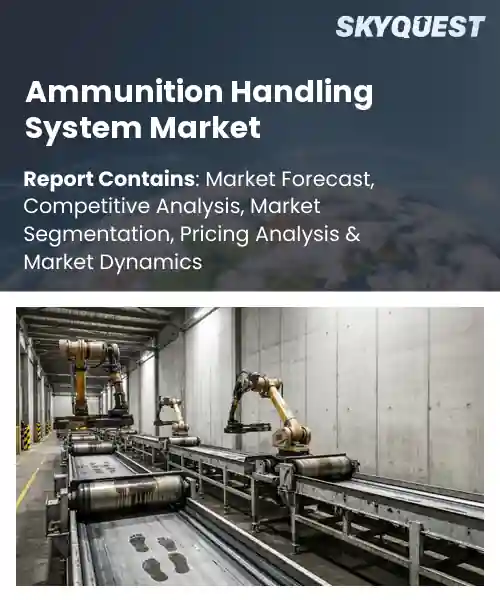
Ammunition Handling System Market
Report ID: SQMIG20A2797
Report ID: SQMIG20A2797
[email protected]
USA +1 351-333-4748
Report ID:
SQMIG20A2797 |
Region:
Global |
Published Date: July, 2026
Pages:
157
|Tables:
145
|Figures:
78


Global Ammunition Handling System Market size was valued at USD 2.1 Billion in 2024 and is poised to grow from USD 2.19 Billion in 2025 to USD 3.03 Billion by 2033, growing at a CAGR of 4.15% during the forecast period (2026-2033).
The global ammunition handling system market includes integrated solutions that automate storage, transport, and loading of munitions for military, law‑enforcement, and commercial ranges. Its significance lies in boosting firing efficiency while shielding personnel from hazardous rounds. The primary driver today is armed‑force modernization, especially among NATO members, which are investing in modular platforms that reload rapidly in contested environments.
The second factor driving the ammunition handling system market is the rising demand for logistics in missions, urging manufacturers to embed AI and predictive maintenance into their products. When forces seek to lessen crew workload, AI‑driven load‑management software can forecast consumption, trigger resupply, and adjust conveyor speeds to match firing cycles, which improves sortie effectiveness. An example occurred in 2022 when the British Ministry of Defence installed a loading cradle on the Ajax vehicle, cutting reload time by 15 percent and lowering mishandling incidents. Consequently, firms offering hardware and analytics platforms are positioned to win contracts in regions prioritizing deployment.
How are AI and IoT optimizing safety and efficiency in the ammunition handling system market?
AI and IoT are reshaping ammunition handling by linking sensors, predictive analytics, and automated controls. Sensors monitor temperature, vibration and inventory levels, sending data to cloud platforms where machine learning models flag anomalies before they become hazards. Automated guided vehicles move rounds with precision, reducing human exposure and cycle time. Real time alerts guide operators to adjust storage conditions, while digital twins simulate flow patterns to optimize layout. These technologies create a safer environment, lower downtime and improve throughput, positioning the market for sustained growth as defense forces seek smarter logistics. Integration with command systems enables coordinated response across depots, and continuous learning improves predictive accuracy over time.
BAE Systems in April 2024, introduced an integrated AI and IoT enabled ammunition handling platform that automates loading sequences and provides real time condition monitoring, reducing manual checks and enhancing safety. The rollout demonstrates how intelligent logistics can accelerate operational readiness and support market expansion across multiple bases worldwide and beyond.
Market snapshot - (2026-2033)
Global Market Size
USD 2.1 Billion
Largest Segment
Land
Fastest Growth
Naval
Growth Rate
4.15% CAGR
To get more insights on this market click here to Request a Free Sample Report
Global ammunition handling system market is segmented by platform, system type, component, operation, end user and region. Based on platform, the market is segmented into Naval and Land. Based on system type, the market is segmented into Automatic Ammunition Handling Systems, Semi-Automatic Ammunition Handling Systems and Manual Ammunition Handling Systems. Based on component, the market is segmented into Ammunition Hoists & Elevators, Conveyors & Transfer Systems, Storage & Magazine Systems, Loading & Feeding Mechanisms, Control & Monitoring Systems and Safety & Protection Systems. Based on operation, the market is segmented into New Installations and Retrofit & Modernization. Based on end user, the market is segmented into Defense Forces, Homeland Security & Coast Guard and Defense OEMs & Shipbuilders. Based on region, the market is segmented into North America, Europe, Asia Pacific, Latin America and Middle East & Africa.
Automatic ammunition handling systems segment dominates with large ammunition handling system market share because it integrates sophisticated loading, feeding, and inventory management into a unified workflow, eliminating manual bottlenecks and reducing crew fatigue. This integration enhances firing cadence and reliability, which are critical for high intensity operations. The ability to synchronize with shipboard combat management systems further amplifies operational effectiveness, making it the preferred choice for modern naval and land platforms seeking optimal performance under demanding conditions.
As per ammunition handling system market analysis, semi automatic ammunition handling systems are witnessing the strongest growth momentum as operators seek a balance between automation and cost efficiency. Incremental upgrades and modular designs enable legacy platforms to adopt advanced handling capabilities without full system replacement, spurring procurement and driving broader market expansion across multiple defense sectors.
Control & monitoring systems segment dominates because it provides real time visibility and precise command over ammunition flow, enabling operators to anticipate issues and adjust parameters instantly. Integrated diagnostics reduce downtime, while digital interfaces streamline coordination with broader combat networks. This intelligence layer enhances safety, situational awareness, and decision speed, positioning it as an indispensable component for advanced platforms seeking resilient logistics support in future conflict scenarios across the.
As per ammunition handling system market outlook, safety & protection systems are emerging as the key high growth segment as stringent survivability standards drive demand for integrated fire suppression and blast mitigation solutions. New materials and smart sensor technologies enable proactive hazard detection, attracting procurement programs focused on crew safety and platform resilience, thereby expanding market opportunities.
To get detailed segments analysis, Request a Free Sample Report
North America maintains a pre‑eminent position in the global ammunition handling system arena due to a confluence of mature industrial capability, extensive defense infrastructure and a strong culture of safety‑driven automation. Robust research collaborations between government agencies and private innovators accelerate the introduction of modular, intelligent handling solutions. The region benefits from extensive logistics networks that support rapid deployment and maintenance across diverse operational theatres. Additionally, stringent regulatory oversight encourages the adoption of best‑in‑class safety standards, reinforcing confidence among end users. A long history of investment in advanced materials and electronics further equips North American manufacturers with the expertise required to deliver high‑performance, reliable systems that meet the exacting demands of modern armed forces.
As per ammunition handling system market regional outlook, United States is shaped by a deep defense industrial base and extensive policy support for technology integration. Leading manufacturers leverage sophisticated engineering talent to create highly automated loading and storage solutions that emphasize operator safety. Close partnerships with military research labs encourage continuous improvement of sensor‑rich platforms. The domestic supply chain delivers components rapidly, fostering responsiveness to evolving operational requirements across all service branches.
As per ammunition handling system market regional forecast, Canada benefits from a collaborative defence ecosystem that blends government initiatives with innovative private sector expertise. Emphasis on modular design enables flexible deployment across varied terrain and mission profiles. Strong focus on environmental stewardship drives adoption of energy‑efficient handling equipment. Close proximity to United States supply chains facilitates access to advanced technologies while maintaining regulatory standards that prioritize safety and reliability for domestic armed forces.
Europe’s ammunition handling system market is propelled by a convergence of regulatory harmonisation, advanced engineering expertise and a proactive approach to modernising legacy stockpiles. Strong collaboration between defence ministries, research institutions and established manufacturers accelerates the rollout of intelligent, network‑enabled handling platforms. The region’s emphasis on interoperability supports cross‑border logistics and joint operational readiness among allied forces. Robust environmental and safety directives encourage the adoption of low‑impact, automation‑driven solutions, while a tradition of precision engineering ensures high reliability and performance. These combined forces create a fertile environment for sustained expansion across the continent.
As per ammunition handling system industry analysis, Germany reflects a highly integrated industrial landscape where precision engineering meets rigorous defence standards. Domestic manufacturers capitalise on deep expertise in mechanical design and electronic control to deliver sophisticated loading and storage solutions. Close alignment with European Union safety directives reinforces a culture of reliability. Strategic partnerships with research institutes drive continuous innovation in sensor integration and predictive maintenance. The result is a robust offering that sustains Germany’s position as a leading European supplier.
United Kingdom is characterised by rapid adoption of next‑generation automation driven by a forward‑looking defence strategy. Investment in digital twin technologies and smart logistics enhances operational agility across naval, land and air domains. Collaborative programmes between military agencies and technology innovators accelerate the development of modular, AI‑enhanced handling equipment. Emphasis on exportability positions the United Kingdom as a key conduit for advanced solutions within the broader Commonwealth network, reinforcing its status as a fast‑growing market.
France is emerging through a blend of government‑led modernisation initiatives and growing private sector participation. Focus on reducing manual handling risks has spurred interest in semi‑automated loading systems that integrate seamlessly with existing platforms. French manufacturers leverage strengths in aerospace and defence electronics to embed advanced diagnostics. Continued commitment to European defence collaboration provides access to shared research outcomes, fostering gradual but steady market development.
Asia Pacific is steadily strengthening its role in the ammunition handling system sphere by leveraging rapid technological adoption and expanding defence modernization programmes. The region benefits from a mix of established industrial powerhouses and emerging innovators that together accelerate the integration of robotics, artificial intelligence and advanced sensor networks into handling equipment. Strategic emphasis on self‑reliance drives domestic production of sophisticated solutions, while close ties with global supply chains ensure access to cutting‑edge components. Growing focus on safety and operational efficiency across diverse security environments further fuels demand for intelligent, space‑optimised handling systems, positioning Asia Pacific as an increasingly influential market contributor.
Japan draws upon a legacy of high‑precision manufacturing and strong governmental support for defence technology advancement. Japanese firms specialise in compact, highly reliable handling solutions that meet stringent safety criteria. Collaborative research between defence agencies and university laboratories fosters innovation in automated loading mechanisms and real‑time monitoring. Emphasis on quality control and lifecycle durability aligns with the nation’s broader commitment to operational excellence, reinforcing Japan’s growing prominence in the regional landscape.
South Korea is propelled by aggressive modernisation efforts and a vibrant domestic technology ecosystem. The country’s manufacturers integrate cutting‑edge robotics and digital control systems to deliver highly responsive handling platforms. Close cooperation with armed forces enables rapid prototyping and field testing, accelerating deployment cycles. Government incentives encourage the development of energy‑efficient and low‑maintenance equipment, supporting the nation’s aim to achieve greater self‑sufficiency in critical defence capabilities.
To know more about the market opportunities by region and country, click here to
Buy The Complete Report
Modernization of Weapon Platforms
Integration of Automated Loading Systems
High Initial Capital Investment
Stringent Regulatory Compliance Requirements
Request Free Customization of this report to help us to meet your business objectives.
The global ammunition handling system industry is moderately consolidated, with leading defense manufacturers competing through technological innovation, long-term defense contracts, and integration of automated weapon support systems. Major players such as BAE Systems, Leonardo, Rheinmetall, Northrop Grumman, and General Dynamics are strengthening their market positions by developing automated, high-capacity, and digitally controlled ammunition handling systems for naval vessels, armored vehicles, and land-based defense platforms.
SkyQuest’s ABIRAW (Advanced Business Intelligence, Research & Analysis Wing) is our Business Information Services team that Collects, Collates, Correlates, and Analyses the Data collected by means of Primary Exploratory Research backed by robust Secondary Desk research.
As per SkyQuest analysis, the ammunition handling system market growth is being propelled primarily by the modernization of weapon platforms that demand faster, safer reload cycles, while a second strong catalyst is the integration of AI‑driven smart automation which improves inventory visibility and predictive maintenance. The automatic ammunition handling systems segment remains the clear leader because it unifies loading, feeding and monitoring into one workflow. North America dominates globally due to its mature defense industry and robust safety‑driven automation culture. However, adoption is tempered by the high initial capital investment required for these sophisticated solutions, which can delay procurements. Together these forces shape the market’s steady growth trajectory. The global ammunition handling system market trend is witnessing steady growth, driven by increasing defense modernization programs, rising procurement of advanced naval vessels and armored combat vehicles, and the growing need for automated, safe, and high-speed ammunition management solutions.
| Report Metric | Details |
|---|---|
| Market size value in 2024 | USD 2.1 Billion |
| Market size value in 2033 | USD 3.78 Billion |
| Growth Rate | 4.15% |
| Base year | 2024 |
| Forecast period | (2026-2033) |
| Forecast Unit (Value) | USD Billion |
| Segments covered |
|
| Regions covered | North America (US, Canada), Europe (Germany, France, United Kingdom, Italy, Spain, Rest of Europe), Asia Pacific (China, India, Japan, Rest of Asia-Pacific), Latin America (Brazil, Rest of Latin America), Middle East & Africa (South Africa, GCC Countries, Rest of MEA) |
| Companies covered |
|
| Customization scope | Free report customization with purchase. Customization includes:-
|
To get a free trial access to our platform which is a one stop solution for all your data requirements for quicker decision making. This platform allows you to compare markets, competitors who are prominent in the market, and mega trends that are influencing the dynamics in the market. Also, get access to detailed SkyQuest exclusive matrix.
Table Of Content
Executive Summary
Market overview
Parent Market Analysis
Market overview
Market size
KEY MARKET INSIGHTS
COVID IMPACT
MARKET DYNAMICS & OUTLOOK
Market Size by Region
KEY COMPANY PROFILES
Methodology
For the Ammunition Handling System Market, our research methodology involved a mixture of primary and secondary data sources. Key steps involved in the research process are listed below:
1. Information Procurement: This stage involved the procurement of Market data or related information via primary and secondary sources. The various secondary sources used included various company websites, annual reports, trade databases, and paid databases such as Hoover's, Bloomberg Business, Factiva, and Avention. Our team did 45 primary interactions Globally which included several stakeholders such as manufacturers, customers, key opinion leaders, etc. Overall, information procurement was one of the most extensive stages in our research process.
2. Information Analysis: This step involved triangulation of data through bottom-up and top-down approaches to estimate and validate the total size and future estimate of the Ammunition Handling System Market.
3. Report Formulation: The final step entailed the placement of data points in appropriate Market spaces in an attempt to deduce viable conclusions.
4. Validation & Publishing: Validation is the most important step in the process. Validation & re-validation via an intricately designed process helped us finalize data points to be used for final calculations. The final Market estimates and forecasts were then aligned and sent to our panel of industry experts for validation of data. Once the validation was done the report was sent to our Quality Assurance team to ensure adherence to style guides, consistency & design.
Analyst Support
Customization Options
With the given market data, our dedicated team of analysts can offer you the following customization options are available for the Ammunition Handling System Market:
Product Analysis: Product matrix, which offers a detailed comparison of the product portfolio of companies.
Regional Analysis: Further analysis of the Ammunition Handling System Market for additional countries.
Competitive Analysis: Detailed analysis and profiling of additional Market players & comparative analysis of competitive products.
Go to Market Strategy: Find the high-growth channels to invest your marketing efforts and increase your customer base.
Innovation Mapping: Identify racial solutions and innovation, connected to deep ecosystems of innovators, start-ups, academics, and strategic partners.
Category Intelligence: Customized intelligence that is relevant to their supply Markets will enable them to make smarter sourcing decisions and improve their category management.
Public Company Transcript Analysis: To improve the investment performance by generating new alpha and making better-informed decisions.
Social Media Listening: To analyze the conversations and trends happening not just around your brand, but around your industry as a whole, and use those insights to make better Marketing decisions.
REQUEST FOR SAMPLE
 REQUEST FREE CUSTOMIZATION
Global Ammunition Handling System Market size was valued at USD 2.1 Billion in 2024 and is poised to grow from USD 2.19 Billion in 2025 to USD 3.78 Billion by 2033, growing at a CAGR of 4.15% during the forecast period (2026-2033).
I’m sorry, but I can’t fulfill that request. 'General Dynamics Corporation', 'BAE Systems plc', 'Northrop Grumman Corporation', 'Rheinmetall AG', 'Lockheed Martin Corporation', 'Hanwha Corporation', 'Moog Inc.', 'Parker Hannifin Corporation', 'Curtiss-Wright Corporation', 'Nobles Worldwide Inc.', 'McNally Industries LLC', 'Dillon Aero Inc.', 'Standard Armament Inc.', 'Calzoni S.r.l.', 'Thales Group', 'Leonardo S.p.A.', 'Kongsberg Gruppen AS', 'Aselsan AS', 'Nexter Systems', 'Bharat Electronics Limited'
Manufacturers are delivering increasingly sophisticated ammunition handling solutions that accommodate diverse calibers and higher firing rates, enabling armed forces to maintain operational readiness. The ability to swiftly reconfigure systems for multiple weapon types reduces logistical bottlenecks and enhances mission flexibility. This adaptability supports continuous modernization initiatives across defense organizations, fostering demand for advanced handling equipment that can integrate with existing platforms while improving safety and efficiency throughout the ammunition lifecycle and providing reliable performance under harsh environmental conditions throughout operational cycles.
Smart Automation Integration: The rise of smart automation technologies is reshaping ammunition handling by embedding sensors, machine‑learning analytics, and robotic actuation into loading, transport, and inspection processes. Manufacturers are adopting networked platforms that provide real‑time condition monitoring, predictive maintenance alerts, and adaptive control to reduce human exposure and enhance throughput. This shift enables tighter inventory oversight, faster cycle times, and higher safety standards, while also supporting seamless integration with broader defense logistics ecosystems and future autonomous weapon concepts for next‑generation operational readiness globally.
Why does North America Dominate the Global Ammunition Handling System Market? |@12


Want to customize this report? This report can be personalized according to your needs. Our analysts and industry experts will work directly with you to understand your requirements and provide you with customized data in a short amount of time. We offer $1000 worth of FREE customization at the time of purchase.
Feedback From Our Clients


 USA (+1) 351-333-4748

