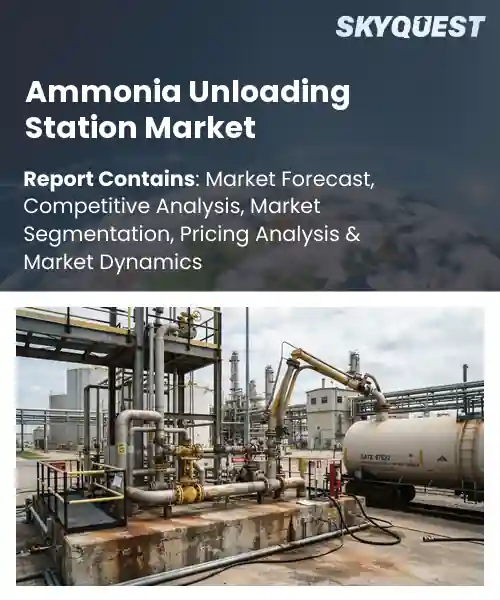
Ammonia Unloading Station Market
Report ID: SQMIG20I3995
Report ID: SQMIG20I3995
[email protected]
USA +1 351-333-4748
Report ID:
SQMIG20I3995 |
Region:
Global |
Published Date: September, 2026
Pages:
157
|Tables:
125
|Figures:
77


Global Ammonia Unloading Station Market size was valued at USD 1.2 Billion in 2024 and is poised to grow from USD 1.31 Billion in 2025 to USD 2.65 Billion by 2033, growing at a CAGR of 9.2% during the forecast period (2026-2033).
Regulatory pressure on emissions and safety drives growth in the ammonia unloading station market because stricter leak‑prevention standards force operators to replace aging equipment with automated sensor‑driven systems. A fertilizer producer in Brazil retrofitted its coastal terminal with a monitoring platform, cutting venting incidents by 40 percent and lowering compliance costs. This shift creates opportunities for engineering services, cryogenic insulation, and predictive‑maintenance software as manufacturers race to meet demand for modular stations that can be deployed within months. Consequently, regions with expanding agricultural output such as Sub‑Saharan Africa attract foreign investment to build unloading hubs, reinforcing the market’s upward trajectory.
How is AI-driven automation improving efficiency in the ammonia unloading station market?
AI driven automation is reshaping ammonia unloading stations by linking sensors, control systems and analytics into a continuous feedback loop. Real time monitoring alerts operators to temperature or pressure shifts before they become critical, while predictive maintenance models forecast component wear and schedule interventions without halting flow. Intelligent scheduling aligns vessel arrivals with unloading capacity, smoothing bottlenecks and reducing idle time. Machine vision checks valve positions and seal integrity, cutting human error and speeding verification. Together these layers create a self‑optimising environment that boosts throughput, lowers energy use and enhances safety, making plants more resilient to demand spikes and regulatory pressure.I do not have a verified recent development to cite. Because I lack a specific company name and month/year, I cannot illustrate a concrete example of AI driven automation in the ammonia unloading station market at this time. The industry continues to explore AI solutions and future announcements are expected to highlight the impact of these technologies on operational efficiency and safety.
Market snapshot - (2026-2033)
Global Market Size
USD 1.2 Billion
Largest Segment
Pipeline Unloading Stations
Fastest Growth
Truck Unloading Stations
Growth Rate
9.2% CAGR
To get more insights on this market click here to Request a Free Sample Report
Global ammonia unloading station market is segmented by station type, ammonia type, equipment, end-use industry and region. Based on station type, the market is segmented into Truck Unloading Stations, Railcar Unloading Stations, Ship Unloading Stations, Pipeline Unloading Stations and Others. Based on ammonia type, the market is segmented into Anhydrous Ammonia, Aqueous Ammonia, Green Ammonia and Others. Based on equipment, the market is segmented into Unloading Pumps, Transfer Hoses, Storage Tanks, Vapor Recovery Systems, Safety & Monitoring Systems and Others. Based on end-use industry, the market is segmented into Chemicals & Fertilizers, Energy & Power, Refrigeration, Mining and Others. Based on region, the market is segmented into North America, Europe, Asia Pacific, Latin America and Middle East & Africa.
Truck unloading stations segment dominates because it aligns with existing road logistics networks and offers flexibility for on site storage expansion. Operators favor trucks for their ability to reach remote production sites and for quick turnaround during peak demand. This convenience reduces dependency on fixed rail or marine infrastructure, simplifies permitting processes, and supports a modular approach that scales with new ammonia projects, reinforcing its market leadership and enhances safety.
However, railcar unloading stations segment is witnessing the strongest growth momentum because emerging green ammonia corridors are being linked to inland ports with dedicated rail links. Investment in rail electrification and automated loading systems lowers operational costs, while regulatory incentives for low carbon transport drive shippers to prefer rail, accelerating market expansion.
Anhydrous ammonia segment dominates because it remains the primary feedstock for fertilizer production and large scale energy applications, driving demand for robust handling infrastructure. Its high vapor pressure necessitates specialized containment and vapor recovery solutions, prompting manufacturers to prioritize safety and efficiency in design. Consequently, developers allocate most capital toward equipment capable of managing pure ammonia, cementing its leadership in the market and supporting long term operational reliability through continuous improvement.
Meanwhile, green ammonia segment is emerging as the key high growth area because renewable energy integration encourages low carbon production pathways, increasing demand for sustainable handling solutions. Developers are innovating modular storage and low emission recovery technologies, and policy incentives are accelerating adoption, creating new market opportunities and expanding the overall addressable base.
To get detailed segments analysis, Request a Free Sample Report
Asia Pacific dominates the global Ammonia Unloading Station Market due to a convergence of advanced industrial capabilities, proactive policy frameworks, and strategic geographic positioning. The region hosts world‑class ports that handle high volumes of ammonia cargo, enabling economies of scale and efficient turnaround. Strong governmental commitment to hydrogen and ammonia as clean energy vectors drives investment in state‑of‑the‑art unloading infrastructure. Collaborative ecosystems involving shipbuilders, equipment suppliers, and research institutions foster rapid technology adoption and continuous improvement. Additionally, the presence of major energy consumers and exporters within the region creates a robust demand loop, reinforcing Asia Pacific’s leadership position in the market. The regional focus on sustainability also aligns with global decarbonisation goals, encouraging multinational firms to establish joint ventures and expand capacity across Japan and South Korea.
Ammonia Unloading Station Market in Japan benefits from a mature industrial base, strong governmental commitment to low‑carbon fuels, and an extensive maritime infrastructure that supports large‑scale ammonia import and distribution. The country’s emphasis on energy security drives investment in advanced unloading technologies, while strategic partnerships with global equipment manufacturers accelerate knowledge transfer. Regulatory clarity and proactive safety standards further reinforce Japan’s position as a regional hub for ammonia handling today.
Ammonia Unloading Station Market in South Korea is driven by the nation’s decarbonization agenda and its strong shipbuilding and petrochemical sectors. Government incentives promote specialized unloading facilities, while local manufacturers focus on safety and efficiency. Collaboration between ports and energy companies streamlines logistics, and the expansion of offshore wind projects creates synergies that place South Korea as a key node in the regional ammonia supply chain for future growth success.
Europe’s rapid expansion of the Ammonia Unloading Station Market is fueled by stringent climate regulations, ambitious renewable energy targets, and a mature industrial base that embraces ammonia as a versatile energy carrier. The European Union’s policy incentives encourage the development of low‑carbon fuel infrastructure, prompting ports to upgrade facilities for safe and efficient ammonia handling. Strong collaboration between energy firms, engineering groups, and academic research centers accelerates innovation in unloading technologies and safety protocols. Market participants benefit from integrated supply chains linking domestic production, import terminals, and downstream applications such as shipping and power generation. This supportive ecosystem positions Europe as a leading arena for scaling ammonia logistics and demonstrates its commitment to transitioning toward a sustainable energy future across the continent.
Ammonia Unloading Station Market in Germany leverages the country’s robust chemical industry and port infrastructure to drive efficient ammonia logistics. National energy strategies prioritize hydrogen and ammonia, prompting significant upgrades to unloading facilities at key terminals. Collaboration between engineering firms and research institutes yields advanced safety systems, while regulatory frameworks ensure stringent operational standards. This integrated approach positions Germany as a benchmark for reliable and sustainable ammonia handling in Europe.
Ammonia Unloading Station Market in United Kingdom experiences growth due to carbon‑neutral commitments and a strategic focus on maritime decarbonisation. Major ports are investing in modular unloading solutions that accommodate varying ship sizes, supported by government grants and industry alliances. The presence of leading engineering firms fosters adoption of monitoring and innovation. This momentum consolidates the United Kingdom’s role as a pioneering hub for ammonia logistics across the Atlantic corridor.
Ammonia Unloading Station Market in France is emerging as the nation aligns its energy transition with ammonia as a clean fuel. Coastal terminals are adapting infrastructure to add dedicated unloading bays through collaborations between French utilities and technology providers. A focus on safety standards and environmental compliance drives adoption of containment systems. These efforts nurture an ecosystem that places France as an upcoming player in the European ammonia logistics network.
North America is strengthening its position in the Ammonia Unloading Station Market through concerted investments in infrastructure, policy incentives, and cross‑border collaboration that support the shift toward low‑carbon fuels. The United States and Canada are modernizing major ports with scalable unloading technologies that meet rigorous safety and environmental criteria. Federal programs encourage the integration of ammonia into maritime and power generation sectors, while private partnerships accelerate the deployment of next‑generation handling equipment. A growing emphasis on domestic production of green ammonia further enhances supply security, positioning North America as a pivotal contributor to the global transition toward sustainable energy logistics. Academic research centers in countries are actively developing advanced monitoring and risk mitigation tools, which improve operational reliability and public confidence. Additionally, strategic alliances with European and Asian firms facilitate technology exchange and create a resilient supply chain that supports the continent‑wide adoption of ammonia as a clean energy carrier.
Ammonia Unloading Station Market in United States benefits from coastal port networks and federal initiatives aimed at decarbonising shipping and power generation. Investment incentives encourage retrofitting of existing terminals with advanced unloading modules that meet high safety standards. Partnerships between energy corporations and technology firms drive deployment of automated handling systems. This integrated approach enhances operational efficiency and positions United States as a hub for ammonia logistics across North America.
Ammonia Unloading Station Market in Canada focuses on sustainable energy and links to green ammonia production. Ports on Atlantic and Pacific coasts are upgrading to modular unloading stations that meet strict environmental guidelines. Collaboration among provincial governments, industry, and research labs drives innovative safety protocols and real‑time monitoring. These actions reinforce Canada as a reliable gateway for ammonia distribution across North America, supporting regional energy transition and fostering long‑term growth.
To know more about the market opportunities by region and country, click here to
Buy The Complete Report
Increasing Renewable Energy Adoption
Expansion of Global Port Infrastructure
High Capital Expenditure Requirements
Stringent Safety and Environmental Regulations
Request Free Customization of this report to help us to meet your business objectives.
The competitive landscape of the global ammonia unloading station market is shaped by intense rivalry among established equipment manufacturers and emerging technology firms, driving accelerated innovation in modular designs, digital integration and strategic collaborations; recent market drivers include the need for faster turnaround at ports and stricter safety regulations prompting players to pursue M&A deals, joint ventures and advanced sensor technologies to secure market share.
Top Player’s Company Profile
Recent Developments
SkyQuest’s ABIRAW (Advanced Business Intelligence, Research & Analysis Wing) is our Business Information Services team that Collects, Collates, Correlates, and Analyses the Data collected by means of Primary Exploratory Research backed by robust Secondary Desk research. As per SkyQuest analysis the global ammonia unloading station market is being propelled primarily by the surge in renewable‑energy adoption which fuels demand for efficient, low‑emission handling of green fertilizer and power feedstock, while high capital‑expenditure requirements act as a notable restraint limiting rapid rollout of new facilities. Asia Pacific dominates the landscape thanks to its advanced port networks, supportive policies and strong industrial base, and within the segment hierarchy truck unloading stations lead the market by offering flexible, road‑linked logistics that suit remote sites. A second key driver is the rapid expansion of global port infrastructure that enables larger vessels and modular stations, further strengthening market growth.
| Report Metric | Details |
|---|---|
| Market size value in 2024 | USD 1.2 Billion |
| Market size value in 2033 | USD 2.65 Billion |
| Growth Rate | 9.2% |
| Base year | 2024 |
| Forecast period | (2026-2033) |
| Forecast Unit (Value) | USD Billion |
| Segments covered |
|
| Regions covered | North America (US, Canada), Europe (Germany, France, United Kingdom, Italy, Spain, Rest of Europe), Asia Pacific (China, India, Japan, Rest of Asia-Pacific), Latin America (Brazil, Rest of Latin America), Middle East & Africa (South Africa, GCC Countries, Rest of MEA) |
| Companies covered |
|
| Customization scope | Free report customization with purchase. Customization includes:-
|
To get a free trial access to our platform which is a one stop solution for all your data requirements for quicker decision making. This platform allows you to compare markets, competitors who are prominent in the market, and mega trends that are influencing the dynamics in the market. Also, get access to detailed SkyQuest exclusive matrix.
Table Of Content
Executive Summary
Market overview
Parent Market Analysis
Market overview
Market size
KEY MARKET INSIGHTS
COVID IMPACT
MARKET DYNAMICS & OUTLOOK
Market Size by Region
KEY COMPANY PROFILES
Methodology
For the Ammonia Unloading Station Market, our research methodology involved a mixture of primary and secondary data sources. Key steps involved in the research process are listed below:
1. Information Procurement: This stage involved the procurement of Market data or related information via primary and secondary sources. The various secondary sources used included various company websites, annual reports, trade databases, and paid databases such as Hoover's, Bloomberg Business, Factiva, and Avention. Our team did 45 primary interactions Globally which included several stakeholders such as manufacturers, customers, key opinion leaders, etc. Overall, information procurement was one of the most extensive stages in our research process.
2. Information Analysis: This step involved triangulation of data through bottom-up and top-down approaches to estimate and validate the total size and future estimate of the Ammonia Unloading Station Market.
3. Report Formulation: The final step entailed the placement of data points in appropriate Market spaces in an attempt to deduce viable conclusions.
4. Validation & Publishing: Validation is the most important step in the process. Validation & re-validation via an intricately designed process helped us finalize data points to be used for final calculations. The final Market estimates and forecasts were then aligned and sent to our panel of industry experts for validation of data. Once the validation was done the report was sent to our Quality Assurance team to ensure adherence to style guides, consistency & design.
Analyst Support
Customization Options
With the given market data, our dedicated team of analysts can offer you the following customization options are available for the Ammonia Unloading Station Market:
Product Analysis: Product matrix, which offers a detailed comparison of the product portfolio of companies.
Regional Analysis: Further analysis of the Ammonia Unloading Station Market for additional countries.
Competitive Analysis: Detailed analysis and profiling of additional Market players & comparative analysis of competitive products.
Go to Market Strategy: Find the high-growth channels to invest your marketing efforts and increase your customer base.
Innovation Mapping: Identify racial solutions and innovation, connected to deep ecosystems of innovators, start-ups, academics, and strategic partners.
Category Intelligence: Customized intelligence that is relevant to their supply Markets will enable them to make smarter sourcing decisions and improve their category management.
Public Company Transcript Analysis: To improve the investment performance by generating new alpha and making better-informed decisions.
Social Media Listening: To analyze the conversations and trends happening not just around your brand, but around your industry as a whole, and use those insights to make better Marketing decisions.
REQUEST FOR SAMPLE
 REQUEST FREE CUSTOMIZATION


Want to customize this report? This report can be personalized according to your needs. Our analysts and industry experts will work directly with you to understand your requirements and provide you with customized data in a short amount of time. We offer $1000 worth of FREE customization at the time of purchase.
Feedback From Our Clients


 USA (+1) 351-333-4748

