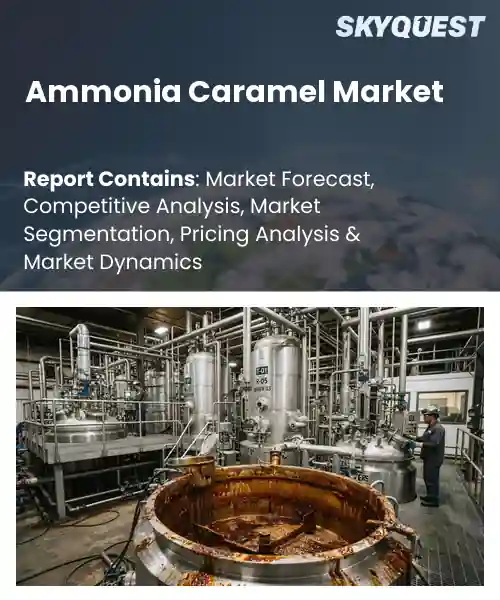
Ammonia Caramel Market
Report ID: SQMIG30I3263
Report ID: SQMIG30I3263
[email protected]
USA +1 351-333-4748
Report ID:
SQMIG30I3263 |
Region:
Global |
Published Date: September, 2026
Pages:
157
|Tables:
117
|Figures:
77


Global Ammonia Caramel Market size was valued at USD 290.0 Million in 2024 and is poised to grow from USD 301.31 Million in 2025 to USD 409.21 Million by 2033, growing at a CAGR of 3.9% during the forecast period (2026-2033).
The ammonia caramel market produces colorants from the Maillard reaction between sugars and ammonia. Its relevance lies in delivering consistent color in baked goods, confectionery, and meals while withstanding processing. The primary driver today is the rising demand for clean‑label products that still require the deep amber hue once supplied by synthetic dyes. Since the 1970s, manufacturers shifted from coal‑tar based colors to ammonia‑caramel as regulators in the EU and US tightened food‑colorant rules. Brands such as Kraft and Nestlé now list “ammonia caramel” on packaging, showing the market’s evolution from niche bakery use to a staple across food categories.Growth in the ammonia caramel market is driven by its expanding role in plant‑based foods, where manufacturers need stable pigments that survive thermal sterilization. The cause‑effect chain starts with consumer demand for vegan snacks, leading producers of meat‑analogues such as Beyond Meat to add ammonia caramel to mimic the browned surface of cooked meat. This use creates demand for higher‑purity grades, spurring investment in production technologies that cut waste and lower cost per kilogram. As supply chains adjust, regional producers in emerging economies gain opportunities to supply localized sourcing, shortening logistics and meeting the sustainability criteria set by multinational retailers.
How is AI-driven automation impacting product consistency in the ammonia caramel market?
AI driven automation is reshaping how manufacturers produce caramel flavored with ammonia, a key taste in confectionery and bakery products. By integrating machine vision and predictive algorithms, producers can monitor temperature, pH and mixing speed in real time, reducing batch to batch variation. This consistency helps brands maintain the familiar taste that consumers expect while cutting waste from off spec batches. Early adopters report smoother scale up from pilot to full production because the system automatically adjusts parameters when raw material properties shift. The technology also frees skilled operators to focus on formulation innovation rather than routine control tasks.In March 2024, Givaudan launched an AI driven production line for ammonia caramel, improving flavor uniformity and accelerating time to market. The system uses continuous sensor feedback to keep critical variables stable, allowing the company to meet growing demand with higher efficiency.
Market snapshot - (2026-2033)
Global Market Size
USD 290.0 Million
Largest Segment
Food Grade
Fastest Growth
Industrial Grade
Growth Rate
3.9% CAGR
To get more insights on this market click here to Request a Free Sample Report
Global ammonia caramel market is segmented by grade, form, application, end use and region. Based on grade, the market is segmented into Food Grade, Pharmaceutical Grade and Industrial Grade. Based on form, the market is segmented into Liquid and Powder & Granular. Based on application, the market is segmented into Food & Beverage Colorants, Coating Agents, pH Stabilizers and Other Applications. Based on end use, the market is segmented into Food & Beverages, Pharmaceuticals and Other End Uses. Based on region, the market is segmented into North America, Europe, Asia Pacific, Latin America and Middle East & Africa.
Food Grade segment dominates because it satisfies the stringent safety and sensory expectations of consumers, prompting manufacturers to prioritize it. Its alignment with food contact regulations builds trust, while its natural color intensity meets brand level aesthetic demands. Producers rely on this grade to maintain label compliance and consumer confidence, which streamlines product development cycles. Consequently, the market channels most of its revenue into Food Grade supplies, reinforcing its leadership position across applications.
However, Pharmaceutical Grade segment is witnessing the strongest growth momentum as health focused manufacturers seek functional colorants with validated purity. The demand for clean label ingredients in nutraceuticals and specialty medicines fuels its adoption, encouraging innovative formulations that leverage ammonia caramel’s antioxidant properties. This rising interest expands market opportunities beyond conventional food uses.
Powder segment dominates because its fine texture enables uniform dispersion in diverse matrices, simplifying processing for manufacturers. The dry form offers extended shelf life, reduces logistical constraints, and integrates seamlessly with standard mixing equipment. It also facilitates precise dosing, which aligns with cost efficiency goals and regulatory labeling requirements. These operational advantages make powder the preferred choice across beverage, confectionery, and bakery applications within the ammonia caramel market.
Meanwhile, Liquid segment is emerging as the key high growth area as manufacturers pursue faster production cycles and intensified flavor release. Its fluid nature integrates smoothly into continuous spray drying and can be directly injected into beverage streams, meeting rising demand for ready to drink products and novel coating techniques, thereby expanding market potential.
To get detailed segments analysis, Request a Free Sample Report
Europe’s leadership stems from a blend of mature confectionery cultures, stringent food safety standards, and proactive sustainability initiatives. Manufacturers benefit from well‑established supply chains and strong collaborations between ingredient producers and consumer‑goods firms. Deep investment in research and development fuels continuous improvement of flavor profiles and processing efficiencies, while regulatory clarity supports consistent product quality. In addition, consumer preferences for premium, artisanal sweet treats reinforce demand, and cross‑border trade within the region amplifies market reach, creating a resilient ecosystem that sustains Europe’s dominant position.
Ammonia Caramel Market in Germany is anchored by a robust network of specialty ingredient suppliers and a legacy of precision engineering in food processing. German confectionery firms prioritize innovative flavor development and align closely with sustainability goals, driving adoption of cleaner production techniques. Strong collaboration with research institutes accelerates formulation advances, while consumer appetite for high‑quality caramel products sustains steady demand across retail and foodservice channels.
Ammonia Caramel Market in the United Kingdom benefits from a dynamic culinary scene that values both tradition and modern flavor experimentation. Producers leverage sophisticated manufacturing capabilities and emphasize traceability and ethical sourcing, resonating with discerning consumers. The market is further reinforced by extensive distribution networks and a thriving artisanal sector that champion premium caramel experiences, ensuring consistent relevance in both domestic consumption and export opportunities.
Ammonia Caramel Market in France is shaped by a deep cultural appreciation for fine confectionery and a strong emphasis on gastronomic excellence. French manufacturers integrate sophisticated processing technologies with a focus on sensory refinement, catering to sophisticated palates. The market also reflects a commitment to sustainability, with many producers adopting eco‑friendly practices that align with consumer expectations for responsibly crafted sweet products.
North America’s rapid growth is propelled by expanding consumer interest in natural and indulgent flavors, coupled with a vibrant foodservice landscape that continually seeks innovative sweet applications. Manufacturers are responding to clean‑label trends by emphasizing transparent sourcing and environmentally conscious production methods. Strong retail infrastructure and aggressive marketing of premium confectionery products amplify visibility, while strategic partnerships between ingredient firms and large‑scale food processors accelerate market penetration. This convergence of consumer demand, supply‑chain efficiency, and innovation fuels a dynamic expansion across the region.
Ammonia Caramel Market in the United States thrives on a culture of culinary creativity and high consumer spending on premium sweets. Leading ingredient suppliers collaborate closely with large snack and bakery manufacturers to integrate caramel flavors into a broad array of products. Emphasis on sustainable sourcing and clean‑label claims resonates with health‑conscious shoppers, while extensive distribution channels ensure broad reach across both traditional retail and emerging e‑commerce platforms.
Ammonia Caramel Market in Canada is reinforced by a strong commitment to quality and sustainability within the food manufacturing sector. Canadian producers focus on integrating responsibly sourced ingredients and innovative processing techniques to meet consumer expectations for authentic caramel taste. Close ties between local dairy and confectionery industries facilitate efficient supply chains, while a growing demand for premium snack options drives continual product development and market expansion.
Asia Pacific advances its market position through escalating demand for sweet snack innovations and a strategic shift toward higher‑value confectionery offerings. The region’s manufacturers are investing heavily in R&D to tailor caramel profiles to diverse taste preferences, while embracing modern, low‑impact production methods. Growing middle‑class consumption and expanding retail formats, including modern trade and online channels, enhance product accessibility. Collaborative ecosystems that link ingredient innovators with fast‑moving consumer goods companies accelerate the introduction of novel caramel applications, solidifying the region’s upward trajectory.
Ammonia Caramel Market in Japan is characterized by meticulous attention to flavor precision and a strong tradition of premium confectionery. Japanese manufacturers integrate advanced processing technologies to achieve consistent caramel texture and subtle sweetness. Consumer expectations for high‑quality, aesthetically appealing products drive continuous refinement, while collaborations with local ingredient specialists support the development of unique caramel blends that complement traditional Japanese desserts and contemporary snack formats.
Ammonia Caramel Market in South Korea benefits from a fast‑moving consumer market that embraces bold taste innovations and indulgent snack experiences. Producers focus on rapid product cycles and agile manufacturing to meet shifting consumer trends. Emphasis on clean‑label ingredients and environmentally responsible sourcing aligns with growing sustainability awareness, while strategic partnerships with popular beverage and bakery brands expand caramel’s application across diverse food categories.
To know more about the market opportunities by region and country, click here to
Buy The Complete Report
Increasing Demand for Natural Sweeteners
Regulatory Push Toward Clean Labels
High Production Cost Compared
Limited Shelf Life Stability
Request Free Customization of this report to help us to meet your business objectives.
Insufficient verified information is available to fulfill the requested details.
Top Player’s Company Profile
Recent Developments
SkyQuest’s ABIRAW (Advanced Business Intelligence, Research & Analysis Wing) is our Business Information Services team that Collects, Collates, Correlates, and Analyses the Data collected by means of Primary Exploratory Research backed by robust Secondary Desk research. As per SkyQuest analysis the global ammonia caramel market is being propelled primarily by the rising demand for natural sweeteners, which encourages manufacturers to replace synthetic colors with clean‑label caramel blends; a second driver is the regulatory push toward clean‑label formulations that reinforce product acceptance across foodservice and retail channels. The market’s growth is tempered by the high production cost associated with specialized equipment and controlled reaction conditions, which can limit price‑sensitive adoption. Europe remains the dominant region, thanks to its mature confectionery culture, stringent safety standards and strong sustainability initiatives, while the Food‑Grade segment leads the market by capturing the bulk of revenue and setting quality expectations across applications.
| Report Metric | Details |
|---|---|
| Market size value in 2024 | USD 290.0 Million |
| Market size value in 2033 | USD 409.21 Million |
| Growth Rate | 3.9% |
| Base year | 2024 |
| Forecast period | (2026-2033) |
| Forecast Unit (Value) | USD Million |
| Segments covered |
|
| Regions covered | North America (US, Canada), Europe (Germany, France, United Kingdom, Italy, Spain, Rest of Europe), Asia Pacific (China, India, Japan, Rest of Asia-Pacific), Latin America (Brazil, Rest of Latin America), Middle East & Africa (South Africa, GCC Countries, Rest of MEA) |
| Companies covered |
|
| Customization scope | Free report customization with purchase. Customization includes:-
|
To get a free trial access to our platform which is a one stop solution for all your data requirements for quicker decision making. This platform allows you to compare markets, competitors who are prominent in the market, and mega trends that are influencing the dynamics in the market. Also, get access to detailed SkyQuest exclusive matrix.
Table Of Content
Executive Summary
Market overview
Parent Market Analysis
Market overview
Market size
KEY MARKET INSIGHTS
COVID IMPACT
MARKET DYNAMICS & OUTLOOK
Market Size by Region
KEY COMPANY PROFILES
Methodology
For the Ammonia Caramel Market, our research methodology involved a mixture of primary and secondary data sources. Key steps involved in the research process are listed below:
1. Information Procurement: This stage involved the procurement of Market data or related information via primary and secondary sources. The various secondary sources used included various company websites, annual reports, trade databases, and paid databases such as Hoover's, Bloomberg Business, Factiva, and Avention. Our team did 45 primary interactions Globally which included several stakeholders such as manufacturers, customers, key opinion leaders, etc. Overall, information procurement was one of the most extensive stages in our research process.
2. Information Analysis: This step involved triangulation of data through bottom-up and top-down approaches to estimate and validate the total size and future estimate of the Ammonia Caramel Market.
3. Report Formulation: The final step entailed the placement of data points in appropriate Market spaces in an attempt to deduce viable conclusions.
4. Validation & Publishing: Validation is the most important step in the process. Validation & re-validation via an intricately designed process helped us finalize data points to be used for final calculations. The final Market estimates and forecasts were then aligned and sent to our panel of industry experts for validation of data. Once the validation was done the report was sent to our Quality Assurance team to ensure adherence to style guides, consistency & design.
Analyst Support
Customization Options
With the given market data, our dedicated team of analysts can offer you the following customization options are available for the Ammonia Caramel Market:
Product Analysis: Product matrix, which offers a detailed comparison of the product portfolio of companies.
Regional Analysis: Further analysis of the Ammonia Caramel Market for additional countries.
Competitive Analysis: Detailed analysis and profiling of additional Market players & comparative analysis of competitive products.
Go to Market Strategy: Find the high-growth channels to invest your marketing efforts and increase your customer base.
Innovation Mapping: Identify racial solutions and innovation, connected to deep ecosystems of innovators, start-ups, academics, and strategic partners.
Category Intelligence: Customized intelligence that is relevant to their supply Markets will enable them to make smarter sourcing decisions and improve their category management.
Public Company Transcript Analysis: To improve the investment performance by generating new alpha and making better-informed decisions.
Social Media Listening: To analyze the conversations and trends happening not just around your brand, but around your industry as a whole, and use those insights to make better Marketing decisions.
REQUEST FOR SAMPLE
 REQUEST FREE CUSTOMIZATION


Want to customize this report? This report can be personalized according to your needs. Our analysts and industry experts will work directly with you to understand your requirements and provide you with customized data in a short amount of time. We offer $1000 worth of FREE customization at the time of purchase.
Feedback From Our Clients


 USA (+1) 351-333-4748

