Amiotide Eye Drop Market
Report ID: SQMIG35I3659
Report ID: SQMIG35I3659
[email protected]
USA +1 351-333-4748
Report ID:
SQMIG35I3659 |
Region:
Global |
Published Date: August, 2026
Pages:
157
|Tables:
143
|Figures:
78


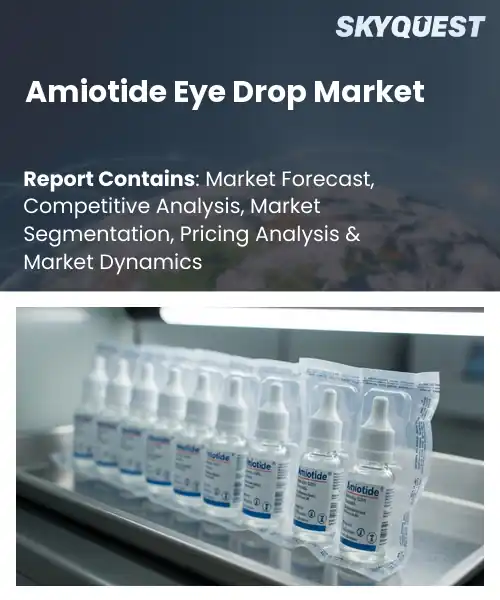
Global Amiotide Eye Drop Market size was valued at USD 180.0 Million in 2024 and is poised to grow from USD 190.44 Million in 2025 to USD 298.99 Million by 2033, growing at a CAGR of 5.8% during the forecast period (2026-2033).
The rising prevalence of ocular disorders is a major driver of the global Amiotide eye drop market because growing patient populations create greater demand for effective ophthalmic treatments. The rise of the elderly population, increased time spent on screens, diabetes-related eye diseases, and lifestyle changes are factors that affect the growing number of eye diseases. More patients develop symptoms that call for the need of treatment. The treatments will then stimulate diagnostic processes that would create prospects for drug production in ophthalmology. As a result, doctors will start prescribing eye drops more regularly for daily and lasting therapies. With the increase of illnesses, the market for drugs will grow, and the suppliers will enhance their marketing policy.
Advancements in ophthalmic drug-delivery technologies are an key trend driving the global amiotide eye drop sector. Thanks to changes in the production process manufacturers have moved their attention towards formulations designed to assure high ocular absorption, drug stability, ease of use, and efficiency of therapy. In view of the fact that the majority of eye drops are rapidly removed from the eye, new delivery techniques may make it possible to increase the period the drug stays in the area treated for more effective results. Therefore, new formulations may become more acceptable to doctors and increase patient compliance, especially in cases where repeated use of medication is needed. Manufacturing companies will benefit from investments in formulation research, preservative-free products, and advanced delivery systems.
How is Ai-Driven Drug Delivery Automation Influencing the Amiotide Eye Drop Market?
AI is indirectly impacting the global Amiotide eye drop market by accelerating ophthalmic drug discovery, target identification, and candidate screening. Because AI can analyze large biomedical datasets and identify disease–target relationships faster, pharmaceutical companies can shorten early-stage research and improve candidate selection, potentially increasing innovation in ophthalmic therapies. A related development occurred in July 2026, when FRONTEO and Santen Pharmaceutical launched a second AI-driven project using KIBIT to identify promising ophthalmic assets and mechanisms of action.
Market snapshot - (2026-2033)
Global Market Size
USD 180.0 Million
Largest Segment
Preservative-Free
Fastest Growth
Preservative-Free
Growth Rate
5.8% CAGR
To get more insights on this market click here to Request a Free Sample Report
Global amiotide eye drop market is segmented by formulation, indication, packaging type, distribution channel, end user and region. Based on formulation, the market is segmented into preservative-free and preserved. Based on indication, the market is segmented into dry eye syndrome, ocular irritation, post-surgical care and others. Based on packaging type, the market is segmented into single-dose and multi-dose. Based on distribution channel, the market is segmented into hospital pharmacies, retail pharmacies and online pharmacies. Based on end user, the market is segmented into hospitals, ophthalmology clinics and home care. Based on region, the market is segmented into North America, Europe, Asia Pacific, Latin America and Middle East & Africa.
preservative free segment dominates because clinicians prioritize safety and patient comfort, eliminating the risk of preservative induced toxicity. People’s preference for using preservative-free products leads to higher use of chronic dry eye treatments, where taking multiple doses of medication is very common, because of preference and it results in manufacturers investing in advanced sterile production. Also, guidance by regulatory authorities promotes preservation-free formulations to minimize irritation of the eyes and guarantees steady demand for preservation-free formulations.
However, Preserved segment emerges as the fastest growing area due to its cost efficiency and ease of integration into existing supply chains. Manufacturers are leveraging preservative technologies to extend shelf life, appealing to high volume retail channels and emerging markets where price sensitivity drives adoption, thus accelerating market expansion.
Hospital pharmacies segment dominates because they are primary access points for specialized ocular therapies, ensuring clinicians obtain amiotide eye drops with proper handling and documentation. The integration of their services with inpatient and outpatient care allows for easy prescription of drugs for surgery and chronic health issues, thus building confidence and ensuring constant volume of institutional procurement. Furthermore, the hospital pharmacy protocols highlight sterility and traceability in line with regulatory requirements for ophthalmic drugs.
Meanwhile, online pharmacies segment is witnessing the strongest growth momentum as digital adoption enhances convenience for patients with chronic dry eye. Ecommerce platforms simplify ordering, provide home delivery, expanding reach beyond traditional channels. This ease of access fuels market penetration, creating opportunities for manufacturers to engage directly with end users and accelerate market expansion.
To get detailed segments analysis, Request a Free Sample Report
North America retains a clear leadership position in the industry due to a confluence of advanced healthcare infrastructure, strong reimbursement frameworks, and a mature ecosystem of specialized ophthalmology practices. With the presence of many highly performing research institutions that contribute to constant innovation, the region enjoys quick access to new technologies in drug delivery. Furthermore, because the process of getting regulatory approvals for new therapies is easier, the collaboration of leading universities with top international producers ensures that clinical knowledge acquired is quickly transformed into commercially viable products. Besides, high level of patient education and demand for scientific evidence support the need in urban and suburban areas, thus creating favorable circumstances for product introduction in the market.
Amiotide eye drop market in the United States is shaped by a deep network of specialty eye clinics and a proactive payer environment that values clinical outcomes. Doctors’ advocacy organizations are essential in the development of guidelines, thus leading to early adoption of targeted treatments. Integrative health systems provide the setting for the provision of coordinated care paths, making sure that patients get prompt treatment. Hence, the collaboration of physicians, payers and innovators allows the U.S. to be the benchmark for the performance of goods.
Amiotide eye drop market in Canada is driven by a publicly funded health system that emphasizes equitable access to essential ophthalmic treatments. Cost-effectiveness is the primary consideration of provincial health authorities; hence, manufacturers are required to show a clear therapeutic effect. At the same time, the formation of collaborative research networks among leading academic hospitals facilitates the process of clinical trials and obtaining real-world evidence. The supportive environment with patient advocates leads to a constant introduction of new eye drop products in Canada.
Europe experiences rapid expansion of the industry as a result of cohesive regulatory alignment, strong reimbursement mechanisms, and an increasingly patient‑centric healthcare paradigm. The dedication shown by the region towards precision medicine serves as an impetus for the increasing use of solutions that are better suited for treating specific eye diseases. Existing clinical trial networks facilitate the generation of the necessary data, which helps to pave the way for the adoption of new treatments. In addition, authorities responsible for health issues in the main markets are keen on making new therapies available. Finally, the rising interest in eye health among older generations leads to the increased demand for adequate solutions.
Amiotide eye drop market in Germany benefits from a robust pharmaceutical landscape anchored by leading research institutions and a health insurance system that rewards therapeutic innovation. Pioneering physicians utilize a variety of advanced education programs to add new formulations of eye drops to their practices. An agreement between biotech companies and university hospitals simplifies the process of turning clinical data into medicine approvals. The combination of these systems makes Germany a leader in fine products in the area of eye care.
Amiotide eye drop market in the United Kingdom is propelled by a dynamic NHS framework that incentivizes cost‑effective treatments alongside rapid technology assessment pathways. Specialty groups led by clinicians advocate the use of evidence-based practices to speed up the incorporation of new types of eye drops. There are close links between academic research and business that promote the collection of real-world evidence to reassure prescribers about the effectiveness of treatments. As a result of this combination of regulatory flexibility and clinical passion, the United Kingdom is the fastest-growing market in Europe.
Amiotide eye drop market in France is emerging as a focal point for ophthalmic innovation, supported by a universal health coverage model that ensures broad patient access. Ophthalmological networks focus on complying with certain guidelines so that new treatment strategies could be integrated gradually. Spending money on translational research enables the newly developed treatments to be applied in practices. There is increasing support and understanding of eye diseases among patients which result in the broader demand for novel types of eye drops.
Asia Pacific is strengthening its position in the industry through a blend of rapid healthcare modernization, expanding middle‑class populations, and proactive regulatory environments. Various nations within the geographical region are allocating huge sums of money for eye-related malady examination initiatives, making it possible to deal with such illnesses in an early manner. Local makers have started to cooperate with the global industry leaders more and more frequently, using local manufacturing capacities for greater efficiency of the supply chain. The traditional focus on preventive eye treatment along with an increased readiness of consumers for new therapies creates favourable conditions for rapid development of the market.
Amiotide eye drop market in Japan is characterized by a sophisticated medical infrastructure and a culturally ingrained emphasis on preventive eye health. Ophthalmology's top professional organizations reach agreement on norms referring to treatment, which leads to quick application of modern drops. Tight cooperation between local research facilities and international companies ensures constant improvement of products. The system of reimbursements guided by the results of clinical trials helps physicians apply only efficient treatments and confirms Japan’s image of being a mature and powerful market.
Amiotide eye drop market in South Korea thrives on a high‑tech healthcare ecosystem and an agile regulatory pathway that accelerates product launches. Public health campaigns with the goal of raising awareness make it easier for patients to engage with eye care services. Biotech startups and pharmaceutical companies working together results in faster innovation cycles. These two factors, along with consumers' growing acceptance of advance medical solutions are what help South Korea achieve more importance in the Asia Pacific region.
To know more about the market opportunities by region and country, click here to
Buy The Complete Report
Increasing Prevalence of Ocular Disorders
Advancements In Drug Delivery Technologies
Stringent Regulatory Approval Processes
High Cost of Advanced Formulations
Request Free Customization of this report to help us to meet your business objectives.
The global amiotide eye drop market outlook features Jiangsu Puhua Kesheng Pharmaceutical, Zhenjiang Hengxin Pharmaceutical, and Hangzhou Guoguang Pharmaceutical as key manufacturers. Jiangsu Puhua Kesheng is known for its focus on enhancing local manufacturing and healthcare distribution, while Zhenjiang Hengxin and Hangzhou Guoguang excel in production and marketing expansion. The firms are further focused on portfolio expansion, regulatory compliance, and marketing ambitions.
Top Player’s Company Profile
Recent Developments in Global Amiotide Eye Drop Market
SkyQuest’s ABIRAW (Advanced Business Intelligence, Research & Analysis Wing) is our Business Information Services team that Collects, Collates, Correlates, and Analyses the Data collected by means of Primary Exploratory Research backed by robust Secondary Desk research.
As per SkyQuest analysis the global amiotide eye drop industry is driven primarily by the rising prevalence of ocular disorders that boost demand for effective, non‑invasive therapies. A second catalyst is the rapid advancement of drug‑delivery technologies, especially preservative‑free and nano‑emulsion formulations that improve bioavailability and patient comfort. The market is led by North America, where advanced healthcare infrastructure and strong reimbursement support rapid adoption. Within the product landscape the preservative‑free segment dominates, reflecting clinician preference for safety. However, stringent regulatory approval processes act as a restraint, extending development timelines and limiting entry for new players.
| Report Metric | Details |
|---|---|
| Market size value in 2024 | USD 180.0 Million |
| Market size value in 2033 | USD 298.99 Million |
| Growth Rate | 5.8% |
| Base year | 2024 |
| Forecast period | (2026-2033) |
| Forecast Unit (Value) | USD Million |
| Segments covered |
|
| Regions covered | North America (US, Canada), Europe (Germany, France, United Kingdom, Italy, Spain, Rest of Europe), Asia Pacific (China, India, Japan, Rest of Asia-Pacific), Latin America (Brazil, Rest of Latin America), Middle East & Africa (South Africa, GCC Countries, Rest of MEA) |
| Companies covered |
|
| Customization scope | Free report customization with purchase. Customization includes:-
|
To get a free trial access to our platform which is a one stop solution for all your data requirements for quicker decision making. This platform allows you to compare markets, competitors who are prominent in the market, and mega trends that are influencing the dynamics in the market. Also, get access to detailed SkyQuest exclusive matrix.
Table Of Content
Executive Summary
Market overview
Parent Market Analysis
Market overview
Market size
KEY MARKET INSIGHTS
COVID IMPACT
MARKET DYNAMICS & OUTLOOK
Market Size by Region
KEY COMPANY PROFILES
Methodology
For the Amiotide Eye Drop Market, our research methodology involved a mixture of primary and secondary data sources. Key steps involved in the research process are listed below:
1. Information Procurement: This stage involved the procurement of Market data or related information via primary and secondary sources. The various secondary sources used included various company websites, annual reports, trade databases, and paid databases such as Hoover's, Bloomberg Business, Factiva, and Avention. Our team did 45 primary interactions Globally which included several stakeholders such as manufacturers, customers, key opinion leaders, etc. Overall, information procurement was one of the most extensive stages in our research process.
2. Information Analysis: This step involved triangulation of data through bottom-up and top-down approaches to estimate and validate the total size and future estimate of the Amiotide Eye Drop Market.
3. Report Formulation: The final step entailed the placement of data points in appropriate Market spaces in an attempt to deduce viable conclusions.
4. Validation & Publishing: Validation is the most important step in the process. Validation & re-validation via an intricately designed process helped us finalize data points to be used for final calculations. The final Market estimates and forecasts were then aligned and sent to our panel of industry experts for validation of data. Once the validation was done the report was sent to our Quality Assurance team to ensure adherence to style guides, consistency & design.
Analyst Support
Customization Options
With the given market data, our dedicated team of analysts can offer you the following customization options are available for the Amiotide Eye Drop Market:
Product Analysis: Product matrix, which offers a detailed comparison of the product portfolio of companies.
Regional Analysis: Further analysis of the Amiotide Eye Drop Market for additional countries.
Competitive Analysis: Detailed analysis and profiling of additional Market players & comparative analysis of competitive products.
Go to Market Strategy: Find the high-growth channels to invest your marketing efforts and increase your customer base.
Innovation Mapping: Identify racial solutions and innovation, connected to deep ecosystems of innovators, start-ups, academics, and strategic partners.
Category Intelligence: Customized intelligence that is relevant to their supply Markets will enable them to make smarter sourcing decisions and improve their category management.
Public Company Transcript Analysis: To improve the investment performance by generating new alpha and making better-informed decisions.
Social Media Listening: To analyze the conversations and trends happening not just around your brand, but around your industry as a whole, and use those insights to make better Marketing decisions.
REQUEST FOR SAMPLE
 REQUEST FREE CUSTOMIZATION
Global Amiotide Eye Drop Market size was valued at USD 180.0 Million in 2024 and is poised to grow from USD 190.44 Million in 2025 to USD 298.99 Million by 2033, growing at a CAGR of 5.8% during the forecast period (2026-2033).
I don’t have sufficient information to generate the requested content. 'Sun Pharmaceutical Industries Limited', 'Cipla Limited', 'Lupin Limited', 'Dr. Reddy's Laboratories Ltd.', 'Alcon Inc.', 'AbbVie Inc.', 'Bausch + Lomb Corporation', 'Santen Pharmaceutical Co., Ltd.', 'Thea Pharma', 'Ajanta Pharma Limited', 'Intas Pharmaceuticals Ltd.', 'FDC Limited', 'ENTOD Pharmaceuticals Ltd.', 'Micro Labs Limited', 'Torrent Pharmaceuticals Ltd.', 'Zydus Lifesciences Limited', 'Aurobindo Pharma Limited', 'Rohto Pharmaceutical Co., Ltd.', 'Novartis AG', 'Johnson & Johnson Vision'
Rising incidence of conditions such as dry eye syndrome, glaucoma, and postoperative inflammation creates sustained demand for therapeutic eye drops, prompting clinicians to incorporate Amiotide as an effective option. The growing awareness of early intervention and the preference for non‑invasive treatments further encourage prescription rates. As patients seek relief from symptoms, ophthalmologists prioritize agents that offer rapid onset and favorable safety profiles, positioning Amiotide to capture expanding market share and support overall market expansion. Additionally, the ease of self‑administration reduces dependence on clinical visits, reinforcing patient adherence and long‑term usage.
Personalized Therapy Adoption: Clinicians are increasingly tailoring amiotide eye drop regimens to individual patient profiles, driven by advances in genetic screening and biomarker identification. This personalization enables optimized dosing schedules, improved adherence, and enhanced therapeutic outcomes, particularly for complex ocular conditions. Pharmaceutical firms are responding by developing modular formulation platforms that can be rapidly adjusted to meet specific patient needs, fostering a shift from a one-size-fits-all model toward a more precise, patient-centric care paradigm across ophthalmology globally by 2025 and beyond in practice.
Why does North America Dominate the Global Amiotide Eye Drop Market? |@12


Want to customize this report? This report can be personalized according to your needs. Our analysts and industry experts will work directly with you to understand your requirements and provide you with customized data in a short amount of time. We offer $1000 worth of FREE customization at the time of purchase.
Feedback From Our Clients


 USA (+1) 351-333-4748

