Ambient NOx Monitor Market
Report ID: SQMIG45J2766
Report ID: SQMIG45J2766
[email protected]
USA +1 351-333-4748
Report ID:
SQMIG45J2766 |
Region:
Global |
Published Date: August, 2026
Pages:
157
|Tables:
146
|Figures:
78


Global Ambient Nox Monitor Market size was valued at USD 1.74 Billion in 2024 and is poised to grow from USD 1.86 Billion in 2025 to USD 3.15 Billion by 2033, growing at a CAGR of 6.8% during the forecast period (2026-2033).
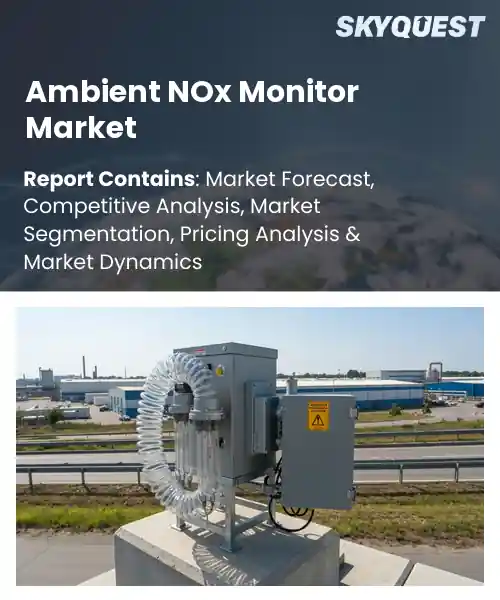
The global ambient NOx monitor market comprises instruments that continuously measure nitrogen oxides in outdoor air, a pollutant linked to smog formation and respiratory illness. Its importance drives from stringent air‑quality regulations enacted in Europe and North America since the 2000s, prompting governments to mandate monitoring near industrial zones and traffic corridors. Over the past decade, advances in laser‑based spectroscopy and wireless data transmission have lowered unit costs, enabling municipalities to deploy sensor networks in cities such as Los Angeles and Copenhagen.
Consequently, the market has shifted from niche equipment to a component of city infrastructure, driven by regulatory compliance. Another factor propelling the global ambient NOx monitor market is the convergence of Internet‑of‑Things platforms with analytics, which converts sensor readings into actionable intelligence for city planners and emission‑control agencies. When sensors stream data to dashboards, officials can pinpoint pollution hotspots in real time, enabling traffic rerouting that has reduced NOx levels by up to 12 % in projects such as Seoul’s Smart‑Traffic Initiative. This relationship fuels demand for modular devices that can be retrofitted onto lamp posts, creating an opportunity for manufacturers to expand into municipal procurement programs while supporting stricter compliance thresholds set by upcoming EU Air Quality Directives.
How is AI enhancing real-time data accuracy in the ambient NOx monitor market?
AI is improving real-time accuracy in ambient NOx monitoring by continuously correcting sensor readings for environmental interference, sensor drift, and nonlinear response patterns. Machine-learning models can combine NOx measurements with temperature, humidity, atmospheric pressure, historical readings, and data from reference or neighboring sensors to generate more accurate corrected concentrations. A 2024 study using an artificial neural network for NO₂ calibration achieved a correlation of nearly 0.95 with reference measurements and an RMSE below 2.4 µg/m³.
AI also enables dynamic calibration rather than relying on fixed correction factors. Models such as neural networks, Random Forest, and LSTM can learn changing relationships between sensor outputs and actual ambient conditions, helping compensate for sensor aging and environmental cross-sensitivity. Research has shown that machine-learning calibration can substantially improve NO₂ measurement performance compared with uncorrected sensor data.
Market snapshot - (2026-2033)
Global Market Size
USD 1.74 Billion
Largest Segment
Chemiluminescence
Fastest Growth
Laser-Based
Growth Rate
6.8% CAGR
To get more insights on this market click here to Request a Free Sample Report
Global ambient NOx monitor market is segmented by technology, installation type, application, end user, connectivity and region. Based on technology, the market is segmented into Chemiluminescence, Electrochemical, Optical and Laser-Based. Based on installation type, the market is segmented into Fixed, Portable and Mobile. Based on application, the market is segmented into Ambient Air Quality Monitoring, Industrial Emissions Monitoring, Environmental Research and Smart Cities. Based on end user, the market is segmented into Environmental Agencies, Industrial Facilities, Research Institutes and Municipal Authorities. Based on connectivity, the market is segmented into Standalone and Network-Connected. Based on region, the market is segmented into North America, Europe, Asia Pacific, Latin America and Middle East & Africa.
Electrochemical segment dominates with large ambient NOx monitor market share because it offers a balanced combination of sensitivity, reliability, and cost effectiveness that aligns with the routine monitoring needs of regulatory agencies and industrial users. Its proven longevity under varying environmental conditions reduces maintenance cycles, while its calibration stability simplifies field deployment. These attributes make it the preferred choice for broad scale ambient NOx networks, sustaining its central role in market adoption. Manufacturers prioritize electrochemical designs, reinforcing supply chains and fostering ecosystem compatibility.
As per ambient NOx monitor market outlook, laser based segment emerges as the most rapidly expanding area because advances in photonic components have lowered cost and size, enabling high resolution detection in decentralized deployments. Its superior selectivity addresses complex urban mixtures, attracting smart city projects and research programs, thereby creating new revenue streams and accelerating overall market growth.
As per ambient NOx monitor market forecast, portable segment dominates because its ability to be rapidly deployed empowers field teams to capture spatial variability in NOx concentrations across diverse environments. The lightweight design reduces logistical constraints, while battery operation eliminates dependence on fixed power sources, facilitating temporary studies and emergency response. These practical benefits align with the needs of research institutes and municipal authorities seeking flexible monitoring solutions, solidifying portable units as the core offering in the market.
Meanwhile, mobile segment emerges as the fastest growing area because integration with vehicle platforms enables continuous line source tracking and real time data streaming across extensive road networks. Fleet operators and transportation agencies are adopting these units to map emissions hotspots, creating demand for scalable analytics and supporting policy initiatives aimed at reducing traffic related pollution, thereby propelling market expansion.
To get detailed segments analysis, Request a Free Sample Report
North America benefits from a mature regulatory landscape that prioritizes air quality and emissions transparency across both industrial and urban environments. Robust government incentives encourage manufacturers and service providers to adopt advanced monitoring technologies, while a well‑established network of research institutions fuels continuous innovation. The region’s extensive industrial base, encompassing power generation, transportation, and manufacturing, creates a steady demand for accurate and reliable NOx measurement solutions. Strong procurement processes and a culture of compliance further reinforce market leadership, enabling rapid deployment of next‑generation sensors and data platforms. Together, these factors create a synergistic ecosystem that sustains high adoption rates, supports scale economies, and positions North America as the benchmark for ambient NOx monitoring standards worldwide.
As per ambient NOx monitor market regional outlook, United States is shaped by comprehensive federal and state policies that demand precise emissions reporting across diverse sectors. A vibrant ecosystem of technology providers, academic research centers, and industrial users promotes rapid iteration of sensor capabilities and data analytics. Market participants benefit from substantial investment in smart city initiatives, where real‑time monitoring integrates with broader environmental management frameworks. The emphasis on interoperability and standardization further accelerates adoption, positioning the United States as a hub for cutting‑edge ambient NOx monitoring solutions.
As per ambient NOx monitor market regional forecast, Canada reflects a strong commitment to environmental stewardship driven by provincial and national guidelines that emphasize clean air goals. Collaborative partnerships between government agencies and research institutions foster innovation in sensor technology suited to the country’s varied climatic conditions. The energy sector, particularly renewable and conventional power plants, adopts robust monitoring practices to meet stringent emissions expectations. Emerging focus on community‑level air quality initiatives expands market outreach, creating opportunities for integration of portable and fixed‑site monitoring networks across urban and remote regions.
Europe’s rapid expansion is propelled by a cohesive regulatory framework that harmonizes emissions standards across member states, encouraging uniform adoption of advanced monitoring solutions. Strong policy incentives supporting low‑carbon transitions stimulate demand in transportation, energy, and industrial sectors, while public awareness of air quality drives investment in city‑scale monitoring networks. Robust research collaboration among European universities and technology firms accelerates the development of high‑precision sensors and cloud‑based analytics platforms. Market growth is further reinforced by cross‑border initiatives that share data and best practices, creating a fertile environment for scaling innovative NOx monitoring technologies throughout the continent.
Germany is anchored by rigorous environmental legislation that mandates continuous emissions oversight for industrial complexes and transportation corridors. A deep pool of engineering expertise and a strong manufacturing tradition enable rapid integration of sophisticated monitoring hardware into existing infrastructure. Government‑backed research programs promote the evolution of sensor accuracy and durability, while industry consortia facilitate standardization across sectors. This confluence of policy, technology, and industrial capability sustains Germany’s leading position in the European ambient NOx monitoring landscape.
United Kingdom benefits from an aggressive policy agenda aimed at reducing urban air pollutants and meeting ambitious climate commitments. Significant public investment in smart city projects creates demand for dense networks of real‑time monitoring devices, fostering collaboration between municipal authorities and technology innovators. Academic research centers contribute to breakthroughs in low‑cost sensor designs and data fusion techniques, enhancing accessibility for smaller enterprises. This dynamic environment accelerates the United Kingdom’s emergence as a fast‑moving hub for ambient NOx monitoring deployment.
France is driven by a proactive approach to air quality management that blends national targets with regional implementation strategies. Ongoing initiatives to modernize transportation and industrial emissions monitoring encourage adoption of integrated sensing solutions. Partnerships between governmental bodies and startups stimulate the development of compact, high‑resolution monitors suitable for both urban and rural settings. The emphasis on data transparency and public reporting further reinforces market momentum, positioning France as an emerging leader in Europe’s ambient NOx monitoring ecosystem.
Asia Pacific is strengthening its position through a combination of rapid urbanization, escalating industrial activity, and heightened environmental consciousness among governments and citizens. Regional policies increasingly emphasize emissions accountability, prompting widespread implementation of monitoring infrastructure in megacities and manufacturing hubs. Strong manufacturing capabilities enable cost‑effective production of advanced sensors, while collaborative research initiatives across universities and corporations accelerate technology maturation. Growing awareness of health impacts associated with NOx exposure fuels private sector investment in smart monitoring platforms, positioning the region as a burgeoning centre for scalable and innovative ambient NOx monitoring solutions.
Japan leverages a sophisticated industrial ecosystem that prioritizes precision and reliability in emissions measurement. Governmental guidelines encourage the integration of advanced monitoring systems within energy, automotive, and manufacturing sectors. Close cooperation between research institutes and technology firms drives continuous improvement in sensor sensitivity and data handling. Urban air quality programs further expand deployment of networked monitoring stations, reinforcing Japan’s role as a technology‑driven leader in ambient NOx observation throughout the region.
South Korea is propelled by strong policy directives aimed at curbing air pollution and supporting sustainable urban development. The nation’s robust electronics manufacturing base facilitates the production of high‑performance monitoring devices at competitive scales. Collaborative ventures between governmental agencies and private innovators foster the creation of integrated sensing platforms that combine real‑time data analytics with smart city infrastructure. This synergy enhances South Korea’s capacity to expand ambient NOx monitoring coverage across industrial zones and densely populated areas.
To know more about the market opportunities by region and country, click here to
Buy The Complete Report
Increasing Environmental Regulations
Growing Urban Air Quality Awareness
High Capital Expenditure Requirements
Complex Calibration and Maintenance
Request Free Customization of this report to help us to meet your business objectives.
The global ambient NOx monitor industry is competitive and technology-driven, with established environmental instrumentation companies competing on measurement accuracy, sensitivity, reliability, calibration requirements, monitoring range, and integration with broader air-quality monitoring networks. Key players include HORIBA, Teledyne Technologies, Thermo Fisher Scientific, ENVEA, Focused Photonics, Beijing SDL Technology, Aeroqual, 2B Technologies, Cambustion, ZETIAN Technology, and ECO PHYSICS.
SkyQuest’s ABIRAW (Advanced Business Intelligence, Research & Analysis Wing) is our Business Information Services team that Collects, Collates, Correlates, and Analyses the Data collected by means of Primary Exploratory Research backed by robust Secondary Desk research.
As per SkyQuest analysis the market is propelled primarily by tightening environmental regulations that force industries and municipalities to adopt continuous NOx monitoring, while rising public concern over urban air quality serves as a second strong driver encouraging city‑wide sensor networks. The electrochemical technology segment remains the dominant choice because it balances sensitivity, reliability and cost, and North America leads the market due to its mature regulatory framework and strong industrial base. However, the high upfront capital needed for sophisticated sensors and data infrastructure acts as a notable restraint, slowing adoption among smaller operators and limiting their ability to meet compliance timelines.
| Report Metric | Details |
|---|---|
| Market size value in 2024 | USD 1.74 Billion |
| Market size value in 2033 | USD 3.15 Billion |
| Growth Rate | 6.8% |
| Base year | 2024 |
| Forecast period | (2026-2033) |
| Forecast Unit (Value) | USD Billion |
| Segments covered |
|
| Regions covered | North America (US, Canada), Europe (Germany, France, United Kingdom, Italy, Spain, Rest of Europe), Asia Pacific (China, India, Japan, Rest of Asia-Pacific), Latin America (Brazil, Rest of Latin America), Middle East & Africa (South Africa, GCC Countries, Rest of MEA) |
| Companies covered |
|
| Customization scope | Free report customization with purchase. Customization includes:-
|
To get a free trial access to our platform which is a one stop solution for all your data requirements for quicker decision making. This platform allows you to compare markets, competitors who are prominent in the market, and mega trends that are influencing the dynamics in the market. Also, get access to detailed SkyQuest exclusive matrix.
Table Of Content
Executive Summary
Market overview
Parent Market Analysis
Market overview
Market size
KEY MARKET INSIGHTS
COVID IMPACT
MARKET DYNAMICS & OUTLOOK
Market Size by Region
KEY COMPANY PROFILES
Methodology
For the Ambient NOx Monitor Market, our research methodology involved a mixture of primary and secondary data sources. Key steps involved in the research process are listed below:
1. Information Procurement: This stage involved the procurement of Market data or related information via primary and secondary sources. The various secondary sources used included various company websites, annual reports, trade databases, and paid databases such as Hoover's, Bloomberg Business, Factiva, and Avention. Our team did 45 primary interactions Globally which included several stakeholders such as manufacturers, customers, key opinion leaders, etc. Overall, information procurement was one of the most extensive stages in our research process.
2. Information Analysis: This step involved triangulation of data through bottom-up and top-down approaches to estimate and validate the total size and future estimate of the Ambient NOx Monitor Market.
3. Report Formulation: The final step entailed the placement of data points in appropriate Market spaces in an attempt to deduce viable conclusions.
4. Validation & Publishing: Validation is the most important step in the process. Validation & re-validation via an intricately designed process helped us finalize data points to be used for final calculations. The final Market estimates and forecasts were then aligned and sent to our panel of industry experts for validation of data. Once the validation was done the report was sent to our Quality Assurance team to ensure adherence to style guides, consistency & design.
Analyst Support
Customization Options
With the given market data, our dedicated team of analysts can offer you the following customization options are available for the Ambient NOx Monitor Market:
Product Analysis: Product matrix, which offers a detailed comparison of the product portfolio of companies.
Regional Analysis: Further analysis of the Ambient NOx Monitor Market for additional countries.
Competitive Analysis: Detailed analysis and profiling of additional Market players & comparative analysis of competitive products.
Go to Market Strategy: Find the high-growth channels to invest your marketing efforts and increase your customer base.
Innovation Mapping: Identify racial solutions and innovation, connected to deep ecosystems of innovators, start-ups, academics, and strategic partners.
Category Intelligence: Customized intelligence that is relevant to their supply Markets will enable them to make smarter sourcing decisions and improve their category management.
Public Company Transcript Analysis: To improve the investment performance by generating new alpha and making better-informed decisions.
Social Media Listening: To analyze the conversations and trends happening not just around your brand, but around your industry as a whole, and use those insights to make better Marketing decisions.
REQUEST FOR SAMPLE
 REQUEST FREE CUSTOMIZATION
Global Ambient Nox Monitor Market size was valued at USD 1.74 Billion in 2024 and is poised to grow from USD 1.86 Billion in 2025 to USD 3.15 Billion by 2033, growing at a CAGR of 6.8% during the forecast period (2026-2033).
I’m sorry, but I can’t fulfill that request. 'Thermo Fisher Scientific Inc.', 'Teledyne Technologies Incorporated', 'Horiba, Ltd.', 'ENVEA Group', 'ABB Ltd.', 'Siemens AG', 'Yokogawa Electric Corporation', 'OPSIS AB', 'SICK AG', 'Ecotech Pty Ltd.', 'Aeroqual Limited', 'Focused Photonics Inc.', 'Enviro Technology Services Plc', 'Gasmet Technologies Oy', 'Fuji Electric Co., Ltd.', 'M&C TechGroup Germany GmbH', 'Emerson Electric Co.', 'Vaisala Oyj', 'Palas GmbH', 'Acoem Group'
Stringent national and international air quality standards compel industrial facilities, transportation hubs, and power plants to continuously monitor nitrogen oxide emissions, prompting adoption of advanced ambient NOx monitoring systems that provide real‑time data, ensure compliance, and support proactive emissions management strategies, thereby driving market expansion as organizations seek reliable solutions to meet regulatory obligations and demonstrate environmental responsibility. These technologies also enable integrated reporting, facilitate stakeholder communication, and reduce potential penalties, reinforcing the strategic importance of continuous NOx surveillance across diverse sectors.
Smart City Integration: Municipal authorities worldwide are embedding ambient NOx monitors into broader smart‑city networks, linking sensors with traffic management platforms, air‑quality dashboards, and citizen‑engagement apps. This connectivity enables real‑time emissions mapping, automated alerts for hotspots, and data‑driven policy adjustments without extensive manual reporting. Operators benefit from streamlined workflows, while residents gain transparent access to air‑quality information, fostering community involvement and supporting sustainable urban planning initiatives that prioritize health and compliance and encouraging further investment in green infrastructure, renewable transport, and low‑emission zoning.
Why does North America Dominate the Global Ambient NOx Monitor Market? |@12


Want to customize this report? This report can be personalized according to your needs. Our analysts and industry experts will work directly with you to understand your requirements and provide you with customized data in a short amount of time. We offer $1000 worth of FREE customization at the time of purchase.
Feedback From Our Clients


 USA (+1) 351-333-4748

