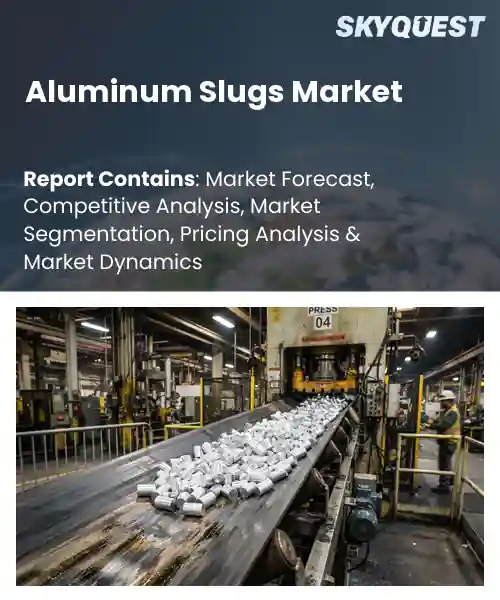
Aluminum Slugs Market
Report ID: SQMIG15I2027
Report ID: SQMIG15I2027
[email protected]
USA +1 351-333-4748
Report ID:
SQMIG15I2027 |
Region:
Global |
Published Date: August, 2026
Pages:
157
|Tables:
125
|Figures:
77


Global Aluminum Slugs Market size was valued at USD 3.42 Billion in 2024 and is poised to grow from USD 3.63 Billion in 2025 to USD 5.83 Billion by 2033, growing at a CAGR of 6.1% during the forecast period (2026-2033).
The aluminum slugs market has emerged as a segment within the metal alloy industry, driven primarily by the need for lightweight projectiles in civilian and defense applications. Historically, manufacturers relied on lead‑based slugs, but regulatory pressure to reduce toxic material use prompted a shift toward aluminum alternatives in the early 2000s. This transition gained momentum as governments introduced stricter emissions standards and hunting organizations endorsed environmentally friendly ammunition. Consequently, producers invested in alloy formulation research, resulting in slugs that combine ballistic performance with lower recoil. The market’s relevance lies in its capacity to satisfy sustainability mandates while supporting shooting technology. Rising demand for environmentally compliant ammunition acts as a catalyst propelling the aluminum slugs market toward expansion, because stricter hunting regulations and shooting bans force users to replace lead with alternatives. This pressure has unlocked opportunities for manufacturers to leverage aluminum’s strength‑to‑weight ratio, enabling thinner‑walled projectiles that maintain kinetic energy while reducing barrel wear. Defense contractors have adopted these slugs for lightweight rounds, improving vehicle payload efficiency, and law‑enforcement agencies deploy them in training to lower health risks. As recycling infrastructure for aluminum grows, material costs fall, further encouraging significant volume growth and geographic penetration into global emerging markets future.
How is AI-driven automation impacting production efficiency in the aluminum slugs market?
AI‑driven automation is reshaping aluminum slug production by linking sensors, machine‑learning models and robotic handling into a seamless workflow. Real‑time data from extrusion presses feed predictive algorithms that adjust temperature, pressure and feed rates, reducing scrap and cycle time. Vision systems inspect dimensions on the fly, allowing immediate corrective actions without stopping the line. Integrated scheduling software balances orders across multiple furnaces, smoothing workloads and cutting idle periods. These technologies together create a more responsive plant that can adapt to demand spikes while maintaining tight quality standards, making the sector more competitive and resource‑efficient.Ball 2025, launched an AI‑controlled slug forming line in July, demonstrating how intelligent automation can lift throughput and lower energy use, reinforcing growth in the aluminum slug market.
Market snapshot - (2026-2033)
Global Market Size
USD 3.42 Billion
Largest Segment
Impact-Extruded Aluminum Slugs
Fastest Growth
Deep-Drawing Aluminum Slugs
Growth Rate
6.1% CAGR
To get more insights on this market click here to Request a Free Sample Report
Global aluminum slugs market is segmented by product type, alloy type, application, end user and region. Based on product type, the market is segmented into Impact-Extruded Aluminum Slugs, Cold-Formed Aluminum Slugs, Deep-Drawing Aluminum Slugs and Other Aluminum Slugs. Based on alloy type, the market is segmented into 1xxx Series Aluminum, 3xxx Series Aluminum, 5xxx Series Aluminum and Other Aluminum Alloys. Based on application, the market is segmented into Aerosol Cans, Collapsible Tubes, Pharmaceutical Packaging, Automotive Components, Consumer Products and Others. Based on end user, the market is segmented into Packaging Manufacturers, Pharmaceutical Manufacturers, Personal Care & Cosmetics Manufacturers, Automotive Manufacturers, Industrial Manufacturers and Others. Based on region, the market is segmented into North America, Europe, Asia Pacific, Latin America and Middle East & Africa.
Impact-Extruded Aluminum Slugs segment dominates because manufacturers value its high production efficiency and consistent wall thickness, which streamline filling operations. The process yields strong, lightweight components that meet performance criteria for pressurized containers. Its ability to integrate with automated lines reduces labor costs and minimizes material waste, reinforcing its preference among producers seeking reliable, cost effective solutions. Compatibility with various alloy compositions enhances design flexibility, allowing engineers to tailor properties for specific applications.
Meanwhile, Deep Drawing Aluminum Slugs are witnessing the strongest growth momentum as manufacturers pursue complex geometries for premium packaging. The technique enables thinner walls without compromising strength, appealing to brands focused on material reduction and aesthetic differentiation. Emerging demand for high end consumer products drives investment in tooling, positioning this sub type as a catalyst for market expansion.
Aerosol cans segment dominates because the majority of pressurized consumer products rely on aluminum slugs for reliable valve actuation and corrosion resistance. The slug’s lightweight nature reduces overall package weight, enhancing shipping efficiency and user convenience. Its proven compatibility with propellant chemistries ensures safety and performance, making it the preferred choice for manufacturers seeking dependable, cost effective solutions. Regulatory standards favor aluminum for its recyclability, reinforcing adoption and spurring design innovation.
Conversely, pharmaceutical packaging is emerging as the key high growth area for aluminum slugs as drug manufacturers prioritize tamper evident, sterile solutions. The slug’s ability to provide precise dosing and maintain barrier integrity aligns with stringent health regulations. Rising demand for injectable and inhalable therapies accelerates adoption, positioning this application as a driver of market expansion.
To get detailed segments analysis, Request a Free Sample Report
The Asia Pacific region benefits from a deep integration of automotive and aerospace manufacturing that places premium value on lightweight, high‑strength components. Extensive engineering expertise and long‑standing relationships with global OEMs foster continuous innovation in alloy formulation and precision casting. Favorable regulatory environments encourage the adoption of material efficiencies, while abundant industrial infrastructure supports cost‑effective production at scale. Strong emphasis on sustainability drives demand for recyclable aluminum solutions, reinforcing the region’s leadership in design, supply chain resilience, and value creation for downstream applications.
Aluminum Slugs Market in Japan thrives on the nation’s reputation for precision engineering and high‑performance vehicle design. Advanced research institutions collaborate closely with leading manufacturers to refine alloy characteristics, meeting stringent quality standards. The automotive sector’s focus on fuel efficiency and emissions reduction fuels demand for lightweight components, while aerospace projects seek reliable high‑strength materials. Government incentives for green manufacturing further promote the adoption of recyclable aluminum solutions across diverse industrial segments.
Aluminum Slugs Market in South Korea is propelled by the country’s dynamic automotive and shipbuilding industries, both of which prioritize weight reduction without compromising structural integrity. Strong corporate investment in research and development accelerates the introduction of next‑generation alloys tailored for high‑stress environments. Collaborative clusters linking suppliers, manufacturers, and end‑users enhance supply chain agility, while environmental policies encourage the shift toward recyclable aluminum products, reinforcing the nation’s competitive edge in the global market.
North America experiences rapid expansion driven by sustained demand for fuel‑efficient transportation and increasing adoption of lightweight components in both passenger and commercial vehicles. Robust innovation ecosystems in key industrial hubs foster collaborative development of advanced aluminum alloys that meet rigorous performance criteria. Environmental regulations and corporate sustainability commitments stimulate the shift toward recyclable materials, while a mature manufacturing base ensures reliable production capacity. Strategic partnerships between material suppliers and OEMs accelerate product integration, positioning the region as a dynamic arena for growth and technological advancement in aluminum slug applications.
Aluminum Slugs Market in the United States benefits from a strong automotive heritage and a vibrant aerospace sector that demand high‑performance, lightweight solutions. Leading research universities partner with industry to advance alloy science, while extensive manufacturing networks provide scalable production capabilities. Corporate sustainability goals encourage the use of recyclable aluminum, enhancing market attractiveness. Close collaboration between tier‑one suppliers and original equipment manufacturers ensures rapid adoption of innovative slug designs across a broad range of vehicle platforms.
Aluminum Slugs Market in Canada is shaped by its focused automotive supply chain and growing emphasis on greener manufacturing practices. Collaborative initiatives between government agencies and industry accelerates the development of high‑strength, lightweight alloys suited for harsh climates. The country’s strong emphasis on resource efficiency drives the integration of recyclable aluminum components in both vehicle assembly and emerging renewable energy equipment. Strategic location near major North American markets supports efficient distribution and strengthens the overall value proposition for aluminum slug solutions.
Europe strengthens its position through a concerted focus on engineering excellence, stringent quality standards, and a regulatory framework that promotes material efficiency and circular economy principles. Leading automotive manufacturers prioritize lightweight construction to meet stringent emissions targets, creating robust demand for advanced aluminum slugs. Intensive research collaborations across academia and industry accelerate alloy innovation, while a well‑established supply chain ensures consistent delivery of high‑grade products. Investment in sustainable manufacturing practices and recycling infrastructure further consolidates Europe’s role as a hub for premium, eco‑focused aluminum solutions.
Aluminum Slugs Market in Germany is underpinned by the country’s reputation for precision engineering and high‑performance automotive production. Strong partnerships between research institutes and major OEMs drive continuous refinement of alloy properties, aligning with rigorous safety and durability requirements. Commitment to sustainability leads manufacturers to adopt recyclable aluminum components, reinforcing the market’s growth. A dense network of specialized suppliers and advanced casting facilities ensures reliable supply, supporting Germany’s leadership in lightweight vehicle technology.
Aluminum Slugs Market in the United Kingdom benefits from a dynamic automotive and aerospace ecosystem that emphasizes lightweight design and emission reductions. Collaborative research programs across universities and industry foster rapid development of high‑strength aluminum alloys tailored for diverse applications. Government incentives for sustainable manufacturing encourage the integration of recyclable materials, while a skilled workforce supports precision fabrication. Strategic focus on innovation and quality positions the United Kingdom as a key contributor to the broader European aluminum slug landscape.
Aluminum Slugs Market in France is driven by the nation’s strong automotive heritage and growing emphasis on sustainable mobility solutions. Close cooperation between research organizations and vehicle manufacturers accelerates the creation of advanced alloy formulations that meet strict performance criteria. Environmental policies promote the use of recyclable aluminum in vehicle structures, enhancing market appeal. A well‑developed industrial base provides efficient production capabilities, reinforcing France’s contribution to Europe’s expanding demand for lightweight, high‑strength aluminum components.
To know more about the market opportunities by region and country, click here to
Buy The Complete Report
Increasing Automotive Lightweight Trends
Growth In Renewable Energy Infrastructure
High Production Energy Consumption
Supply Chain Volatility Risks
Request Free Customization of this report to help us to meet your business objectives.
The competitive landscape in the global aluminum slugs market is shaped by intense rivalry among manufacturers seeking cost efficiencies and product differentiation, driving strategic M&A and partnership activities to expand geographic reach and enhance technology capabilities. Recent examples include a notable acquisition of a regional slug producer by a larger alloy specialist to broaden its product portfolio, and a joint venture between two metal processing firms to develop high‑precision rectangular slug lines, underscoring the emphasis on innovation and supply‑chain integration.
Top Player’s Company Profile
Recent Developments
SkyQuest’s ABIRAW (Advanced Business Intelligence, Research & Analysis Wing) is our Business Information Services team that Collects, Collates, Correlates, and Analyses the Data collected by means of Primary Exploratory Research backed by robust Secondary Desk research. As per SkyQuest analysis the global aluminum slugs market is being propelled primarily by the push for lighter automotive structures, which fuels strong demand for high‑strength, low‑weight slugs, while the expanding renewable‑energy sector adds a second boost as wind and solar installations seek corrosion‑resistant, lightweight components. Impact‑extruded slugs dominate the product landscape because they offer consistent wall thickness and easy integration with automated lines. Asia Pacific leads the market thanks to its deep automotive and aerospace supply chains and cost‑effective production. However, high energy consumption in smelting and extrusion poses a restraint, raising costs and drawing sustainability scrutiny that could temper growth.
| Report Metric | Details |
|---|---|
| Market size value in 2024 | USD 3.42 Billion |
| Market size value in 2033 | USD 5.83 Billion |
| Growth Rate | 6.1% |
| Base year | 2024 |
| Forecast period | (2026-2033) |
| Forecast Unit (Value) | USD Billion |
| Segments covered |
|
| Regions covered | North America (US, Canada), Europe (Germany, France, United Kingdom, Italy, Spain, Rest of Europe), Asia Pacific (China, India, Japan, Rest of Asia-Pacific), Latin America (Brazil, Rest of Latin America), Middle East & Africa (South Africa, GCC Countries, Rest of MEA) |
| Companies covered |
|
| Customization scope | Free report customization with purchase. Customization includes:-
|
To get a free trial access to our platform which is a one stop solution for all your data requirements for quicker decision making. This platform allows you to compare markets, competitors who are prominent in the market, and mega trends that are influencing the dynamics in the market. Also, get access to detailed SkyQuest exclusive matrix.
Table Of Content
Executive Summary
Market overview
Parent Market Analysis
Market overview
Market size
KEY MARKET INSIGHTS
COVID IMPACT
MARKET DYNAMICS & OUTLOOK
Market Size by Region
KEY COMPANY PROFILES
Methodology
For the Aluminum Slugs Market, our research methodology involved a mixture of primary and secondary data sources. Key steps involved in the research process are listed below:
1. Information Procurement: This stage involved the procurement of Market data or related information via primary and secondary sources. The various secondary sources used included various company websites, annual reports, trade databases, and paid databases such as Hoover's, Bloomberg Business, Factiva, and Avention. Our team did 45 primary interactions Globally which included several stakeholders such as manufacturers, customers, key opinion leaders, etc. Overall, information procurement was one of the most extensive stages in our research process.
2. Information Analysis: This step involved triangulation of data through bottom-up and top-down approaches to estimate and validate the total size and future estimate of the Aluminum Slugs Market.
3. Report Formulation: The final step entailed the placement of data points in appropriate Market spaces in an attempt to deduce viable conclusions.
4. Validation & Publishing: Validation is the most important step in the process. Validation & re-validation via an intricately designed process helped us finalize data points to be used for final calculations. The final Market estimates and forecasts were then aligned and sent to our panel of industry experts for validation of data. Once the validation was done the report was sent to our Quality Assurance team to ensure adherence to style guides, consistency & design.
Analyst Support
Customization Options
With the given market data, our dedicated team of analysts can offer you the following customization options are available for the Aluminum Slugs Market:
Product Analysis: Product matrix, which offers a detailed comparison of the product portfolio of companies.
Regional Analysis: Further analysis of the Aluminum Slugs Market for additional countries.
Competitive Analysis: Detailed analysis and profiling of additional Market players & comparative analysis of competitive products.
Go to Market Strategy: Find the high-growth channels to invest your marketing efforts and increase your customer base.
Innovation Mapping: Identify racial solutions and innovation, connected to deep ecosystems of innovators, start-ups, academics, and strategic partners.
Category Intelligence: Customized intelligence that is relevant to their supply Markets will enable them to make smarter sourcing decisions and improve their category management.
Public Company Transcript Analysis: To improve the investment performance by generating new alpha and making better-informed decisions.
Social Media Listening: To analyze the conversations and trends happening not just around your brand, but around your industry as a whole, and use those insights to make better Marketing decisions.
REQUEST FOR SAMPLE
 REQUEST FREE CUSTOMIZATION


Want to customize this report? This report can be personalized according to your needs. Our analysts and industry experts will work directly with you to understand your requirements and provide you with customized data in a short amount of time. We offer $1000 worth of FREE customization at the time of purchase.
Feedback From Our Clients


 USA (+1) 351-333-4748

