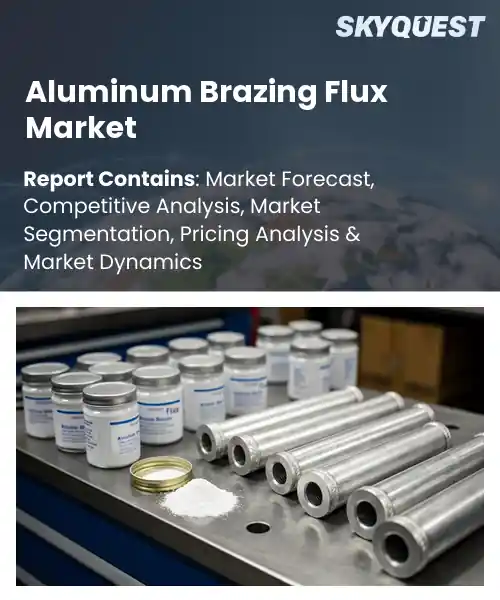
Aluminum Brazing Flux Market
Report ID: SQMIG15E3296
Report ID: SQMIG15E3296
[email protected]
USA +1 351-333-4748
Report ID:
SQMIG15E3296 |
Region:
Global |
Published Date: February, 2026
Pages:
157
|Tables:
120
|Figures:
77


Global Aluminum Brazing Flux Market size was valued at USD 1.80 Billion in 2024 and is poised to grow from USD 1.90 Billion in 2025 to USD 2.94 Billion by 2033, growing at a CAGR of 5.6% during the forecast period (2026-2033).
Aluminum brazing flux market share is driven primarily by the expanding demand for lightweight, corrosion-resistant heat exchangers and automotive components, which has elevated flux consumption in furnaces and controlled-atmosphere brazing lines. The availability of specialized inorganic fluxes for use during the high-temperature joining of aluminum has increased substantially due to the growth in demand due to electrification and energy efficiency. Historically, this supply chain and the related market have evolved for use in batch brazing to engineered, low-fume formulations designed for low stress. This evolution can be seen with the growing use of these products in the manufacture of HVACR coils and cooling plates for electric vehicles.
Supply chain optimization and regulatory pressure on emissions represent a key trend driving the global aluminum brazing flux sector dynamics because tighter environmental standards compel formulators to reduce hazardous halides while maintaining flux activity, prompting innovation in low-emission chemistries. Producers need to reformulate their products so that manufacturers improve their fume handling costs and therefore also provide increased safety to the worker. This allows for the acceptance of this technology in all of the appliance and automotive sectors quickly. For instance, HVACR manufacturers are setting up brazing lines that allow them to produce more products.
How is AI Improving Process Control in the Aluminum Brazing Flux Market?
Process control in aluminum brazing flux focuses on precise flux placement, stable furnace atmospheres, and repeatable wetting to ensure strong joints. With inline sensors attached to machine learning models and closed-loop controllers that sense drift, AI enhances these controls so that they can automatically modify dispensing and thermal profiles while ensuring quality through real-time adjustments. Manufacturers are responding to the market forces created by electric vehicles and refrigeration demands by increasing their use of automated, tightly controlled production lines to minimize scrap and provide greater consistency.
Honeywell November 2025, the company highlighted jet applied brazing flux and automation integration that can be paired with AI guided dispense planning and inline sensing to improve dispense accuracy and furnace stability. This reduces rework and raises throughput, supporting wider adoption of aluminum brazing in high volume markets.
Market snapshot - (2026-2033)
Global Market Size
USD 1.8 Billion
Largest Segment
Powder
Fastest Growth
Liquid
Growth Rate
5.6% CAGR
To get more insights on this market click here to Request a Free Sample Report
Global aluminum brazing flux market is segmented by product type, application, end-user, distribution channel and region. Based on product type, the market is segmented into powder, paste, and liquid. Based on application, the market is segmented into HVAC, automotive, aerospace, electronics, and others. Based on end-user, the market is segmented into manufacturing, construction, automotive, aerospace, and others. Based on distribution channel, the market is segmented into online and offline. Based on region, the market is segmented into North America, Europe, Asia Pacific, Latin America, and Middle East & Africa.
Based on the global aluminum brazing flux market forecast, powder segment dominates because its granular form enables precise metering and uniform distribution during furnace brazing, producing consistent wetting and joint integrity across high volume lines. Because of its compatibility with automatic dosing systems and its long storage life, manufacturers can favourably utilise this product to produce heat exchangers and radiators. Thus, resulting in reduced process variability, down time and enhanced performance Johnson’s leading position within the aluminium brazing flux market has also been enhanced due to the practical benefits of significantly reduced production costs and defect rates.
However, paste is witnessing the strongest growth momentum as formulators create thixotropic mixes for selective application and repair, enabling targeted deposition on complex parts without waste. Renovated cleaning profiles and better contamination management are appealing to companies looking for flexible repairs, with thousands of small batch modification opportunities opening up through the aluminum brazing flux market.
HVAC segment dominates because it represents steady demand for brazed aluminum heat exchangers and coils where reliable joint performance under thermal cycling is essential. Manufacturers focus on flux chemistry that provides uniform wetting, is corrosion-resistant, and produces a high yield in continuous furnace manufacturing methods, which promotes standardization in procurement and optimization of the entire process. Manufacturers are increasingly using brazed assemblies in the manufacturing of HVAC equipment to produce efficient and serviceable products; therefore, companies will have a strong preference for flux formulations designed to meet the production requirements of their HVAC equipment.
Meanwhile, automotive is witnessing the strongest growth momentum as electrification and lightweighting drive adoption of brazed aluminum heat exchangers and thermal management components. OEMs need to use more advanced alloys as well as meet higher cleanliness requirements, which is driving the need for suppliers to offer new fluxes and improve their qualification processes to attract more suppliers to meet demand for both OEM and aftermarket applications.
To get detailed segments analysis, Request a Free Sample Report
As per the global aluminum brazing flux market analysis, Asia Pacific dominates the industry due to a dense concentration of manufacturing hubs, integrated supply chains, and established specialty chemical producers that can scale brazing flux production and provide technical support. Continuous improvement of flux formulations and application processes is being driven by strong regional demand from the automotive, HVACR and electronics industries. In addition, a vast ecosystem composed of OEM's, Tier suppliers and materials researchers fosters rapid adoption of advanced brazing practices and also provides opportunities for close collaboration between flux producers and end users.
Aluminum brazing flux market regional outlook in Japan is characterized by advanced application engineering, collaboration between material suppliers and precision OEMs, and a focus on reliability for thermal management components. Moreover, supplier cultures of incremental innovation and after market support have solidified market acceptance, creating an environment conducive to increasing user adoption of customized brazing solutions for today’s industrial market segments, through delivering superior-quality product performance than those of their competitors.
Aluminum brazing flux market regional forecast in South Korea benefits from integration with advanced electronics and automotive manufacturing clusters, where demand for efficient thermal solutions drives specialized flux development. Domestic manufacturers collaborate closely with tier suppliers to adapt chemistries for high performance alloys and compact heat exchanger designs. Emphasis on process optimization, supplier technical service, and rapid prototyping supports application flexibility. Market dynamics favor suppliers that can provide quality and localized support.
Europe expansion in aluminum brazing flux stems from a convergence of industrial modernization, stringent performance and environmental expectations, and a strong concentration of OEMs requiring high reliability thermal solutions. With the demand in automotive, refrigeration, and industrial equipment increasing, suppliers have been under pressure to create cleaner and more adaptable flux chemistries; as well as provide application engineering services to support these activities. With a strong supplier base in critical manufacturing regions, suppliers are able to quickly transfer technology and offer localized support to their customers. The emphasis on efficiency and durability within policy has encouraged the adoption of brazing methods that will increase component life and improve energy performance.
Aluminum brazing flux market in Germany benefits from a deep industrial base with close ties between flux manufacturers and major automotive OEMs. Strong process reliability, strict quality requirements, and complete testing facilities lead to an increase in demand for manufactured solutions for flux formulations and their proper application. The German suppliers enhance their focus on process parameters through the documentation of results, the validation of processes, and working with their partners to maintain a high level of consistency for important thermal management components.
Aluminum brazing flux market in the United Kingdom features an emerging cluster of specialty suppliers and engineering providers supporting niche automotive and industrial applications. Emphasis falls on lightweight component joining, bespoke flux formulations, and collaborative pilot work with OEMs and research partners. Participants prioritize agility, technical consultancy, and targeted aftersales support to meet evolving design needs. Expansion is driven by innovation partnerships and a readiness among manufacturers to trial brazing approaches.
Aluminum brazing flux market in France is marked by dynamic adoption of innovative flux formulations and close cooperation between materials developers and system manufacturers. A surge in thermal management and refrigeration activity is driving experimentation with low-residue and eco-friendly chemistry. Suppliers are combining their formulation expertise with process consulting services, helping to support series production of prototypes.
North America is strengthening its position through a combination of supply chain localization, targeted technical investment, and closer collaboration between flux producers and major OEMs. Regional manufacturing is aiming to strengthen their abilities to create different types of products for automotive thermal management, industrial refrigeration, and home appliances. Additionally, emphasis on supplier qualification, process control and supplier support increases consumer confidence when it comes to purchasing products manufactured in a region. The development of strategic partnerships between material suppliers and research institutions is allowing companies to provide faster validation to their processes and help accelerate the adoption of advanced brazing techniques.
Aluminum brazing flux market in United States is driven by proximity to major OEMs across automotive and HVACR sectors that demand validated, high performance brazing solutions. Application labs/qualification protocols/and chemistries that are tailored to meet the production needs of their customers are the primary focus of suppliers. Ultimately, supplier relationships are strengthened through their focus on providing localized technical support, being able to supply on a continuous basis, and ensuring compliance with environmental standards.
Aluminum brazing flux market in Canada is characterized by a pragmatic supplier community focused on serving regional manufacturing and refrigeration needs with reliable flux systems. To provide the manufacturer with means to achieve consistence in their brazing processes, suppliers emphasize sustaining supply continuity, technical training and field support as priorities. Suppliers have partnered with regional partners enabling them to assist in adapting their formulations to the alloys used and production conditions found locally. The market appreciates having dependable logistics, reactive technical service and stability of performance within different operating environments.
To know more about the market opportunities by region and country, click here to
Buy The Complete Report
Rising Demand from Automotive Industry
Advancements In Flux Formulations
Stringent Environmental Regulations on Flux
Supply Chain Raw Material Volatility
Request Free Customization of this report to help us to meet your business objectives.
Competition in the global aluminum brazing flux market outlook is concentrated among established chemicals and welding consumables groups, with rivalry driven by application specific low residue formulations and process integration. Companies look to achieve wider scope and distribution through real world strategy options such as joint venture partnerships and acquisitions, with both voestalpine’s use of joint ventures and Solvay’s NoColok leadership as examples, while the most recent spin offs have entered into the markets of jet-applied and liquid dispersion fluxes for the assembly of both electric vehicles and heat exchangers.
SkyQuest’s ABIRAW (Advanced Business Intelligence, Research & Analysis Wing) is our Business Information Services team that Collects, Collates, Correlates, and Analyses the Data collected by means of Primary Exploratory Research backed by robust Secondary Desk research.
As per SkyQuest analysis, the global aluminum brazing flux industry is poised for steady growth driven primarily by rising demand from the automotive industry for lightweight, thermally efficient components and by advancements in flux formulations that improve wetting, lower residues and enable automated application. However, stringent environmental regulations on flux chemistries and emissions constrain development cycles and market adoption. Due to its series of major production centres and its significant amounts of scalable specialty chemicals, the Asia Pacific region has greater market share than other regions, enabling them to be major players. The dominance of powder flux products in the market stems from their easy metering, uniform distribution, and compatibility with large-volume furnace brazing lines. New innovative processes or integrated solutions will determine how quickly suppliers in this industry can fulfill new specifications from original equipment manufacturers (OEMs).
| Report Metric | Details |
|---|---|
| Market size value in 2024 | USD 1.8 Billion |
| Market size value in 2033 | USD 2.94 Billion |
| Growth Rate | 5.6% |
| Base year | 2024 |
| Forecast period | (2026-2033) |
| Forecast Unit (Value) | USD Billion |
| Segments covered |
|
| Regions covered | North America (US, Canada), Europe (Germany, France, United Kingdom, Italy, Spain, Rest of Europe), Asia Pacific (China, India, Japan, Rest of Asia-Pacific), Latin America (Brazil, Rest of Latin America), Middle East & Africa (South Africa, GCC Countries, Rest of MEA) |
| Companies covered |
|
| Customization scope | Free report customization with purchase. Customization includes:-
|
To get a free trial access to our platform which is a one stop solution for all your data requirements for quicker decision making. This platform allows you to compare markets, competitors who are prominent in the market, and mega trends that are influencing the dynamics in the market. Also, get access to detailed SkyQuest exclusive matrix.
Table Of Content
Executive Summary
Market overview
Parent Market Analysis
Market overview
Market size
KEY MARKET INSIGHTS
COVID IMPACT
MARKET DYNAMICS & OUTLOOK
Market Size by Region
KEY COMPANY PROFILES
Methodology
For the Aluminum Brazing Flux Market, our research methodology involved a mixture of primary and secondary data sources. Key steps involved in the research process are listed below:
1. Information Procurement: This stage involved the procurement of Market data or related information via primary and secondary sources. The various secondary sources used included various company websites, annual reports, trade databases, and paid databases such as Hoover's, Bloomberg Business, Factiva, and Avention. Our team did 45 primary interactions Globally which included several stakeholders such as manufacturers, customers, key opinion leaders, etc. Overall, information procurement was one of the most extensive stages in our research process.
2. Information Analysis: This step involved triangulation of data through bottom-up and top-down approaches to estimate and validate the total size and future estimate of the Aluminum Brazing Flux Market.
3. Report Formulation: The final step entailed the placement of data points in appropriate Market spaces in an attempt to deduce viable conclusions.
4. Validation & Publishing: Validation is the most important step in the process. Validation & re-validation via an intricately designed process helped us finalize data points to be used for final calculations. The final Market estimates and forecasts were then aligned and sent to our panel of industry experts for validation of data. Once the validation was done the report was sent to our Quality Assurance team to ensure adherence to style guides, consistency & design.
Analyst Support
Customization Options
With the given market data, our dedicated team of analysts can offer you the following customization options are available for the Aluminum Brazing Flux Market:
Product Analysis: Product matrix, which offers a detailed comparison of the product portfolio of companies.
Regional Analysis: Further analysis of the Aluminum Brazing Flux Market for additional countries.
Competitive Analysis: Detailed analysis and profiling of additional Market players & comparative analysis of competitive products.
Go to Market Strategy: Find the high-growth channels to invest your marketing efforts and increase your customer base.
Innovation Mapping: Identify racial solutions and innovation, connected to deep ecosystems of innovators, start-ups, academics, and strategic partners.
Category Intelligence: Customized intelligence that is relevant to their supply Markets will enable them to make smarter sourcing decisions and improve their category management.
Public Company Transcript Analysis: To improve the investment performance by generating new alpha and making better-informed decisions.
Social Media Listening: To analyze the conversations and trends happening not just around your brand, but around your industry as a whole, and use those insights to make better Marketing decisions.
REQUEST FOR SAMPLE
 REQUEST FREE CUSTOMIZATION
Global Aluminum Brazing Flux Market size was valued at USD 1.8 Billion in 2024 and is poised to grow from USD 1.9 Billion in 2025 to USD 2.94 Billion by 2033, growing at a CAGR of 5.6% during the forecast period (2026-2033).
Competition in the global aluminum brazing flux market is concentrated among established chemicals and welding consumables groups, with rivalry driven by application specific low residue formulations and process integration. Companies pursue concrete strategies such as joint ventures and acquisitions for scale and distribution, exemplified by voestalpine JV activity and Solvay NOCOLOK leadership, while recent spin offs introduced jet applied and liquid dispersion fluxes for EV and heat exchanger assembly. 'SOLVAY', 'HONEYWELL INTERNATIONAL INC.', 'LUCAS-MILHAUPT LLC', 'HARRIS PRODUCTS GROUP (THE LINCOLN ELECTRIC COMPANY)', 'NIHON SUPERIOR CO., LTD.', 'Kyocera', 'Saru Silver Alloys', 'Johnson Matthey', 'CASTOLIN EUTECTIC', 'PRINCE & IZANT COMPANY', 'SUNKWANG AMPA', 'INDIAN SOLDER AND BRAZE ALLOYS PVT. LTD.', 'SENTES-BIR A.S.', 'STELLA S.R.L.', 'Kester', 'HANGZHOU HUAGUANG ADVANCED WELDING MATERIALS CO., LTD.', 'HEBEI YUGUANG WELDING CO., LTD', 'VBC GROUP', 'Superior Flux', 'BrazeTec'
The growing adoption of aluminum brazing in vehicle heat exchangers and lightweight structural components has increased demand for specialized brazing fluxes, because reliable flux performance ensures consistent oxide removal and joint integrity during high-volume automotive production. Manufacturers seek fluxes that yield repeatable results across varied alloys and fabrication environments, which encourages suppliers to innovate and scale production. This alignment of automotive manufacturing needs with flux development strengthens market expansion by creating sustained, application-driven demand for advanced brazing consumables, and it fosters collaboration with OEMs to tailor solutions.
Lightweighting Driving Demand: Adoption of lightweight materials across transportation and consumer industries is increasing demand for reliable aluminum brazing fluxes that enable thin-sheet joining and complex assemblies. Manufacturers prioritize flux chemistries that provide consistent wetting on diverse alloys while supporting tighter joint tolerances and faster cycle times. This trend pushes suppliers to develop formulations that balance active fluxing capability with improved process robustness, enabling higher throughput, reduced rework, and closer collaboration with OEMs to qualify fluxes for more demanding structural and thermal-management components.
Asia Pacific Dominate the Global Aluminum Brazing Flux Market?


Want to customize this report? This report can be personalized according to your needs. Our analysts and industry experts will work directly with you to understand your requirements and provide you with customized data in a short amount of time. We offer $1000 worth of FREE customization at the time of purchase.
Feedback From Our Clients


 USA (+1) 351-333-4748

