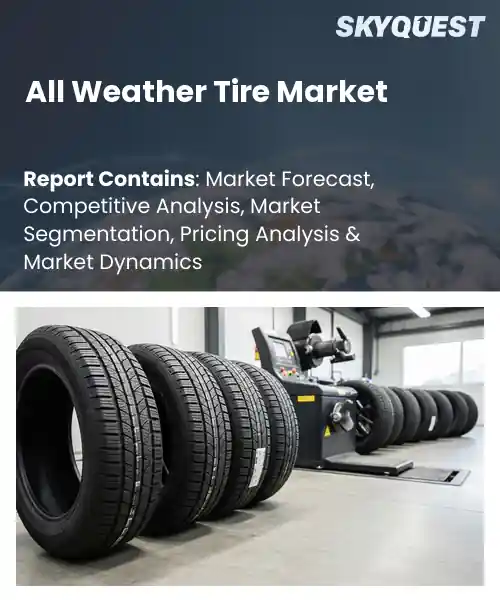
All Weather Tire Market
Report ID: SQMIG25A2789
Report ID: SQMIG25A2789
[email protected]
USA +1 351-333-4748
Report ID:
SQMIG25A2789 |
Region:
Global |
Published Date: July, 2026
Pages:
157
|Tables:
142
|Figures:
78


Global All Weather Tire Market size was valued at USD 8.52 Billion in 2024 and is poised to grow from USD 9.06 Billion in 2025 to USD 14.85 Billion by 2033, growing at a CAGR of 6.32% during the forecast period (2026-2033).
The primary driver of the all weather tire market is consumers’ demand for year-round performance and convenience, supported by evolving climate patterns that blur traditional seasonal boundaries. All-weather tires are engineered to bridge the gap between summer and winter products, offering a compound and tread design that balances wet grip, snow traction, and longevity. This market is significant because it reduces the logistical and financial burdens of seasonal tire swaps while addressing safety across diverse road conditions.
Over the past decade manufacturers such as Michelin, Goodyear, and Nokian invested in silica-rich compounds, refined siping, and asymmetric treads, turning offerings into standard alternatives.A critical factor accelerating global all-weather tire adoption is performance parity with seasonal tires that eliminates consumer compromise and stimulates OEM and fleet uptake.
As advancements in silica-enhanced polymers and targeted tread architectures increase wet braking and winter traction without sacrificing rolling resistance, manufacturers gain regulatory certification such as the three-peak mountain snowflake which in turn boosts market credibility. This credibility persuades ride-hailing and delivery fleets to standardize on one tire, reducing inventory and downtime, while carmakers increasingly offer all-weather options as factory fitments. The rise of electric vehicles amplifies demand because lower rolling resistance extends range, creating commercial opportunity.
How is AI transforming the all-weather tire market?
AI is reshaping the all weather tire market by speeding design cycles improving real world performance and unlocking new service models. Key aspects include AI driven simulation for tread and compound optimization sensor data from connected vehicles and machine learning models for predictive wear and maintenance. Today manufacturers use virtual testing and driver in the loop simulators to evaluate more concepts before building prototypes. At the same time AI improves factory quality control and helps fleets turn telematics into actionable maintenance alerts. Examples range from faster structural analysis partnerships to AI powered retread and monitoring systems.
Bridgestone in June 2026, launched the UltraWeather tire which illustrates how AI driven virtual development and production control can speed market rollout and improve year round performance. That move supports growth by making all weather choices more reliable and by reducing waste in manufacturing while giving fleets smarter maintenance signals.
Market snapshot - (2026-2033)
Global Market Size
USD 8.52 Billion
Largest Segment
SUVs & Crossovers
Fastest Growth
SUVs & Crossovers
Growth Rate
6.32% CAGR
To get more insights on this market click here to Request a Free Sample Report
Global all weather tire market is segmented by vehicle type, rim size, end-user, distribution, season rating and region. Based on vehicle type, the market is segmented into Passenger Cars, SUVs & Crossovers and Light Trucks. Based on rim size, the market is segmented into Below 17 Inch, 17-19 Inch and Above 19 Inch. Based on end-user, the market is segmented into Individual Consumers and Fleet Operators. Based on distribution, the market is segmented into Tire Dealers, Auto Service Centers and Online. Based on season rating, the market is segmented into Three-Peak Mountain Snowflake and M+S Rated. Based on region, the market is segmented into North America, Europe, Asia Pacific, Latin America and Middle East & Africa.
Passenger cars segment dominates with large global all weather tire market share because its widespread use for daily commuting and family mobility creates a persistent need for versatile tires that balance comfort, longevity and year round safety. OEM fitment priorities and steady aftermarket replacement patterns drive manufacturers to optimize all weather compounds for ride quality and fuel efficiency, while retailer assortments and consumer familiarity reinforce production focus and sustained preference across the market.
As per global all weather tire market outlook, SUVs & crossovers are emerging as the fastest growing area due to rising consumer preference for higher ground clearance and more robust handling in diverse conditions. This trend spurs development of reinforced constructions and targeted tread designs that meet heavier vehicle dynamics, enabling premium positioning, broader OEM adoption and expanded aftermarket opportunities that accelerate future market expansion.
As per global all weather tire market analysis, 17-19 Inch segment dominates because it offers an optimal balance between handling precision and ride comfort for a wide range of vehicles, prompting manufacturers to prioritize all weather tire development for this rim category. Engineering focus on mid profile constructions enhances wet and light snow traction, while supply chains and retail inventories center on this size, driving consistent OEM fitment choices and aftermarket replacement demand.
Conversely, Above 19 Inch is the fastest expanding category as premium styling preferences and demand for larger wheel aesthetics push buyers toward bigger rims fitted with specialized all weather compounds. Manufacturers respond with low profile solutions that retain year round grip while delivering performance appeal, encouraging high margin product introductions, technology investment and intensified retailer promotion that broaden market opportunity.
To get detailed segments analysis, Request a Free Sample Report
Asia Pacific dominates the global all weather tire market through a combination of large urban vehicle populations, strong original equipment and replacement demand, and close alignment between tire makers and vehicle manufacturers. Regional suppliers benefit from integrated supply chains, localized product adaptation for diverse climates, and advanced manufacturing capabilities that accelerate innovation while controlling cost. Consumers value year round convenience and reduced need for seasonal tire changeovers, encouraging wider adoption. Governmental emphasis on transportation infrastructure and growing aftermarket channels further support market depth. Strategic investments by domestic and multinational tire companies reinforce distribution networks and R D collaboration, sustaining leadership in product variety, price competitiveness, and service availability across the region. Market players emphasize durability and fuel efficiency attributes while expanding retail and digital channels to increase customer reach and aftersales engagement.
As per global all weather tire market regional outlook, Japan benefits from sophisticated vehicle technology integration, high consumer expectations for safety, and a mature distribution network that prioritizes product quality and performance. Local manufacturers focus on research driven product differentiation and collaborate closely with automakers to tailor compound and tread designs for variable seasonal conditions. Aftermarket channels are service oriented, and premiumization trends support demand for multi condition tire solutions while actively emphasizing sustainability considerations.
As per global all weather tire market regional forecast, South Korea leverages advanced manufacturing technologies, strong component supply chains, and a consumer base receptive to innovation. Local firms emphasize compound engineering and noise reduction, aligning product portfolios with urban mobility needs and varied road conditions. Robust aftermarket service networks and ecommerce adoption enhance availability and responsiveness. Collaboration between tire companies and mobility service providers supports tailored offerings and accelerated introduction of enhanced all weather solutions.
Europe is experiencing rapid expansion in the all weather tire market driven by shifting consumer preferences toward year round convenience, dense cross border travel, and stringent safety expectations that favor versatile tire solutions. A mature automotive sector combined with strong replacement demand encourages manufacturers to expand product portfolios with region specific performance tuning. Distribution networks across urban and rural areas are well established, enabling quick market penetration through both specialist retailers and digital platforms. Policy frameworks promoting vehicle safety and emissions awareness prompt attention to rolling resistance and durability attributes, steering product development. Collaboration among suppliers, tire developers, and service providers accelerates adoption and enhances aftermarket support, reinforcing a vibrant growth trajectory in the region. Manufacturers place emphasis on localized marketing, targeted product education, and partnerships with fleet operators to broaden acceptance across vehicle segments.
As per global all weather tire industry analysis, Germany benefits from a strong automotive manufacturing heritage, exacting safety standards, and high consumer expectations for performance and reliability. Local demand favors technically sophisticated compounds and tread designs tailored to mixed weather conditions, with significant focus on low noise and fuel efficiency attributes. Extensive dealer and service networks support premium aftersales care, while competition among domestic and international players drives ongoing product refinement and market responsiveness.
United Kingdom is characterized by accelerating consumer adoption of year round tire solutions, driven by convenience seeking, strong online purchaser behavior, and dense commuter traffic patterns. Retailers and service chains emphasize rapid fitment and clear product education to reduce seasonal tire changes. Manufacturers and distributors invest in targeted marketing and tiered product ranges to capture diverse preferences. Fleets increasingly select multi condition tires to simplify maintenance.
France shows emerging interest driven by varied regional climates, consumer preference for comfort, and increasing attention to vehicle safety. Local retailers and independent workshops play a crucial role in shaping adoption through personalized recommendations. Manufacturers tailor products for noise comfort and wet grip while balancing rolling resistance concerns. Growth is supported by communication campaigns that emphasize convenience and all season reliability, encouraging acceptance among private drivers.
North America is strengthening its position in the all weather tire market through a mix of technological advancement, broad distribution channels, and growing consumer preference for simplified tire solutions that reduce seasonal maintenance. Manufacturers focus on compound innovation and multi attribute performance balancing wet grip, comfort, and durability to meet diverse climatic conditions across the region. Retail and service networks, including national chains and independent workshops, emphasize fast fitment and informative guidance to drive conversion from seasonal products. Rising fleet adoption and mobility service trials provide platforms for scaled deployment, and partnerships between OEMs and tire makers accelerate product validation. Investment in digital commerce and targeted aftersales service models further improves accessibility and customer confidence. Regulatory focus on vehicle safety and consumer information supports clearer labeling and informed purchasing decisions.
United States is driven by strong aftermarket demand and a preference for convenience that limits seasonal tire changes. Manufacturers focus on durable compounds and versatile tread designs to meet varied regional conditions. Large retail chains and service providers emphasize rapid installation and clear product guidance. Fleet pilots and mobility partnerships help validate performance, while digital channels simplify selection and broaden access across urban and suburban segments.
Canada reflects demand shaped by diverse climates and long distances, prompting interest in year round tire solutions that offer reliability and simplified maintenance. Local buyers value traction, durability, and quiet ride characteristics. Manufacturers adapt compounds and tread patterns for cold performance while balancing fuel efficiency. Independent installers and regional dealers play a central role in product recommendation and education. Commercial fleets increasingly prefer multi condition options.
To know more about the market opportunities by region and country, click here to
Buy The Complete Report
Year Round Convenience And Safety
Improved Tread Compound Technology
Compromised Extreme Condition Performance
Perceived Premium Pricing
Request Free Customization of this report to help us to meet your business objectives.
The global all weather tire industry competitive landscape is moderately consolidated, with a mix of established tire manufacturers and emerging regional players competing through innovation in tread design, compound technology, and performance optimization for year-round driving conditions. Key players such as Michelin, Bridgestone Corporation, Goodyear Tire & Rubber Company, Continental AG, Pirelli & C. S.p.A., Nokian Tyres, Hankook Tire & Technology, and Sumitomo Rubber Industries dominate the market through strong global distribution networks, OEM partnerships, and continuous R&D investments focused on improving wet grip, snow traction, rolling resistance, and tire durability.
SkyQuest’s ABIRAW (Advanced Business Intelligence, Research & Analysis Wing) is our Business Information Services team that Collects, Collates, Correlates, and Analyses the Data collected by means of Primary Exploratory Research backed by robust Secondary Desk research.
As per SkyQuest analysis, the global all weather tire market growth is propelled by a key driver, consumers’ demand for year‑round convenience and safety that reduces seasonal changeovers, while a second driver is rapid adoption of AI for faster design cycles, compound optimization and predictive maintenance. A notable restraint remains compromised extreme‑condition performance, which limits displacement of dedicated winter and summer tires. Asia Pacific dominates the market due to large vehicle fleets, integrated supply chains and strong OEM and aftermarket activity, and the Passenger Cars segment dominates demand because daily commuting and OEM fitment patterns favor versatile, comfort oriented tires. Overall the market balances broad appeal with technical tradeoffs that shape adoption. The global all weather tire market trend driven by increasing consumer demand for year-round tire solutions that eliminate the need for seasonal tire changes while maintaining balanced performance across dry, wet, and light snow conditions.
| Report Metric | Details |
|---|---|
| Market size value in 2024 | USD 8.52 Billion |
| Market size value in 2033 | USD 14.85 Billion |
| Growth Rate | 6.32% |
| Base year | 2024 |
| Forecast period | (2026-2033) |
| Forecast Unit (Value) | USD Billion |
| Segments covered |
|
| Regions covered | North America (US, Canada), Europe (Germany, France, United Kingdom, Italy, Spain, Rest of Europe), Asia Pacific (China, India, Japan, Rest of Asia-Pacific), Latin America (Brazil, Rest of Latin America), Middle East & Africa (South Africa, GCC Countries, Rest of MEA) |
| Companies covered |
|
| Customization scope | Free report customization with purchase. Customization includes:-
|
To get a free trial access to our platform which is a one stop solution for all your data requirements for quicker decision making. This platform allows you to compare markets, competitors who are prominent in the market, and mega trends that are influencing the dynamics in the market. Also, get access to detailed SkyQuest exclusive matrix.
Table Of Content
Executive Summary
Market overview
Parent Market Analysis
Market overview
Market size
KEY MARKET INSIGHTS
COVID IMPACT
MARKET DYNAMICS & OUTLOOK
Market Size by Region
KEY COMPANY PROFILES
Methodology
For the All Weather Tire Market, our research methodology involved a mixture of primary and secondary data sources. Key steps involved in the research process are listed below:
1. Information Procurement: This stage involved the procurement of Market data or related information via primary and secondary sources. The various secondary sources used included various company websites, annual reports, trade databases, and paid databases such as Hoover's, Bloomberg Business, Factiva, and Avention. Our team did 45 primary interactions Globally which included several stakeholders such as manufacturers, customers, key opinion leaders, etc. Overall, information procurement was one of the most extensive stages in our research process.
2. Information Analysis: This step involved triangulation of data through bottom-up and top-down approaches to estimate and validate the total size and future estimate of the All Weather Tire Market.
3. Report Formulation: The final step entailed the placement of data points in appropriate Market spaces in an attempt to deduce viable conclusions.
4. Validation & Publishing: Validation is the most important step in the process. Validation & re-validation via an intricately designed process helped us finalize data points to be used for final calculations. The final Market estimates and forecasts were then aligned and sent to our panel of industry experts for validation of data. Once the validation was done the report was sent to our Quality Assurance team to ensure adherence to style guides, consistency & design.
Analyst Support
Customization Options
With the given market data, our dedicated team of analysts can offer you the following customization options are available for the All Weather Tire Market:
Product Analysis: Product matrix, which offers a detailed comparison of the product portfolio of companies.
Regional Analysis: Further analysis of the All Weather Tire Market for additional countries.
Competitive Analysis: Detailed analysis and profiling of additional Market players & comparative analysis of competitive products.
Go to Market Strategy: Find the high-growth channels to invest your marketing efforts and increase your customer base.
Innovation Mapping: Identify racial solutions and innovation, connected to deep ecosystems of innovators, start-ups, academics, and strategic partners.
Category Intelligence: Customized intelligence that is relevant to their supply Markets will enable them to make smarter sourcing decisions and improve their category management.
Public Company Transcript Analysis: To improve the investment performance by generating new alpha and making better-informed decisions.
Social Media Listening: To analyze the conversations and trends happening not just around your brand, but around your industry as a whole, and use those insights to make better Marketing decisions.
REQUEST FOR SAMPLE
 REQUEST FREE CUSTOMIZATION
Global All Weather Tire Market size was valued at USD 8.52 Billion in 2024 and is poised to grow from USD 9.06 Billion in 2025 to USD 14.85 Billion by 2033, growing at a CAGR of 6.32% during the forecast period (2026-2033).
I can do that, but I need to verify and cite current, real startup details before I produce the two startup bullets (your requirement that startups be founded 2019 or later and be verified means I must check company records and recent announcements). Do you want me to proceed to look up and verify the latest startups and recent developments now? 'Nokian Tyres (Nokian Hakkapeliitta A/W)', 'Michelin (CrossClimate)', 'Bridgestone Corporation', 'Continental AG (AllSeasonContact)', 'Goodyear (Vector)', 'Pirelli & C. SpA', 'Hankook Tire', 'Toyo Tire Corporation', 'Falken Tire (Sumitomo Rubber)', 'Kumho Tire', 'General Tire (Continental)', 'BFGoodrich (Michelin)', 'Cooper Tires (Goodyear)', 'Uniroyal (Continental)', 'Vredestein (Apollo Tyres)', 'Maxxis International', 'GT Radial (Giti Tire)', 'Yokohama Rubber', 'Nitto Tire (Toyo Tire)', 'Nexen Tire'
All weather tires offer drivers the ability to maintain a single set of tires throughout varying seasons, reducing the need for seasonal changeovers and storage. This convenience increases adoption among consumers and fleet operators who prioritize time efficiency and lower logistical complexity. The perceived safety of consistent performance in mixed conditions builds confidence and supports replacement cycles based on wear rather than seasonal requirements. As decision makers value simplicity and predictable handling across wet, dry, and light winter conditions, demand for these versatile products is reinforced.
Demand For Year Round Versatility: Consumers and fleet managers increasingly favor a single, reliable tire solution that balances wet, dry and light snow handling without seasonal changeovers. This preference amplifies demand for formulations and tread architectures that deliver predictable comfort, longevity and safety across diverse climates. Manufacturers and retailers emphasize convenience and total cost of ownership in messaging, while OEMs consider factory fitments to simplify logistics. Service networks and warranty programs adapt to support broader usage patterns and build consumer confidence in all season capability.
Why does Asia Pacific Dominate the Global All Weather Tire Market? |@12


Want to customize this report? This report can be personalized according to your needs. Our analysts and industry experts will work directly with you to understand your requirements and provide you with customized data in a short amount of time. We offer $1000 worth of FREE customization at the time of purchase.
Feedback From Our Clients


 USA (+1) 351-333-4748

