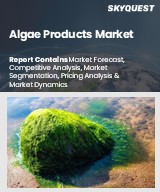
Algae Products Market
Report ID: SQMIG30H2205
Report ID: SQMIG30H2205
[email protected]
USA +1 351-333-4748
Report ID:
SQMIG30H2205 |
Region:
Global |
Published Date: May, 2025
Pages:
196
|Tables:
97
|Figures:
71


Global Algae Products Market size was valued at USD 3.03 Billion in 2024 and is poised to grow from USD 3.27 Billion in 2025 to USD 6.1 Billion by 2033, growing at a CAGR of 8.1% during the forecast period (2026–2033).
The global algae products market is significantly driven by the growing focus on environmental sustainability. Algae use very few resources to cultivate—non-drinking water, no land, and minimal energy input—positioning them as an environmentally friendly option over conventional agricultural crops. With industries under mounting pressure to minimize their environmental footprint, the low carbon footprint of algae coupled with its potential to suck up CO2 while growing it makes it a highly desirable option. This has resulted in a boom in demand for products derived from algae in industries like food, biofuels, and cosmetics. Algae oils, for example, are now used in the culinary industry as a sustainable alternative to traditional oils and fueling increased market growth.
Technological advancements in algae cultivation and processing are key trends driving the global algae products sector. Biotechnology has made it possible to improve the efficiency of algae production, making it more scalable and cost-effective. Innovation in fermentation processes has allowed the creation of algae-based products like omega-3 supplements, biofuels, and sustainable oils, offering viable alternatives to conventional sources such as fish oil or palm oil. As methods of growing algae become more sophisticated, their production has become increasingly sustainable, and thus their uptake among industries has increased. This technology is making the market's growth move faster by turning algae into a cost-effective substitute in other uses.
What Role does AI Play in Reducing Energy Consumption in Algae Cultivation?
Artificial Intelligence (AI) is revolutionizing the global algae products market strategies to a large extent by optimizing cultivation efficiency and product quality. AI-based systems allow real-time monitoring and optimization of environmental conditions like light intensity, temperature, pH levels, and nutrient concentration. For example, AI algorithms can forecast ideal growth conditions and adjust variables, accordingly, resulting in higher biomass yields and lower energy consumption. One of the interesting advances is applying machine learning models to predict growth patterns for algae and to determine the best harvesting periods, thus making algae-based biofuels and other products more economically feasible.
In March 2024, University at Buffalo researchers, with the Georgia Institute of Technology, embarked on a project to develop algae biofuel production using artificial intelligence (AI). The group uses polyculture farming, AI-powered microscopy, and monitoring of the environment to anticipate and prevent algae infections from taking root.
Market snapshot - 2026-2033
Global Market Size
USD 2.8 billion
Largest Segment
Brown Algae
Fastest Growth
Blue–Green Algae
Growth Rate
8.1% CAGR
To get more insights on this market click here to Request a Free Sample Report
Global Algae Products Market is segmented by Type, Source, Form, Distribution Channel, Application and region. Based on Type, the market is segmented into Lipids, Carrageenan, Carotenoids, Algal Protein, Alginate and Others. Based on Source, the market is segmented into Brown Algae, Blue-Green Algae, Red Algae and Green Algae. Based on Form, the market is segmented into Solid and Liquid. Based on Distribution Channel, the market is segmented into Online and Offline. Based on Application, the market is segmented into Food and Beverages, Nutraceuticals and Dietary Supplements, Personal Care, Feed, Pharmaceuticals, Chemicals and Others. Based on region, the market is segmented into North America, Europe, Asia Pacific, Latin America and Middle East & Africa.
Brown algae are the most dominant in the global algae products market because they contain high levels of bioactive compounds such as alginates, fucoidan, and fucoxanthin. The compounds are a must-have in pharmaceuticals, nutraceuticals, and cosmetics. The widespread occurrence of brown algae, especially in coastal areas, also widens their market base. Their uses include food thickeners and anti-inflammatories, cementing their status as a top choice source in the algae sector.
Blue–green algae, particularly Spirulina and Aphanizomenon flos-aquae, are rapidly gaining in the global algae products market share due to their high protein content, rich nutritional profile, and versatility in various applications. These algae are being used more and more in dietary supplements, functional foods, and natural food colorants due to consumer demand for plant-based and sustainable ingredients.
Hydrocolloids, derived from algae like carrageenan, agar, and alginate, dominate the global algae products market due to their exceptional gelling, thickening, and stabilizing properties. Such functional advantages render them irreplaceable in food and beverage uses, especially in plant-based meats, dairy alternatives, and ready meals. They also find applications in pharmaceuticals and cosmetics, adding texture and efficiency to products. Increasing consumer demands for clean label, plant-based, and sustainability drive the need for algae hydrocolloids, cementing their market leadership.
Astaxanthin, the microalgae-derived powerful antioxidant found in Haematococcus pluvialis, is set to become the fastest growing segment in the global algae products market. Its increasing popularity in nutraceuticals, cosmetics, and aquaculture, thanks to its health benefits such as anti-inflammatory and anti-aging, is fueling demand. Its increase in natural, clean-label consumption further pushes it to expand, making astaxanthin a key market driver.
To get detailed segments analysis, Request a Free Sample Report
As per the global algae products industry analysis, North America holds a significant share in the industry, driven by increasing demand for plant-based, sustainable products. The U.S. and Canada lead this growth, especially in sectors like nutraceuticals, food and beverages, and biofuels. Innovation in algae growing technology and growing healthcare awareness among people are main driving factors. Increasing innovation in the use of bioplastics involving algae and cultivation of seaweed on larger scales also significantly enhance market possibilities.
The United States is the key player in North America's algae products industry, led by huge investments in algae-based nutraceuticals and biofuels. The market is further boosted by innovative products like algae-based protein supplements and skincare. Support from the U.S. government in the form of grants to study algae bioenergy also supports market development. The nation also has a long coastline, making it easier to conduct large-scale farming of seaweed and thereby expanding the industry.
Canada is emerging as a key player in the North America's algae products market, leveraging its vast coastline for sustainable seaweed cultivation. Canada has embarked on searching for kelp-based uses for biofuels and cosmetics consistent with its approach to climate action. Canadian ingenuity, as with algae-plastic bioplastic, makes headway at an international stage while establishing Canada's position of excellence in producing eco-friendly products based on algae.
Asia Pacific is the most rapidly growing market in the global algae products market, fueled by growing demand for algae-derived ingredients in food, beverages, and cosmetics. China, Japan, and India are at the forefront of algae cultivation, with an emphasis on green aquaculture and biofuels. Asia Pacific is also seeing algae-based bio-packaging and nutraceutical innovations with government support for promoting green technology and environmental sustainability.
Japan is a major contributor to the Asia Pacific’s algae products market, especially in the production of edible seaweeds like nori, kombu, and wakame. The nation's sophisticated algae-growing methods and environmental concerns have fostered major improvements in algae-products, such as food additives, nutraceuticals, and biofuels. Japan's dedication to environment preservation and demand for plant-derived alternatives further increase its market penetration.
South Korea plays a pivotal role in the Asia Pacific’s algae products market, being one of the largest producers of edible seaweeds, such as nori and kelp. The nation is famous for its innovative algae food products and nutraceuticals. South Korea's emphasis on sustainable aquaculture practices, coupled with government incentives for algae farming, makes it a leading player in the growing algae products market.
Europe is one of the major regions for the global market of algae products, with the strong demand for eco-friendly and sustainable alternatives. Germany and the UK are market leaders, prioritizing algae-derived food, cosmetics, and pharmaceutical ingredients. Europe is also making headway in algae cultivation technology with the help of government funding and increasing consumer demand for plant-based, healthy products. The focus on sustainability and innovation places Europe at a critical position in the algae market.
Germany is a key driver, propelling innovations in food, biofuel, and pharmaceutical algae cultivation technologies. Germany's high research efforts, particularly under EU initiatives such as Horizon Europe, and emphasis on sustainability put it at the forefront of algae product innovation, especially in ocean-based applications.
France plays a major role in Europe's algae products market by providing edible seaweeds and other products derived from algae such as carrageenan. France is diversifying its market for skincare through algae-based products and emphasizes a strong biotechnology marine culture coupled with green business practices that align with its status in the food and cosmetic segments of algae products.
The UK is leading in algae-based biofuels and bioplastics, with significant investments in algae farming for sustainability. Official programs aid carbon emission reductions and increasing demands on algae-derived cosmetics and food supplements contribute to its growing position in the algae products market.
To know more about the market opportunities by region and country, click here to
Buy The Complete Report
Rising Demand for Sustainable Ingredients
Health and Nutritional Benefits of Algae
Limited Consumer Awareness
Supply Chain Challenges
Request Free Customization of this report to help us to meet your business objectives.
The global algae products market outlook is highly competitive, with key players focusing on innovation, sustainability, and expanding product offerings. Key players are DSM, Cargill, BASF, Dow Chemical, and Algatechnologies. Key strategies are mergers, collaborations, and R&D in algae-based ingredients, biofuels, and nutraceuticals. For instance, DSM is working on developing its algae-based omega-3 product portfolio, whereas Algatechnologies is working on developing its microalgae cultivation technology for the cosmetics sector.
The startup environment in the global algae products market forecast is expanding rapidly, with emerging companies targeting algae-based innovations across food, cosmetics, and biofuels. The startups are creating sustainable, high-value algae products using innovative technologies and R&D. They are working to minimize environmental footprints, providing healthier options, and enhancing algae production scalability for commercial applications.
SkyQuest’s ABIRAW (Advanced Business Intelligence, Research & Analysis Wing) is our Business Information Services team that Collects, Collates, Correlates, and Analyses the Data collected by means of Primary Exploratory Research backed by robust Secondary Desk research.
As per SkyQuest analysis, the global algae products industry is observing rapid growth fueled by technology and sustainability. With industries transitioning towards green alternatives, algae's low resource consumption and low carbon intensity make it the go-to option. Improvements in cultivation and processing technologies along with AI integration also increase the efficiency of algae production.
Increased demand for algae-derived ingredients across food, biofuels, and cosmetics, coupled with its health-promoting properties, drives market growth. Also, growing use of algae in cosmetics and nutraceuticals mirrors an overarching consumer trend toward natural, sustainable products. Even with challenges such as lack of awareness and supply chain bottlenecks, market growth is anticipated to continue, with innovation being the key to overcoming hurdles.
| Report Metric | Details |
|---|---|
| Market size value in 2024 | USD 3.03 Billion |
| Market size value in 2033 | USD 6.1 Billion |
| Growth Rate | 8.1% |
| Base year | 2024 |
| Forecast period | 2026-2033 |
| Forecast Unit (Value) | USD Billion |
| Segments covered |
|
| Regions covered | North America (US, Canada), Europe (Germany, France, United Kingdom, Italy, Spain, Rest of Europe), Asia Pacific (China, India, Japan, Rest of Asia-Pacific), Latin America (Brazil, Rest of Latin America), Middle East & Africa (South Africa, GCC Countries, Rest of MEA) |
| Companies covered |
|
| Customization scope | Free report customization with purchase. Customization includes:-
|
To get a free trial access to our platform which is a one stop solution for all your data requirements for quicker decision making. This platform allows you to compare markets, competitors who are prominent in the market, and mega trends that are influencing the dynamics in the market. Also, get access to detailed SkyQuest exclusive matrix.
Table Of Content
Executive Summary
Market overview
Parent Market Analysis
Market overview
Market size
KEY MARKET INSIGHTS
COVID IMPACT
MARKET DYNAMICS & OUTLOOK
Market Size by Region
KEY COMPANY PROFILES
Methodology
For the Algae Products Market, our research methodology involved a mixture of primary and secondary data sources. Key steps involved in the research process are listed below:
1. Information Procurement: This stage involved the procurement of Market data or related information via primary and secondary sources. The various secondary sources used included various company websites, annual reports, trade databases, and paid databases such as Hoover's, Bloomberg Business, Factiva, and Avention. Our team did 45 primary interactions Globally which included several stakeholders such as manufacturers, customers, key opinion leaders, etc. Overall, information procurement was one of the most extensive stages in our research process.
2. Information Analysis: This step involved triangulation of data through bottom-up and top-down approaches to estimate and validate the total size and future estimate of the Algae Products Market.
3. Report Formulation: The final step entailed the placement of data points in appropriate Market spaces in an attempt to deduce viable conclusions.
4. Validation & Publishing: Validation is the most important step in the process. Validation & re-validation via an intricately designed process helped us finalize data points to be used for final calculations. The final Market estimates and forecasts were then aligned and sent to our panel of industry experts for validation of data. Once the validation was done the report was sent to our Quality Assurance team to ensure adherence to style guides, consistency & design.
Analyst Support
Customization Options
With the given market data, our dedicated team of analysts can offer you the following customization options are available for the Algae Products Market:
Product Analysis: Product matrix, which offers a detailed comparison of the product portfolio of companies.
Regional Analysis: Further analysis of the Algae Products Market for additional countries.
Competitive Analysis: Detailed analysis and profiling of additional Market players & comparative analysis of competitive products.
Go to Market Strategy: Find the high-growth channels to invest your marketing efforts and increase your customer base.
Innovation Mapping: Identify racial solutions and innovation, connected to deep ecosystems of innovators, start-ups, academics, and strategic partners.
Category Intelligence: Customized intelligence that is relevant to their supply Markets will enable them to make smarter sourcing decisions and improve their category management.
Public Company Transcript Analysis: To improve the investment performance by generating new alpha and making better-informed decisions.
Social Media Listening: To analyze the conversations and trends happening not just around your brand, but around your industry as a whole, and use those insights to make better Marketing decisions.
REQUEST FOR SAMPLE
 REQUEST FREE CUSTOMIZATION


Want to customize this report? This report can be personalized according to your needs. Our analysts and industry experts will work directly with you to understand your requirements and provide you with customized data in a short amount of time. We offer $1000 worth of FREE customization at the time of purchase.
Feedback From Our Clients


 USA (+1) 351-333-4748

