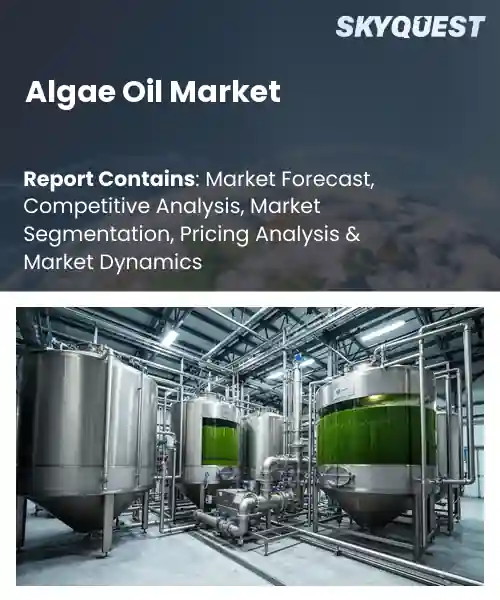
Algae Oil Market
Report ID: SQMIG35E2068
Report ID: SQMIG35E2068
[email protected]
USA +1 351-333-4748
Report ID:
SQMIG35E2068 |
Region:
Global |
Published Date: March, 2026
Pages:
157
|Tables:
151
|Figures:
78


Global Algae Oil Market size was valued at USD 788.6 Million in 2024 and is poised to grow from USD 889.54 Million in 2025 to USD 2331.52 Million by 2033, growing at a CAGR of 12.8% during the forecast period (2026-2033).
The growth of the algae oil market drives from the increasing need for high-purity, sustainable lipids as substitutes for depleting stocks of fish oil and to lessen reliance on feedstocks derived from fossil fuels. The algae oil market serves many commercial markets, principally the production of omega-3 fatty acids, specialty lipid ingredients for cosmetics and food, and potential biofuels. Algae oil has great importance in the context of addressing overfishing challenges, greenhouse gas emissions targets, and consumers' desires for traceable ingredient sources and sustainability.
The algae oil industry moved from being beta-test biofuels to producing commercially feasible alternatives for nutraceuticals and aquaculture feed via such success stories as the Veramaris partnership with salmon harvesting companies to provide algal-derived EPA/DHA, and advances in heterotrophic fermentation technology that decreased costs and improved producibility. Growth in the algae oil industry is driven by the continued advancement and maturation of sustainability-focused biotechnology, which is lowering unit costs and expanding the market for algae-based oils. Additionally, improvements in efficient cultivation methods, particularly heterotrophic fermentation are enabling commercial-scale production and supporting producers in penetrating aquaculture and food ingredient markets.
For example, through reduced fermentation and some downstream processing costs, Veramaris and other parties have been able to provide algal EPA/DHA for salmon feeding operations, reducing the industry's reliance upon wild fish for salmon feeds and providing stable feed margins for farmers. Similarly, advancements in strain engineering have increased lipid yields significantly enough that manufacturers can justify their capital investments in producing cosmetics and nutraceuticals from algae-based oils.
How is AI Optimizing Production Efficiency in the Algae Oil Market?
Through automating and improving the management of biological and process parameters, AI has improved production efficiency in the algae oil industry. A few of the ways AI is doing this include using data driven models to guide strain selection, monitoring light, temperature, nutrients, and CO2 in real time, using predictive scheduling for harvesting decisions, and allowing for adaptive extraction settings. Currently, pilot and early commercial systems are working to reduce variability and increase oil quality by using closed loop machine learning. This is important as algae oil is being challenged by the need for scale and consistency at the same time as consumers have increased their demand for sustainable oils.
Market snapshot - 2026-2033
Global Market Size
USD 788.6 Million
Largest Segment
Crude Algae Oil
Fastest Growth
Algal Omega-3 Oil
Growth Rate
12.8% CAGR
To get more insights on this market click here to Request a Free Sample Report
The algae oil market is segmented into product type, source, application, end-use industry, distribution channel and region. Based on product type, the market is segmented into crude algae oil, refined algae oil, algal omega-3 oil and specialty/high-purity algae oils. Based on source, the market is segmented into microalgae and macroalgae. Based on application, the market is segmented into food & beverages, dietary supplements, cosmetics & personal care, pharmaceuticals & nutraceuticals, animal & aquaculture feed, biofuel & energy and industrial applications.
Based on end-use industry, the market is segmented into food & beverage, healthcare & nutraceuticals, cosmetics & personal care, biofuel producers, animal nutrition and other industries. Based on distribution channel, the market is segmented into direct sales, distributors & dealers and online retail. Based on region, the market is segmented into North America, Europe, Asia Pacific, Latin America and Middle East & Africa.
As per global algae oil market analysis, the algal omega 3 oil segment is a dominant player due to the concentrated long chain fatty acid profile that meets consumer health needs and generates high need in nutraceutical and functional food formulation. In addition, because of established proven efficacy and established experience with regulations, manufacturers work hard to obtain a consistent supply of product which continues to create investment in algae cultivation and extraction capabilities. This investment results in improved reliability/quality of production and bola product positioning and ultimately reinforces the leadership position of the companies supplying the algae oil market.
As per global algae oil market forecast, the specialty high purity algae oil segment is the fastest growing in the market. The development of improved purification and fractionation techniques has created the opportunity to offer differentiated/high-value products that will attract specialty customers and research partners. This opens up new/customary applications that are high-margin and provides continued opportunity to advance product innovation through ongoing process improvements and niche development opportunities.
The dietary supplements segment currently leads due to the ever-growing global algae oil market trend of consumers preferring to source their omega 3s from plant-based sources as well as the clarity of functional claims to manufacturers of capsules and premixes. The existence of established regulatory pathways and formulation know-how are reducing the risk of commercializing these products, thereby encouraging manufacturers to prioritize their production of consistently high-quality products and obtaining certification. Furthermore, the scaling in extraction and stabilization of algae to meet the standards set forth for supplement uses is improving the reliability of the supply chain and increasing consumer confidence in the use of algae oil as a primary use of the product.
As per global algae oil market outlook, animal & aquaculture feed is the fastest growing application, driven by demand to replace marine oils and enhance feed nutritional profiles. As such, there is a large amount of demand for replacing fish with algae oil and nutritionally improving the overall feed profile. Algae oil is being used in feed and has been found to provide improved growth performance and levels of omega 3 in the farmed species. As a result, more feed manufacturers are beginning to adopt the use of algae oils in their formulations, which are leading to greater investments in scalable production and supply chain integration.
To get detailed segments analysis, Request a Free Sample Report
As per global algae oil market regional outlook, North America has the biggest market because their combined industrial, research and political environments all work together to reduce commercialization barriers. There are established relationships between universities, technology developers, and industry partners that facilitate the process of development at scale and delta refinement. The logistics of feedstock are in place and there is existing demand from a variety of sectors including food, nutraceuticals, cosmetics, and renewable fuel which creates a continuous building supply chain from the increase of algae oil production.
As per global algae oil market regional forecast, U.S. market will continue to thrive due to its developed research base; availability of venture capital; and an outlook for future demand in food, cosmetics and renewable fuel products. University and industry partnerships along with pilot projects also help to validate new technology. The US has logistics capabilities that enable producers to scale production.
The regulatory landscape is clear, and there are multiple certifications available which will further enhance commercialization efforts. The availability of contract manufacturing and the formation of consortia provide new avenues for collaboration that will enable a smoother transition into commercialization while providing the opportunity for companies to build strategic alliance for the various products that will utilize algae oil.
As per global algae oil market regional analysis, Canada market is uniquely positioned to grow due to the existence of strong research partnerships; provincial government innovation funding; and access to renewable energy inputs that create an environment for sustainable production. The collaboration between algae oil technology developers and algae oil processors promotes the development of integrated supply chains that benefit both parties and focus on utilizing algae oil as a specialty oil for nutraceutical and cosmetic uses and supporting renewable fuels by diversifying feedstock sources.
Europe is rapidly expanding its market due to aligned government polices focused on the algae oil market growth of a sustainable bioeconomy, being driven by consumer interest in plant-and-marine-based nutritional ingredients, and due to an active innovation ecosystem where research institutions and industrial partners collaborate. Harmonized regulatory standards and regional certification schemes help reduce the initial investment needed for companies to enter into the algae oil sector by allowing them to procure algae oil in accordance with these standards without having to invest so much capital to develop the required infrastructure.
In addition, developing pilot infrastructure, fermentation and cultivation capabilities, as well as international partnerships, will create scalable supply chains for the algae oil market, and the demand for algae oil in functional foods, personal care and specialty chemicals will create innovation opportunities for manufacturers.
Germany algae oil market utilizes industrial biotechnology expertise, advanced chemical manufacturing, and collaborative research networks between universities and the private sector. The use of defined quality and traceability standards provides an incentive for downstream manufacturers to buy from companies that provide specialty oils due to the resulting reliability of these products. The establishment of cluster initiatives and support assist companies in transitioning from pilot-stage to full production.
The algae oil market in the UK is characterized by a vibrant start-up landscape, substantial capital investment, and many research institutions that fast-track commercialization through innovative cultivation and extraction methods; corporate collaborations and pilot facilities enable scale-up testing. The focus on sustainable sourcing and clean ingredient credentials has attracted established food and personal care brands. Adaptive regulatory engagement and industry groups add collaborative structures that facilitate speed to market and entry into wider regional value chains.
The French algae oil market, driven by a concentration of research and development activities, has strong connections with the culinary; cosmetic; and nutraceuticals sectors. High Quality; traceable sourcing tends to appeal to premium food producers and personal care brands. Innovation initiatives in the region include the creation of incubators to support early-stage companies and partnerships with established processors to connect pilots with commercial scales. Growing exports are anticipated as French suppliers increasingly take advantage of the European algae oil market.
The algae oil market in Asia-Pacific is being developed through innovative biotechnology investments, worldwide partnerships with other companies, as well as strategic integration between aquaculture and processing. Manufacturers are focusing on reducing costs through innovative processes, locally sourced feedstocks, and adapted cultivation methods based on local climates. The demand for algae oil from the health supplement, food, and cosmetics markets is also a significant driver in being able to scale production commercially, as well as government programs providing green technologies that support international collaboration.
The algae oil market in Japan has developed based on advanced biotechnology research; stringent quality control systems; and a strong focus on delivering high-purity products suited for functional food and personal care applications. Collaborative relationships between research institutions and manufacturers build on improved strain development and refining production processes. Japanese identifying manufacturers have focused on building consumer confidence via product traceability and integrity at each value chain step. Additionally, investment in pilot facilities, and downstream processing, has given Japanese manufacturers the ability to offer algae-based products that suit selected market segments.
The algae oil market in South Korea continues its advancement through industrial biotechnology initiatives; manufacturing technology expertise; and governmental assistance via commercial pilot programs. A primary focus of the technology firms is the maximization of process intensification and scalable cultivation methods, particularly in marine environments. Additionally, product quality improvements and branding initiatives by manufacturers have been influenced by increasing consumer demand from the cosmetics and nutraceuticals industries.
To know more about the market opportunities by region and country, click here to
Buy The Complete Report
Rising Demand for Sustainable Oils
Technological Advances In Cultivation
High Production and Processing Costs
Regulatory Challenges and Approval Issues
Request Free Customization of this report to help us to meet your business objectives.
The global algae oil industry is characterized by consolidation, strategic partnerships, and technology-led scaling up activities aimed at securing feedstock, regulatory access, and formulation channels. Some recent initiatives highlighting this trend are Corbion's purchase of TerraVia assets and teaming up with Lubrizol for AlgaPur, along with the Veramaris joint venture between DSM and Evonik that aims to commercialize EPA DHA algae oil for use in aquafeed and supply chains.
Sustainable Feedstock Integration
Functional Ingredient Innovation
SkyQuest’s ABIRAW (Advanced Business Intelligence, Research & Analysis Wing) is our Business Information Services team that Collects, Collates, Correlates, and Analyses the Data collected by means of Primary Exploratory Research backed by robust Secondary Desk research.
As per SkyQuest analysis, the increasing requirement for sustainable and highly refined lipids replacing limited fish oil and fulfilling traceability and ecologically-friendly goals is a crucial force to drive progress in the worldwide market for algal omega-3 oil as the number one segment in terms of sales to date. Conversely, continuing to realize a competitive price for the production and processing of algal omega-3 oils presents the major constraint to achieving long-term sustainability. Currently, North America has dominated the worldwide market for algal omega-3 oil, primarily due to the continued investment and subsequent accumulation of mature industrial capacity, ongoing partnerships for research and development, and continuing strong demand downstream. The leading product segment for algal omega-3 oils to date is nutraceuticals and functional foods. Technological advancements driving progress in the development of algal omega-3 oils include improvements to both the strains utilized for production and their associated cultivation and extraction processes (including improvements through the application of artificial intelligence) that have resulted in decreasing unit costs and enhancing the ability to commercially launch algal omega-3 oils into the food, feed, and personal care industries.
| Report Metric | Details |
|---|---|
| Market size value in 2024 | USD 788.6 Million |
| Market size value in 2033 | USD 2331.52 Million |
| Growth Rate | 12.8% |
| Base year | 2024 |
| Forecast period | 2026-2033 |
| Forecast Unit (Value) | USD Million |
| Segments covered |
|
| Regions covered | North America (US, Canada), Europe (Germany, France, United Kingdom, Italy, Spain, Rest of Europe), Asia Pacific (China, India, Japan, Rest of Asia-Pacific), Latin America (Brazil, Rest of Latin America), Middle East & Africa (South Africa, GCC Countries, Rest of MEA) |
| Companies covered |
|
| Customization scope | Free report customization with purchase. Customization includes:-
|
To get a free trial access to our platform which is a one stop solution for all your data requirements for quicker decision making. This platform allows you to compare markets, competitors who are prominent in the market, and mega trends that are influencing the dynamics in the market. Also, get access to detailed SkyQuest exclusive matrix.
Table Of Content
Executive Summary
Market overview
Parent Market Analysis
Market overview
Market size
KEY MARKET INSIGHTS
COVID IMPACT
MARKET DYNAMICS & OUTLOOK
Market Size by Region
KEY COMPANY PROFILES
Methodology
For the Algae Oil Market, our research methodology involved a mixture of primary and secondary data sources. Key steps involved in the research process are listed below:
1. Information Procurement: This stage involved the procurement of Market data or related information via primary and secondary sources. The various secondary sources used included various company websites, annual reports, trade databases, and paid databases such as Hoover's, Bloomberg Business, Factiva, and Avention. Our team did 45 primary interactions Globally which included several stakeholders such as manufacturers, customers, key opinion leaders, etc. Overall, information procurement was one of the most extensive stages in our research process.
2. Information Analysis: This step involved triangulation of data through bottom-up and top-down approaches to estimate and validate the total size and future estimate of the Algae Oil Market.
3. Report Formulation: The final step entailed the placement of data points in appropriate Market spaces in an attempt to deduce viable conclusions.
4. Validation & Publishing: Validation is the most important step in the process. Validation & re-validation via an intricately designed process helped us finalize data points to be used for final calculations. The final Market estimates and forecasts were then aligned and sent to our panel of industry experts for validation of data. Once the validation was done the report was sent to our Quality Assurance team to ensure adherence to style guides, consistency & design.
Analyst Support
Customization Options
With the given market data, our dedicated team of analysts can offer you the following customization options are available for the Algae Oil Market:
Product Analysis: Product matrix, which offers a detailed comparison of the product portfolio of companies.
Regional Analysis: Further analysis of the Algae Oil Market for additional countries.
Competitive Analysis: Detailed analysis and profiling of additional Market players & comparative analysis of competitive products.
Go to Market Strategy: Find the high-growth channels to invest your marketing efforts and increase your customer base.
Innovation Mapping: Identify racial solutions and innovation, connected to deep ecosystems of innovators, start-ups, academics, and strategic partners.
Category Intelligence: Customized intelligence that is relevant to their supply Markets will enable them to make smarter sourcing decisions and improve their category management.
Public Company Transcript Analysis: To improve the investment performance by generating new alpha and making better-informed decisions.
Social Media Listening: To analyze the conversations and trends happening not just around your brand, but around your industry as a whole, and use those insights to make better Marketing decisions.
REQUEST FOR SAMPLE
 REQUEST FREE CUSTOMIZATION
Global Algae Oil Market size was valued at USD 788.6 Million in 2024 and is poised to grow from USD 889.54 Million in 2025 to USD 2331.52 Million by 2033, growing at a CAGR of 12.8% during the forecast period (2026-2033).
Key vendors in the Algae Oil Market include DSM-Firmenich, Corbion N.V., Cellana Inc., Cargill Incorporated, DIC Corporation, Algatech Ltd., TerraVia Holdings, Cyanotech Corporation, Algaecytes, and ADM, competing through biotechnology innovation, sustainable production, and expanding applications in food, feed, and biofuels.
The key driver of the Algae Oil Market is the rising demand for sustainable and plant-based alternatives to traditional oils, supported by growing awareness of environmental impact, health benefits, and expanding use in food, nutraceuticals, and biofuel applications.
The key market trend in the Algae Oil Market is the growing shift toward plant-based and sustainable alternatives, particularly for omega-3 supplements and biofuels, along with increasing adoption in functional foods, nutraceuticals, and eco-friendly industrial applications.
North America accounted for the largest share in the Algae Oil Market, driven by strong demand for plant-based nutrition, advanced biotechnology capabilities, and increasing adoption of algae-based products across food, feed, and biofuel applications.


Want to customize this report? This report can be personalized according to your needs. Our analysts and industry experts will work directly with you to understand your requirements and provide you with customized data in a short amount of time. We offer $1000 worth of FREE customization at the time of purchase.
Feedback From Our Clients


 USA (+1) 351-333-4748

