Algae Biofeedback Market
Report ID: SQMIG10C2074
Report ID: SQMIG10C2074
[email protected]
USA +1 351-333-4748
Report ID:
SQMIG10C2074 |
Region:
Global |
Published Date: March, 2026
Pages:
157
|Tables:
118
|Figures:
77


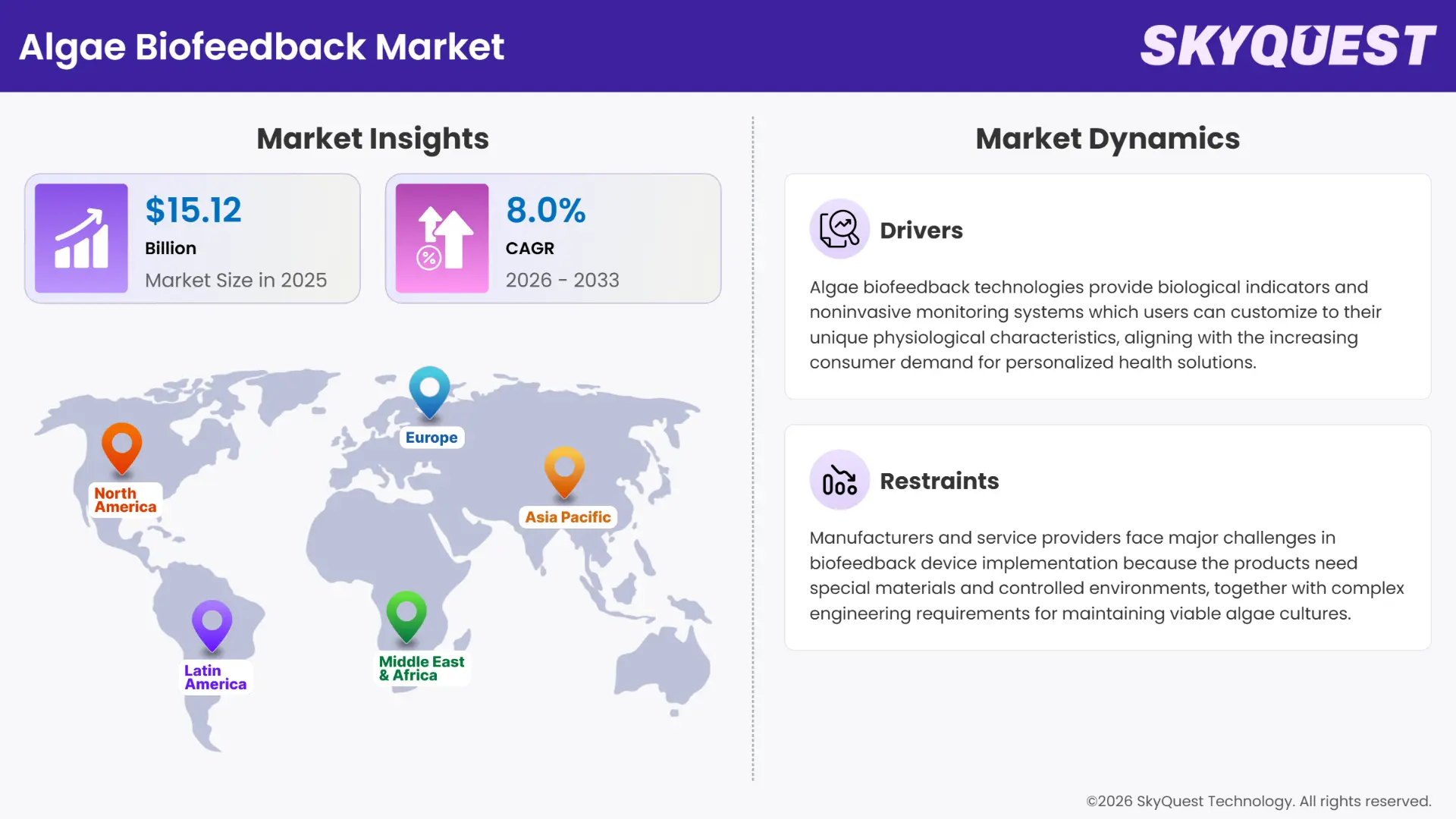
Global Algae Biofeedback Market size was valued at USD 14.0 Billion in 2024 and is poised to grow from USD 15.12 Billion in 2025 to USD 27.99 Billion by 2033, growing at a CAGR of 8.0% during the forecast period (2026-2033).
Key Takeaways: Market Trends & Insights
The global algae biofeedback market growth is driven because environmental needs and biological sensing technology development reach their highest level. The market includes technologies that utilize algae to provide continuous water quality monitoring and contamination detection and carbon capture process efficiency assessment through their natural responses which chemical testing methods cannot maintain. The field transformed from academic research into commercial biosensor development and biosensor-based environmental monitoring systems which cities tested through algal fluorescence for nutrient detection and industrial plants used algae arrays to optimize effluent treatment.
Moreover, the global algae biofeedback market penetration depends on companies facing new regulations which demand continuous biological monitoring and digital networks to enable operational control over sensor network systems. Utilities and manufacturers use algal biofeedback to meet tighter nutrient discharge limits while wireless telemetry links sensors with control systems to create optimized aeration and dosing schedules which cut energy and chemical expenditures. The aquaculture industry uses algal signals to stop harmful blooms while municipal water treatment facilities reduce their bypass incidents and industrial facilities generate compliance reports which contain data needed for carbon credit programs and sustainability assessments.
How is AI Enhancing Predictive Accuracy In The Algae Biofeedback Market?
The global algae biofeedback market outlook develops better predictive models through sensor data integration and machine learning which detects bloom patterns and species identification and growth prediction. The system needs all three sensor types to create optical and chemical and satellite data streams which the system will use to develop predictive models through training past bloom data and ongoing validation through fresh data inputs. Commercial adoption has started for autonomous buoys and hyperspectral satellites and low-cost sensor systems which enable aquaculture operators and water managers to detect hazards early and respond effectively. AI powered buoy networks together with low-cost sensor systems achieved better operational results than traditional methods, according to field trials.
Kuva Space declared, in July 2025, that it will conduct a pilot project with the Finnish Environment Institute which will use hyperspectral satellite data and AI technology to identify algae species and estimate biomass. The new capabilities improve predictive modeling while they enable faster detection processes which help managers execute their interventions at earlier points in time.
To get more insights on this market click here to Request a Free Sample Report
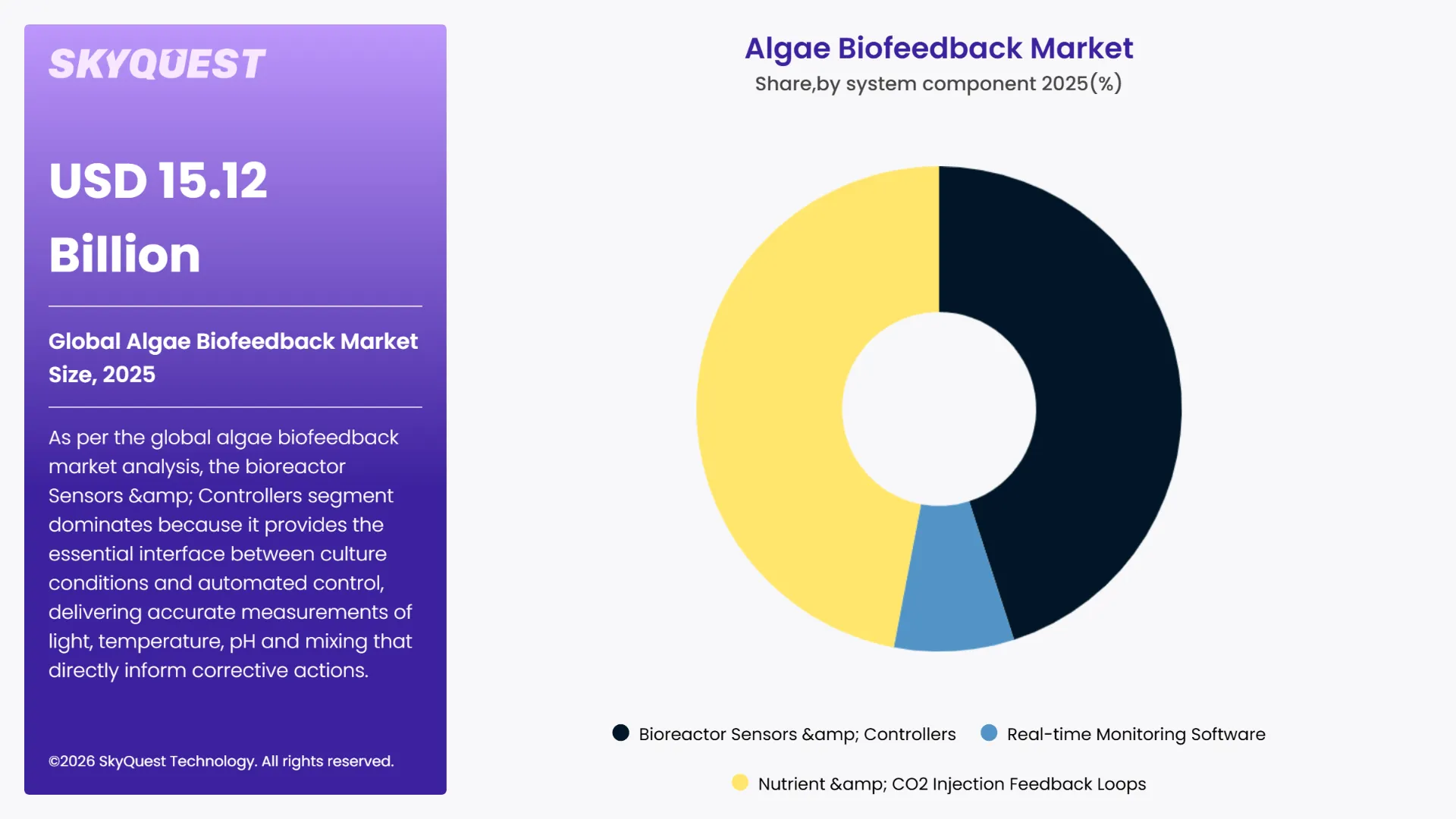
The global algae biofeedback market is segmented based on system component, algae species or model, application domain, end-user, and region. By system component, the market includes bioreactor sensors and controllers, real-time monitoring software, and nutrient and CO₂ injection feedback loops. In terms of algae species or model, it is categorized into spirulina, chlorella, and general microalgae. Based on application domain, the market is divided into biofuel production optimization, wastewater treatment, carbon sequestration monitoring, and pharmaceutical and nutraceutical cultivation. By end user, it comprises industrial biotechnology companies, environmental research laboratories, and municipal utility providers. Regionally, the market is analyzed across North America, Europe, Asia Pacific, Latin America, and the Middle East & Africa.
As per the global algae biofeedback market analysis, the bioreactor Sensors & Controllers segment dominates because it provides the essential interface between culture conditions and automated control, delivering accurate measurements of light, temperature, pH and mixing that directly inform corrective actions. The operation loses costs and risks because reliable sensing technology prevents production failures, and it enables stricter process monitoring. The control hardware integration enables better operational performance and operational performance, which creates essential support infrastructure for commercial algae cultivation feedback systems.
However, the most rapidly growing sector currently operates through Real time Monitoring Software which enables sensor data to generate predictive insights through analytics and cloud connections for remote system monitoring. Software platform usage spreads among operators because of its ability to help users make better operational choices while creating business pathways through data services and system integrations that enable better operational choice and business growth.
According to the global algae biofeedback market forecast, the economic drivers of cultivation make biofuel production optimization segment the leading segment because it connects real time feedback with lipid accumulation information and harvest timing details which determine fuel yield and cost through downstream process efficiency. The biofeedback system needs monitoring solutions which help operators maintain their best operational states because key solutions help operations maintain their optimal state. The economic need drives financial support for biofeedback systems which optimize fuel production processes.
Whereas the water and wastewater treatment sector is experiencing the fastest growth rate because regulatory pressures and resource recovery systems are both driving organizations to establish algae systems which contain control feedback capabilities. The real-time monitoring system improves nutrient extraction efficiency while making biomass harvesting easier for secondary applications which utilities and industrial facilities find valuable. The market develops through operational and commercial drivers, which create two paths to expand market power and produce immediate financial gains.
To get detailed segments analysis, Request a Free Sample Report
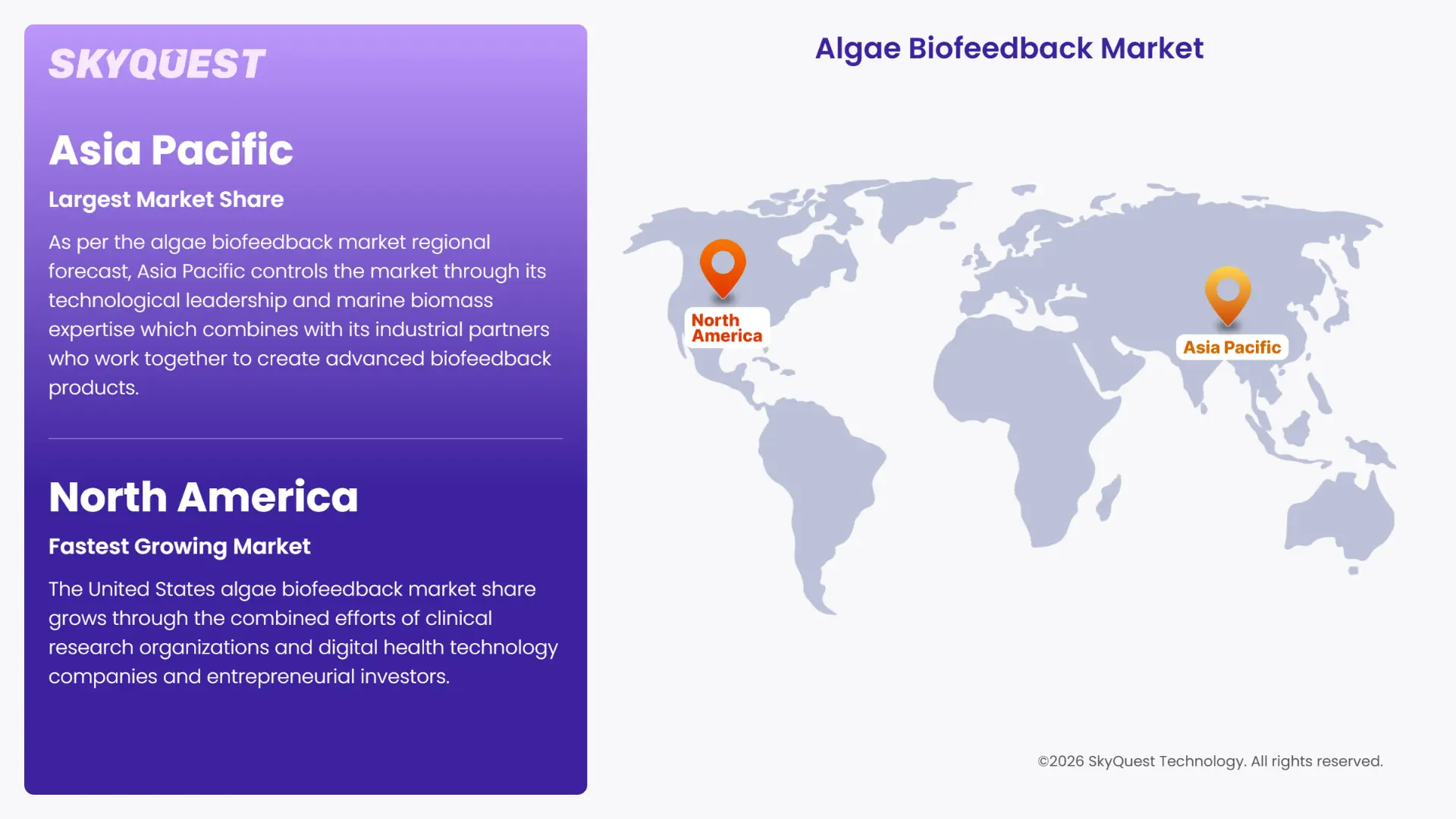
As per the algae biofeedback market regional forecast, Asia Pacific controls the market through its technological leadership and marine biomass expertise which combines with its industrial partners who work together to create advanced biofeedback products. The region establishes vertically integrated value chains through its advanced sensor development and adaptive software which combines with its deep experience in algae cultivation to enable faster product development.
Institutions establish networks through which businesses build partnerships to transform laboratory discoveries into market-ready products while their financial support enables various industries to develop health-related and cosmetic and environmental monitoring systems. Biofeedback systems gain social acceptance through cultural understanding while manufacturing capabilities which are concentrated in specific areas help companies launch products faster and enhance their design process. Asia Pacific develops a competitive advantage through its research ecosystem, which combines research activities with production facilities and product testing to establish standards for market entry.
The Japanese algae biofeedback sector unites its clinical research activities with its cosmetic development activities through precise instrumentation integration. The electronics and biotech industries join forces to enhance sensing technologies and wearable devices while academic institutions develop translational studies which demonstrate the therapeutic value and wellness applications of these technologies. The established manufacturing infrastructure enables Japanese companies to manufacture products at scale while they prioritize quality assurance and regulatory compliance, and their partnerships boost product trust in local markets.
The algae biofeedback industry in South Korea expands through its combination of advanced electronics manufacturing and startup companies and marine biotech research. Local companies develop biofeedback products for consumers through their use of tiny sensors together with their mobile platform development. Korean universities maintain close contact with industry partners to accelerate the development of new products through prototype testing and commercialization. South Korea has become an important regional innovator because its design process uses multiple design iterations and focuses on user experience and cosmetic product development.
North America has emerged as a rapid expansion region for algae biofeedback because of deep innovation networks, strong clinical and commercial demand for bio responsive technologies, and close integration with digital health ecosystems. Healthcare providers join consumer wellness brands and environmental monitoring firms to develop multiple methods for creating and implementing applications. The research institutions together with their entrepreneurial ecosystems help organizations create product prototypes which they can use to enter markets while validating safety and efficacy, which results in quicker adoption.
Manufacturers use their advanced data analytics capabilities together with their manufacturing infrastructure to develop products which use advanced signal processing technology and user interface design for market differentiation. The growth of North America multifunctional algae biofeedback solutions accelerates through sector partnerships which emphasize interoperability with established health platforms. The path to commercialization requires both skilled workers and clear regulatory requirements.
The United States algae biofeedback market share grows through the combined efforts of clinical research organizations and digital health technology companies and entrepreneurial investors. Broad engagement among hospitals, wellness brands, and monitoring companies foster diversified use cases and commercialization routes. The system offers clinically credible solutions which use interoperability to connect electronic health systems and advanced data analytics functions. The established manufacturing infrastructure, together with its cross-sector partnership system, enables organizations to extend their verified products into new market areas.
The algae biofeedback market in Canada is shaped by collaborative research networks, strong university industry linkages, and an emphasis on sustainable marine resource utilization. Canadian initiatives establish environmental monitoring systems and therapeutic applications through partnerships which link early research projects with commercial development activities. The favorable innovation environment together with the skilled scientific workforce enables companies to create prototypes while manufacturing facilities support their North American supply chain operations and product development requirements.
European nations establish their presence in the algae biofeedback industry through coordinated research platforms and their dedication to sustainable practices and special partnerships between academic institutions and businesses of various sizes. The region supports initiatives which create trustworthy measurement methods while enabling systems to pass both rigorous regulatory demands and high-quality standards required for medical and environmental assessments. National centers advance their output development through their combination of precise engineering methods with life science knowledge and existing chemical and cosmetic industrial bases.
Cross-border consortia and industry associations support shared infrastructure development through common protocols and knowledge transfer to decrease regional market fragmentation. The combination of systemic methods with extensive manufacturer networks and user-focused design approaches enables the region to strengthen its market position while delivering proven algae biofeedback systems that meet demands. The combination of public and private funding for pilot programs together with manufacturing facility upgrades helps speed up both product launch and international market expansion.
The algae biofeedback market in Germany is defined by its combination of precision engineering and industrial biotechnology competence and its strict enforcement of quality control systems. Companies develop solutions for both healthcare and environmental needs through its work on durable sensor hardware and validated protocols and production system integration. Research institutes maintain strong ties with specialized suppliers which enable them to achieve efficient process improvements and scale-up operations. Enterprises build trust through their dedication to standards and their high-performance industrial products which enable them to expand their market presence throughout the European Union.
The algae biofeedback market in the United Kingdom benefits from its three core elements of research clusters that link academic work with practical applications and its biomedical research capabilities and its entrepreneurship ecosystem. User centric design and digital health platform integration create solutions which operate in clinical environments. The three parties' universities and health systems and startups work together to accelerate the process of validating their solutions which London hubs assist through their investment and commercialization capabilities. The United Kingdom business landscape prepares companies to enter European and international markets through its commitment to evidence-based performance and seamless system integration.
The algae biofeedback market in France operates through its three core components of life-science research activities and its active cosmetics industry and its collaborative efforts between public institutions and private businesses. French teams focus on three development areas which include design materials for product composition and effective user interface creation that complies with strict quality standards. Research laboratories collaborate closely with manufacturers to develop testing and production facilities for both wellness and environmental monitoring systems. The design focus and regulatory compliance of French firms enable them to create unique market propositions which help them succeed in the European market.
To know more about the market opportunities by region and country, click here to
Buy The Complete Report
Increasing Demand For Personalized Health
Algae biofeedback technologies provide biological indicators and noninvasive monitoring systems which users can customize to their unique physiological characteristics, aligning with the increasing consumer demand for personalized health solutions. This alignment prompts healthcare providers and wellness companies to start developing products which utilize algae-based sensing technology, which will lead to dedicated investment and research efforts for specific application-based solutions. The adoption of algae biofeedback solutions grows across clinical and wellness settings because stakeholders require unique products which provide personalized insights for effective treatment.
Advancements In Sensor Integration
The algae biofeedback project has achieved enhanced commercial viability through its reliable field-testing capabilities and development of unified systems which make existing digital health systems work together. The enhanced compatibility of products enables medical and wellness professionals to implement products through remote monitoring systems and wearable devices. The ongoing development process leads to better data accuracy and user experience, which boosts the suitability of algae-derived feedback for product developers and end users, while driving research and collaboration growth and market commercialization efforts.
High Implementation Complexity and Cost
Manufacturers and service providers face major challenges in biofeedback device implementation because the products need special materials and controlled environments, together with complex engineering requirements for maintaining viable algae cultures. The product faces development risks which companies view as high, leading to extended product development timelines, which results in companies delaying their investment and product launch plans. The operational demands and resource requirements create two challenges, which restrict the number of qualified market players, while the slow process of commercializing products leads to limited market expansion and usage in both clinical and consumer sectors.
Regulatory Uncertainty Limiting Adoption
The regulatory frameworks for biological sensing devices that use living organisms create compliance uncertainty for developers and investors because they require developers to establish their compliance procedures which will guide their market entry strategies. As the situation is so unpredictable, companies are more likely to make safe choices that avoid regulatory problems. This means that product launches are delayed, and expansion efforts are limited. Algae biofeedback solutions have a hard time entering the international market because of problems with international standardization and a lack of market guidance. These problems stop products from being introduced to international markets and slow down the development of new market channels.
Request Free Customization of this report to help us to meet your business objectives.
The global algae biofeedback market experiences competitive consolidation, as existing companies use mergers and acquisitions together with business partnerships to obtain feedstock materials for their operational growth ambitions, while specialized startups research new cultivation methods and sensor technologies to develop affordable solutions which help them stand out from competitors. The JRS Group has acquired Algaia which processes seaweed while Origin by Ocean and CABB established a partnership to build a commercial algae biorefinery and Algenie introduced a new reactor technology.
SkyQuest’s ABIRAW (Advanced Business Intelligence, Research & Analysis Wing) is our Business Information Services team that Collects, Collates, Correlates, and Analyses the Data collected by means of Primary Exploratory Research backed by robust Secondary Desk research.
As per SkyQuest analysis, the global algae biofeedback market is driven by regulatory tightening and digitalization which serves as the main market driver while high implementation complexity and cost functions as the primary market restraint. Asia Pacific accounts for the largest market share with bioreactor sensors controllers being the main market segment due to its strong regional manufacturing operations and complete value chain. The system uses advanced analytics and AI technologies to improve prediction accuracy while optimizing operational efficiency, which enables organizations to start their response operations early while achieving better results in crop production. The market is experiencing momentum because biofuel optimization and wastewater integration are becoming important application areas, yet wider commercial success relies on making technology usage easier and establishing clear paths for following regulations.
| Report Metric | Details |
|---|---|
| Market size value in 2024 | USD 14.0 Billion |
| Market size value in 2033 | USD 27.99 Billion |
| Growth Rate | 8.0% |
| Base year | 2024 |
| Forecast period | 2026-2033 |
| Forecast Unit (Value) | USD Billion |
| Segments covered |
|
| Regions covered | North America (US, Canada), Europe (Germany, France, United Kingdom, Italy, Spain, Rest of Europe), Asia Pacific (China, India, Japan, Rest of Asia-Pacific), Latin America (Brazil, Rest of Latin America), Middle East & Africa (South Africa, GCC Countries, Rest of MEA) |
| Companies covered |
|
| Customization scope | Free report customization with purchase. Customization includes:-
|
To get a free trial access to our platform which is a one stop solution for all your data requirements for quicker decision making. This platform allows you to compare markets, competitors who are prominent in the market, and mega trends that are influencing the dynamics in the market. Also, get access to detailed SkyQuest exclusive matrix.
Table Of Content
Executive Summary
Market overview
Parent Market Analysis
Market overview
Market size
KEY MARKET INSIGHTS
COVID IMPACT
MARKET DYNAMICS & OUTLOOK
Market Size by Region
KEY COMPANY PROFILES
Methodology
For the Algae Biofeedback Market, our research methodology involved a mixture of primary and secondary data sources. Key steps involved in the research process are listed below:
1. Information Procurement: This stage involved the procurement of Market data or related information via primary and secondary sources. The various secondary sources used included various company websites, annual reports, trade databases, and paid databases such as Hoover's, Bloomberg Business, Factiva, and Avention. Our team did 45 primary interactions Globally which included several stakeholders such as manufacturers, customers, key opinion leaders, etc. Overall, information procurement was one of the most extensive stages in our research process.
2. Information Analysis: This step involved triangulation of data through bottom-up and top-down approaches to estimate and validate the total size and future estimate of the Algae Biofeedback Market.
3. Report Formulation: The final step entailed the placement of data points in appropriate Market spaces in an attempt to deduce viable conclusions.
4. Validation & Publishing: Validation is the most important step in the process. Validation & re-validation via an intricately designed process helped us finalize data points to be used for final calculations. The final Market estimates and forecasts were then aligned and sent to our panel of industry experts for validation of data. Once the validation was done the report was sent to our Quality Assurance team to ensure adherence to style guides, consistency & design.
Analyst Support
Customization Options
With the given market data, our dedicated team of analysts can offer you the following customization options are available for the Algae Biofeedback Market:
Product Analysis: Product matrix, which offers a detailed comparison of the product portfolio of companies.
Regional Analysis: Further analysis of the Algae Biofeedback Market for additional countries.
Competitive Analysis: Detailed analysis and profiling of additional Market players & comparative analysis of competitive products.
Go to Market Strategy: Find the high-growth channels to invest your marketing efforts and increase your customer base.
Innovation Mapping: Identify racial solutions and innovation, connected to deep ecosystems of innovators, start-ups, academics, and strategic partners.
Category Intelligence: Customized intelligence that is relevant to their supply Markets will enable them to make smarter sourcing decisions and improve their category management.
Public Company Transcript Analysis: To improve the investment performance by generating new alpha and making better-informed decisions.
Social Media Listening: To analyze the conversations and trends happening not just around your brand, but around your industry as a whole, and use those insights to make better Marketing decisions.
REQUEST FOR SAMPLE
 REQUEST FREE CUSTOMIZATION
Global Algae Biofeedback Market size was valued at USD 14.0 Billion in 2024 and is poised to grow from USD 15.12 Billion in 2025 to USD 27.99 Billion by 2033, growing at a CAGR of 8.0% during the forecast period (2026-2033).
The competitive landscape in the global algae biofeedback market is consolidation-driven, with incumbents using M&A and industrial partnerships to secure feedstock and scale while specialist startups pursue novel cultivation and sensor technologies to lower costs and differentiate. Recent strategic moves include JRS Group’s acquisition of seaweed processor Algaia, Origin by Ocean’s partnership with CABB to build a commercial algae biorefinery, and reactor innovation from Algenie. 'Algenol', 'Sapphire Energy', 'Blue Marble Productions', 'Culture Biosystems', 'Proviron', 'Reliance Life Sciences', 'Algae Systems', 'TerraVia (Corbion)', 'Euglena Co.', 'Manta Biofuel', 'Green Plains Inc.', 'Cellana Inc.', 'Calyxt', 'Solix Algredients', 'Cyanotech', 'Algatech (Solabia)', 'Synthetic Genomics', 'ADL BioPharma', 'DIC Corporation', 'Pond Technologies'
Algae biofeedback technologies align closely with growing consumer interest in personalized health by providing adaptable biological indicators and noninvasive monitoring options that can be tailored to individual physiological profiles. This alignment encourages healthcare providers and wellness companies to incorporate algae based sensing and feedback into product roadmaps, facilitating investment and research into application specific solutions. As stakeholders seek differentiated offerings that deliver individualized insights and treatment optimization, the perceived value proposition of algae biofeedback strengthens, fostering broader adoption across clinical and consumer wellness environments.
Premium Bioproduct Diversification: Industry participants are shifting focus toward high value niche products derived from algae, including specialty nutraceuticals, cosmetics actives and functional ingredients for personal care. This trend is driven by demand for sustainable, traceable ingredients and willingness among brand owners to pay premiums for purity and documented environmental benefits. Developers are expanding strain libraries, optimizing downstream processing and pursuing strategic partnerships with consumer brands to capture margin, differentiate offerings and open new commercial channels beyond conventional commodity markets while ensuring quality.
Asia Pacific Dominate the Global Algae Biofeedback Market?
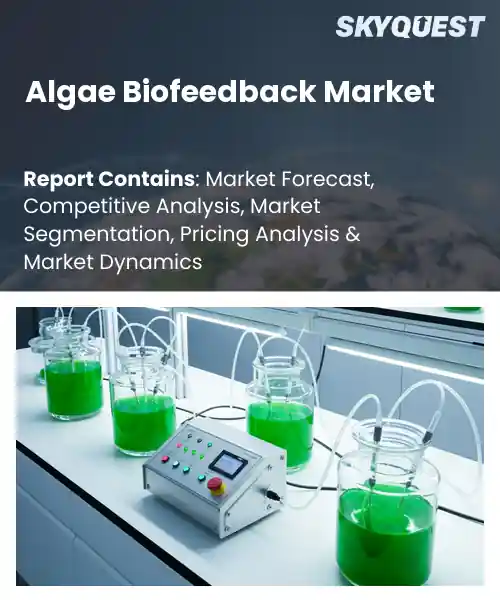
The Algae Biofeedback Market focuses on systems that use bioreactor sensors, real-time monitoring software, and nutrient & CO₂ injection feedback loops to optimize algae cultivation and performance. It serves applications involving Spirulina, Chlorella, and other microalgae-based systems.
Key system components include bioreactor sensors & controllers, real-time monitoring software, and nutrient & CO₂ injection feedback loops.


Want to customize this report? This report can be personalized according to your needs. Our analysts and industry experts will work directly with you to understand your requirements and provide you with customized data in a short amount of time. We offer $1000 worth of FREE customization at the time of purchase.
Feedback From Our Clients


 USA (+1) 351-333-4748

