Airport Baggage Protection Market
Report ID: SQMIG20W2023
Report ID: SQMIG20W2023
[email protected]
USA +1 351-333-4748
Report ID:
SQMIG20W2023 |
Region:
Global |
Published Date: July, 2026
Pages:
157
|Tables:
116
|Figures:
77


Global Airport Baggage Protection Market size was valued at USD 1.3 Billion in 2024 and is poised to grow from USD 1.35 Billion in 2025 to USD 1.88 Billion by 2033, growing at a CAGR of 4.2% during the forecast period (2026-2033).
Digital connectivity drives the airport baggage protection market because airlines now depend on cloud platforms to merge sensor data, passenger profiles, and insurance claims instantly. When a bag carries an IoT sleeve, the system updates its location, allowing staff to redirect misplaced items before they exit the terminal; this practice cut loss rates by 30 % for an Asian carrier in 2022. The efficiency motivates airports to join fintech firms that embed micro‑insurance into ticket sales, creating revenue while delivering coverage. As a result, providers that add AI anomaly detection to their offerings secure an edge, prompting R&D investment across the industry.
The airport baggage protection market comprises solutions that safeguard passengers' luggage from loss, damage, or theft, ranging from RFID tracking tags to reinforced containers and insurance policies. Its significance grew as air travel volumes surged; in 2000 the industry handled one billion passengers, while by 2023 that figure exceeded five billion, magnifying exposure to mishandling incidents. Early adopters such as carriers in Europe introduced barcode tags in the mid‑2000s, prompting a ripple effect that spurred vendor investment in monitoring platforms. This evolution reflects a shift from reactive compensation toward proactive risk mitigation, positioning baggage protection as a service rather than an ancillary add‑on.
How is AI-driven automation enhancing security in the airport baggage protection market?
AI driven automation is reshaping security in the airport baggage protection market by linking visual inspection, weight analysis and behavior modeling in a single decision layer. Sensors capture real time data while machine learning algorithms compare patterns against known threat signatures. The system alerts operators instantly, allowing focused intervention and reducing bottlenecks. Airlines and airports are adopting these tools to meet rising passenger volumes and tighter safety regulations. Early pilots show smoother flow and higher detection confidence, making the technology a cornerstone of modern baggage handling strategies. Integration with airport IT platforms ensures that alerts are logged and shared across security teams, creating a unified response framework.
SITA introduced an AI driven imaging system in June 2026, which automatically flags suspicious items and routes them to dedicated inspection lanes. The deployment cut manual review time and boosted confidence in threat detection, reinforcing market growth by delivering faster, more reliable baggage security for airlines and passengers alike.
Market snapshot - (2026-2033)
Global Market Size
USD 1.3 Billion
Largest Segment
Protective Film
Fastest Growth
Tracking Tags
Growth Rate
4.2% CAGR
To get more insights on this market click here to Request a Free Sample Report
Global airport baggage protection market is segmented by system type, operational model, core material, sales channel and region. Based on system type, the market is segmented into Wrapping Machines, Protective Film, Hard Shell Covers and Tracking Tags. Based on operational model, the market is segmented into Concessionaire Operated and Airline Self Service. Based on core material, the market is segmented into Linear Polyethylene, Polypropylene Base and Recycled Plastics. Based on sales channel, the market is segmented into Direct Airport Contracts and Franchise Partner Networks. Based on region, the market is segmented into North America, Europe, Asia Pacific, Latin America and Middle East & Africa.
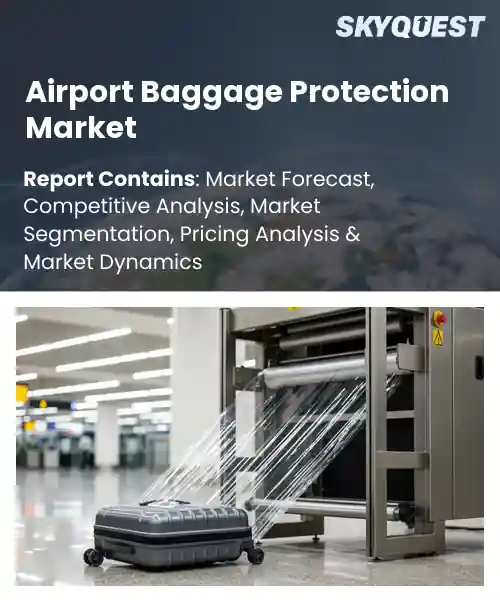
Wrapping machines segment dominates with large airport baggage protection market share because airports prioritize rapid, automated encasement that minimizes handling time and protects luggage from damage. The technology integrates with conveyor systems, offering consistent tensile strength and ease of deployment across diverse terminal layouts. Operators value the reliability and low labor input, which translates into smoother throughput and reduced claims. Consequently, investment decisions favor wrapping solutions that deliver operational certainty and enhanced passenger confidence.
As per airport baggage protection market outlook, hard shell covers segment is witnessing the strongest growth momentum because manufacturers have introduced lightweight composites that combine rigidity with impact absorption. Airports adopt these covers for premium baggage zones, driven by passenger expectations for damage free travel and emerging luggage safety regulations. This innovation expands market reach and fuels new revenue streams.
Airline self service segment leads because carriers can directly integrate protection workflows into their own ground handling processes, ensuring consistent standards and quick response to passenger concerns. This model leverages existing staff and IT systems, reducing reliance on third parties and aligning protection measures with airline branding. The result is streamlined operations and heightened accountability, which drives preferential adoption.
As per airport baggage protection market analysis, concessionaire operated model emerges as the key high growth area because airports are expanding revenue sharing arrangements that allow specialized firms to manage protection services. These operators bring expertise, invest in wrapping and tracking technologies, and offer service tiers that attract a broad range of airlines. Their scalability and focus on innovation accelerate market expansion and create new partnership opportunities.
To get detailed segments analysis, Request a Free Sample Report
The region benefits from a mature aviation ecosystem where leading carriers and service providers have long embraced sophisticated risk‑management solutions. A culture of high passenger expectation drives continuous improvement in service reliability and claims handling. Strong collaboration between insurers, technology firms, and airport operators creates seamless integration of protection products into travel workflows. Regulatory frameworks emphasize consumer protection and safety, encouraging widespread adoption. Additionally, the presence of numerous large‑scale hubs supports economies of scale that reinforce market leadership.
As per airport baggage protection market regional outlook, United States is shaped by a deep network of insurers that partner closely with major airlines to embed coverage into ticketing platforms. Innovation thrives as providers leverage data analytics and mobile applications to streamline claim processing and enhance traveler confidence. The market also reflects a proactive stance on customer service, with rapid response teams and comprehensive policy options that address diverse traveler needs across a highly competitive airline landscape.
As per airport baggage protection market regional forecast, Canada is characterized by strong regulatory oversight that elevates safety standards and consumer confidence. Insurers focus on collaborative solutions that integrate with national carrier systems, often emphasizing digital claim submission and transparent policy terms. Government initiatives support technology adoption, encouraging the development of platforms that simplify protection purchase at the point of booking. The market’s growth is further propelled by a commitment to reliable service and a culture that values passenger peace of mind.
Europe’s expansion is fueled by heightened traveler awareness and a regulatory environment that prioritizes passenger rights. Airlines across the continent are increasingly embedding protective products into ticketing experiences to differentiate service offerings. The region’s strong emphasis on sustainability and risk mitigation aligns with insurers developing tailored solutions that address both environmental considerations and operational resilience. Cross‑border cooperation among European carriers and a shared commitment to high service standards accelerate market diffusion and innovation.
Germany leverages the nation’s reputation for engineering precision and reliability. Insurers collaborate with leading carriers to offer robust coverage that integrates seamlessly with sophisticated baggage handling systems. The market benefits from a strong manufacturing base, where technology providers develop advanced sensors and tracking solutions that enhance claim accuracy and reduce loss incidence. Customer confidence is reinforced by clear policy frameworks and efficient resolution processes.
United Kingdom reflects a dynamic environment where consumer expectations drive rapid adoption of flexible coverage options. Insurers partner with airlines to embed protection into digital booking journeys, offering instant purchase and real‑time claim updates. Regulatory encouragement of transparent terms and proactive customer service fuels market vitality. The sector also capitalizes on the country’s strong fintech ecosystem, enabling seamless payment and settlement experiences for travelers.
France is emerging as travelers increasingly seek assurance against baggage disruptions. Insurers focus on aligning offerings with European consumer protection directives, ensuring clear communication and fair claim handling. Partnerships with national carriers promote the inclusion of protective products in the travel booking flow, enhancing visibility and uptake. Growing tourism and a cultural emphasis on service quality further stimulate market momentum.
Asia Pacific region is advancing through a blend of rapid travel growth and strong technology adoption. Airlines are integrating protective services into increasingly digital booking platforms, catering to a tech‑savvy traveler base. Insurers are innovating with mobile‑first solutions that simplify policy purchase and claim submission, while governmental support encourages the development of resilient travel ecosystems. Collaborative efforts among regional carriers, technology firms, and insurers are fostering a cohesive market that emphasizes efficiency, reliability, and customer satisfaction.
Japan is distinguished by a meticulous approach to service quality and precision engineering. Insurers work closely with carriers to embed coverage within highly automated ticketing and baggage handling systems, ensuring seamless traveler experiences. The market embraces cutting‑edge technologies such as real‑time tracking and AI‑driven risk assessment, which enhance claim accuracy and reduce incident rates. Commitment to punctuality and reliability underpins strong consumer confidence in protection offerings.
South Korea is propelled by swift adoption of smart solutions and a vibrant digital ecosystem. Insurers leverage mobile platforms to deliver instant policy access and streamlined claim processes, resonating with a generation accustomed to on‑demand services. Collaboration with leading airlines supports the integration of protective coverage into online reservation systems, enhancing visibility. Government encouragement of innovative fintech applications further accelerates market development and consumer trust.
To know more about the market opportunities by region and country, click here to
Buy The Complete Report
Rising Demand for Secure Baggage
Adoption Of Smart Tracking Technologies
High Installation Cost Barriers
Regulatory Compliance Complexity
Request Free Customization of this report to help us to meet your business objectives.
The competitive landscape is shaped by rapid adoption of RFID, IoT and autonomous technologies, prompting incumbents to secure strategic partnerships and acquire niche AI firms to strengthen baggage protection capabilities; Octup’s recent multi‑round financing illustrates how startups leverage airline‑backed venture capital to accelerate integration of real‑time tracking, while larger equipment manufacturers are forming joint ventures with AI providers to embed predictive analytics into conveyor systems, intensifying rivalry and driving innovation across the sector.
SkyQuest’s ABIRAW (Advanced Business Intelligence, Research & Analysis Wing) is our Business Information Services team that Collects, Collates, Correlates, and Analyses the Data collected by means of Primary Exploratory Research backed by robust Secondary Desk research.
As per SkyQuest analysis the global airport baggage protection market growth driven primarily by rising demand for secure baggage that pushes airports to adopt advanced sealing and tracking solutions. A second important driver is the rapid adoption of smart tracking technologies such as RFID and IoT which give real‑time visibility and cut loss rates. North America remains the dominant region due to its mature aviation ecosystem and strong insurer‑airline collaborations. Within the market, wrapping machines lead the segment share because they provide fast automated encasement and consistent protection. However, high installation cost barriers restrain wider rollout, especially for smaller airports. The global airport baggage protection market trend due to rising air passenger traffic, increasing concerns regarding baggage loss, theft, damage, and mishandling, and growing demand for enhanced passenger convenience.
| Report Metric | Details |
|---|---|
| Market size value in 2024 | USD 1.3 Billion |
| Market size value in 2033 | USD 1.88 Billion |
| Growth Rate | 4.2% |
| Base year | 2024 |
| Forecast period | (2026-2033) |
| Forecast Unit (Value) | USD Billion |
| Segments covered |
|
| Regions covered | North America (US, Canada), Europe (Germany, France, United Kingdom, Italy, Spain, Rest of Europe), Asia Pacific (China, India, Japan, Rest of Asia-Pacific), Latin America (Brazil, Rest of Latin America), Middle East & Africa (South Africa, GCC Countries, Rest of MEA) |
| Companies covered |
|
| Customization scope | Free report customization with purchase. Customization includes:-
|
To get a free trial access to our platform which is a one stop solution for all your data requirements for quicker decision making. This platform allows you to compare markets, competitors who are prominent in the market, and mega trends that are influencing the dynamics in the market. Also, get access to detailed SkyQuest exclusive matrix.
Table Of Content
Executive Summary
Market overview
Parent Market Analysis
Market overview
Market size
KEY MARKET INSIGHTS
COVID IMPACT
MARKET DYNAMICS & OUTLOOK
Market Size by Region
KEY COMPANY PROFILES
Methodology
For the Airport Baggage Protection Market, our research methodology involved a mixture of primary and secondary data sources. Key steps involved in the research process are listed below:
1. Information Procurement: This stage involved the procurement of Market data or related information via primary and secondary sources. The various secondary sources used included various company websites, annual reports, trade databases, and paid databases such as Hoover's, Bloomberg Business, Factiva, and Avention. Our team did 45 primary interactions Globally which included several stakeholders such as manufacturers, customers, key opinion leaders, etc. Overall, information procurement was one of the most extensive stages in our research process.
2. Information Analysis: This step involved triangulation of data through bottom-up and top-down approaches to estimate and validate the total size and future estimate of the Airport Baggage Protection Market.
3. Report Formulation: The final step entailed the placement of data points in appropriate Market spaces in an attempt to deduce viable conclusions.
4. Validation & Publishing: Validation is the most important step in the process. Validation & re-validation via an intricately designed process helped us finalize data points to be used for final calculations. The final Market estimates and forecasts were then aligned and sent to our panel of industry experts for validation of data. Once the validation was done the report was sent to our Quality Assurance team to ensure adherence to style guides, consistency & design.
Analyst Support
Customization Options
With the given market data, our dedicated team of analysts can offer you the following customization options are available for the Airport Baggage Protection Market:
Product Analysis: Product matrix, which offers a detailed comparison of the product portfolio of companies.
Regional Analysis: Further analysis of the Airport Baggage Protection Market for additional countries.
Competitive Analysis: Detailed analysis and profiling of additional Market players & comparative analysis of competitive products.
Go to Market Strategy: Find the high-growth channels to invest your marketing efforts and increase your customer base.
Innovation Mapping: Identify racial solutions and innovation, connected to deep ecosystems of innovators, start-ups, academics, and strategic partners.
Category Intelligence: Customized intelligence that is relevant to their supply Markets will enable them to make smarter sourcing decisions and improve their category management.
Public Company Transcript Analysis: To improve the investment performance by generating new alpha and making better-informed decisions.
Social Media Listening: To analyze the conversations and trends happening not just around your brand, but around your industry as a whole, and use those insights to make better Marketing decisions.
REQUEST FOR SAMPLE
 REQUEST FREE CUSTOMIZATION
Global Airport Baggage Protection Market size was valued at USD 1.3 Billion in 2024 and is poised to grow from USD 1.35 Billion in 2025 to USD 1.88 Billion by 2033, growing at a CAGR of 4.2% during the forecast period (2026-2033).
The competitive landscape is shaped by rapid adoption of RFID, IoT and autonomous technologies, prompting incumbents to secure strategic partnerships and acquire niche AI firms to strengthen baggage protection capabilities; Octup’s recent multi‑round financing illustrates how startups leverage airline‑backed venture capital to accelerate integration of real‑time tracking, while larger equipment manufacturers are forming joint ventures with AI providers to embed predictive analytics into conveyor systems, intensifying rivalry and driving innovation across the sector. 'Safe Bag SpA', 'TraWell Co SpA', 'TrueStar Group SpA', 'Secure Wrap of America Inc', 'Bag Wrap', 'Baggage Wrap Ltd', 'Wrap N' Fly', 'Luggage Wrapping Services Ltd', 'Seal & Go BV', 'Fly Safe', 'Fly Wrapping', 'Sinma Group', 'Pack Defence', 'Tegaron', 'Sita', 'Beumer Group GmbH & Co KG', 'Vanderlande Industries BV', 'Daifuku Co Ltd', 'Siemens Logistics GmbH', 'Grenzebach Group'
The growing awareness of baggage theft and tampering has prompted airlines and airport operators to prioritize protective solutions, leading to increased adoption of advanced sealing and tracking technologies. As travelers expect higher levels of security, operators invest in integrated systems that combine physical barriers with digital monitoring, thereby creating a favorable environment for manufacturers to innovate and expand their product offerings. This heightened focus on safeguarding luggage directly fuels market expansion and encourages continuous development of more sophisticated protection mechanisms.
Smart Tracking Integration: Airports are increasingly adopting RFID‑enabled luggage tags and IoT sensors that communicate in real time with central monitoring platforms, providing passengers and operators instant visibility of bag location, condition, and handling history. This connectivity enables proactive alerts for mishandling, reduces claim processing time, and supports data‑driven process improvements. As airlines partner with technology firms to embed analytics, the ecosystem evolves toward a seamless, secure, and predictive baggage protection model that enhances trust and operational efficiency through integrated stakeholder collaboration efforts
Why does North America Dominate the Global Airport Baggage Protection Market? |@12


Want to customize this report? This report can be personalized according to your needs. Our analysts and industry experts will work directly with you to understand your requirements and provide you with customized data in a short amount of time. We offer $1000 worth of FREE customization at the time of purchase.
Feedback From Our Clients


 USA (+1) 351-333-4748

