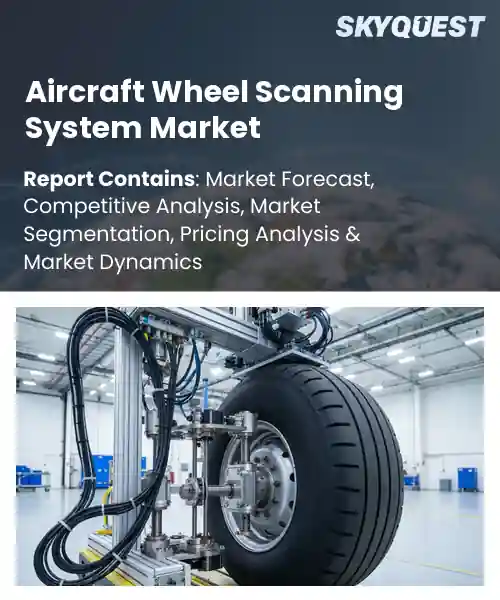
Aircraft Wheel Scanning System Market
Report ID: SQMIG20A2715
Report ID: SQMIG20A2715
[email protected]
USA +1 351-333-4748
Report ID:
SQMIG20A2715 |
Region:
Global |
Published Date: July, 2026
Pages:
157
|Tables:
116
|Figures:
77


Global Aircraft Wheel Scanning System Market size was valued at USD 182.5 Million in 2024 and is poised to grow from USD 193.67 Million in 2025 to USD 312.4 Million by 2033, growing at a CAGR of 6.12% during the forecast period (2026-2033).
The aircraft wheel scanning system market growth is mainly due to the regulatory pressures placed on commercial airlines by both FAA and EASA where they are required to maintain rigorous maintenance and inspection protocols and have to comply with these through frequent, detailed inspections of key components like aircraft wheels. Because of this, operators are moving to an automated, non-destructive testing solution for their maintenance and inspection activities rather than completing manual checks due to the fact that conventional manual methods of inspection are becoming increasingly inefficient and inaccurate in comparison to 3D scouting. Between 2023 and 2024, the adoption rate of handheld laser 3D scanners for wheels inspections has increased by 17% annually. For example, a wheel's rim wear and hub defects can be measured with these scanners in less than five minutes.
In addition, new structured-light scanners have been released that will reduce the amount of time to scan a wheel by as much as 25%. An excellent example of this is Hexagon AB's partnership with Lufthansa Technik to implement AI-controlled wheel and brake scanners at MRO facilities throughout Europe in February 2024. With the increased number of acquisitions expected in 2024 due to larger companies acquiring specialized companies in the market, North America and Europe will lead the adoption of these technologies, while emerging markets with older fleets present opportunities to grow and expand.
How is AI Enhancing Predictive Maintenance In The Aircraft Wheel Scanning System Market?
Aircraft wheel scanning systems are being improved by artificial intelligence (AI). Raw sensor data is being processed by AI algorithms. Vibration, temperature, and wear metrics are fed into machine learning models through high-resolution scanners. The machine learning algorithm learns what is normal for each aircraft's wheels and will notify operators about abnormal conditions instantly. Not only does this improve the operator's ability to find faults quickly and reduce labor hours spent analyzing data, but AI also provides operators with a clearer view of fleet condition. These advancements will make it possible for operators to locate defective wheels before they affect braking performance, giving them an advantage over competitors who are not using smarter wheel scanning systems.
The implementation of AI in wheel scanning systems was exemplified by the launch of an AI-powered wheel scanning platform. The platform uses deep learning-based defect detection algorithms and cloud-based maintenance dashboards to improve the speed of inspections, identify faults earlier in the process, and lower the costs of operation. As a result, this technology will help operators meet regulatory requirements for higher levels of reliability and will allow them to reduce inspection cycle time.
Market snapshot - (2026-2033)
Global Market Size
USD 182.5 Million
Largest Segment
X-ray Based Scanning
Fastest Growth
CT Scanning
Growth Rate
6.12% CAGR
To get more insights on this market click here to Request a Free Sample Report
Global aircraft wheel scanning system market is segmented by technology, application, end-user, distribution and region. Based on technology, the market is segmented into X-ray Based Scanning, CT Scanning and Ultrasonic Testing. Based on application, the market is segmented into Commercial Aviation MRO, Military Aviation MRO and OEM Quality Inspection. Based on end-user, the market is segmented into Airlines & MRO Providers, Military Air Bases and Aircraft Manufacturers. Based on distribution, the market is segmented into Direct Sales and Distributors. Based on region, the market is segmented into North America, Europe, Asia Pacific, Latin America and Middle East & Africa.
The x-ray scanning segment is the leading market due to its ability to provide rapid, non-contact evaluation that integrates seamlessly with existing MRO processes, and provides detailed images of the wheel integrity. Additionally, x-ray scanning provides the ability to detect internal cracks and material fatigue without requiring disassembly, resulting in minimal aircraft downtime and operational efficiency which is very important to airlines. This reliability and ease of use contribute to the widespread preference of x-ray scanning by MRO providers, solidifying its position as the market leader, and creating confidence in meeting future regulatory compliance requirements.
At the same time, the CT scanning segment is experiencing the fastest growth rate as the three-dimensional images allow for a thorough evaluation of the complicated wheel structures (e.g. composite wheels) and supports a predictive maintenance model. Improved detector technology continues to reduce scanning times, making it attractive for MRO operators with high volume activities, while new standards being developed by organizations will drive its use for better characterization of defects and for creating additional market opportunities.
In the OEM quality inspection area, manufacturers are integrating wheel scanning into the manufacturing process from the beginning of the production process to ensure that they meet all specifications before they enter service. Manufacturers will reduce rework later, which is a key element in meeting the demanding certification requirements of the A&D industry and help establish a brand reputation for safety. Additionally, by linking data generated on OEM quality inspections directly into digital twin platforms, manufacturers are able to streamline data capture and create a complete history for improving processes through continuous improvement throughout the life of the aircraft. Manufacturers can also use this data for quick, accurate feedback to suppliers in order to help improve material quality and achieve lean manufacturing goals.
On the other hand, military aviation MRO market is experiencing significant growth due to the modernization of their aging wheel fleets, and the use of advanced diagnostic tools to ensure availability for mission-critical operations. Increased funding for readiness programs will lead to increased procurement of advanced scanners. Over the next five years, the number of MRO operators implementing a complete non-destructive test program will continue to increase, resulting in additional growth throughout the military aviation MRO market.
To get detailed segments analysis, Request a Free Sample Report
By blending advanced aerospace technology with a large number of maintenance organizations and a regulatory environment that supports proactive safety practices, North America is dominating the Aircraft Wheel Scanning System market. The United States has an abundance of both commercial air freight and defense operations that are using high-tech tools for diagnostics; in addition, Canada brings further depth through its dedication to tough certification standards and cooperative research projects. Together, these countries develop a healthy supply chain of component makers, software developers, and service providers, thus creating an ecosystem in which new ideas for inspecting wheel integrity begin to thrive and spread rapidly throughout the continent. There is also a very strong academic and industrial relationship between the two locations facilitating the very rapid incorporation of new sensor technologies into usable solutions in the field and a culture of continuous improvement that encourages airlines to adopt scan systems as part of their everyday wheel turnaround process.
The U.S. Aircraft Wheel Scanning System Market has many commercial airline companies and a long-standing maintenance, repair, and overhaul (MRO) system with a focus on predictive inspections. The presence of several aircraft makers and suppliers of advanced aircraft technology stimulates joint developments of advanced wheel scanning systems. Regulatory authorities require strict safety standards and therefore promote the use of non-destructive test (NDT) equipment to execute these standards. All of these factors combined create strong demand for sophisticated wheel integrity evaluations.
The Aircraft Wheel Scanning System Market in Canada is enhanced by the federal government's commitment to aviation safety and a commitment to using the latest and best inspection methodologies in their national aviation program. Working closely with the largest air carriers, government aviation agencies, and the research community, this need for advanced scanning technologies creates demand for the continued use of high resolution scanning systems in Canada. The geographic location of Canada within the markets for trans-Atlantic and trans-Pacific air transportation, as well as the inspection requirements outlined by the authorities, drive air carrier operators to monitor the condition of their wheels using the highest level of diagnostic equipment.
Europe experiences rapid expansion of the Aircraft Wheel Scanning System Market driven by stringent safety directives, a thriving ecosystem of aerospace manufacturers, and escalating demand for operational efficiency across legacy and next‑generation fleets. Leading regulators enforce comprehensive inspection regimes that promote adoption of non‑destructive testing, while manufacturers in Germany, the United Kingdom and France invest heavily in sensor innovation and integrated data platforms. Collaborative research programs across the continent foster knowledge exchange, enabling airlines and MROs to leverage advanced wheel scanning to minimize unplanned downtime and extend component life, thereby reinforcing Europe’s position as a hub of high‑value aerospace technology. Airlines also perceive wheel scanning as a key enabler for meeting stringent carbon reduction targets, as early detection of defects reduces the need for extensive rework and supports greener maintenance cycles.
Aircraft Wheel Scanning System Market Germany stands out as a cornerstone of European technological leadership, driven by a dense cluster of OEMs and specialist suppliers that prioritize precision engineering. Strong collaboration between research institutes and industry accelerates the development of high‑resolution imaging and data analytics tools. Regulatory expectations reinforce the adoption of proactive wheel inspection, while the country’s export‑oriented aerospace sector propagates these advanced solutions across global airline fleets.
Aircraft Wheel Scanning System Market United Kingdom is experiencing accelerated growth as airlines seek to combine safety imperatives with operational agility. A strong tradition of aerospace innovation, coupled with supportive governmental funding for digital inspection research, fuels rapid deployment of next‑generation scanning equipment. Leading MRO providers integrate these systems into routine maintenance cycles, delivering measurable reductions in wheel-related delays. The collaborative ecosystem among airlines, technology firms and regulators fuels a continuous feedback loop that refines performance and expands market acceptance.
Aircraft Wheel Scanning System Market France is emerging as a fertile ground for innovative wheel inspection approaches, propelled by a vibrant aerospace cluster and progressive regulatory mindset. Collaborative projects between universities and niche technology firms generate customized scanning solutions that address specific airline operational challenges. Growing awareness of the cost benefits associated with early defect detection encourages operators to adopt these tools within their maintenance frameworks. This momentum positions France as an influential contributor to the broader European market evolution.
Asia Pacific is strengthening its role in the Aircraft Wheel Scanning System Market by integrating emerging digital inspection technologies with expansive growth in commercial air travel and a burgeoning MRO sector. Regional airlines prioritize reliability and turnaround speed, prompting investment in high‑resolution scanning solutions that deliver real‑time condition monitoring. Government initiatives encourage domestic development of sensor platforms, while partnerships with global equipment suppliers accelerate technology transfer and local manufacturing capabilities. This synergistic environment positions Asia Pacific as a dynamic arena where advanced wheel diagnostics support rapid fleet expansion and heightened safety standards. The focus on predictive maintenance aligns with broader industry trends toward data‑driven operations, enabling carriers to reduce unscheduled inspections and enhance overall asset utilization across increasingly complex route networks.
Aircraft Wheel Scanning System Market Japan benefits from a sophisticated aviation landscape marked by high operational reliability standards and a strong culture of precision engineering. Domestic airlines prioritize advanced diagnostic tools to maintain tight turnaround schedules, while local manufacturers invest in miniaturized sensor technologies that enhance scanning accuracy. Government support for digital transformation initiatives encourages integration of wheel scanning data into broader aircraft health monitoring systems, fostering a holistic approach to safety and efficiency across the nation’s extensive carrier network.
Aircraft Wheel Scanning System Market South Korea is advancing through a combination of strong governmental aerospace agendas and a rapidly modernizing fleet base. Leading carriers adopt cutting‑edge wheel scanning to sustain high utilization rates while meeting stringent safety expectations. Domestic technology firms collaborate closely with research institutions to develop compact, high‑speed imaging solutions tailored for the region’s mix of narrow‑body and wide‑body aircraft. This synergy accelerates market acceptance and positions South Korea as a notable hub for next‑generation wheel diagnostic capabilities.
To know more about the market opportunities by region and country, click here to
Buy The Complete Report
Enhanced Aircraft Maintenance Efficiency
Regulatory Mandates for Wheel Integrity
High Initial Capital Investment
Limited Skilled Workforce Availability
Request Free Customization of this report to help us to meet your business objectives.
The competitive landscape is shaped by major OEMs such as Honeywell, Safran and GE Aviation, each leveraging strategic partnerships with regional MROs and joint development agreements to embed advanced wheel‑scanning sensors in local fleets, while also pursuing technology‑focused acquisitions to accelerate sensor mini‑aturization and data‑analytics capabilities, intensifying rivalry over service contracts and aftermarket support.
SkyQuest’s ABIRAW (Advanced Business Intelligence, Research & Analysis Wing) is our Business Information Services team that Collects, Collates, Correlates, and Analyses the Data collected by means of Primary Exploratory Research backed by robust Secondary Desk research.
As per SkyQuest analysis the global aircraft wheel scanning system market is being propelled primarily by enhanced maintenance efficiency where early defect detection cuts downtime and improves dispatch reliability, a second strong catalyst is AI‑driven predictive maintenance that turns sensor data into real‑time alerts extending component life and supporting stricter safety mandates. The market’s main restraint remains the high upfront capital outlay required for sophisticated scanning equipment, which slows adoption among budget‑constrained carriers. North America dominates the landscape due to advanced aerospace infrastructure and proactive regulators, while X‑ray based scanning holds the largest share for its rapid, non‑destructive inspection capability that seamlessly fits existing MRO workflows.
| Report Metric | Details |
|---|---|
| Market size value in 2024 | USD 182.5 Million |
| Market size value in 2033 | USD 312.4 Million |
| Growth Rate | 6.12% |
| Base year | 2024 |
| Forecast period | (2026-2033) |
| Forecast Unit (Value) | USD Million |
| Segments covered |
|
| Regions covered | North America (US, Canada), Europe (Germany, France, United Kingdom, Italy, Spain, Rest of Europe), Asia Pacific (China, India, Japan, Rest of Asia-Pacific), Latin America (Brazil, Rest of Latin America), Middle East & Africa (South Africa, GCC Countries, Rest of MEA) |
| Companies covered |
|
| Customization scope | Free report customization with purchase. Customization includes:-
|
To get a free trial access to our platform which is a one stop solution for all your data requirements for quicker decision making. This platform allows you to compare markets, competitors who are prominent in the market, and mega trends that are influencing the dynamics in the market. Also, get access to detailed SkyQuest exclusive matrix.
Table Of Content
Executive Summary
Market overview
Parent Market Analysis
Market overview
Market size
KEY MARKET INSIGHTS
COVID IMPACT
MARKET DYNAMICS & OUTLOOK
Market Size by Region
KEY COMPANY PROFILES
Methodology
For the Aircraft Wheel Scanning System Market, our research methodology involved a mixture of primary and secondary data sources. Key steps involved in the research process are listed below:
1. Information Procurement: This stage involved the procurement of Market data or related information via primary and secondary sources. The various secondary sources used included various company websites, annual reports, trade databases, and paid databases such as Hoover's, Bloomberg Business, Factiva, and Avention. Our team did 45 primary interactions Globally which included several stakeholders such as manufacturers, customers, key opinion leaders, etc. Overall, information procurement was one of the most extensive stages in our research process.
2. Information Analysis: This step involved triangulation of data through bottom-up and top-down approaches to estimate and validate the total size and future estimate of the Aircraft Wheel Scanning System Market.
3. Report Formulation: The final step entailed the placement of data points in appropriate Market spaces in an attempt to deduce viable conclusions.
4. Validation & Publishing: Validation is the most important step in the process. Validation & re-validation via an intricately designed process helped us finalize data points to be used for final calculations. The final Market estimates and forecasts were then aligned and sent to our panel of industry experts for validation of data. Once the validation was done the report was sent to our Quality Assurance team to ensure adherence to style guides, consistency & design.
Analyst Support
Customization Options
With the given market data, our dedicated team of analysts can offer you the following customization options are available for the Aircraft Wheel Scanning System Market:
Product Analysis: Product matrix, which offers a detailed comparison of the product portfolio of companies.
Regional Analysis: Further analysis of the Aircraft Wheel Scanning System Market for additional countries.
Competitive Analysis: Detailed analysis and profiling of additional Market players & comparative analysis of competitive products.
Go to Market Strategy: Find the high-growth channels to invest your marketing efforts and increase your customer base.
Innovation Mapping: Identify racial solutions and innovation, connected to deep ecosystems of innovators, start-ups, academics, and strategic partners.
Category Intelligence: Customized intelligence that is relevant to their supply Markets will enable them to make smarter sourcing decisions and improve their category management.
Public Company Transcript Analysis: To improve the investment performance by generating new alpha and making better-informed decisions.
Social Media Listening: To analyze the conversations and trends happening not just around your brand, but around your industry as a whole, and use those insights to make better Marketing decisions.
REQUEST FOR SAMPLE
 REQUEST FREE CUSTOMIZATION
Global Aircraft Wheel Scanning System Market size was valued at USD 182.5 Million in 2024 and is poised to grow from USD 193.67 Million in 2025 to USD 312.4 Million by 2033, growing at a CAGR of 6.12% during the forecast period (2026-2033).
The competitive landscape is shaped by major OEMs such as Honeywell, Safran and GE Aviation, each leveraging strategic partnerships with regional MROs and joint development agreements to embed advanced wheel‑scanning sensors in local fleets, while also pursuing technology‑focused acquisitions to accelerate sensor mini‑aturization and data‑analytics capabilities, intensifying rivalry over service contracts and aftermarket support. 'Analogic Corporation', 'Smiths Detection', 'Analogic Technologies', 'L3 Security & Detection (L3Harris)', 'Gilardoni SpA', 'MACH-MS (Matec Instrument)', 'Digital Barriers plc', 'Astrophysics Inc.', 'Tek84 (Leidos)', 'AS&E (American Science and Engineering)', 'Rapiscan Systems (OSI Systems)', 'Nuctech Company Limited', 'Scanna MSC', 'Ceia SpA', 'Garrett Metal Detectors', 'Teledyne Technologies', 'GE Inspection Technologies', 'Olympus NDT', 'Baker Hughes (Inspection)', 'Sonatest Ltd.'
The adoption of advanced wheel scanning systems enables airlines to detect surface cracks and material fatigue early, reducing unscheduled downtime and preventing costly replacements. By integrating real‑time diagnostic data into maintenance planning, operators can schedule interventions strategically, improving aircraft dispatch reliability and extending component life cycles. This proactive approach also enhances safety margins, fostering greater confidence among regulators and passengers, which collectively drives market uptake as airlines seek operational resilience and cost containment and long‑term profitability for their organizations globally.
Ai-Driven Predictive Maintenance: Aircraft wheel scanning systems are increasingly equipped with AI algorithms that analyze sensor data in real time, enabling early detection of surface anomalies, material fatigue, and potential failure points. By learning from historical maintenance records, these tools continuously refine diagnostic thresholds, reducing false alarms and improving confidence in condition‑based interventions. Operators benefit from extended component lifecycles, minimized unscheduled downtime, and more efficient allocation of engineering resources, while regulators gain greater assurance of safety compliance across diverse operating environments worldwide aviation.
Why does North America Dominate the Global Aircraft Wheel Scanning System Market? |@12


Want to customize this report? This report can be personalized according to your needs. Our analysts and industry experts will work directly with you to understand your requirements and provide you with customized data in a short amount of time. We offer $1000 worth of FREE customization at the time of purchase.
Feedback From Our Clients


 USA (+1) 351-333-4748

