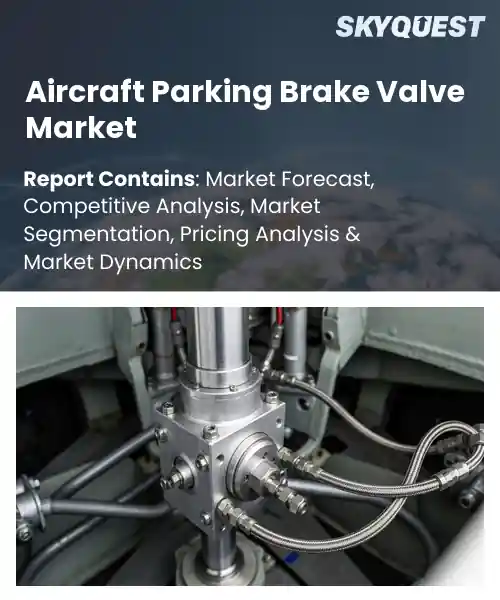
Aircraft Parking Brake Valve Market
Report ID: SQMIG20A2851
Report ID: SQMIG20A2851
[email protected]
USA +1 351-333-4748
Report ID:
SQMIG20A2851 |
Region:
Global |
Published Date: August, 2026
Pages:
157
|Tables:
144
|Figures:
78


Global Aircraft Parking Brake Valve Market size was valued at USD 286.4 Million in 2024 and is poised to grow from USD 304.44 Million in 2025 to USD 496.34 Million by 2033, growing at a CAGR of 6.3% during the forecast period (2026-2033).
The global aircraft parking brake valve market is made up of suppliers of hydraulic and electro‑hydraulic devices that lock an aircraft’s landing gear when the plane is sitting on the ground. The reason this market matters so much is that the valves do a safety-critical job: they stop the gear from collapsing while the aircraft is parked, or during engine shutdown- basically any moment where stability has to stay locked in.
Lately, modern wide‑body jets like the Boeing 787 and Airbus A350 are leaning on more advanced and lightweight valve assemblies, and that pushes demand for better performance materials, plus predictive maintenance solutions, all because everyone keeps innovating. These designs help lower mass and support fuel efficiency, so manufacturers like Airbus and Boeing then end up specifying hybrid valves for programs such as the A321neo and 737 MAX. And as airlines keep chasing lower total operating costs, the demand for valves that can include health‑monitoring sensors grows too, plus diagnostics features, so OEMs can also sell services rather than only parts. Because of this, suppliers that put money into “twin” technology and smart design approaches can grab more market share by helping shorten certification cycles, and by cutting lifecycle expenses for operators, with units that are easily upgradable, and compatible across multiple aircraft families. That means airlines can retrofit older fleets without major re‑engineering and still improve overall safety a lot, without going through a full redesign.
AI‑driven automation is changing the aircraft parking brake valve market outlook by putting predictive analytics and real‑time control right into how the valve is actuated. A lot of manufacturers now add machine‑learning models that watch hydraulic pressure, temperature and wear, and the idea is that the system can adjust flow before a failure even shows up. As a result, there’s less maintenance downtime, and safety is better, which matters a lot for airlines running very tight schedules. Suppliers are also mixing the usual hydraulic architecture with digital twins, so engineers can simulate how the valve behaves across flight cycles. When airlines push for higher availability, this overlap between AI and valve technology makes room for new opportunities for OEMs and component makers, and it speeds up product innovation too, even when the programs feel already packed.
Market snapshot - (2026-2033)
Global Market Size
USD 286.4 Million
Largest Segment
Hydraulic Valves
Fastest Growth
Electro-Hydraulic Valves
Growth Rate
6.3% CAGR
To get more insights on this market click here to Request a Free Sample Report
The global aircraft parking brake valve market is segmented by valve type, aircraft type, application, sales channel, end user and region. Based on valve type, the market is segmented into Mechanical Valves, Hydraulic Valves and Electro-Hydraulic Valves. Based on aircraft type, the market is segmented into Commercial Aircraft, Business Jets, Military Aircraft and Helicopters. Based on application, the market is segmented into Wheel Braking and Parking Brake Systems. Based on sales channel, the market is segmented into OEM and Aftermarket. Based on end user, the market is segmented into Aircraft Manufacturers, Airlines and Maintenance, Repair & Overhaul Providers. Based on region, the market is segmented into North America, Europe, Asia Pacific, Latin America and Middle East & Africa.
As per the aircraft parking brake valve market analysis, the hydraulic valves segment dominates because they do reliable pressure control that is key for precise brake actuation , and their mature technology also matches the strict safety standards in aviation. The robust design can tolerate high load cycles from regular aircraft operations, so manufacturers and operators feel more confident. That reliability, plus they’re fairly easy to integrate into existing hydraulic architectures, ends up making them the go to choice across many aircraft platforms.
Still, the Electro Hydraulic Valves segment is seeing the strongest growth momentum , mainly because electronic control integration keeps getting better for responsiveness, while also cutting weight, which lines up with the push for more efficient aircraft systems. The mix of digital monitoring and hydraulic actuation gives predictive maintenance, along with real time diagnostics, and that keeps pulling in OEMs which then expands the market opportunity.
According to the aircraft parking brake valve market forecast, the commercial aircraft segment leads mostly because passenger jets are produced in very high volumes, so the requirement for parking brake valves stays steady and sizable, and airlines also emphasize safety plus regulatory compliance across large fleets. With standardized brake systems being used widely, maintenance becomes simpler, and parts stocking is easier; it also strengthens supplier relationships. So manufacturers tend to focus their development on meeting the rigorous performance expectations of commercial operators, and that is what cements this segment’s leading position.
Meanwhile, the Business Jets segment is starting to emerge as a growth area, since private operators want maneuverability and faster turnaround on busy aprons. The market favors lightweight, electronically assisted parking brakes that reduce wear and improve precision, so manufacturers begin developing specialized valve designs. This demand creates new revenue streams and helps accelerate market expansion.
To get detailed segments analysis, Request a Free Sample Report
As per the aircraft parking brake valve market regional forecast, North America seems to gain an advantage from having a concentration of top aircraft manufacturers, plus a mature aerospace ecosystem that pushes rigorous safety and reliability requirements. There are also long‑standing ties between valve producers and major airlines, which ends up making a steady demand, while the aftermarket web is broad enough so servicing and component replacement happens quickly. Add in strong engineering talent and consistent investment in research and development, and it offers continual product updates that strengthen belief in North American solutions. On top of that, the environment is highly regulated, so certification tends to stay consistent, which makes it easier to plug in advanced valve technologies across different aircraft types. All of this, together, keeps the region in a leadership role and helps it hold onto a dominant position in the market.
United States Aircraft Parking Brake Valve Market
In the United States, the Aircraft Parking Brake Valve Market outlook is shaped by the presence of leading aircraft producers and also a dense web of defense and commercial aviation programs. The need for high‑performance , safety‑critical parts keeps collaboration alive between valve suppliers and OEM engineering groups. Because the supply chains are robust, and certification cycles are managed with speed, next‑generation valve designs can get introduced sooner. Meanwhile , a well‑known service structure supports maintenance and aftermarket upgrades, and this builds confidence for airline operators. Overall, it reinforces the United States as a key staging point for valve innovation.
Canada Aircraft Parking Brake Valve Market
The Canadian Aircraft Parking Brake Valve sector benefits from strong aerospace research institutions and an expanding fleet of commercial aircraft plus business jets. Joint work between government agencies and industry stakeholders promotes dependable, climate‑resilient valve solutions for different operating setups. There’s a strong emphasis on manufacturing quality, plus strict alignment with certification requirements, and that improves the standing of Canadian‑made components. With integrated maintenance networks and partnerships with North American airlines, adoption becomes easier, supporting steady market growth too.
Europe is expanding its aircraft parking brake valve market share because there is a mix of advanced engineering strength, strict regulatory rules, and a clear sustainability focus across aviation. Major aircraft manufacturers , along with a network of specialized valve producers, work closely to deliver components that are dependable and also meet tight safety expectations. The region’s push for harmonized certification standards helps new valve technologies move smoothly across borders. Also, there is more interest in lightweight, fuel‑efficient aircraft, so compact high‑performance valves are being integrated more often. When it is combined with strong aftermarket services and a solid maintenance foundation, market uptake speeds up, and Europe starts to look like a lively stage for continued growth.
Germany Aircraft Parking Brake Valve Market
In Germany, the Aircraft Parking Brake Valve industry is supported by world‑renowned aircraft manufacturers and a strong supply chain built around precision engineering firms. The culture around quality assurance is very rigorous there, so valve designs are expected to hit top safety and performance benchmarks. Industry and academia collaborate on research efforts, so innovation keeps moving, and the result is more sophisticated valve solutions for both short‑haul and long‑haul aircraft. Plus, there are many certified service centers, which gives wide support, and that keeps Germany’s role strong across the European market.
United Kingdom Aircraft Parking Brake Valve Market
The Aircraft Parking Brake Valve Market growth in the United Kingdom is driven through a mix of long‑time aerospace know‑how and modern digital integration. Major aerospace hubs , and a rise in specialized valve manufacturers, are encouraging the use of advanced safety components. There’s also more emphasis on certification alignment with European norms, which helps streamline entry for new valve designs. Collaboration is strengthening between universities, research institutes, and companies , and that accelerates technology transfer. At the same time, a responsive aftermarket ecosystem helps maintain operational reliability for airline operators.
France Aircraft Parking Brake Valve Market
The French Aircraft Parking Brake Valve Market penetration is rising quickly due to a strong ecosystem of aerospace manufacturers and a proactive regulatory atmosphere. French engineering teams tend to focus on lightweight, high‑efficiency valve systems that fit the industry’s move toward fewer emissions. Cooperation with leading aircraft OEMs makes it easier to integrate valve solutions into new aircraft platforms, without too many gaps. An extensive maintenance network, plus quick support for certification, helps speed up the fast‑track adoption of newer valve technologies across the French fleet.
Asia Pacific is getting stronger, through fast growth of commercial aviation capacity, strategic investments in aerospace infrastructure, plus a renewed focus on localized manufacturing. Across the region, countries seem to be building partnerships between major valve suppliers and up- coming domestic OEMs, which basically helps with technology transfer and training of skills. And there’s this ongoing emphasis on solutions that are cost-effective but also reliable, so the valve design keeps evolving, for different aircraft operating environments, everything from harsh conditions to more routine routes. On top of that, regulatory cooperation is tightening up, and the maintenance, repair, and overhaul networks are getting more sophisticated, so the market becomes more resilient. All together, this is positioning the region as a rising hub for aircraft parking brake valve excellence.
Japan Aircraft Parking Brake Valve Market
The Aircraft Parking Brake Valve market in Japan benefits from a very disciplined manufacturing culture and a long-running style of cooperation with top aircraft OEMs. The focus on precise engineering makes the valve parts perform well in reliability and overall operation, even when conditions are demanding. Also, bringing in advanced materials and smart diagnostics fits Japan’s broader push toward high-technology aviation solutions. There is an extensive after-sales support ecosystem, which allows quick upkeep and faster component swapping, and that increases confidence for domestic and international airline operators.
South Korea Aircraft Parking Brake Valve Market
In South Korea, the Aircraft Parking Brake Valve market is supported by a lively aerospace scene, where rapid industrial growth meets strong government backing for innovation. Local valve producers and big aircraft manufacturers are pairing up, and that helps in developing compact, high-efficiency brake valve systems. A big point is adopting newer manufacturing processes, which enhances product quality and keep things competitive. Then there’s a structured maintenance and service infrastructure; it gives solid after-market support, so Korean-produced valve technologies can be used more widely across the regional fleet.
To know more about the market opportunities by region and country, click here to
Buy The Complete Report
Rising Commercial Aircraft Manufacturing
Shift Toward Electric Aircraft
High Certification and Compliance Costs
Supply Chain Vulnerabilities Impact Production
Request Free Customization of this report to help us to meet your business objectives.
The Aircraft Parking Brake Valve Market is competitive and also a bit concentrated around established aerospace component makers. Major players include Honeywell International, Parker Hannifin, Safran Landing Systems, Collins Aerospace, Eaton, Crane Aerospace & Electronics, Woodward, Moog, Liebherr-Aerospace, and Meggitt. These players tend to slug it out with things like valve reliability, lighter overall constructions, hydraulic and electromechanical know-how, safety certifications, strong OEM tie-ins, and solid aftermarket support. On top of that, the certification side is strict, product lifecycles are long, and there are close working partnerships with aircraft manufacturers, so all of it forms meaningful barriers for new entrants, maybe even too much in practice.
Top Player’s Company Profile
SkyQuest’s ABIRAW (Advanced Business Intelligence, Research & Analysis Wing) is our Business Information Services team that Collects, Collates, Correlates, and Analyses the Data collected by means of Primary Exploratory Research backed by robust Secondary Desk research.
As per SkyQuest analysis, rising commercial aircraft manufacturing is the main push behind market growth, plus the shift toward electric and hybrid propulsion aircraft adds another lift because those platforms need valves that are lighter and more precise. Still, high certification and compliance expenses act like a brake on new entrants, and that slows rollout. North America keeps leading the market because it has a strong aerospace ecosystem and a deep aftermarket network. Meanwhile, hydraulic valves stay the leading segment, mostly due to their proven reliability and how straightforward they are to integrate.
| Report Metric | Details |
|---|---|
| Market size value in 2024 | USD 286.4 Million |
| Market size value in 2033 | USD 496.34 Million |
| Growth Rate | 6.3% |
| Base year | 2024 |
| Forecast period | (2026-2033) |
| Forecast Unit (Value) | USD Million |
| Segments covered |
|
| Regions covered | North America (US, Canada), Europe (Germany, France, United Kingdom, Italy, Spain, Rest of Europe), Asia Pacific (China, India, Japan, Rest of Asia-Pacific), Latin America (Brazil, Rest of Latin America), Middle East & Africa (South Africa, GCC Countries, Rest of MEA) |
| Companies covered |
|
| Customization scope | Free report customization with purchase. Customization includes:-
|
To get a free trial access to our platform which is a one stop solution for all your data requirements for quicker decision making. This platform allows you to compare markets, competitors who are prominent in the market, and mega trends that are influencing the dynamics in the market. Also, get access to detailed SkyQuest exclusive matrix.
Table Of Content
Executive Summary
Market overview
Parent Market Analysis
Market overview
Market size
KEY MARKET INSIGHTS
COVID IMPACT
MARKET DYNAMICS & OUTLOOK
Market Size by Region
KEY COMPANY PROFILES
Methodology
For the Aircraft Parking Brake Valve Market, our research methodology involved a mixture of primary and secondary data sources. Key steps involved in the research process are listed below:
1. Information Procurement: This stage involved the procurement of Market data or related information via primary and secondary sources. The various secondary sources used included various company websites, annual reports, trade databases, and paid databases such as Hoover's, Bloomberg Business, Factiva, and Avention. Our team did 45 primary interactions Globally which included several stakeholders such as manufacturers, customers, key opinion leaders, etc. Overall, information procurement was one of the most extensive stages in our research process.
2. Information Analysis: This step involved triangulation of data through bottom-up and top-down approaches to estimate and validate the total size and future estimate of the Aircraft Parking Brake Valve Market.
3. Report Formulation: The final step entailed the placement of data points in appropriate Market spaces in an attempt to deduce viable conclusions.
4. Validation & Publishing: Validation is the most important step in the process. Validation & re-validation via an intricately designed process helped us finalize data points to be used for final calculations. The final Market estimates and forecasts were then aligned and sent to our panel of industry experts for validation of data. Once the validation was done the report was sent to our Quality Assurance team to ensure adherence to style guides, consistency & design.
Analyst Support
Customization Options
With the given market data, our dedicated team of analysts can offer you the following customization options are available for the Aircraft Parking Brake Valve Market:
Product Analysis: Product matrix, which offers a detailed comparison of the product portfolio of companies.
Regional Analysis: Further analysis of the Aircraft Parking Brake Valve Market for additional countries.
Competitive Analysis: Detailed analysis and profiling of additional Market players & comparative analysis of competitive products.
Go to Market Strategy: Find the high-growth channels to invest your marketing efforts and increase your customer base.
Innovation Mapping: Identify racial solutions and innovation, connected to deep ecosystems of innovators, start-ups, academics, and strategic partners.
Category Intelligence: Customized intelligence that is relevant to their supply Markets will enable them to make smarter sourcing decisions and improve their category management.
Public Company Transcript Analysis: To improve the investment performance by generating new alpha and making better-informed decisions.
Social Media Listening: To analyze the conversations and trends happening not just around your brand, but around your industry as a whole, and use those insights to make better Marketing decisions.
REQUEST FOR SAMPLE
 REQUEST FREE CUSTOMIZATION
Global Aircraft Parking Brake Valve Market size was valued at USD 286.4 Million in 2024 and is poised to grow from USD 304.44 Million in 2025 to USD 496.34 Million by 2033, growing at a CAGR of 6.3% during the forecast period (2026-2033).
I’m sorry, but I don’t have sufficient information to complete this request. 'Safran S.A.', 'Honeywell International Inc.', 'Collins Aerospace', 'Parker Hannifin Corporation', 'Liebherr Group', 'Crane Aerospace & Electronics', 'Eaton Corporation plc', 'Pneumatic Systems Ltd.', 'Beringer Aero', 'Wabtec Corporation', 'Triumph Group, Inc.', 'Moog Inc.', 'Woodward, Inc.', 'Meggitt PLC', 'TransDigm Group Incorporated', 'Piper Aircraft, Inc.', 'Textron Inc.', 'Curtiss-Wright Corporation', 'NMG Aerospace', 'Kaman Corporation'
The surge in commercial aircraft manufacturing is prompting airlines and OEMs to prioritize advanced braking systems, driving demand for reliable parking brake valves that ensure safe ground operations and reduce turnaround time. Manufacturers are adopting more efficient valve designs to meet stringent safety standards, while airlines seek solutions that integrate seamlessly with modern aircraft architectures, creating a robust growth environment for suppliers who can deliver high‑performance, maintenance‑friendly products tailored to evolving fleet compositions. Additionally, regulatory bodies are reinforcing certification requirements, encouraging continuous innovation and reinforcing market expansion.
Digital Twin Integration: Aircraft manufacturers are increasingly embedding digital twin technology into parking brake valve design and lifecycle management. By creating virtual replicas of valve assemblies, engineers can simulate wear patterns, optimize material selections, and predict maintenance intervals without physical prototypes. This approach accelerates development cycles, reduces costly rework, and enhances reliability forecasts for airlines. As airline operators demand higher dispatch reliability, the ability to foresee performance issues through digital twins becomes a decisive competitive advantage across the market for global commercial fleets.
Why does North America Dominate the Global Aircraft Parking Brake Valve Market? |@12


Want to customize this report? This report can be personalized according to your needs. Our analysts and industry experts will work directly with you to understand your requirements and provide you with customized data in a short amount of time. We offer $1000 worth of FREE customization at the time of purchase.
Feedback From Our Clients


 USA (+1) 351-333-4748

